
How to Market Your Equity Crowdfunding Campaign Successfully
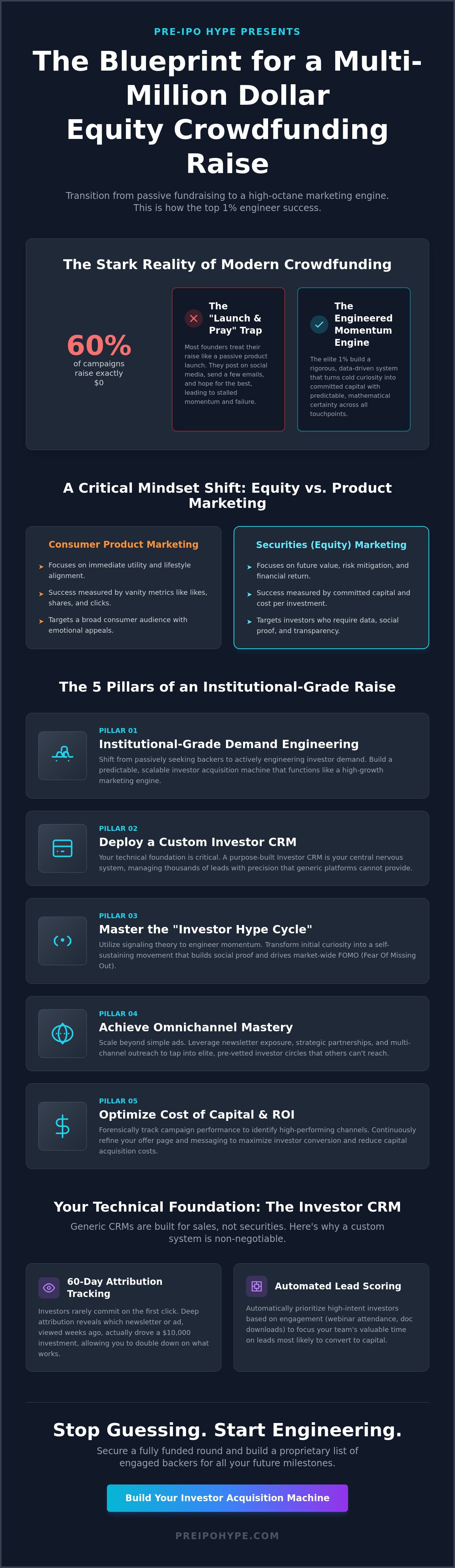
Did you know that 60% of Regulation Crowdfunding campaigns in 2026 raise exactly zero dollars? Most founders treat their raise like a passive launch, but the elite 1% treat it like a high-octane marketing engine. To join that top tier, you must understand 1. how to market your equity crowdfunding campaign by connecting restricted information with broader opportunity through precise execution. If you're struggling with high costs per lead or an inability to track which channels actually drive investment, you're not alone. It's frustrating to watch momentum stall while manually managing a mountain of retail leads.
You are about to master the data-driven systems and omnichannel strategies required to engineer a successful multi-million dollar capital raise. This isn't just about hitting a funding goal; it's about building a predictable, scalable investor acquisition machine. We'll explore how to secure a fully funded round and create a proprietary list of engaged backers for your future milestones. The keys to this gated financial world are now within your reach for those who act decisively.
Key Takeaways
- Transition from passive fundraising to institutional-grade demand engineering to ensure your capital raise functions like a high-growth marketing engine.
- Deploy a Custom Investor CRM as your technical foundation to manage thousands of leads with the precision that generic platforms simply cannot provide.
- Master signaling theory and the "Investor Hype Cycle" to transform initial curiosity into a self-sustaining movement of market momentum.
- Discover 1. how to market your equity crowdfunding campaign through omnichannel outreach and newsletter exposure to tap into elite, pre-vetted investor circles.
- Optimize your Cost of Capital by identifying high-performing channels and refining your offer page to maximize investor conversion and ROI.
The New Era of Equity Crowdfunding Marketing in 2026
Equity crowdfunding marketing is no longer a peripheral activity. It is the strategic engineering of investor demand. In a market projected to reach $15.37 billion by the end of 2026, the stakes have never been higher. This evolution marks a definitive shift from simple "crowdfunding" to institutional-grade digital fundraising. You aren't just looking for backers. You are orchestrating a sophisticated capital event. Understanding Equity crowdfunding as a high-velocity financial vehicle is the first step toward a successful raise.
Most founders fall into the "Launch and Pray" trap. They post on social media, send a few emails, and hope for the best. The data reveals a harsh reality. As of June 2026, 60% of Regulation Crowdfunding campaigns raise zero dollars. Success requires an "Engineered Momentum" approach. This means building a rigorous system that tracks 1. how to market your equity crowdfunding campaign across every digital touchpoint. It is about data, not luck. You need a mechanism that turns cold curiosity into committed capital with mathematical certainty.
To better understand how these systems function in the real world, watch this helpful video:
Why Traditional Marketing Fails Capital Raises
Selling equity is fundamentally different from selling a consumer product. Consumer marketing focuses on immediate utility or lifestyle alignment. Securities marketing focuses on future value and risk mitigation. Vanity metrics like likes or shares are dangerous distractions. They don't translate to a funded balance sheet. The investor's mind operates on a different frequency than a consumer's. They require social proof, transparency, and a clear path to a realization event. If your strategy doesn't account for this psychological barrier, your cost per lead will skyrocket while your conversion rate stays flat.
The Regulatory Landscape: Reg CF, Reg A+, and Beyond
Compliance is the foundation of your raise. Whether you're utilizing the $5 million Reg CF limit or a larger Reg A+ offering, your marketing must align with strict SEC guidelines. The February 2026 SEC clarifications emphasized that switching funding portals requires a full restart of the offering. This makes early precision vital. Smart founders use "Testing the Waters" (TTW) periods to gauge market interest before the official clock starts. By leveraging proprietary investor data, you can ensure your campaign launches with pre-built momentum. Knowing 1. how to market your equity crowdfunding campaign within these legal boundaries is what separates elite raises from failed attempts.
Engineering Your Technical Foundation: The Investor CRM
Success in capital raising is a game of data, not just deals. If you're wondering 1. how to market your equity crowdfunding campaign effectively, the answer starts with your infrastructure. Most founders treat their raise like a standard e-commerce launch, but selling securities is a different beast entirely. You need a Custom Investor CRM to act as the central nervous system of your operation. Generic platforms like HubSpot or Salesforce are built for linear sales cycles. They often fail to capture the nuances of a successful crowdfunding campaign, such as tracking non-linear investor behavior across a multi-month raise.
Precision requires 60-day attribution tracking. Retail investors rarely commit on the first click. They watch, they wait, and they analyze. Without deep attribution, you won't know if that $10,000 investment came from a specific newsletter or a retargeting ad you ran six weeks ago. Lead scoring is equally vital. Your system must automatically prioritize high-intent investors over "window shoppers" based on engagement metrics like webinar attendance or document downloads. This ensures your team spends time where the capital is most likely to move. If your current setup feels fragmented, it might be time to discuss your foundation infrastructure with an expert.
Building Your Fundraising Tech Stack
Your stack must be robust enough to handle the pressure of a live raise. Essential components include advanced tracking pixels, attribution software, and automated outreach tools that trigger based on investor behavior. Owning your data is the only way to ensure long-term success. Relying solely on platform-owned analytics is a strategic risk. For a deep dive into the specific tools that drive multi-million dollar raises, review our guide on the Fundraising Tech Stack. This isn't just about the current round; it's about building a database for every future milestone.
Data-Driven Investor Acquisition
In a post-cookie world, first-party data is your most valuable asset. You can use proprietary Investor Data to create hyper-accurate lookalike audiences for your digital advertising. This lowers your cost per lead by targeting individuals who already exhibit the characteristics of active equity investors. When you're managing 10,000+ retail leads, manual entry is a death sentence. Your CRM must be structured to automate the nurturing process, moving investors through the funnel while you focus on the big-ticket institutional conversations. Mastering 1. how to market your equity crowdfunding campaign means engineering a system that works while you sleep.
The Hype Cycle: Engineering Momentum for Maximum Signal
Momentum in a capital raise isn't a byproduct of luck. It's a manufactured psychological state. Understanding 1. how to market your equity crowdfunding campaign means mastering the Investor Hype Cycle: the strategic progression from curiosity to FOMO. This cycle relies on signaling theory. Investors are social creatures. They look for cues from the market to validate their own risk. If your campaign page shows zero progress, you're signaling a lack of institutional confidence. You must demonstrate that the movement has already begun.
The core elements of a successful crowdfunding campaign center on this perception of velocity. We utilize the "1-30-60" rule to engineer this signal. This strategy dictates having 1% of your total target audience ready to commit on day one, reaching 30% of your funding goal within the first week, and maintaining a steady 60-day pulse of updates to close the round. For founders who need to automate this pressure, leveraging professional Reg CF Marketing Services is the most efficient way to ensure the cycle never breaks.
Phase 1: The Internal Circle and Early Traction
Never launch to the public with a cold start. You must secure the first 20% to 30% of your goal from your existing network and "inner circle" before the general crowd ever sees the offer. This initial traction acts as the ultimate social proof. It tells the retail market that those who know the company best have already put their capital on the line. Tactics here include private webinars and exclusive early-access periods that turn your closest supporters into vocal advocates for the brand. If your inner circle isn't excited, the public won't be either.
Phase 2: Scaling with Digital Advertising
Once your foundation is solid, you scale. The 2026 playbook for private market advertising has shifted away from broad targeting toward high-precision intent. Meta remains the primary vehicle for storytelling and retail reach, while LinkedIn is the surgical tool for reaching accredited investors. Success requires crafting creative angles that resonate with the "investor's mind" rather than the "consumer's mind." You aren't selling a product; you're selling a future realization event. Use retargeting sequences to move hesitant observers from initial interest to a final investment commitment. Knowing 1. how to market your equity crowdfunding campaign at scale requires a constant feedback loop between your ad spend and your funded balance sheet.
Omnichannel Mastery: Scaling Beyond Simple Ads
Omnichannel Mastery is the strategic synchronization of your message across every possible investor touchpoint. It transforms a fragmented raise into an inescapable market movement. If you're looking for 1. how to market your equity crowdfunding campaign at an elite level, you must move beyond siloed advertising. Most founders treat Meta and LinkedIn as separate experiments. This is a strategic error. Your narrative must be consistent, whether an investor sees a retargeting ad, opens a newsletter, or reads a PR feature. This level of coordination creates a sense of ubiquity that retail investors can't ignore.
Leveraging Newsletter Outreach allows you to bypass cold audiences and speak directly to pre-vetted investor lists. In 2026, social media algorithm fatigue is a significant barrier to entry. Using specialized channels like Invst Guru ensures your opportunity reaches the right eyes without being buried by irrelevant trending noise. This is where earned media and PR provide the ultimate validation for your paid efforts. A well-placed feature acts as a high-authority endorsement that turns curiosity into conviction. It's about building an ecosystem where every channel reinforces the others.
Synchronizing Email, SMS, and Social
The "Rule of 7" has evolved. In the high-stakes environment of 2026, an investor often requires 7 to 12 touchpoints before they're willing to commit capital. You need automated "Investor Nurture" sequences that feel personal but scale infinitely. These sequences should bridge the gap between platforms. For example, an investor who clicks a LinkedIn ad should receive a follow-up email that mirrors the same "Hype" narrative. Use SMS for urgent, high-stakes updates. A simple message stating "Only 24 hours left to join the round" can trigger a massive influx of capital from investors who were previously on the fence. If your current outreach feels disjointed, you can book an omnichannel strategy session to align your channels.
The Role of Content Strategy in Capital Raises
Content is the fuel for your omnichannel engine. Your video strategy is paramount. The "Founder Story" remains your highest-converting asset because it humanizes the investment opportunity. It moves the conversation from abstract metrics to visionary potential. Complement this with live webinars and Q&A sessions. These events build trust through direct, real-time interaction that static ads simply can't replicate. Finally, use "Investor Spotlights" and case studies as social proof. When potential backers see others joining the movement, the psychological barrier to entry drops. Mastering 1. how to market your equity crowdfunding campaign requires a content strategy that speaks to both the head and the heart of the investor.
Optimizing ROI and Converting Curiosity into Capital
The final phase of a raise is where the math becomes unforgiving. Engineering momentum is a prerequisite, but optimizing your return on that effort is what separates elite founders from the rest. To truly master 1. how to market your equity crowdfunding campaign, you must move beyond vanity metrics and focus on your actual Cost of Capital. This is calculated by dividing your total marketing spend by the total capital raised. In the high-stakes environment of 2026, if you aren't tracking this figure with surgical precision, you're essentially flying blind while your budget evaporates.
Conversion optimization is a continuous process. If your conversion rate drops, it's time to A/B test your offer page immediately. Small shifts in your headline, the placement of your lead investor's quote, or the visibility of your "invest" button can trigger massive swings in funded volume. As you enter the "Closing Sprint," which covers the final 14 days of your campaign, the psychological lever shifts from opportunity to scarcity. This is when your omnichannel engine should hit peak intensity, reminding every lead in your CRM that the window to participate is slamming shut. If your current trajectory isn't meeting your milestones, it's time to schedule a consultation to audit your capital acquisition strategy.
Analyzing Performance Metrics That Matter
In 2026, Cost Per Lead (CPL) is a secondary metric. The only figure that dictates your success is the Cost Per Invested Dollar (CPID). You must identify "leaky funnels" where potential backers drop off after clicking your ads but before completing the subscription agreement. Use heatmap data to analyze exactly where investors lose interest on your page. Are they bouncing at the risk disclosures? Is your financial section too dense? Data-driven adjustments here can significantly lower your Cost of Capital and maximize your final funded balance.
Post-Raise Marketing: Turning Investors into Brand Ambassadors
The marketing journey doesn't end when the round closes. In fact, the real work is just beginning. You now have a proprietary list of 2,000 or more new shareholders who are financially incentivized to see you succeed. Investor relations should be viewed as a long-term acquisition strategy for future rounds. By keeping this group engaged through regular, high-transparency updates, you turn them into a decentralized marketing force. These brand ambassadors can drive revenue, provide market feedback, and serve as the foundation for your next realization event. Understanding 1. how to market your equity crowdfunding campaign means recognizing that every investor is a potential long-term partner in your growth story.
Dominate the Digital Private Markets
The transition from a passive launch to an engineered capital event is the defining factor for success in 2026. You've seen how a technical foundation, built on a Custom Investor CRM, transforms thousands of leads into a coordinated movement. Mastering 1. how to market your equity crowdfunding campaign requires this shift from hope to technical precision. By leveraging omnichannel touchpoints and our proprietary 60-day attribution tracking, you can finally identify which channels actually drive investment and optimize your cost of capital in real time.
We've facilitated over $100M in funding and managed 230+ successful campaigns using these exact data-driven systems. Don't leave your balance sheet to chance when the tools for elite investor acquisition are now within reach. It's time to act decisively and claim your place in the market. Scale Your Raise with Pre-IPO Hype's Custom Investor CRM and turn your vision into a fully funded reality. Your next milestone is waiting.
Strategic Campaign Intelligence
How much should I spend on marketing my equity crowdfunding campaign?
Your marketing budget should be viewed as an investment in your Cost of Capital rather than a sunk cost. Successful raises generally allocate a strategic percentage of their target goal to digital acquisition and infrastructure. This funding covers everything from content creation to high-precision advertising. It's vital to ensure your spend is front-loaded to hit that critical 30% funding milestone within the first week of the public launch.
Is social media advertising effective for Reg CF raises in 2026?
Social media remains a primary engine for retail investor acquisition when executed with institutional-grade precision. Meta is particularly effective for visual storytelling and building community momentum; LinkedIn serves as the surgical tool for reaching high-net-worth individuals. The key is moving beyond generic likes and focusing on conversion events. In 2026, success requires a sophisticated understanding of 1. how to market your equity crowdfunding campaign using retargeting sequences that nurture leads over a 60-day cycle.
What is the best platform to market an equity crowdfunding campaign?
The best platform is actually an omnichannel ecosystem rather than a single site. While Meta and LinkedIn drive the bulk of top-of-funnel traffic, specialized channels like Invst Guru provide access to pre-vetted investor lists that are immune to social media algorithm fatigue. A winning strategy synchronizes these paid ads with earned media and newsletter exposure to create a sense of market ubiquity that drives committed capital.
How long should a typical equity crowdfunding marketing campaign last?
An engineered raise typically spans 60 to 90 days of active public fundraising. However, the work begins much earlier with a Testing the Waters phase to build a reservation list. This pre-launch period ensures you don't enter the market with zero momentum. The final 14 days of the campaign, known as the Closing Sprint, often see a massive surge in capital as scarcity and FOMO drive hesitant observers to commit.
Can I market my raise before my SEC filing is complete?
Yes, you can gauge market interest through Testing the Waters (TTW) communications before your Form C is officially filed. This allows you to build a proprietary list of potential backers and refine your messaging based on real-world feedback. You must follow strict SEC guidelines regarding these communications; you cannot accept capital or firm commitments until the filing is live and the offering is officially open for investment.
What is the difference between marketing to retail vs. accredited investors?
Retail marketing emphasizes the movement and the democratic opportunity to own a piece of a visionary company. It relies heavily on social proof and community alignment. Accredited investors, conversely, demand technical rigor. They focus on IRR, liquidation preferences, and the specific mechanics of the exit strategy. Your content strategy must speak both languages simultaneously to capture the full spectrum of available capital within the gated financial world.
How do I track which ads are actually resulting in investments?
Tracking requires a Custom Investor CRM equipped with 60-day attribution software. Standard pixels often lose track of an investor's journey because the decision to invest equity takes much longer than a typical e-commerce purchase. By mapping every touchpoint from the first click to the final subscription agreement, you can identify which specific creative angles and channels are delivering the highest ROI for your funded balance sheet.
Do I need a specialized agency to market my equity crowdfunding raise?
While some founders attempt a DIY approach, the 60% failure rate for Reg CF campaigns highlights the risk of going it alone. A specialized agency provides the foundation infrastructure and performance tracking necessary to navigate complex regulations and high-stakes market movements. Knowing 1. how to market your equity crowdfunding campaign with professional precision can be the difference between a stalled round and a multi-million dollar oversubscription that fuels your future growth.
Disclaimer
Educational only. Not investment, tax, or legal advice. Pre-IPO Hype is investor relations infrastructure for Regulation CF and Regulation A+ raises. We are not a broker-dealer, funding portal, or investment adviser, and we do not offer or sell securities or make investment recommendations. Any securities offering is made only by the issuer, through its own offering documents and, where required, a registered intermediary.


