
How to Prepare for a Capital Raise: The Insider’s Playbook for 2026
What if your pitch deck is actually the bottleneck preventing your next round from closing? Most founders believe they know how to prepare for a capital raise by polishing slides, but the 2026 market demands a technical shift from manual pitching to engineered investor acquisition. You've likely felt the frustration of stagnant momentum or the inability to see which outreach efforts are actually moving the needle. It's exhausting to operate in the dark while your runway ticks down toward that critical 18 month threshold.
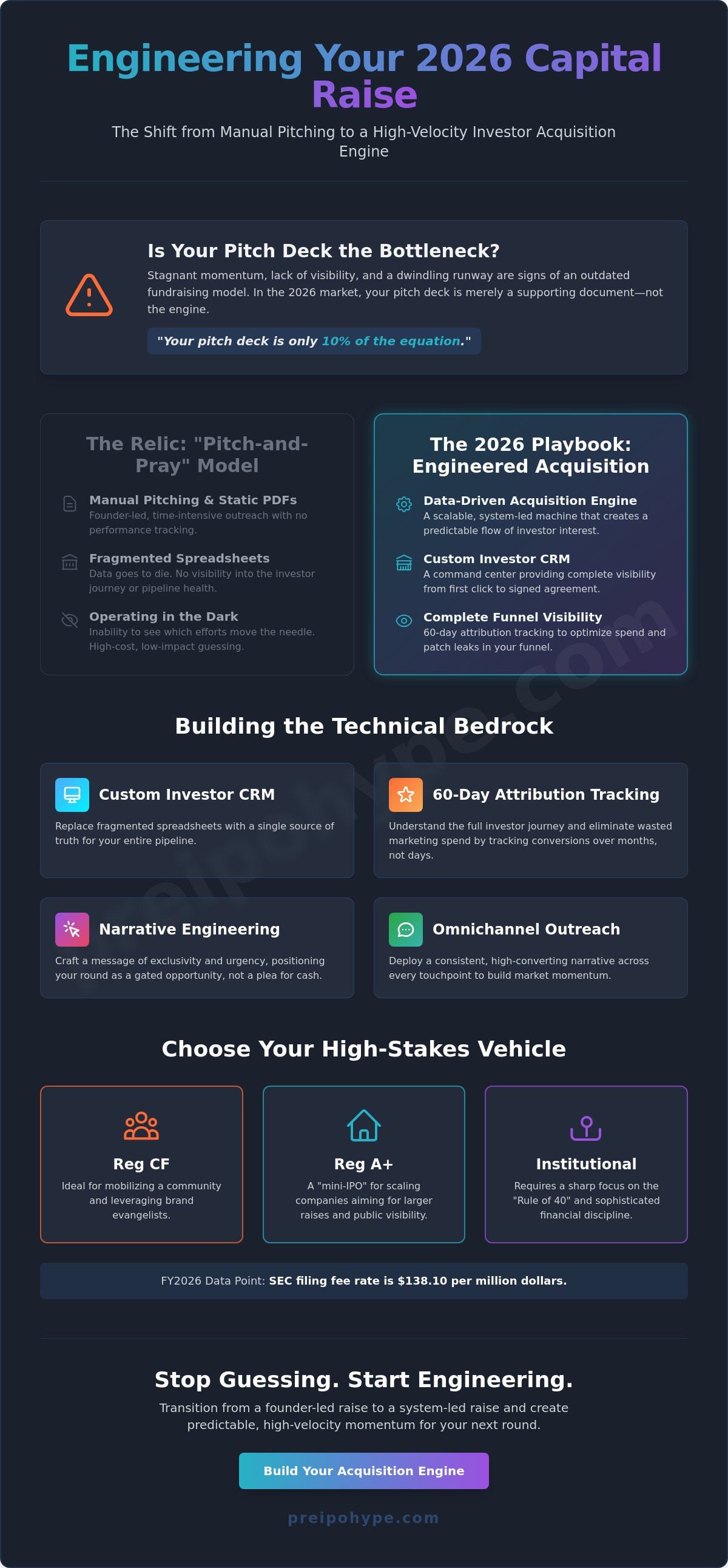
We agree that the old ways of fundraising feel like a black box where data goes to die. This playbook promises to move you beyond the static PDF. You'll learn how to build a high-velocity system that provides complete visibility into the investor journey and treats fundraising like a scalable sales machine. We'll preview the exact infrastructure, from custom CRMs to omnichannel outreach, that allows elite firms to hit their funding goals ahead of schedule while maintaining a healthy Rule of 40 profile. It's time to stop guessing and start engineering your momentum.
Key Takeaways
- Shift your strategy from manual pitching to an engineered acquisition engine that treats fundraising as a scalable, data-driven system.
- Discover how to prepare for a capital raise by deploying Foundation Infrastructure and 60-day attribution tracking to eliminate wasted marketing spend.
- Master the psychology of Narrative Engineering to position your round as a gated opportunity rather than a desperate plea for liquidity.
- Replace fragmented spreadsheets with a Custom Investor CRM designed to provide complete visibility into every stage of the investor journey.
- Follow a proven 5-step roadmap to scale your reach using omnichannel outreach and high-converting content strategies that build immediate market momentum.
Beyond the Pitch Deck: Engineering Your Capital Raise for 2026
We've moved into an era where Reg CF and Reg A+ have democratized access, but they've also increased the noise. Standing out requires understanding the fundamentals of fundraising while simultaneously deploying high-precision digital acquisition systems. It's no longer about asking for permission. It's about creating an exclusive movement that signals growth and scarcity to the market. This systemic approach ensures your message reaches the right desks at the right time.
To better understand this concept, watch this helpful video:
The Shift from Asking to Engineering
Identifying Your Raise Strategy: Reg CF, Reg A+, or Institutional?
Choosing your vehicle is a high-stakes decision. Reg CF is ideal for mobilizing a community. Reg A+ acts as a mini-IPO for scaling companies. Preparation costs have changed. For fiscal year 2026, the SEC filing fee rate is $138.10 per million dollars. Institutional rounds still demand an awareness of the 6.75% Prime Rate and a focus on the Rule of 40. The SEC's proposed reforms to filer status frameworks, with comments closing July 20, 2026, may soon simplify public market entries. Regardless of the path, omnichannel mastery is the common denominator. Your narrative must be consistent across every touchpoint. You can see how this works in practice by exploring a high-converting video funnel designed for modern acquisition.
Building the Technical Bedrock: Foundation Infrastructure and Data Readiness
A 60-day attribution tracking window is non-negotiable for optimizing your marketing spend. Investors rarely commit on the first touchpoint. They watch, they research, and they wait for momentum. If you can't see which specific ad or piece of content triggered a curiosity that turned into capital two months later, you're guessing. Integrating your marketing stack with compliance platforms like DealMaker or StartEngine creates a seamless Lead to Investor pipeline. This integration ensures that your technical setup mirrors the sophistication of your financial offer.
The 2026 market doesn't reward "maybe." It rewards precision. By mapping the digital journey, you gain complete visibility into where leads drop off. This allows you to patch leaks in your funnel before they cost you six figures in lost investment. For those ready to audit their current tech stack, you can reach out directly to see where your infrastructure might be leaking capital.
The Role of a Custom Investor CRM
Generic CRMs fail in the specialized world of investor relations because they aren't built for the nuances of private placements. A Custom Investor CRM allows for sophisticated lead scoring. You can identify "Whales" based on their engagement patterns before they ever commit a single dollar. This level of insight lets your team prioritize high-value outreach while the automated system handles the broader retail pool. It's about moving from a founder-led grind to a system-led scale.
Data Integrity and Attribution Tracking
Signal loss is the silent killer of modern raises. Standard browser cookies are no longer enough to track the investor journey accurately. Setting up Google Tag Manager with server-side tracking is the only way to bypass these limitations and maintain data integrity. This technical setup allows you to track "curiosity to capital" conversion rates with pinpoint accuracy. When you have clean data, you can perform real-time A/B testing on your investment offer. You'll know exactly which narrative resonates with the market, allowing you to double down on what works while cutting the waste. This is how to prepare for a capital raise that actually closes.
Narrative Engineering: Crafting the Momentum for Elite Capital Raises
Why do some raises hit their funding goals ahead of schedule while others languish in the valley of "Raise Fatigue"? The difference isn't always the product. It is the narrative engineering. In the 2026 market, investors are bombarded with opportunities. To stand out, you must stop "pitching" and start positioning your raise as a gated, exclusive movement. This is the psychology of the Informed Insider. It transforms your company from a seeker of capital into a vehicle for wealth creation that investors are lucky to access.
The Power of Omnichannel Outreach
A single email won't cut it. To dominate the private markets, you need to hit investors from every angle using a coordinated Digital Marketing and Advertising strategy. This involves syncing your social presence, email sequences, and newsletter exposure. Tapping into pre-vetted investor pools, such as the Invst Guru newsletter, allows you to bypass the noise and speak directly to those already looking for the next big realization event. This omnichannel approach ensures your opportunity remains top of mind throughout the entire investor journey.
Content Strategy for Private Markets
In 2026, video is the undisputed king of conversion. A high-production video funnel doesn't just explain your business; it captures the infectious energy of early stage opportunity. Your content should educate while it sells, positioning your leadership team as forward-thinking guides in a gated financial world. This "Value-Add" content builds trust and authority before the first meeting even occurs. If you want to see how elite firms are capturing attention, you can watch our Video Funnel Strategy to see the framework in action. Mastering how to prepare for a capital raise means mastering the medium that moves the market.
The 5-Step Execution Roadmap: Implementing Your Acquisition Engine
Implementing a high-velocity raise isn't about luck. It's about a repeatable, technical process. If you want to master how to prepare for a capital raise that actually closes, you need a roadmap that moves beyond theory and into execution. This engine is designed to build momentum from day zero, ensuring that by the time you go public, the market is already hungry for your offer. Success in 2026 requires moving through these five critical stages with surgical precision.
Execution is the bridge between a vision and a funded reality. If you're ready to stop guessing and start building, you can consult with our CEO to build your custom roadmap today.
Optimizing Your ROI During the Raise
Efficiency is the hallmark of an elite raise. You should use real-time A/B testing to lower your Cost Per Investor (CPI) daily. This data-driven approach ensures you aren't overpaying for acquisition. Retainer-based management allows for constant optimization of your marketing spend, ensuring daily performance stays at its peak. Founders should focus on the close. Let the agency manage the acquisition engine so you can spend your time on high-value investor meetings.
Scaling the Raise: From Reg CF to Reg A+
Success breeds success. Once you've proven your model with retail investors, it's time to pivot your strategy to reach larger institutional checks. You can leverage the social proof of a successful Reg CF Marketing campaign to build credibility for a larger Reg A+ round. This transition allows you to tap into more significant capital pools while maintaining the momentum you've already engineered. Knowing how to prepare for a capital raise means planning for this eventual scale from the very beginning.
The Pre-IPO Hype Advantage: Scaling with the Informed Insider
Engineering a high-velocity raise is a high-stakes endeavor that leaves no room for generalists. While you now understand how to prepare for a capital raise through technical infrastructure and narrative engineering, the final variable is the caliber of your partnership. Pre-IPO Hype brings an elite track record of over $100M raised for more than 230 companies. This isn't just digital marketing. It's insider access to pre-vetted institutional and retail pools that general firms simply cannot touch. We provide the keys to a gated financial world that was previously inaccessible to the broader market.
Consulting and Advisory: Your Strategic Roadmap
Strategy isn't a luxury; it's a de-risking mechanism for your entire company. Our Consulting and Advisory Services provide a strategic roadmap that positions your brand for maximum valuation and investor appeal. We align your Narrative Engineering with current market data, ensuring your unit economics match the expectations of elite circles. For example, private SaaS companies in the lower middle market are currently seeing median multiples of 4.5x ARR. We help you frame your growth to meet or exceed these benchmarks. You can book a 30-minute Strategy Call with Fuzzy Wenzel to stress-test your current plan before you go live.
The Future of Fundraising: Join the Elite
The landscape is shifting toward proprietary data and long-term investor relationships. By using our Custom Investor CRM, you aren't just raising capital for today. You're building a permanent asset that serves as a vehicle for all future milestones. This proprietary database allows you to bypass the noise of the open market in future rounds. The era of starting from scratch every time you need liquidity is over for the informed founder. If you have a specific technical hurdle or a question about market momentum, you can ask our CEO a specific question about your raise. Decisive action is how to prepare for a capital raise that changes the trajectory of your business.
Secure Your Seat in the Elite Investment Circle
The era of static fundraising is over. You've seen that the difference between a stalled round and a high-velocity raise lies in the transition from manual pitching to engineered acquisition. By prioritizing Foundation Infrastructure and Narrative Engineering, you're no longer just asking for capital. You're opening the gates to an exclusive movement. Mastering how to prepare for a capital raise in 2026 requires a technical bedrock and a system that tracks every investor touchpoint with surgical precision.
Ready to engineer your raise? Book your strategy session now.
Frequently Asked Questions
How long does it typically take to prepare for a capital raise?
What is the difference between Reg CF and Reg A+ for my preparation?
Reg CF is designed for raises up to $5 million and requires less intensive reporting than larger vehicles. Reg A+ functions as a mini-IPO, allowing for raises up to $75 million but demanding audited financials and higher compliance costs. Your preparation must match the scale of the vehicle you choose. Reg A+ requires a much more robust technical and legal foundation to handle the increased scrutiny from both regulators and institutional participants.
Do I really need a specialized CRM for my capital raise?
Standard CRMs are built for traditional sales, not for the high-stakes world of investor relations. You need a specialized system to track investor behaviors and regulatory attribution. A custom CRM allows you to score leads based on their interactions with your offering. This ensures your team spends time closing high-value leads instead of chasing cold retail interest that isn't ready to commit capital.
How much should I budget for marketing during a capital raise?
Marketing budgets should be calculated as a percentage of your total funding goal rather than a fixed dollar amount. In 2026, efficient campaigns focus on lowering the Cost Per Investor through real-time A/B testing and data-driven acquisition. You want to prioritize ROI-driven digital marketing that scales as your momentum builds. It's about engineering a system where every dollar spent directly moves the needle toward your final funding milestone.
Can I raise capital without a lead investor in 2026?
You can absolutely raise capital without a lead investor by leveraging sophisticated digital acquisition engines. The era of waiting for a single institutional anchor is fading as Reg CF and Reg A+ allow founders to build their own market momentum. By aggregating smaller checks through omnichannel outreach, you create the social proof needed to attract larger institutional participants later. Decisiveness and a strong technical system replace the need for a traditional lead.
What are the most common mistakes founders make during raise preparation?
The most frequent error is treating a raise as a manual event rather than a technical build. Founders often spend weeks on a pitch deck but zero hours on their Foundation Infrastructure. This lack of data readiness makes it impossible to track which marketing efforts actually drive investment. Without attribution tracking, you're essentially guessing where your capital is coming from and wasting your marketing spend.
How do I track the ROI of my investor acquisition campaigns?
Tracking ROI requires a 60-day attribution window and server-side tracking to bypass modern signal loss. You must be able to see the entire journey from the first click on an ad to the final signed subscription agreement in your CRM. This level of visibility allows you to optimize your spend toward the channels that produce the highest quality leads. If you can't see the conversion, you can't scale the raise effectively.
What documents are legally required for an SEC-regulated raise?
Legal requirements vary by regulation but typically include an SEC filing like Form C or Form 1-A. You'll also need reviewed or audited financial statements and a robust subscription agreement. For fiscal year 2026, remember the SEC filing fee rate is $138.10 per million dollars. These documents are the baseline for how to prepare for a capital raise that meets institutional standards and protects your company's long-term interests.
Disclaimer
Educational only. Not investment, tax, or legal advice. Pre-IPO Hype is investor relations infrastructure for Regulation CF and Regulation A+ raises. We are not a broker-dealer, funding portal, or investment adviser, and we do not offer or sell securities or make investment recommendations. Any securities offering is made only by the issuer, through its own offering documents and, where required, a registered intermediary.

