
How to Raise a Series A: Step-by-Step Guide for 2026
What if the question isn’t whether your startup has hit a universal Series A benchmark, but whether its own evidence makes the next stage investable? If you’re working out how to raise a series A, that distinction matters. Strong traction is a start, but investors also look for signs that growth can repeat, the business can scale, and the numbers support the story.
Fundraising preparation and investor meetings can absorb months of leadership time without producing a lead investor. A disciplined process helps you test readiness before you launch, then keep your narrative, metrics, and outreach aligned as conversations progress.
This guide shows you how to assess Series A readiness using company-specific evidence, build a consistent fundraising case with a clear financial model and diligence materials, and organize investor outreach around focused milestones and follow-up. You’ll also learn how to move promising conversations toward a close while staying grounded in what your business can prove today and where it can go next.
Key Takeaways
- Learn how to raise a series A by treating readiness as a company-specific case, not a universal milestone or funding label.
- Connect your growth story to dated, internally consistent evidence investors can assess.
- Build a focused investor pipeline by matching potential backers to your stage, sector, and fundraising needs.
- Model financing scenarios to understand how valuation and terms could affect founder ownership.
- Keep diligence, deal documents, approvals, and follow-up organized as conversations move toward closing.
How to Raise a Series A: Understand the Milestone Before You Fundraise
What makes a company ready for institutional capital: its age, its latest revenue figure, or evidence that it can turn investment into durable growth? A Series A is a financing milestone, not a badge earned by hitting one universal target.
A Series A is institutional financing intended to help a company fund its next stage of growth, not a round triggered by a fixed age or metric. The Series A round overview offers background on the financing label, but the label alone can’t tell you whether your company is prepared. Stage names and investor expectations vary by sector, business model, market conditions, and the specific opportunity.
To understand how to raise a series A, start with the evidence behind your growth thesis. Investors want more than a promising product or a fast-growing headline metric. They’ll look for signs that customers keep buying, users or accounts stay engaged, and the business has a credible plan to scale. No single revenue, valuation, or growth threshold guarantees a successful raise. Readiness depends on the strength and consistency of your company’s evidence.
What does a Series A help a company accomplish?
Connect the amount you plan to raise to specific operating milestones. For example, capital might fund product development needed to serve a defined customer segment, hiring to address a proven capacity constraint, or go-to-market investment to expand an acquisition channel that’s already showing promise. These are possible uses, not a standard checklist. Let your company’s next needs shape the plan rather than assumptions about what investors expect.
Make the connection explicit: what will the capital support, what milestone should that work advance, and how will you track progress? A focused plan shows investors how financing could translate into execution, while keeping proposed spending grounded in your business priorities.
What signals suggest a company may be ready?
Look for repeatable demand, not isolated wins. Examine customer cohorts, renewal or repeat-purchase patterns, expansion, and the reasons customers choose your product. Then assess whether acquisition channels bring in customers reliably and whether the economics of acquiring and serving them support a reasoned growth thesis. The relevant evidence depends on your model; consistency and context matter more than copying another company’s benchmark.
Readiness also depends on execution capacity. Can the leadership team manage the next phase? Are operating reports clear, current, and consistent? Can you explain which milestones the proposed capital supports and what assumptions sit behind the plan? Evidence-backed answers give you a stronger basis for deciding whether to begin investor conversations. If gaps remain, use them to guide your preparation before launching a raise.
Prepare Your Series A Case: Turn Traction Into Investor Evidence
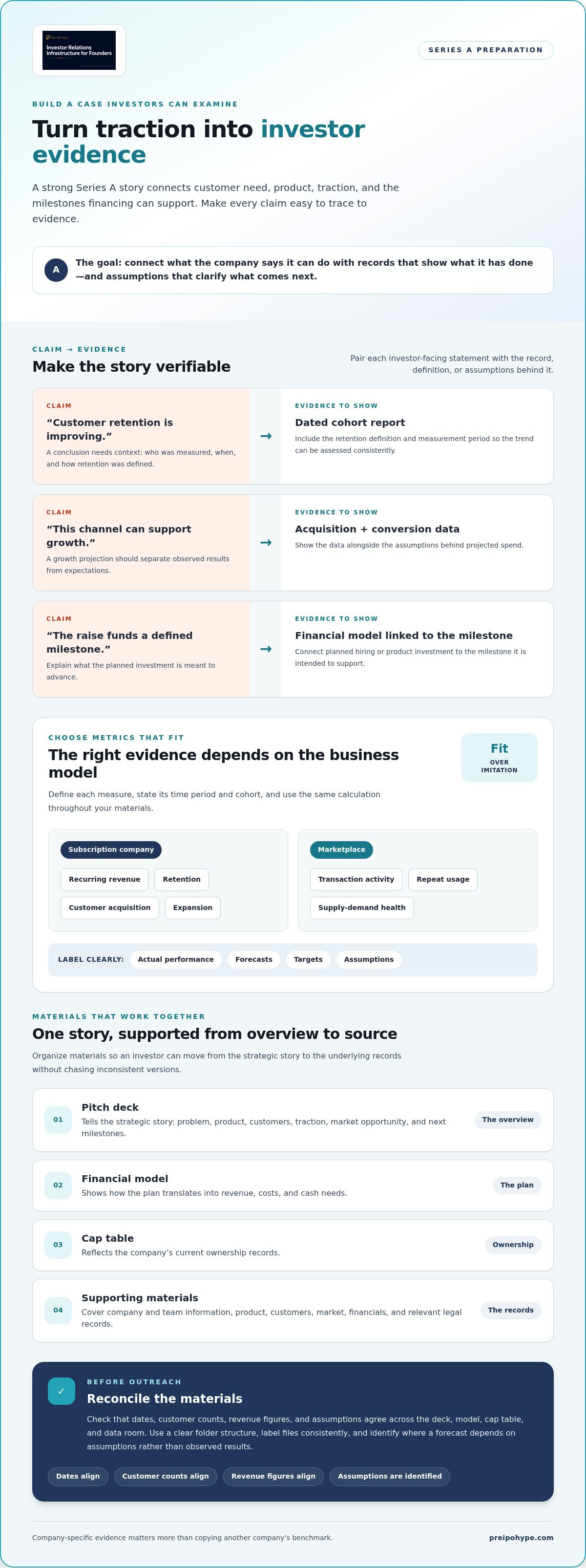
A compelling Series A case is more than a polished deck. It’s a connected argument: customers have a meaningful problem, your product addresses it, traction supports demand, and the capital you’re raising can advance specific milestones. Each claim should lead to evidence an investor can examine.
Build the narrative around the problem, product, customers, traction, market opportunity, and next milestones. Ground the market case in a defined customer segment and explain how you calculated its size. Present risks directly, then describe practical mitigation steps. Credibility grows when you distinguish what the company has achieved from what it expects to achieve.
Which metrics belong in a Series A story?
Choose metrics that fit your business model, stage, and growth thesis. A subscription company might track recurring revenue, retention, customer acquisition, and expansion; a marketplace may need to show transaction activity, repeat usage, and supply-demand health. Define each measure, state its time period and cohort, and use the same calculation throughout your materials.
Label actual performance, forecasts, targets, and assumptions separately. For every investor-facing claim, create a concise evidence map:
- Claim: Customer retention is improving. Evidence: A dated cohort report, with the retention definition and measurement period.
- Claim: A channel can support growth. Evidence: Acquisition and conversion data, plus the assumptions behind projected spend.
- Claim: The raise funds a defined milestone. Evidence: A financial model that connects planned hiring or product investment to the milestone.
How should founders prepare a pitch deck and data room?
Organize materials so an investor can move from the overview to the underlying records without chasing inconsistent versions. A deck should tell the strategic story; the financial model should show how the plan translates into revenue, costs, and cash needs; and the cap table should reflect the company’s current ownership records. Supporting materials can cover company and team information, product, customers, market, financials, and relevant legal records.
Before outreach, reconcile the deck, model, cap table, and data room. Check that dates, customer counts, revenue figures, and assumptions agree. Use a clear folder structure, label files consistently, and note where a forecast depends on assumptions rather than observed results. A fit-for-purpose fundraising technology stack can also help organize the process.
Good preparation won’t remove every diligence question, but it helps you answer with clarity. To talk through the structure of your fundraising materials, discuss your fundraising preparation.
Build a Series A Investor Pipeline and Run Outreach With Discipline
A strong investor list is not a fundraising strategy on its own. Identify a reason each investor may fit, make a relevant introduction, and track what happens next. A focused pipeline helps founders prioritize plausible matches rather than treating every contact as equally valuable.
How do founders identify and prioritize relevant investors?
Start with publicly observable signals: investment stage, sector focus, portfolio companies, stated thesis, and evidence of recent activity. Compare those signals with your company’s business model, financing needs, and next milestones. Record why each investor belongs on the list, such as experience with your market or a history of backing companies at a similar stage. Revisit the fit as circumstances change.
A warm introduction can provide context for a relevant conversation, so prioritize one where it’s available. Prepare thoughtful direct outreach, too. Keep the message concise: explain what the company does, why you’re contacting this investor specifically, and what evidence makes the conversation timely. A possible fit is not proof of interest. Treat an investor as interested only after they communicate that interest.
How can founders keep outreach consistent?
Run outreach through clear stages: research, introduction, meeting, follow-up, diligence, and decision. Use one system to log contact history, meeting notes, stated interests, follow-up dates, and next actions. Assign an owner after each interaction, even if that owner is the founder. Without a clear next step, promising conversations can stall in an inbox.
- After an introduction: Record who connected you, when you replied, and any agreed next step.
- After a meeting: Capture questions, requested materials, concerns, and the date for follow-up.
- During diligence: Track outstanding requests and who is responsible for responding.
Tailor updates to the conversation. If an investor asked about customer retention, lead with relevant progress and explain the period or context behind the metric. Avoid sending the same broad update to every contact. Review the pipeline regularly, prioritize based on actual engagement, and move inactive conversations to a status that reflects reality.
These habits make how to raise a series A less about sending more messages and more about managing each conversation with intent. An investor CRM can support lead scoring and coordinated outreach, while founders remain responsible for the relationships and decisions. Explore investor data resources for related pipeline context, or discuss your fundraising process.
Evaluate Series A Valuation, Dilution, and Terms Without Guesswork
A headline valuation can look compelling and still leave important questions unanswered. Valuation reflects company context, investor demand, market conditions, and negotiated terms. To understand how to raise a series A, compare the full economic and governance picture, not just the number at the top of a term sheet.
How should founders think about valuation and dilution?
Pre-money valuation is the agreed value of the company immediately before a new investment. Post-money valuation is the pre-money value plus the investment, subject to the transaction’s details. A simplified starting point for estimating an investor’s ownership is investment divided by post-money valuation. The actual result can change with an option-pool increase, existing convertibles, and other deal terms.
Build several scenarios using your proposed investment amount and alternative pre-money values. Model the option pool before and after financing, then include possible future rounds to understand how ownership could change over time. These are planning cases, not predictions or universal targets.
Which term-sheet details deserve careful review?
Review liquidation preference, governance rights, protective provisions, and option-pool treatment alongside valuation. These terms interact: ownership percentage alone doesn’t show how proceeds might be distributed in a sale or what decisions require investor approval. Have qualified legal and financial advisers interpret the proposed terms for your company. This overview is educational, not legal, tax, or financial advice.
| Scenario | Ownership impact | Control implications | Questions for counsel |
|---|---|---|---|
| Higher pre-money valuation | May reduce the new investor’s percentage for the same investment, before other adjustments. | Governance rights still depend on negotiated terms. | How do pool changes and other securities affect the modeled ownership? |
| Lower pre-money valuation | May increase the investor’s percentage for the same investment. | Review board composition and approval rights separately from ownership. | How do the economic terms interact with governance provisions? |
| Option-pool increase tied to financing | Can affect existing holders’ ownership, depending on how and when the pool is calculated. | Doesn’t alone determine decision-making authority. | Who bears the dilution, and how is the pool sized and calculated? |
Use the table to structure a side-by-side review, then have advisers check the actual documents and assumptions. The better offer is the one whose economics, governance, and financing plan fit the company’s needs, not necessarily the one with the highest headline valuation. Discuss your fundraising strategy as you prepare to assess financing scenarios.
Close the Series A Process and Build a Repeatable Investor System
Investor interest is a milestone, not a close. Moving from a promising conversation to funded capital takes coordinated diligence, negotiated documents, company approvals, signatures, and funding. The exact documents and procedures vary by company, security, and transaction structure, so treat this as a high-level workflow and coordinate transaction details with qualified legal counsel.
What should founders manage between investor interest and closing?
Keep diligence moving with a shared request log. For every request, record the owner, status, deadline, source document, and any open question. After discussions with investors or advisers, capture what was agreed and assign the next action. This reduces duplicated work and helps the team give accurate, consistent answers as new questions come in.
Coordinate document preparation, revisions, and company approvals with qualified legal counsel. Before signing, confirm that the people responsible for decisions understand the current documents and outstanding steps. Don’t treat verbal interest as a completed commitment; keep the pipeline status aligned with what has actually happened.
How can a structured system support future investor relations?
Closing is also the start of an ongoing investor relationship. Connect the funds to the operating milestones described during fundraising, track progress against those priorities, and share clear updates with investors. Report both progress and material changes to assumptions. Consistent communication builds a useful record for future conversations without overstating results.
A structured CRM can keep contact details, meeting notes, follow-up dates, and campaign interactions in one place. That record helps founders see which conversations are active, what each investor asked about, and which next steps are due. Pre-IPO Hype’s investor relations and fundraising systems include a Custom Investor CRM, omnichannel outreach, and performance tracking to support campaign coordination. These tools organize the process; they don’t determine investor decisions or promise a funding outcome.
Building a repeatable system is part of how to raise a series A, because the discipline developed during one round can support future investor relations. To discuss how a structured process might fit your fundraising plans, discuss your fundraising process.
Turn Fundraising Preparation Into Forward Momentum
Raising a Series A starts before the first investor meeting. Assess readiness through your company’s own evidence, connect traction to a credible growth plan, and make sure your deck, model, and diligence materials tell a consistent story. A focused investor pipeline then helps you manage conversations, follow-ups, and next steps with intent.
As you evaluate offers, look beyond headline valuation. Model how financing scenarios could affect ownership, review economic and governance terms together, and coordinate diligence and closing with qualified advisers. Knowing how to raise a series A means turning preparation into a clear, founder-led process, not relying on a single benchmark or hoping momentum will carry the round.
Since its 2015 founding, Pre-IPO Hype reports working with more than 230 companies across industries and facilitating over $100 million in funding. These are company-wide historical figures, not Series A-specific outcomes or a promise of future funding. If you’re ready to put your next steps into focus, talk through your fundraising strategy.
Frequently Asked Questions
How do you know if your startup is ready for a Series A?
A startup may be ready when it can show that customers repeatedly use and value its product, reporting is reliable, and the team can execute a credible plan for the next milestones. There’s no universal revenue or growth threshold that guarantees readiness. To assess how to raise a series A, compare your evidence with your market, business model, and financing needs, then identify gaps investors may examine.
How much should a startup raise in a Series A?
There’s no standard amount that fits every company. Build your target from a milestone-based operating plan: define what the business needs to accomplish, estimate the resources required, and model the resulting ownership and runway scenarios. Explain the assumptions behind your target. Don’t choose a raise amount solely because another company raised it or because a market benchmark looks attractive; your financing plan should reflect your own needs.
How long does it take to raise a Series A?
The timeline varies with readiness, investor fit, market conditions, diligence, and transaction complexity. Account for preparation before outreach, then meetings, follow-up, diligence, negotiation, and closing. No single timeline is a promise. Keep operating responsibilities covered while fundraising, and agree internally on decision points if the process takes longer than planned. Review progress regularly so leadership can adjust priorities without losing sight of the business.
What should a Series A pitch deck include?
A Series A deck typically covers the customer problem, product, market, business model, traction, go-to-market approach, team, financial outlook, capital plan, and upcoming milestones. Choose evidence that fits your business model and stage. Define metrics consistently, make sure they match supporting records, and separate actual results from projections. Be ready to explain key assumptions and risks when investors ask for more detail after the presentation.
Do you need a lead investor before raising a Series A?
Not every financing process has the same structure, and investor roles depend on the transaction. A potential lead may help shape terms and attract participation, but don’t assume one investor will take that role. Build a focused pipeline, understand each investor’s process, and coordinate conversations carefully. Before making commitments, work with qualified advisers who can provide guidance specific to your transaction and company.
What happens if a Series A fundraise does not close?
A fundraise that doesn’t close can still reveal gaps in readiness, investor fit, the company narrative, or market conditions. Review feedback carefully, preserve relationships, and reassess runway and operating priorities with your leadership team. Update projections and the financing plan before restarting outreach. Keep your records precise: investor interest, meetings, and verbal discussions aren’t committed capital, so don’t treat them as funding secured.
Disclaimer
Educational only. Not investment, tax, or legal advice. Pre-IPO Hype is investor relations infrastructure for Regulation CF and Regulation A+ raises. We are not a broker-dealer, funding portal, or investment adviser, and we do not offer or sell securities or make investment recommendations. Any securities offering is made only by the issuer, through its own offering documents and, where required, a registered intermediary.


