
How to Run a Compliant Online Offering: A Founder’s Guide
Could an online fundraising campaign build momentum and still expose your company to compliance risk? Yes. The exemption, offering documents, investor eligibility rules, and public communications all shape the answer. If you’re weighing how to run a compliant online offering, start with a process guided by qualified securities counsel, not a marketing launch. Legal review, platform operations, outreach, and investor records need to work together, and a strong campaign can’t replace securities counsel.
This guide lays out a practical sequence for coordinating those responsibilities. You’ll learn how to discuss the exemption decision with counsel, prepare offering materials, align promotion with approved disclosures, and organize investor engagement and records before, during, and after a raise. You’ll also see how campaign infrastructure, analytics, and a Custom Investor CRM can support operations without determining legal compliance or guaranteeing fundraising results. The goal is a documented readiness workflow that keeps the campaign organized while giving legal decisions the attention they require.
Key Takeaways
- Learn how to run a compliant online offering by treating it as a counsel-led process, not just a digital campaign.
- Compare offering paths with counsel, because the exemption affects investor eligibility, disclosures, filings, and communications.
- Coordinate website copy, email, social posts, presentations, and investor updates with approved offering disclosures.
- Use a documented readiness checklist to align offering preparation, required filings, platform operations, and launch controls.
- Use CRM tools to organize investor engagement, follow-ups, lead scoring, and attribution while leaving legal review to qualified counsel.
What Does It Mean to Run a Compliant Online Offering?
An online offering is a securities raise conducted partly or entirely through digital channels. A company might share information on a campaign page, email prospective investors, or accept subscriptions through an offering platform. Digital channels change how information travels. They don’t determine which rules apply or remove the company’s responsibilities.
Compliance depends on the offering structure, applicable federal and state requirements, and the company’s circumstances. The Securities Act of 1933 provides background on U.S. securities offerings, but a general overview can’t determine how the rules apply to a specific raise. Involve qualified U.S. securities counsel before soliciting investment. Early legal analysis helps shape the campaign plan before public outreach gets ahead of the documents.
Keep four workstreams distinct: legal analysis, platform operations, marketing execution, and payment processing. A platform may support subscriptions or investor onboarding, while payment providers handle transactions. Neither function determines whether an exemption fits or whether offering materials meet legal requirements. While consulting firms like Versapien help consumer financial services manage risk and regulatory compliance, an organized campaign still needs dedicated legal review.
What makes an online securities offering different?
Digital channels can put offering information in front of people across locations, quickly and at scale. That reach makes coordination essential. Securities offerings may involve federal and state requirements, and online promotion doesn’t eliminate issuer disclosure or filing responsibilities.
Public promotion and private investor communications don’t follow one simple rule for every situation. A website, social post, presentation, or one-to-one email may be treated differently depending on the offering structure and circumstances. The exemption can affect who may invest and what communications are permitted. Don’t assume a message is unrestricted because it’s sent privately, or that online reach changes the underlying obligations.
Which roles should be clear before you launch?
The issuer remains responsible for accurate disclosures and timely coordination. Keep company information current and align campaign materials with the offering documents. Counsel analyzes potential exemptions, prepares or reviews documents, and assesses communications against the selected structure. Establish who approves updates and how approved changes reach everyone involved.
Campaign teams support outreach and execution, not legal determinations or brokerage. A Custom Investor CRM, for example, can organize engagement, follow-ups, lead scoring, and attribution, but it can’t establish legal compliance. Clear roles help the team move efficiently without confusing operational support with legal advice. That distinction is central to how to run a compliant online offering: counsel guides the legal framework, while campaign and platform workflows help execute within it.
Choose an Offering Path Before Building Your Online Campaign
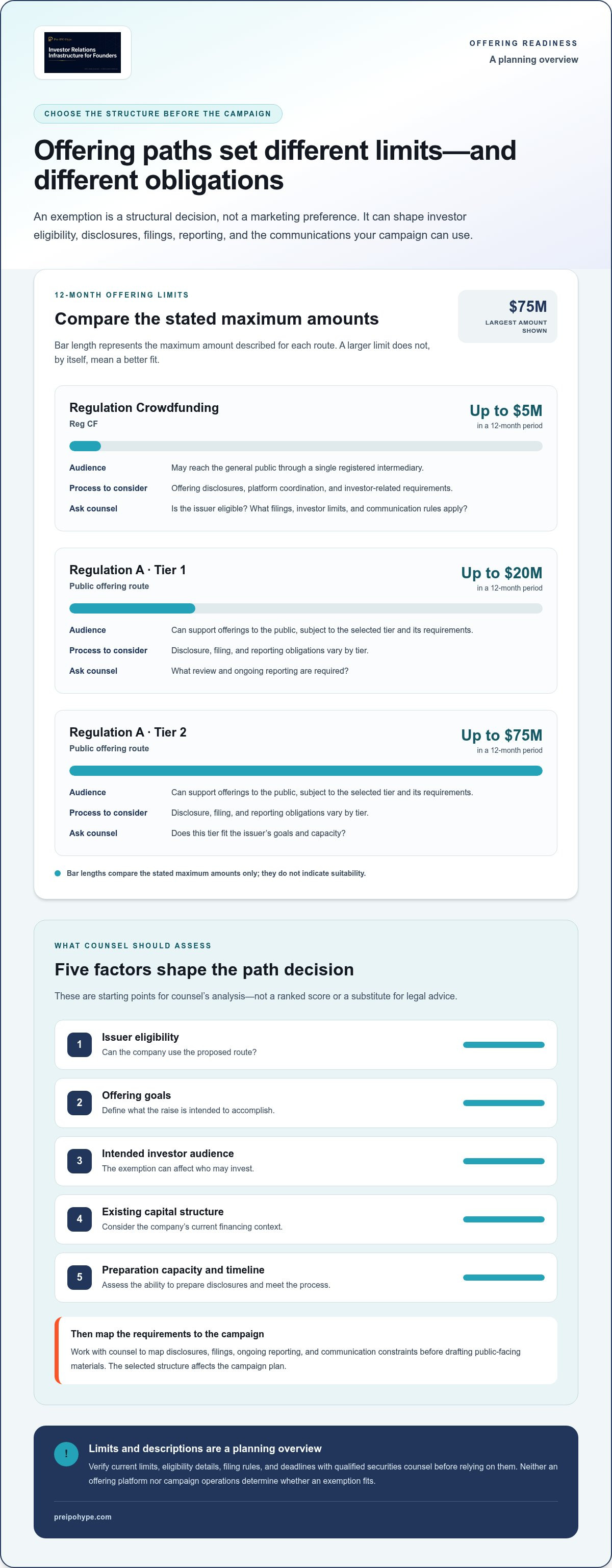
The exemption is a structural decision, not a marketing preference. It influences who may invest, what the company must disclose and file, and how it can communicate with potential investors. Compare routes with qualified securities counsel before building a campaign around an assumed audience or fundraising target.
How should founders compare Regulation Crowdfunding and Regulation A?
Regulation Crowdfunding can allow a company to raise from the general public through a single registered intermediary. Regulation A also provides a route for public offerings, with requirements that differ by tier. Neither is a universal fit. Company stage, target investor audience, timeline, existing capital structure, and capacity to prepare disclosures are useful starting points for counsel’s analysis.
| Path | Audience | Process considerations | Counsel questions |
|---|---|---|---|
| Regulation CF | May reach the general public through a registered intermediary. | Involves offering disclosures, platform coordination, and investor-related requirements. The current offering limit is up to $5 million in a 12-month period. | Is the issuer eligible? What filings, investor limits, and communication rules apply? |
| Regulation A | Can support offerings to the public, subject to the selected tier and its requirements. | Tier 1 currently allows up to $20 million, and Tier 2 up to $75 million, in a 12-month period. Disclosure, filing, and reporting obligations vary. | Which tier, if any, fits the issuer’s goals and capacity? What review and ongoing reporting are required? |
These limits and descriptions are a planning overview, not a substitute for current legal analysis. The SEC’s Regulation Crowdfunding Guidance for Issuers is a useful starting point for understanding Regulation CF. Have counsel verify current limits, eligibility details, filing rules, and deadlines before relying on them.
What should counsel assess before the exemption is selected?
Ask counsel to review issuer eligibility, offering goals, intended investor audience, and existing capital structure. Then map required disclosures, filings, ongoing reporting, and communication constraints to the proposed campaign. Settle these decisions before drafting public-facing materials, since they affect the campaign plan. For a Regulation CF raise, Pre-IPO Hype’s investor relations and marketing systems can support campaign operations alongside the issuer’s registered intermediary and qualified securities counsel.
This sequence is a practical foundation for how to run a compliant online offering: make the legal structure an input to campaign design, not a detail to resolve after launch. To discuss how campaign operations can align with an offering plan, schedule a fundraising workflow conversation.
Keep Online Offering Marketing Consistent With Approved Disclosures
A campaign can lose credibility when its channels tell different stories. Website copy, email sequences, social posts, presentations, paid campaigns, and investor updates should draw from the same approved disclosures. A claim that sounds reasonable in a post can still create problems if it conflicts with offering materials, omits important context, or suggests a return investors haven’t been promised.
Consistency takes more than reusing a tagline. Each investor-facing statement should be supportable, current, and reviewed under the selected offering structure. Avoid unsupported forecasts, misleading omissions, and language that implies guaranteed returns. If company performance or other material facts change, pause and get counsel’s guidance before updating campaign content.
How can a company review investor-facing content?
Build an approval workflow before publishing. Assign an owner to each asset, identify reviewers, track version numbers, and record approval and publication dates. Keep copies of approved materials and the versions actually distributed so the company can trace what investors saw and when.
Before release, compare each statement with the offering documents and supporting evidence. Send forecasts, performance claims, and material updates to securities counsel for review. A CRM or campaign platform can help organize follow-ups and preserve engagement records, but it doesn’t replace legal review.
What online promotion practices need extra care?
Review public website pages, social posts, paid campaigns, presentations, and email sequences together. A message may be shared, quoted, or viewed outside its original channel, so context and consistency matter. General-solicitation rules vary by offering path; have counsel verify how current requirements apply before a campaign goes live or changes.
Where broker-dealers or funding portals are involved, the FINRA Rules & Guidance resource can help readers locate guidance relevant to those regulated intermediaries. It isn’t a substitute for analyzing the issuer’s offering or communications with counsel.
Operationally, a digital marketing and advertising playbook can help teams coordinate channels, content, and campaign execution alongside legal review. Keep each asset’s approval status visible, and route edits through the same process rather than assuming a small wording change is automatically safe. That discipline turns how to run a compliant online offering into a repeatable communications workflow, not a last-minute review before launch.
Use a Counsel-Led Checklist to Prepare and Run the Offering
A clear sequence keeps legal decisions, platform setup, and campaign activity aligned. Use this as a working checklist with named owners, documented approvals, and checkpoints that counsel can adapt to the selected offering structure. Don’t rely on generic filing timelines or assume the same process applies to every raise.
- Define the objectives. Document the raise’s purpose, target audience, intended amount, and business milestones the capital would support.
- Select an exemption with counsel. Review issuer eligibility, investor audience, existing capital structure, disclosure capacity, and communication constraints before choosing a path.
- Prepare the disclosure package. Organize company records, financial information, ownership details, and draft offering materials for counsel’s review. Resolve gaps and confirm that claims are supported.
- Coordinate required filings and platform operations. Assign owners for filing preparation, platform coordination, investor onboarding, and payment workflows. Have counsel verify current requirements and confirm that operational steps fit the chosen structure.
- Approve communications and launch controls. Establish who can approve investor-facing materials, how final versions are stored, and what must happen before publication or campaign changes.
- Monitor activity and follow through. Track investor questions, communications, engagement records, document versions, and required follow-ups. Coordinate material updates and applicable reporting with counsel.
What should be ready before accepting investor interest?
Preparation means more than drafting a campaign page. Gather the company’s core records and assign responsibility for counsel review, filing coordination, communications approval, and investor inquiries. Confirm that platform and payment workflows reflect counsel’s guidance for the selected offering. If a key workflow is unclear, resolve it before launch rather than improvising once investor activity begins.
What should the team monitor during and after the raise?
Keep an organized record of outreach, investor interactions, approved materials, and follow-up items. A CRM can make ownership and engagement easier to track, while analytics can help teams understand campaign activity. Neither replaces counsel’s assessment of disclosure changes or applicable reporting duties. A practical investor relations platform guide can help teams evaluate the tools and workflows supporting outreach.
The discipline behind how to run a compliant online offering continues after launch. Give the team a defined route for escalating investor questions and proposed updates, and document how decisions are handled. To map campaign operations to a counsel-led readiness workflow, schedule a fundraising workflow discussion.
Connect Compliance Workflows With Investor CRM and Campaign Operations
A well-run offering generates more than investor interest. It creates inquiries, follow-ups, campaign interactions, and records the team needs to organize. A Custom Investor CRM can bring these operational details into one workflow, helping teams track engagement without confusing marketing activity with legal review.
What should an investor-management workflow capture?
Set up records to capture the source of an inquiry, relevant consent information, interaction history, follow-up status, and campaign activity. Use consistent fields and clear ownership so the team can see what happened, what needs attention, and who owns the next step. Keep access controlled, records accurate, and data-handling practices documented. Alongside internal controls, teams safeguarding digital portals and campaign infrastructure can use ReadySECURE to perform authorized vulnerability scanning across websites and internet-facing systems. Have qualified counsel review applicable privacy and securities requirements rather than assuming a CRM configuration resolves them.
Useful records also help teams reconstruct an investor’s journey across channels. For example, a prospect might engage with an approved email, visit a campaign page, and later ask a question. A coordinated record helps staff respond consistently and preserve context for appropriate review.
How can campaign systems support a disciplined raise?
Connect approved messaging, channel coordination, and engagement reporting in a shared operating workflow. Pre-IPO Hype’s Custom Investor CRM supports lead scoring and attribution tracking, helping teams organize campaign engagement and understand how outreach connects with investor activity. These are operational capabilities, not legal determinations or promises of fundraising results.
A coordinated fundraising technology stack can support the flow of information between campaign activity and investor management. Pre-IPO Hype also provides campaign support alongside the issuer’s qualified securities counsel. Counsel remains responsible for legal analysis; software and campaign execution don’t establish compliance.
That division of responsibility is central to how to run a compliant online offering. Assign the team to manage outreach, records, and approved campaign workflows, and involve counsel in exemption questions, disclosures, and communications review. To discuss your campaign requirements, discuss your offering workflow.
Build Your Raise on a Stronger Operating Foundation
Knowing how to run a compliant online offering starts with decisions made before launch: choose an exemption with qualified securities counsel, align investor-facing messages with approved disclosures, and keep clear records as the campaign progresses. The right systems can help your team manage outreach and follow-ups, but they don’t replace legal review or guarantee compliance.
Pre-IPO Hype is investor relations infrastructure for Regulation CF and Regulation A+ raises. We are not a broker-dealer, funding portal, or investment adviser, and we do not offer or sell securities or make investment recommendations. Our Custom Investor CRM supports lead scoring and attribution tracking. These operational capabilities can help organize campaign activity while securities counsel guides legal decisions.
Your next step is to map the offering structure, communications workflow, and investor-management needs before the campaign gathers speed. Schedule a 30-minute offering strategy conversation to discuss your campaign requirements and operational workflow. With the right roles and process in place, your team can pursue its fundraising goals with greater clarity and discipline.
Frequently Asked Questions
Can a company advertise an online securities offering?
It depends on the exemption and the rules that apply to the offering. Some structures permit certain forms of public promotion, while others can limit how and to whom a company communicates. Don’t assume every public post or private message is treated the same way. Before publication, have securities counsel review planned website copy, email, social content, and paid campaigns against the offering structure.
Which offering exemption should a startup use online?
There’s no one-size-fits-all exemption for startups raising capital online. Regulation Crowdfunding and Regulation A involve different eligibility, disclosure, filing, investor, and process considerations. The right analysis depends on the company’s circumstances and fundraising objectives, including its ability to meet applicable requirements. Compare potential routes with qualified securities counsel, and verify current rules with authoritative sources rather than relying on a generic online checklist alone.
Does Regulation Crowdfunding require a registered intermediary?
Yes. Each Regulation Crowdfunding offering must be conducted through one intermediary, and only on that intermediary’s online platform. The intermediary must be registered with the SEC as a broker-dealer or a funding portal, and it must be a FINRA member. Check the intermediary’s status on FINRA BrokerCheck or FINRA’s list of funding portals, and confirm with counsel. Investor relations providers and CRM software can support campaign and investor-management operations, but they can’t act as the offering intermediary or replace legal review.
What documents are needed for an online securities offering?
Required materials vary by exemption and issuer circumstances. They may include offering disclosures, financial information, company records, and applicable regulatory filings. A general checklist can help organize preparation, but it can’t establish that the company has everything it needs or that documents are legally sufficient. Have qualified securities counsel identify required materials, review their accuracy, and coordinate filing and investor access before launch.
How can a company keep online offering communications consistent?
Use one approval process for website copy, social posts, email, presentations, and investor updates. Keep controlled versions and supporting evidence, then compare statements with approved offering materials before publication. Send forecasts, performance claims, and material updates to securities counsel for review. A CRM can help organize engagement records and follow-ups, but it can’t determine whether a communication complies with securities rules.
Can investor CRM software make an offering compliant?
No. A CRM can support investor records, lead management, follow-ups, attribution, and campaign coordination, but it can’t select an exemption or establish legal compliance. Compliance depends on applicable rules, company circumstances, disclosures, filings, and conduct. Use the system to organize the team’s workflow while qualified securities counsel handles legal analysis and reviews the offering structure and investor-facing communications.
Disclaimer
Educational only. Not investment, tax, or legal advice. Pre-IPO Hype is investor relations infrastructure for Regulation CF and Regulation A+ raises. We are not a broker-dealer, funding portal, or investment adviser, and we do not offer or sell securities or make investment recommendations. Any securities offering is made only by the issuer, through its own offering documents and, where required, a registered intermediary.


