
How to Run a Successful Reg A+ Campaign: The Insider’s Playbook for 2026
Most founders treat a Reg A+ offering like a digital crowdfunding experiment, but by 2026, the "post and pray" method is officially dead. You've likely seen the data showing that 65% of Tier 2 offerings fail to reach even half of their funding goal because they lack a sophisticated conversion engine. It's a brutal reality when your investor acquisition costs skyrocket while your attribution remains a total mystery. You deserve a predictable system that transforms your offering from a quiet filing into a high-momentum event.
Learning how to run a successful Reg A+ campaign requires moving beyond basic social media ads and into the realm of institutional-grade technical infrastructure. We're pulling back the curtain on the omnichannel strategies and data-tracking frameworks used to engineer multi-million dollar raises. This playbook breaks down exactly how to optimize your funnel for oversubscribed rounds and create the secondary liquidity your early investors demand. You're about to master the mechanics of the modern private market and claim your spot in the elite circle of successful issuers.
Key Takeaways
- Bridge the gap between private secrecy and public opportunity by leveraging Tier 2 advantages to raise up to $75M from both accredited and non-accredited investors.
- Shift your focus from the pitch deck to the technical bedrock, implementing the specific CRM infrastructure required to manage elite, high-volume capital raises.
- Master the omnichannel marketing funnel to learn how to run a successful Reg A+ campaign that converts curiosity into capital across social, email, and SMS.
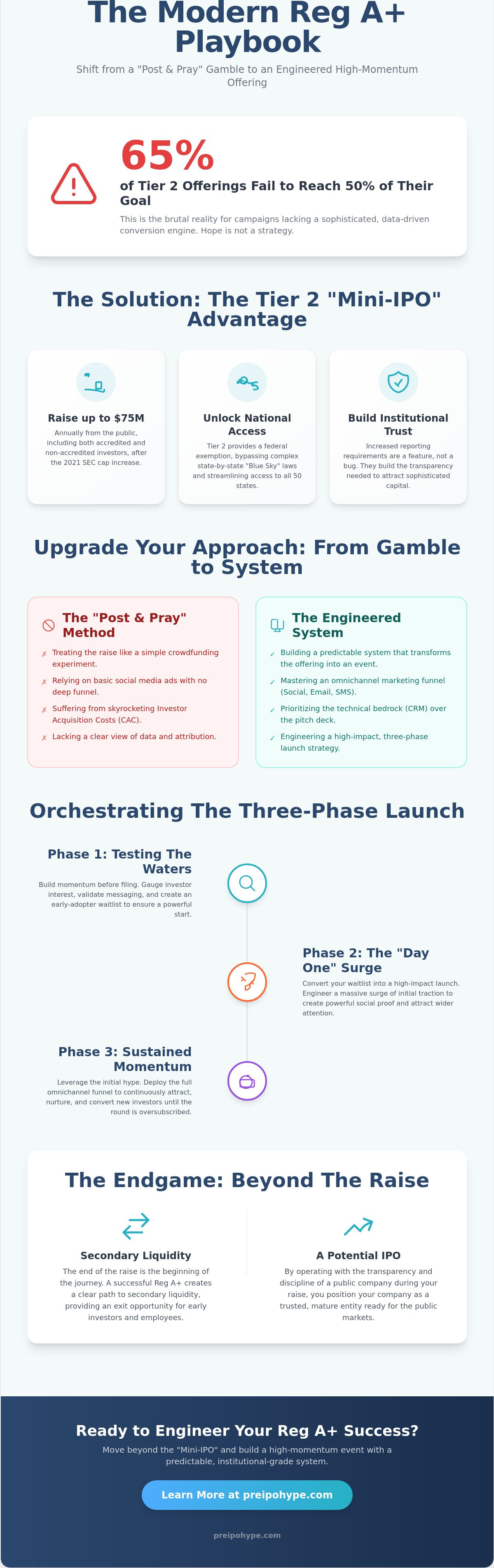
- Orchestrate a three-phase launch strategy, utilizing "Testing the Waters" to build momentum and engineer a high-impact "Day One" surge of investor traction.
- Navigate the hype cycle effectively to ensure the end of your raise is just the beginning of your journey toward secondary liquidity and a potential IPO.
The Reg A+ Landscape in 2026: Why the Mini-IPO Requires a Major Strategy
The era of gated wealth is over. In 2026, the private market stands as the final frontier for significant wealth creation, and Reg A+ is the vehicle leading the charge. This framework acts as the ultimate bridge between private secrecy and public opportunity. Understanding the mechanics of Regulation A is the first step toward unlocking institutional-grade capital from the masses. To learn how to run a successful Reg A+ campaign, you must stop thinking like a quiet startup and start performing like a public entity.
To better understand this concept and the current market dynamics, watch this helpful video from Manhattan Street Capital:
Success in this space isn't guaranteed by a simple filing. Many founders fall for the "Field of Dreams" fallacy, believing that a qualified Form 1-A will automatically attract capital. It won't. The reality is a high-stakes battle of Investor Acquisition Costs (CAC). In 2026, retail dominance means you are competing for the attention of millions of non-accredited investors who crave exclusive access to the next unicorn. You need a strategy that treats your raise like a product launch, not a legal chore.
Tier 1 vs. Tier 2: Why Tier 2 is the Insider Choice
Tier 2 is the undisputed champion for late-stage growth. While Tier 1 requires grueling state-by-state "Blue Sky" reviews, Tier 2 offers a federal exemption that streamlines the process across all 50 states. This allows you to raise up to $75 million annually from both accredited and non-accredited investors. Following the March 2021 SEC amendment that raised the cap from $50 million, Tier 2 became the preferred tool for companies seeking to scale without surrendering control to predatory venture capital terms. The increased reporting requirements aren't a burden; they are a transparency tool. Regular audits and semi-annual filings build the institutional trust necessary to fuel the hype cycle and attract sophisticated capital. This transparency is the core of how to run a successful Reg A+ campaign in a crowded market.
The "Hype" Factor: Moving Beyond the Form 1-A
A qualified SEC filing is just a license to hunt. It is not the meal itself. High-stakes fundraising requires deep consumer resonance. You need to transform your offering into a movement. We define the "Mini-IPO" as a strategic marketing window for secondary liquidity that allows early backers to see a clear path to an exit. If your brand doesn't vibrate with the energy of early-stage opportunity, your campaign will stall. Mastering the video-led marketing funnel is how you convert curiosity into capital. In 2026, the winners are those who can pair rigorous financial compliance with the infectious energy of a ground-floor opportunity. Don't just list your company; launch it.
Engineering the Technical Bedrock: Why Your CRM Is More Important Than Your Pitch Deck
Most founders obsess over the visual polish of their pitch deck while ignoring the plumbing that actually captures capital. If you want to master how to run a successful Reg A+ campaign, you must prioritize your Foundation Infrastructure. This is not just a database; it is the technical bedrock of an elite raise. Off-the-shelf platforms like Salesforce or HubSpot often fail in this environment because they are built for traditional B2B sales cycles, not the high-velocity, regulated world of retail capital formation. They lack the native hooks required to manage SEC Regulation A requirements while simultaneously driving marketing momentum.
A generic CRM treats every lead the same. In a Reg A+ environment, you need a system that distinguishes between a $500 retail participant and a $50,000 "Whale" investor based on real-time behavior. Without this specialized tech, you are flying blind. You won't know which ads are driving actual dollars or which email sequences are causing investors to drop off. To see how this works in practice, you can connect with our leadership team for a direct look at high-performance stacks.
The 60-Day Attribution Window
Investors rarely commit on their first interaction. Data from 2024 raises shows that 84% of capital is committed only after the seventh touchpoint. This creates a massive tracking challenge. An investor might see an ad on their mobile device, read your offering circular on a laptop three days later, and finally invest via a tablet after a week. Your tech must maintain a 60-day attribution window to prevent capital leakage. If your system cannot recognize a returning user across multiple devices, you are essentially throwing your marketing budget into a black hole. High-velocity raises require "Foundation" tech that bridges these gaps, ensuring every dollar spent on awareness is tracked through to the final signature.
Lead Scoring for High-Velocity Raises
Speed is the currency of the private markets. To maintain momentum, you must automate the identification of "Investor Intent." This is achieved through lead scoring. If a lead spends 12 minutes on your financials page or downloads your subscription agreement, their score should spike. This triggers an immediate, automated follow-up or a personal reach-out from your investor relations team. Integrating this logic into a Custom Investor CRM ensures you are not wasting time on tire-kickers. This CRM acts as the engine of momentum, plugging directly into your Foundation Infrastructure to create a seamless flow of data. When you know exactly who is ready to wire funds, you can stop guessing and start closing. This is how to run a successful Reg A+ campaign in a market that demands precision over volume.
The Omnichannel Investor Funnel: Converting Curiosity into Capital
Capital isn't captured by accident. It's harvested through a calculated sequence of touchpoints that transform passive observers into committed shareholders. Knowing how to run a successful Reg A+ campaign in 2026 requires more than a static landing page; it demands a relentless omnichannel engine. This ecosystem synchronizes Social, Search, Email, and SMS to create a surround-sound effect. While social media builds the initial momentum, search captures high-intent investors actively hunting for the next breakout growth story.
We leverage the "Invst Guru" newsletter to provide immediate elite exposure. This puts your offering directly in the inboxes of over 50,000 sophisticated retail investors who are primed for early-stage opportunities. During the SEC qualification period, which typically spans 60 to 120 days, retargeting is your most critical asset. It keeps your brand top-of-mind through every scroll. It ensures that curiosity doesn't evaporate before the "Invest Now" button goes live. For a granular breakdown of these tactics, explore our strategy on Digital Marketing and Advertising.
Building the "Investor Hype" Content Engine
Video is the undisputed heavyweight champion of the Reg A+ funnel. Data shows that video content generates up to 1,200% more shares than text and static images combined. Your content engine must move beyond dry financial projections. It needs a "Story Framework" that speaks to retail emotions while satisfying institutional logic. You aren't just selling equity. You're selling a vision of the future. Since the implementation of the JOBS Act, investing in startups has become a democratic reality, but only for companies that can articulate their "why" with cinematic clarity. You can see this framework in action by reviewing the Pre-IPO Hype Video Funnel.
Filling the Funnel: Paid Media vs. Organic Outreach
The insider secret to how to run a successful Reg A+ campaign lies in the balance of your traffic sources. Use Facebook and Instagram to drive high-volume retail traffic, but pivot to LinkedIn for precision targeting of family offices and institutional players. Ad-blindness is a constant threat. High-authority newsletter exposure allows you to bypass these mental filters by leveraging established trust. Omnichannel is not about being everywhere, but being where the capital is. By dominating the digital spaces where your ideal investor spends their time, you turn a broad offering into an exclusive movement. Success in 2026 belongs to the issuers who can maintain this digital proximity from the first click to the final wire transfer.
Orchestrating the Three Phases of a Successful Reg A+ Raise
A Reg A+ raise isn't a marathon. It's a series of high-intensity sprints designed to manufacture momentum. To master how to run a successful Reg A+ campaign, you have to move beyond the idea of passive fundraising. In 2026, the market rewards those who treat their offering like a high-stakes product launch rather than a dry financial filing. You're not just asking for capital; you're inviting a community to join an exclusive movement before the window slams shut.
The process follows a strict three-act structure. Phase 1 is the reconnaissance phase, where you use Testing the Waters (TTW) to gauge market appetite without the legal pressure of a live offering. Phase 2 is the Qualified Launch, where you engineer a "Day One" surge to prove to the world that your deal is hot. Phase 3 is the Momentum Phase, where you scale your digital ad spend and trigger secondary interest. By implementing monthly "closing" cycles, you create artificial but effective urgency that forces hesitant leads to act. Data from 2025 shows that offerings with clear monthly milestones see a 42% higher conversion rate than those with open-ended timelines.
Testing the Waters (TTW) Strategy
Smart founders use TTW under SEC Rule 255 to build an army before they spend a dime on heavy audits. You're profiling your future cap table. If you don't have $2 million in "indications of interest" before you go live, you aren't ready for the big stage. Analyzing this data allows you to refine your valuation benchmarks. If 65% of your waitlist drops off when the price per share hits a certain threshold, you pivot your strategy before the SEC qualification makes your terms rigid. This ensures your first 48 hours are backed by hard dollars from a pre-sold audience.
Managing the Mid-Campaign Slump
Every raise hits a plateau around the 90-day mark. This is when your Custom Investor CRM becomes your most valuable asset. Re-engage stalled leads with news of major milestones, such as a 20% increase in quarterly revenue or a new strategic partnership. For those looking to bridge the gap between different funding tiers, these Reg CF Marketing Services provide the exact blueprint for engineering the investor hype cycle in 2026. Use news cycles to restart the hype engine and keep the narrative moving toward the next liquidity event.
To truly understand how to run a successful Reg A+ campaign, you must treat every investor interaction as a data point. When you see a spike in engagement from a specific demographic, you double down on those ad sets. This isn't just about spending money; it's about the surgical application of pressure to the right market segments at the right time.
Navigating the Hype Cycle: Positioning Your Company for Secondary Liquidity
Closing a $75 million round is a massive milestone, but it's not the destination. In the PreipoHype world, the end of the raise marks the beginning of your true valuation journey. To master how to run a successful Reg A+ campaign, you have to look past the immediate capital. You're building a shareholder base that serves as your army for the next phase: the secondary markets. The finish line of your raise is actually the starting block for institutional interest.
The final $10 million of a Tier 2 raise often sees the most intense activity. Professional funds and family offices frequently wait for the "social proof" of a nearly completed round before jumping in. This institutional FOMO can lead to oversubscription, creating a backlog of demand that carries over into secondary trading. If you manage this momentum correctly, you aren't just raising money; you're engineering a price floor for your future IPO.
The Path to Secondary Liquidity
Reg A+ shares are unique because they're technically "freely tradable" from day one under SEC rules. They don't carry the standard one-year holding period found in Reg D offerings. This liquidity is a powerful tool for founders. To capitalize on it, you should position your company for listings on Alternative Trading Systems (ATS) like tZERO or Rialto Markets. In 2024, secondary trading volume on these platforms grew significantly, providing an exit ramp for early investors without the volatility of a major exchange.
Maintaining the "hype" post-raise is vital to prevent sell-off pressure. You must treat your 10,000+ retail investors like a mini-public market. If communication stops the moment the check clears, investor confidence stalls. Consistent, high-energy updates regarding valuation benchmarks and growth milestones keep shareholders holding for the long term. This is a core component of how to run a successful Reg A+ campaign that lasts beyond the initial funding period.
The Founder’s Next Steps
Scaling to a $75 million roadmap requires a narrative that survives the transition from private secrecy to public opportunity. Choosing the right Equity Crowdfunding Marketing Agency is a 10-year decision. You're not just buying digital ads; you're hiring architects for your company's public reputation. They'll help you bridge the gap between "startup" and "institutional asset."
- Maintain Momentum: Keep the marketing engine running even after the round closes to support secondary pricing.
- Engage the Base: Use monthly video updates to keep your retail army focused on the 2026 IPO goal.
- Strategic Guidance: If you're unsure how to structure your post-raise governance, you can Ask the CEO for direct strategic insight.
The 2026 market won't wait for those who hesitate. Success belongs to the decisive who understand that capital is just the fuel, but "hype" is the engine. Book a strategy session today to finalize your $75M roadmap and secure your place in the next generation of unicorns.
Own the 2026 Private Market Frontier
The 2026 landscape demands a shift from traditional fundraising to high-velocity momentum. Success isn't found in a static pitch deck; it's built on a technical bedrock where a proprietary CRM tracks every touchpoint over a 60-day attribution window. You've seen how the omnichannel funnel converts curiosity into capital while the three-phase orchestration prepares your company for secondary liquidity. Understanding how to run a successful Reg A+ campaign means bridging the gap between private secrecy and public opportunity with surgical precision.
PreipoHype has already facilitated over $100 million in funding for more than 230 companies by engineering these exact systems. We provide the infrastructure and exclusive access to the Invst Guru newsletter to ensure your raise gains immediate investor exposure. Don't leave your valuation to chance when you can command the hype cycle. The private market remains the final frontier of significant wealth creation for those who act decisively. It's time to step into the inner circle and build your legacy.
Master the Hype: Book Your Reg A+ Strategy Session Now
Frequently Asked Questions
How much does it cost to run a successful Reg A+ campaign in 2026?
Budgeting between $150,000 and $300,000 is the standard entry price for a high-caliber campaign. This capital covers SEC legal filings, two years of audited financials, and initial digital marketing assets. While these upfront costs represent a hurdle, they secure your seat at the table for a $75 million capital raise. It's the cost of admission to the elite private market.
Can I market my Reg A+ offering before the SEC qualifies it?
You can absolutely market your offering before qualification using "Testing the Waters" provisions. This allows you to gauge investor interest and build a massive lead list before the SEC gives the green light. It's a fundamental step in how to run a successful Reg A+ campaign because it generates early momentum. Just ensure every communication includes the mandatory SEC disclaimers to stay compliant.
What is the difference between Reg A+ Tier 1 and Tier 2 for marketing purposes?
Tier 2 offerings are the gold standard for national marketing because they preempt state "Blue Sky" registration requirements. Tier 1 forces you to register in every individual state where you want to show ads, which kills your velocity. Tier 2 lets you run a unified national campaign, making it the only viable path for those learning how to run a successful Reg A+ campaign at scale.
How long does a Reg A+ campaign typically take from filing to close?
A typical timeline spans six to nine months from the initial audit to the final closing bell. The SEC review process generally consumes 60 to 90 days of that window. Once qualified, you have a 12 month period to hit your funding goals, though the most explosive campaigns often reach their hard cap in under 180 days. Speed depends entirely on your marketing engine's efficiency.
Do I need a broker-dealer to successfully raise $75M under Reg A+?
You aren't legally required to use a broker-dealer, but 90% of offerings raising over $20 million partner with one for escrow and technology support. A broker-dealer provides the institutional infrastructure needed to handle thousands of retail investors. They also allow you to market in states like Florida and Texas without additional regulatory friction. Without one, you're essentially building your own investment bank.
What is "Testing the Waters" and why is it critical for Reg A+ success?
Testing the Waters is a regulatory provision that lets you solicit non-binding indications of interest before filing your Form 1-A. It's critical for success because it proves your valuation and messaging resonate with the crowd before you spend $50,000 on legal fees. Think of it as a low-risk stress test for your brand's hype potential. Smart founders use this phase to pivot their pitch.
How does Reg A+ compare to Reg CF for a high-growth startup?
Reg A+ is the superior vehicle for high-growth firms because it allows for $75 million raises compared to the $5 million limit of Reg CF. While Reg CF is faster to launch, it lacks the prestige and secondary liquidity options that Reg A+ provides. If your goal is to build a unicorn, the $75 million ceiling offers the runway your company actually needs to scale.
What are the ongoing reporting requirements for a Reg A+ company?
Tier 2 companies must file annual reports on Form 1-K and semi-annual updates on Form 1-SA. You also have to disclose major corporate changes via Form 1-U within four business days of the event. These requirements keep you transparent and ready for an eventual IPO or secondary market listing on platforms like OTCQX. It's the price of playing in the big leagues.
Disclaimer
Educational only. Not investment, tax, or legal advice. Pre-IPO Hype is investor relations infrastructure for Regulation CF and Regulation A+ raises. We are not a broker-dealer, funding portal, or investment adviser, and we do not offer or sell securities or make investment recommendations. Any securities offering is made only by the issuer, through its own offering documents and, where required, a registered intermediary.


