
How to Segment Your Investor List to Boost Engagement
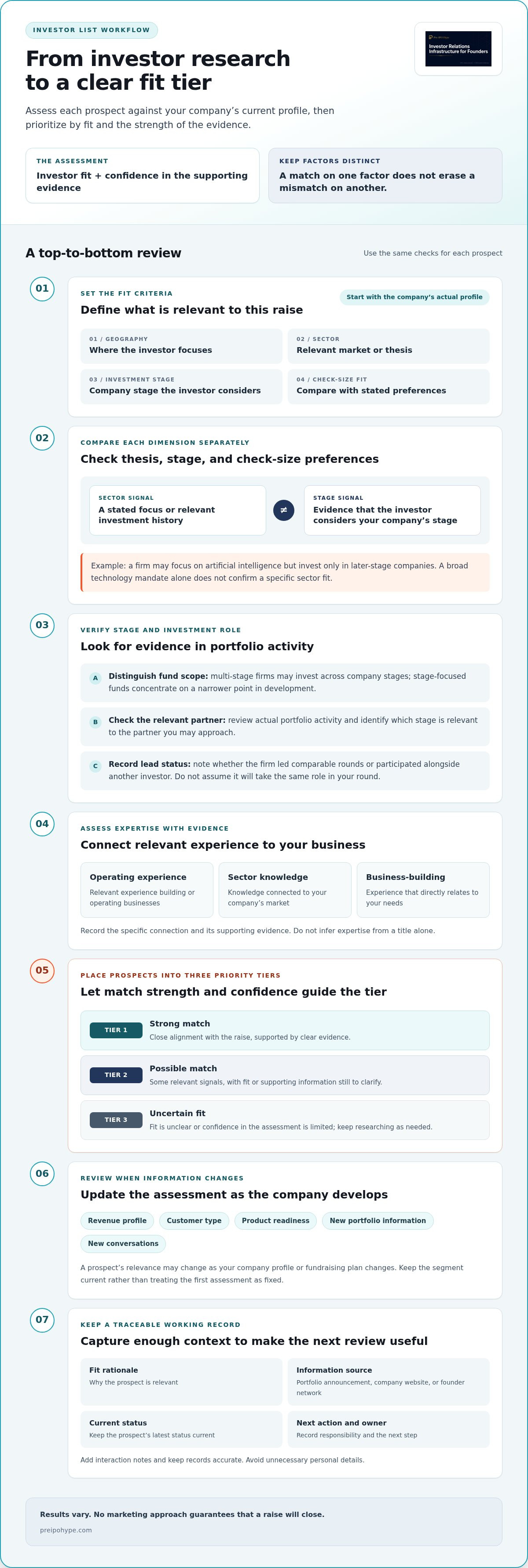
A long investor list can create activity without creating clarity. Knowing how to segment your investor list starts with assessing each prospect’s fit by investment stage, sector, check-size capacity, and relevant expertise. Then group prospects into three priority tiers based on how closely they match your raise and how confident you are in that assessment.
It’s easy to focus on the number of names in a CRM, but a list is more useful when it helps you decide whom to contact, what context to share, and when to follow up. This guide explains how to assess investor fit, distinguish strong prospects from uncertain ones, and keep fundraising work organized as new information comes in.
You’ll learn how to build a focused longlist, assess prospects consistently, and record engagement so your outreach reflects each investor’s priorities. The goal is a clear working process, not a promise of fundraising outcomes. Results vary, and no marketing approach guarantees that a raise will close.
Key Takeaways
- Start with a focused prospect list, then record the details that help you judge each investor’s relevance to your company and raise.
- Compare stage, check-size fit, sector focus, and expertise before prioritizing a prospect for outreach.
- Use three tiers to distinguish strong matches from prospects whose fit or readiness is less certain.
- Track engagement and fundraising milestones in your CRM so follow-ups reflect each prospect’s latest status.
- Review and update your segments as investor activity and your fundraising priorities change.
Using a lead list to support fundraising and CRM workflows
Start researching before fundraising so your target list can develop alongside the company’s plans. In your CRM, track each prospect’s contact details, reasons for fit, information sources, outreach history, current status, and next action. Keep records current and avoid unnecessary personal details.
- Build the initial list using relevant public information and existing business relationships. Look for firms that have funded companies with comparable products, customers, or markets, and record the source for each prospect. Note whether a name came from a portfolio announcement, a company website, or a founder’s network. This makes research easier to revisit and helps distinguish evidence from assumptions or unverified referrals.
Start this work well before outreach. As your product, revenue profile, or fundraising plan changes, update the list rather than treating the first version as fixed. A prospect who seems relevant at one stage may need a different assessment as the company develops. Record the reason for including each name so another team member can understand its relevance.
-
Size the List to the Fundraising Target
Set the list’s scope according to your fundraising target, then assess whether the prospects could collectively support the plan. A large number of names does not mean the target is covered. Review whether each prospect is relevant, active, and appropriate for the issuer’s raise. Remove duplicates and contacts with no clear connection, and keep a research queue for prospects whose fit still needs investigation.
Use the target as a planning reference, not a prediction of investment. Include enough qualified prospects to support a considered outreach process, while keeping the list manageable to research and maintain. Reassess its scope if the fundraising plan or company profile changes.
-
Turn the List into a Fundraising Pipeline
Give every prospect a current pipeline status, such as research, introduction requested, contacted, meeting scheduled, diligence, passed, or follow-up due. Add the date and a short note after each interaction. Assign an owner and a specific next action so every active record has clear responsibility. Keep closed or unsuitable prospects separate from those awaiting a response.
Review the pipeline as a team and use actual engagement to determine the next step. If an investor asks for information, record what they requested and who will respond. If they pass, capture the reason if they provide one, then update the status. This creates a useful history rather than a static directory.
- Choose CRM fields that suit the fundraising stage and the issuer’s workflow. For a Regulation CF or Regulation A+ raise, distinguish internal research and outreach records from investor actions on the issuer’s offering page or through its registered intermediary. Focus records on what the team needs to coordinate, such as source, owner, status, last interaction, and next action.
Limit access to people who need the information, keep records accurate, and remove details without a clear purpose. These practices help the team use the list as a working pipeline and keep issuer communications organized.
Defining investor fit by stage, check size, sector, and expertise
Assess each investor against your company’s current profile and fundraising needs. Separate clear matches from possible matches that still need supporting evidence.
-
Set Investor Fit Criteria
Define the attributes that matter for your raise: geography, sector, investment stage, and check-size range. Compare each prospect’s stated focus with your company’s actual stage and market. For example, a U.S. climate company can distinguish investors focused on climate businesses from those with broader or unrelated interests. Don’t treat a general technology mandate as proof of a specific sector fit.
-
Segment by Thesis, Stage, and Check Size
Group prospects by investment thesis, then compare their stage and check-size preferences. A firm may focus on artificial intelligence but invest only in later-stage companies. Review its public investment history and stated strategy to see whether the fit is supported. Assess sector, stage, and check size separately, so a match on one factor doesn’t hide a mismatch on another.
- Distinguish multi-stage funds from stage-focused funds. A multi-stage firm may invest across company stages, while a stage-focused fund concentrates on a narrower point in development. Review actual portfolio activity and identify which stage is relevant to the partner you may approach. Don’t assume a broad firm mandate means every partner evaluates companies at every stage.
-
Qualify Investors by Stage and Lead Status
Record whether each prospect invests at your stage and whether they have led comparable rounds. Review announcements and portfolio information to identify which partner led a relevant deal. Distinguish firms that lead from those that participate alongside another investor. This helps you assess whether a prospect’s role suits your fundraising plan without assuming they will take that role in your round.
- Assess expertise as a separate part of fit. Note relevant operating experience, sector knowledge, or business-building experience that connects directly to your company. For a healthcare startup, a partner’s experience with healthcare businesses may be more relevant than a general technology background. Record the specific connection and supporting evidence instead of inferring expertise from a title alone.
Revisit your criteria when the company’s profile changes. Revenue, customer type, and product readiness can affect which investor thesis is relevant. Update your assessment when new portfolio information or a conversation changes your understanding, and preserve the reasoning behind each fit decision for future fundraising planning.
Tiering investors by fit and confidence
Assign each prospect a priority based on documented fit and the strength of your evidence. Tailor your outreach to what you know about each investor rather than treating every contact alike.
-
Assess Investor Fit and Confidence
Apply the same assessment criteria to every prospect, and record the evidence behind each decision. Consider stage, sector, investment activity, and relevant partner experience. A comparable portfolio investment may support a strong fit rating; a broad profile description may suggest only possible alignment. Keep confidence in the information separate from fit, so limited evidence isn’t mistaken for a poor match.
- Use clear tier labels, such as high priority, developing fit, and research needed. Place a prospect in the first group when multiple relevant signals are supported by public activity or direct conversation. Use the middle group when a key detail, such as current stage focus, remains unclear. Keep lower-confidence prospects in research until you have enough evidence to decide whether outreach makes sense.
Record the reason for each assignment in plain language. For example, “invested in comparable companies, partner’s current stage focus unclear” explains both the fit and the uncertainty. Update the tier after a meeting, a new portfolio announcement, or a change in the company’s fundraising needs. A warm introduction can improve relationship context, but it doesn’t establish investment fit.
-
Tailor Outreach to Investor Segments
Match the message to each tier’s strongest evidence and open questions. For a high-priority prospect, explain the specific connection between the investor’s thesis and your company. For a developing fit, address the unresolved point directly, such as whether the investor considers your stage. For a prospect needing more research, gather context before sending a detailed pitch.
- Choose the next step based on the relationship and the investor’s known preferences. If a founder has a mutual connection, provide that person with concise context for a relevant introduction. Without a shared contact, refer accurately to a public investment or stated focus. Avoid sending the same generic message to every venture investor, and don’t overstate the relationship or the investor’s interest.
After each response, update both the tier and the outreach record. A meeting may confirm alignment, reveal a mismatch, or leave important questions open. Capture what the investor actually said, what information they requested, and the agreed next step. This gives founders a consistent basis for future prioritization without treating a conversation as a commitment to invest.
Evaluating investor and firm fit
Before prioritizing a prospect, assess the firm’s investment activity and the individual partner’s role. Compare those findings with your company’s needs, sector, and fundraising stage.
- Review the firm’s recent investment activity through its portfolio, announcements, and public partner profiles. Record whether its investments align with your company’s sector and current stage. A firm’s broad thesis is only a starting point: portfolio companies and deal descriptions can show which themes it has actually backed. Note the source and date of each finding so you can update your assessment.
- Identify the partner whose experience best matches your business. Review investment announcements and firm biographies for evidence of relevant deals, operating expertise, or sector focus. A firm-level match may not translate to a partner-level fit. Record the specific connection, such as experience with a comparable business model, rather than assigning relevance based only on seniority or title.
- Assess whether the firm’s available capital appears aligned with its investment approach. Consider its stage focus, the types of rounds it participates in, and whether recent activity supports that focus. For a pre-seed or early-seed company, compare firms known for earlier-stage investments; for a late-seed or Series A raise, assess firms active at those stages. Treat these as screening criteria, not assumptions about an individual commitment.
- Determine whether the prospect could lead or is more likely to participate alongside another investor. A lead may shape the round and seek a greater role in governance, while other participants may follow the lead’s process. Review comparable deals to see which partner led them and whether the firm participated. This helps founders tailor an initial discussion without presuming a term sheet is forthcoming.
- Screen for conflicts and strategic fit before outreach. If a firm has backed a direct competitor, assess whether that relationship could prevent a conversation or raise concerns about confidential information. Also consider whether the investor could be a potential acquirer, since that relationship may affect the company’s future options. Record the concern and its evidence, then discuss legal or strategic decisions with qualified counsel.
- Tie the assessment to sources and company priorities. Capture the relevant partner, comparable investments, stage focus, lead history, and unresolved questions. This helps founders distinguish documented fit from a promising but untested connection, and revise priorities when new investment activity or a partner conversation changes the picture.
Pre-IPO Hype: Custom Investor CRM
Pre-IPO Hype provides investor relations infrastructure for Regulation CF and Regulation A+ raises. We are not a broker-dealer, funding portal, or investment adviser, and we do not offer, sell or recommend securities. This article is educational only and is not legal, tax or investment advice. Pre-IPO Hype fees are never tied to investment results. FWSC and Pre-IPO Hype are paid per form filled out and per meeting booked, with no commission, equity or share of the raise.
For issuers organizing segmented outreach and engagement records, Pre-IPO Hype provides campaign support alongside the issuer’s registered intermediary and qualified securities counsel. Our Custom Investor CRM supports lead scoring and attribution tracking. It can help founders separate prospect fit, confidence, and engagement status, keeping fundraising activity organized for the issuer.
Contact Pre-IPO Hype to discuss investor relations support for your Regulation CF or Regulation A+ raise.
Keep Your Fundraising Process Ready to Adapt
Fundraising priorities can change as your company develops and investor conversations progress. Knowing how to segment your investor list gives your team a framework for deciding what deserves attention next, while allowing you to update assumptions as new information emerges.
Make the next step clear internally: decide who maintains the segmentation criteria, how changes are recorded, and how the team will keep communications consistent. A shared process can help founders stay aligned as fundraising responsibilities shift. Keep investor communications accurate and appropriate to the issuer’s offering process.
With a thoughtful process in place, your team can approach each conversation with greater clarity and keep building on what it learns.
Frequently Asked Questions
What are the best criteria for segmenting an investor list?
The most useful criteria are those that inform your next outreach decision: investment thesis, company stage, check-size range, geography, decision-making role, and relationship context. To apply how to segment your investor list, separate verified information from assumptions. For example, mark sector focus as verified when portfolio activity supports it, but label inferred interest as unverified. Include a disqualification reason, such as a direct competitor conflict, to prevent unsuitable outreach.
How should you segment investors by investment stage, check size, and sector?
Create a separate field for each factor instead of combining them under one label. For example, a healthcare investor may focus on later-stage companies and write checks outside your target range. That prospect matches your sector but may not fit the raise. Use the combined view to prioritize, research further, or exclude the contact. Revisit these fields when the company’s stage, revenue profile, or fundraising plan changes.
How do you categorize investors by geography and location preferences?
Record an investor’s stated geographic focus separately from their office location. A fund based in one state may invest nationally, while another may emphasize businesses in particular regions. Support each tag with public portfolio examples or the firm’s published thesis. For individual investors, note a location preference only when it is relevant and documented. Geography alone doesn’t establish fit without alignment on stage and sector.
How can you segment investors by decision-making role and firm type?
Track both the organization and the person who can evaluate or advance a conversation. A venture firm partner may lead investment decisions, while an associate may conduct initial research or coordinate diligence. Other categories may include angel investors, corporate investment teams, or investment groups. Record the person’s role separately from the firm type. This helps founders direct communications appropriately without assuming every contact has authority to commit.
How do you prioritize investors based on fit and likelihood to invest?
Prioritize documented fit and actual engagement, not a prediction that someone will invest. When applying how to segment your investor list, keep confidence in your information separate from the investor’s interest. Record evidence such as relevant portfolio activity or substantive follow-up after a meeting. A strong fit with no engagement differs from an active conversation, and neither guarantees an investment decision.
How should you segment investors by relationship strength and outreach status?
Track relationship strength and outreach status in separate fields. Relationship strength can distinguish a direct founder connection from a referral or a researched contact with no prior interaction. Outreach status can show whether a message is planned, sent, answered, or closed after a pass. For example, a strong mutual connection may still be awaiting an introduction. This distinction helps teams choose an appropriate next step and avoid duplicate messages.
Disclaimer
Educational only. Not investment, tax, or legal advice. Pre-IPO Hype is investor relations infrastructure for Regulation CF and Regulation A+ raises. We are not a broker-dealer, funding portal, or investment adviser, and we do not offer or sell securities or make investment recommendations. Any securities offering is made only by the issuer, through its own offering documents and, where required, a registered intermediary.


