
How to Share Bad News with Investors and Keep Trust
Bad news doesn’t have to break investor trust; silence can. The answer to how to communicate bad news to investors is to share it promptly, state what happened, explain the context, and outline the next steps. Be clear about what you know and what remains uncertain.
It’s natural to worry that investors will lose confidence when results fall short. But a candid update gives them a clearer basis for understanding the situation and responding. Don’t soften the facts or wait until a setback becomes harder to address.
This article explains how to disclose setbacks early, give investors the reasoning behind difficult decisions, and present a practical plan without overstating what comes next. You’ll also learn how a steady update process can help build trust as conditions change. Results vary, and no marketing approach guarantees a successful raise.
Key Takeaways
- Set a regular investor-update cadence and agree on the metrics that give company performance context.
- Share material setbacks promptly with every investor, even when some details are still developing.
- Explain the decisions and assumptions behind a setback so investors can understand how it unfolded.
- State the impact plainly, identify what remains uncertain, and outline practical next steps.
- Prepare for difficult conversations by choosing a suitable format, rehearsing key points, and following up on commitments.
1. Building investor trust through communication
Investor trust grows through a pattern of clear updates, not one polished announcement. A reliable approach to how to communicate bad news to investors starts before a setback: agree on core success metrics, report them consistently, and explain changes against that baseline. If customer retention weakens while revenue holds steady, investors need both figures and the relationship between them.
Set a predictable cadence with primary backers. Weekly or every-other-week conversations can surface changing conditions before a formal board update. Use brief emails, phone calls, or video calls between quarterly board meetings. Keep the format consistent: current metrics, notable changes, decisions needed, and the next update date. A steady rhythm helps investors distinguish a developing trend from a single unusual result.
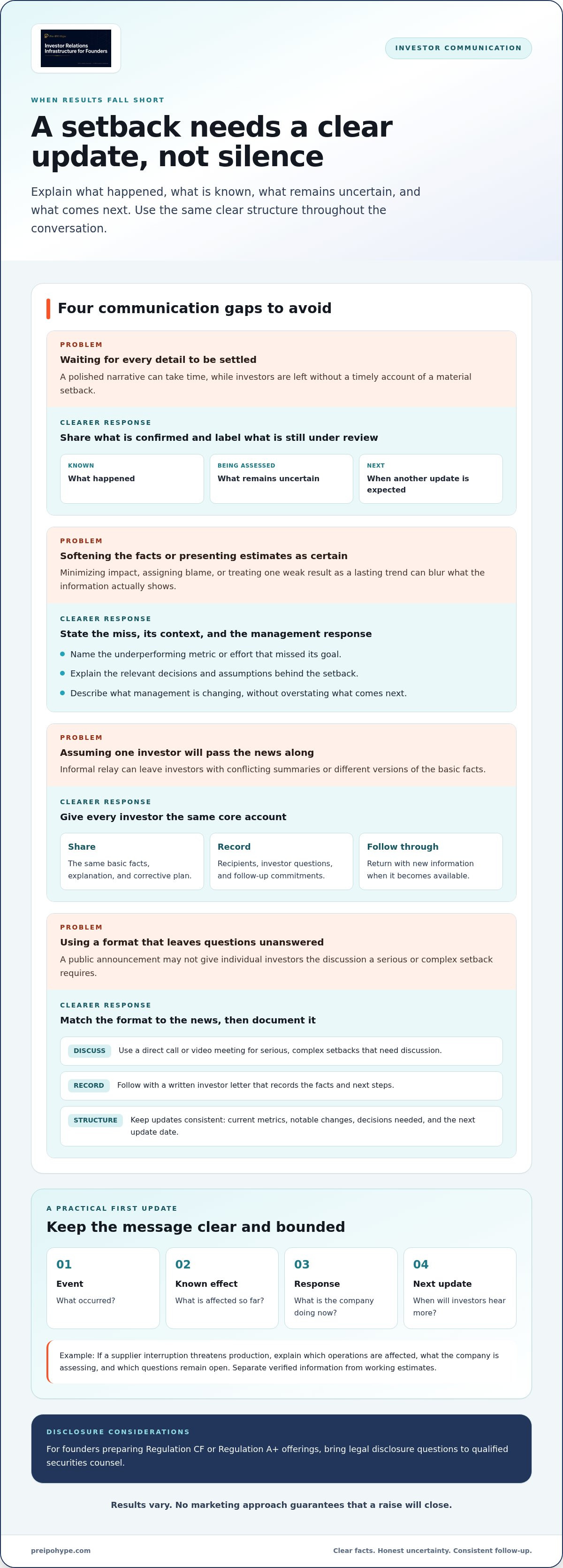
The best format depends on the news and audience. Use a direct call or video meeting for serious, complex setbacks that need discussion, then follow with a written investor letter recording the facts and next steps. A press release can communicate a public announcement, but may not answer individual investors’ questions. For public companies, a scheduled earnings call can provide prepared remarks and Q&A.
When investors ask questions, answer the point directly before adding explanation. If a forecast is uncertain, say which assumptions remain unresolved and when you expect to update it. For example, if a delayed launch affects sales timing, separate the known launch status from the uncertain revenue impact. Record unanswered questions and assign an owner and follow-up date.
Common mistakes include delaying an update, minimizing the impact, blaming a team without taking responsibility, and presenting estimates as facts. Instead, state the underperforming metric, identify the effort that missed its goal, and explain what management is changing. Don’t treat one weak result as a lasting trend unless other indicators support that conclusion.
Investors may respond with concern, frustration, or requests for detail because bad news affects how they view risk and company progress. Don’t dismiss their reaction or rush to defend every decision. Reduce uncertainty by separating confirmed facts, open questions, and planned actions. Then invite questions and explain how investors can send them after the meeting.
Credibility also depends on understanding the business beyond a dashboard. Track qualitative trends, such as recurring customer objections or repeated sales delays, alongside agreed performance metrics. Share material developments with the leadership team so executives can explain their perspectives during board discussions. If a backer has relevant expertise, ask for specific help and explain what input would be useful.
These habits make difficult conversations more useful: investors receive context, founders hear questions early, and both sides can focus on decisions. Allow investors time to react, then return to the agreed metrics and follow-up commitments. Consistency matters most when performance shifts, because the same reporting structure gives each update a clear point of comparison.
2. Disclosing crises and setbacks promptly
Tell investors about a material setback when its impact becomes clear, rather than waiting for a polished narrative. If a product launch misses its target, explain the miss and what the team knows so far. Delaying the update can limit investors’ ability to understand the situation and consider useful responses.
For public companies, the U.S. Securities and Exchange Commission requires an annual report, Form 10-K, and quarterly reports, Form 10-Q. Whether a specific negative development requires additional disclosure depends on the issuer’s circumstances and applicable rules. Founders preparing Regulation CF or Regulation A+ offerings should bring legal disclosure questions to qualified securities counsel.
Early communication doesn’t require pretending every detail is settled. Share confirmed facts, identify what remains under review, and say when investors can expect an update. For example, if a supplier interruption threatens production, state which operations are affected, what the company is doing to assess the impact, and which questions remain open. Separate verified information from working estimates.
When practical, contact investors before a public report or press coverage reaches them. An announcement late on a Friday can look like an attempt to bury bad news, while advance notice gives investors a clearer first account. If public communications are planned, coordinate timing and wording with qualified securities counsel. Don’t use an announcement to conceal details or create a misleading impression.
Send the update to every investor backing the company. Don’t assume a lead investor will brief the rest of the syndicate. Keep a record of recipients, questions, and follow-up commitments. If a product launch falls short, for instance, investors need the same basic facts, explanation, and corrective plan, not conflicting summaries passed along informally.
Should companies provide updated financial guidance after reporting bad news? Provide a revised outlook when management has a reasonable basis for it. Use conservative assumptions, explain the factors affecting the outlook, and avoid setting a timeline that leaves no room for delays. If the available facts don’t support a reliable estimate, explain what is being assessed and what could change the forecast.
Act promptly without confusing speed with completeness. A useful first update can state the event, its known effect, the immediate response, and when investors can expect more information. Then follow through on that commitment. If new facts change the assessment, explain what changed and why. This gives investors a timely account while distinguishing established facts from evolving analysis.
One founder disclosed that a product launch had fallen short of expectations, explained what went wrong, and presented an actionable plan to address it. Sharing bad news proactively can demonstrate good faith and preserve credibility with board members; delay can make problems harder to fix. Meghan Reynolds of Altimeter Capital has told fund managers that the number one rule of investor relations is "no surprises," meaning investors should hear major news from the company before the press reports it. The same habit applies to founders. Reach out before press coverage appears, even when full details are unknown. A sharp quarterly revenue drop merits communication; negative information should not be hidden in a Friday press release.
3. Explaining context and reasoning before stating negative information
Executives can explain poor results without weakening trust by separating the decision, its assumptions, and the outcome. For example, describe the market signal that supported a planned expansion, what the company expected, and how actual performance differed. Then state what management has learned and which decisions are changing. This gives investors a factual account rather than an excuse.
Use a past-present-future sequence to make the explanation easy to follow. Start with what the team knew when it made the decision. Next, state what happened and how the result compares with the relevant target. Close with the current response, the next decision point, and the information that will guide it. Keep the context brief, so it clarifies the news instead of hiding it.
For a missed earnings target, an investor announcement should identify the target, the actual result, and the factors behind the gap. Explain which efforts underperformed, what management expected, and how the shortfall affects operations or plans. Then describe corrective actions and remaining uncertainties. Have qualified securities counsel review communications involving legal disclosure decisions.
Explain the reasoning behind a decision, not just its outcome. If a company expanded into a new market based on customer demand, explain what evidence shaped that choice and what later evidence changed the assessment.
Keep evidence separate from interpretation. For example, state that customer renewals fell below the company’s target, then explain the observed reasons and management’s current assessment. Don’t claim that one factor caused the decline unless the evidence supports that conclusion. If the cause is still being examined, identify the open question and explain how it affects the current plan.
Investors need enough context to judge both the setback and the response. Explain the impact on key business priorities, which assumptions have changed, and what management will monitor next. A revised plan should connect each action to the problem it addresses. If a new sales process is intended to improve renewals, specify what change is being tested and how progress will be assessed.
A clear approach to how to communicate bad news to investors combines explanation with candor. Don’t soften the negative result or bury it in background. Give the essential context, state the result plainly, and describe the response. This helps investors understand the decision path, where management accepts responsibility, and what evidence will shape its next steps.
4. How should companies prepare to communicate bad news to investors?
Prepare before a setback becomes a crisis by assigning owners for key metrics, investor updates, and follow-up questions. For example, the finance lead can verify performance figures while the founder explains the operational impact. This division reduces conflicting accounts and gives each speaker a defined role.
Build a short scenario plan around risks the company already tracks, such as delayed launches, missed sales goals, or rising customer cancellations. For each scenario, note the facts investors would need, who is responsible for confirming them, and the decisions leadership may face. Review the plan as business conditions change.
Before sending an update, compare the reported result with the target and explain the gap. If sales missed plan, identify which channel or customer segment contributed, what evidence supports that analysis, and what remains uncertain. Don’t present an early estimate as a final figure. Clearly label working assumptions in internal drafts.
Choose the communication format based on seriousness, complexity, and your relationship with investors. A difficult, nuanced issue may call for a direct conversation followed by a written summary. A concise operational update may work well as an investor letter. Rehearse the main points with a co-founder and ask them to flag unclear language or unsupported claims.
Prepare for questions, not just prepared remarks. List likely concerns about business impact, management accountability, and corrective actions. Assign a speaker to each topic, and agree on how to respond when an answer is still being developed. A clear response might explain the investigation underway and the evidence leadership is assessing.
Keep the response plan specific. Name the corrective action, the team responsible, and the indicator that will show whether the action is working. If a product issue is driving customer complaints, for example, explain the fix being tested and how the team will assess customer feedback. Avoid timelines that leave no room for delays.
Use conservative guidance when leadership has a sound basis for an outlook. Explain its assumptions, including dependencies such as supplier delivery or customer adoption. If those assumptions change, update the outlook and explain why. Don’t use an optimistic forecast to distract from weak performance or imply certainty the company doesn’t have.
Agree on a follow-up process before the announcement. Record investor questions, assign an owner to each response, and track commitments until they’re addressed. If you promise a later update, schedule its preparation and approval. Consistent follow-through makes the response measurable and keeps unanswered concerns from disappearing after the initial conversation.
For founders preparing a Regulation CF or Regulation A+ raise, include qualified securities counsel in decisions about legal disclosures. Keep factual investor updates distinct from campaign messaging, and make sure the issuer’s communications remain consistent.
Pre-IPO Hype: Custom Investor CRM
Pre-IPO Hype provides investor relations infrastructure for Regulation CF and Regulation A+ raises.
Pre-IPO Hype is not a broker-dealer, funding portal, or investment adviser, and does not offer, sell or recommend securities. This article is educational only and is not legal, tax or investment advice. Pre-IPO Hype fees are never tied to investment results. FWSC and Pre-IPO Hype are paid per form filled out and per meeting booked, with no commission, equity or share of the raise.
For founders preparing a raise, Pre-IPO Hype provides campaign support alongside the issuer's registered intermediary and qualified securities counsel. Investor relations and marketing campaigns are carried out for the issuer, and can support a consistent process for investor updates. Our Custom Investor CRM supports lead scoring and attribution tracking.
This support can help a company organizing communications for a raise manage campaign activity through a structured process. Legal decisions about disclosures and investor communications belong with qualified securities counsel.
Contact Pre-IPO Hype to discuss campaign support for your issuer.
Make candid communication part of your next stage
Knowing how to communicate bad news to investors is not just a response to a setback. It’s a leadership practice that can shape how a company makes decisions, records assumptions, and stays accountable as conditions change. Build that practice into board preparation and investor relations planning, rather than waiting for a difficult announcement to expose gaps.
For a Regulation CF or Regulation A+ raise, keep investor communications aligned with the issuer’s offering materials and review disclosure questions with qualified securities counsel. Marketing support can help organize campaign communications for the issuer, but it doesn’t replace legal review or management’s responsibility for accurate updates.
Use the next investor update to set a clear standard: precise facts, accountable explanations, and follow-through on open questions. That consistency gives the company a practical foundation for future conversations, including the ones no founder wants to have.
Steady, candid communication helps build a company investors can understand through change.
Frequently Asked Questions
How should companies communicate layoffs, a product failure, or a major lawsuit to investors?
Explain what happened, the operational impact, and the response, tailoring the details to the event. For layoffs, describe which business priorities or capabilities are affected and how the remaining work will be managed. For a product failure, clarify customer impact and the steps underway to assess or correct it. For a major lawsuit, coordinate investor communications with qualified securities counsel, avoid speculation about the outcome, and distinguish established facts from ongoing proceedings.
What SEC rules govern disclosure of material negative information to investors?
The SEC requires public companies to file annual Form 10-K reports and quarterly Form 10-Q reports. Whether a specific negative development requires additional disclosure depends on the issuer’s circumstances and applicable rules.
Disclaimer
Educational only. Not investment, tax, or legal advice. Pre-IPO Hype is investor relations infrastructure for Regulation CF and Regulation A+ raises. We are not a broker-dealer, funding portal, or investment adviser, and we do not offer or sell securities or make investment recommendations. Any securities offering is made only by the issuer, through its own offering documents and, where required, a registered intermediary.

