
How to Start and Manage a Successful Investment Club
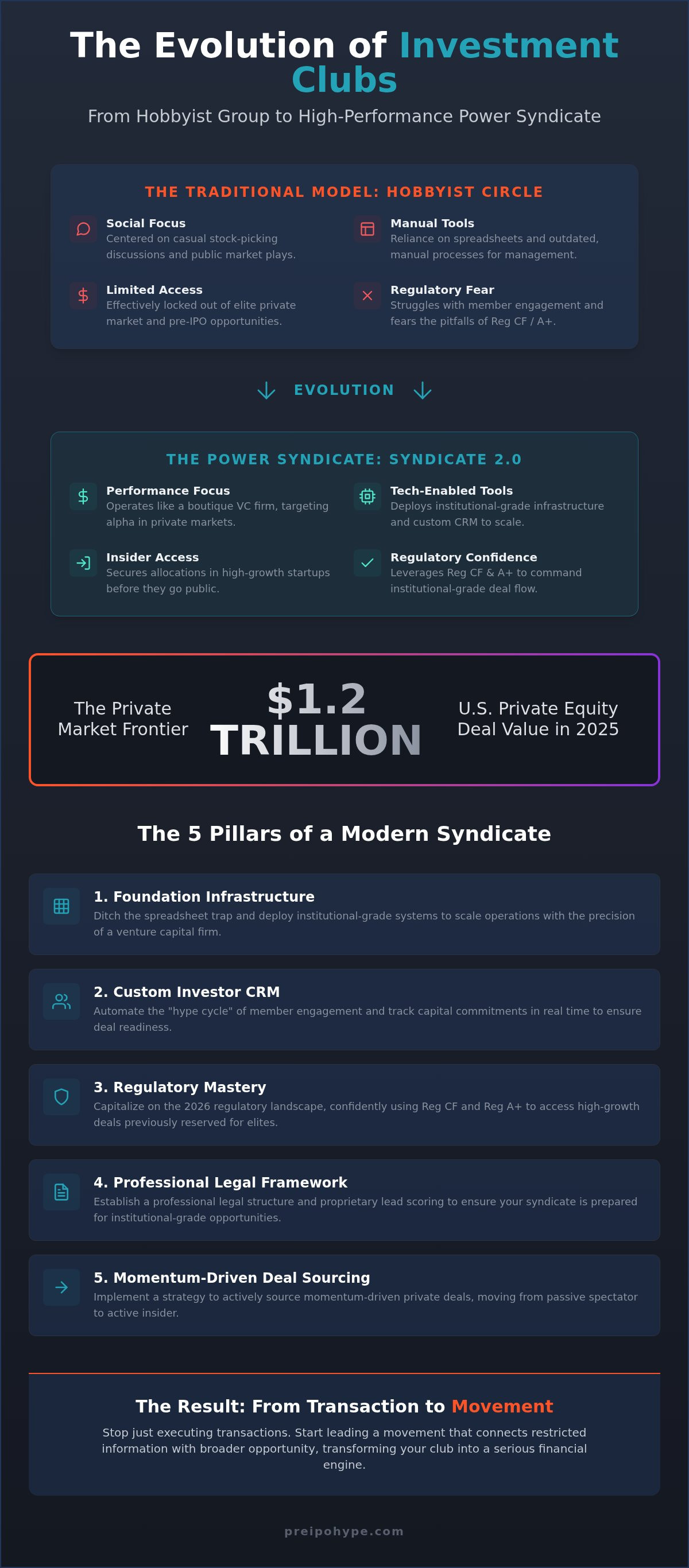
The traditional model of social stock-picking groups is dead. Why settle for a hobbyist circle when you could be leading a high-performance private market syndicate? Most ambitious investors realize that the real wealth creation is happening behind the gated walls of private equity, which saw deal values hit $1.2 trillion in 2025. You likely feel the frustration of being locked out of these elite opportunities while struggling to manage member engagement and capital commitments through outdated, manual processes. It's a common pain point for leaders of investment clubs who fear the regulatory pitfalls of Reg CF and Reg A+ environments.
We're here to bridge that gap. This article provides the blueprint to evolve your casual group into a professional-grade investment vehicle using institutional-grade infrastructure. You'll discover how to source momentum-driven deals and automate the hype cycle of investor acquisition. We will walk through the essential steps of building a custom foundation, from leveraging advanced CRM systems to navigating the 2026 regulatory landscape with confidence. It's time to stop executing transactions and start leading a movement that connects restricted information with broader opportunity.
Key Takeaways
- Evolve from a social stock-picking group into a tech-enabled syndicate that commands institutional respect in the private markets.
- Capitalize on the 2026 regulatory landscape by using Reg CF and Reg A+ to access high-growth deals previously reserved for the elite.
- Ditch the spreadsheet trap and deploy Foundation Infrastructure to scale investment clubs with the precision of a venture capital firm.
- Implement a Custom Investor CRM to automate the hype cycle of member engagement and track capital commitments in real time.
- Establish a professional legal framework and proprietary lead scoring to ensure your syndicate is ready for institutional-grade deal flow.
The Evolution of Investment Clubs: From Social Circles to Power Syndicates
The era of the casual stock-picking group is officially behind us. While the History of investment clubs shows a legacy of social bonding and educational public market plays, the 2026 landscape demands something far more aggressive. Today, investment clubs have evolved into high-performance power syndicates. These are tech-enabled vehicles designed for pooled capital and shared due diligence, operating with the precision of a boutique venture firm. This shift represents a move from passive observation to active participation in the wealth-building events that define our era.
A fundamental change in investor psychology has occurred. Ambitious individuals are no longer satisfied with the standard returns of a diversified index fund. They want a piece of the $1.2 trillion private equity market. The primary difference between a hobbyist club and a professional syndicate lies in access and infrastructure. One discusses what they read in the news; the other uses institutional-grade tools to secure allocations in companies before they ever hit the public market. It's the difference between being a spectator and being an insider.
Defining the 2026 Investment Club Landscape
Retail interest in private equity is at an all-time high because the democratization of Pre-IPO access is no longer just a theory. Digital platforms have torn down the walls that once protected elite deals. Syndicate 2.0 is a tech-first investment group designed to capture alpha in the private markets before the public ever sees a ticker symbol. In 2026, agile syndicates are outmaneuvering traditional institutional funds. They don't have the heavy management fees or the slow-moving committees that plague large-scale private equity firms. This agility allows them to pivot toward momentum-driven sectors with speed that institutional giants simply can't match.
The Rise of the Self-Directed Syndicate
Individual investors are tired of paying traditional brokers for access to mediocre products. They are forming direct-access groups to leverage collective intelligence. By pooling resources, these self-directed syndicates can vet high-growth startups with a level of scrutiny that rivals professional analysts. This isn't just about money; it's about the movement toward restricted information and rare opportunities. Learn more about our exclusive investment club model to see how we facilitate this transition. Modern investment clubs are the new gatekeepers of wealth creation, turning what was once a social hobby into a serious financial engine.
Why Private Markets are the New Frontier for Investment Clubs
Why are the most sophisticated investment clubs abandoning the S&P 500 for private equity? It's a question of alpha. Public markets offer liquidity and lower volatility, but they are also hyper-efficient. By the time a company reaches the public stage, the most explosive growth has usually already occurred. In contrast, U.S. private equity deal value reached a staggering $1.2 trillion in 2025. This massive pool of capital is where the 'Hype Cycle' lives. It's the unique period of rapid valuation growth that happens before the IPO window opens, and it's where modern syndicates find their edge.
The psychology of 'insider' access is a powerful driver for these groups. It's not about illegal information; it's about the rare opportunity to participate in early-stage raises that were once restricted to venture capital firms. Clubs serve as the perfect entry point for investors who want to move beyond passive stock-picking and into active deal sourcing. They provide the collective capital and due diligence power necessary to secure allocations in high-growth private deals.
Accessing Early-Stage Momentum
Identifying future 'unicorns' requires more than just a gut feeling. It demands data-driven marketing signals and an understanding of market sentiment. Startups raising capital under Reg CF are increasingly looking for investment clubs as preferred partners. These companies don't just want a check; they want a community of engaged backers who can amplify their brand. To master this, you need a strategy that mirrors institutional players. You can find more detail on this in our guide to Digital Marketing and Advertising: The Insider Playbook.
The Regulatory Framework for 2026 Syndicates
Navigating the Securities Act of 1933 is essential for any group scaling its capital base in a digital-first world. To remain exempt from registering as an investment company, a club must generally have no more than 100 members and avoid public offerings of its own securities. As of August 2026, compliance also requires a keen eye on member status. While Reg CF allows for non-accredited participation, maintaining a high ratio of accredited investors is often necessary for larger private equity access. The SEC recently raised 'qualified client' thresholds to a net worth of $2.7 million, making it vital to track your member profiles accurately. If you're unsure how these rules apply to your specific goals, consider scheduling a strategy session to review your compliance roadmap.
The Infrastructure Gap: Why Most Investment Clubs Hit a Ceiling
Most investment clubs start with a vision of elite deals but end up drowning in administrative friction. It's called the 'Spreadsheet Trap,' and it's where syndicate momentum goes to die. If you're managing million-dollar capital calls with manual Excel entries, you've already hit your ceiling. Institutional authority isn't just about the quality of the startups you source; it's about the professional data management you bring to the table. Investors in 2026 expect a frictionless experience that mirrors the speed of the high-growth markets they are entering.
To scale a syndicate effectively, you need to know which members are ready to commit capital before you even send the pitch deck. This is where proprietary lead scoring becomes a competitive advantage. By assigning values to member interactions, you turn a passive list into a prioritized strike team. This precision is paired with 60-day attribution tracking, allowing you to understand exactly which touchpoints-from a specific newsletter to a direct follow-up call-actually drove the capital commitment. This level of transparency builds the trust necessary for larger, more complex raises.
Beyond the Spreadsheet: The Custom Investor CRM
Generic CRMs are built for selling software, not for managing the lifecycle of a private market investor. A Custom Investor CRM is designed to handle the nuances of omnichannel outreach. Whether you're communicating through direct mail, newsletters, or digital advertising, every interaction must be logged and analyzed. This ensures your club remains top-of-mind during the critical 'Hype Cycle' of a raise. If you want to see the tools that facilitate this level of engagement, explore our fundraising tech stack for syndicates.
Foundation Infrastructure: The Technical Bedrock
Scaling a professional investment vehicle requires more than just a vision; it requires technical 'pipes' that ensure seamless capital flow. Foundation Infrastructure serves as the bedrock for your syndicate, automating the engagement tracking that identifies your most active members. Instead of manually chasing commitments, the system flags momentum for you. This automation allows you to focus on what matters: sourcing the next unicorn and building the movement. For a deeper look at the setup, read our guide on Foundation Infrastructure: The Technical Bedrock of Elite Capital Raises. Professionalizing your backend is the only way to move from a social circle to a power syndicate that commands respect in the private markets.
Structuring Your Club for Institutional-Grade Deal Flow
A catchy name and a monthly meeting schedule don't make a syndicate. If you want to play in the big leagues of private equity, you need a structure that mirrors institutional standards. Professionalizing investment clubs starts with a five-step blueprint designed for scale. This isn't about social bonding; it's about building a machine that can deploy capital with surgical precision.
First, establish the right legal vehicle. Most high-performance syndicates favor an LLC or a limited partnership to facilitate private equity access. This isn't just for liability; it's about creating a clear framework for capital calls and voting. Second, you must implement a Custom Investor CRM. As discussed, spreadsheets are the enemy of momentum. You need a system that manages the entire member lifecycle from initial interest to final exit. Third, stop waiting for deals to find you. Use omnichannel outreach and data-driven marketing to source high-quality startups. Fourth, execute the 'Hype Cycle' internally. This means building consensus and excitement around a new investment through targeted, automated communication. Finally, manage post-investment relations with automated reporting systems. Your members shouldn't have to ask for updates; the data should be delivered to them with institutional precision.
Legal Bedrocks and Partnership Agreements
Your operating agreement is the most important document you'll ever sign. It defines the rules of engagement. Who has the final say on a deal? How are capital calls handled when a 48-hour window opens? You must define voting rights and capital procedures with absolute clarity to avoid paralysis during high-stakes raises. It's the difference between a group that talks about deals and a group that closes them. For those looking to refine their member profiles and targeting, you can access our investor data resources to better understand the landscape.
Omnichannel Outreach for Deal Sourcing
Elite syndicates don't just wait for pitch decks; they actively attract them. By using digital marketing and advertising, you position your club as a value-add partner for startups. Newsletter exposure also plays a critical role in building your club's brand authority. When startups see your syndicate as a source of both capital and market momentum, you get the first look at the best deals. This active sourcing strategy ensures you aren't just picking from the leftovers of larger VC firms. If you're ready to stop playing small and start leading, schedule a strategy session to build your syndicate infrastructure and secure your place in the next major market realization event.
Scaling Your Syndicate: The Pre-IPO Hype Advantage
Scaling investment clubs into institutional-grade syndicates requires more than just good deals; it requires a specialized engine. Pre-IPO Hype provides that engine. We've facilitated over $100 million in funding since 2015, giving us the unique data set needed to understand exactly what moves the needle for private market investors. By leveraging a Custom Investor CRM, leaders can move beyond social coordination and into high-velocity capital deployment. This is how you transition from a local group to an elite syndicate that commands respect from founders and institutional peers alike.
The Invst Guru newsletter serves as a critical catalyst for this transition. It's not just a communication channel; it's a vetting mechanism that provides exposure to high-growth opportunities while building your syndicate's brand authority. In a crowded private market, elite fundraising tech is the primary differentiator. It provides the "internal access" that makes participation feel like joining a movement rather than just executing a transaction. When you have the infrastructure to track engagement and score leads, you aren't just guessing; you're operating with the precision of a seasoned venture capitalist.
Mastering the Investor Hype Cycle
Engineering momentum is a science, not a stroke of luck. To ensure every capital call is oversubscribed, you must master the 'Hype Cycle' of investor acquisition. This involves using proprietary lead scoring to identify which syndicate members are high-intent and ready to act decisively. Instead of blasting your entire list with every update, you focus your energy on the momentum-driven core of your membership. This targeted approach creates a sense of exclusivity and urgency that drives faster commitments. Learn more about The Custom Investor CRM: Engineering Momentum for Elite Capital Raises.
Your Fundraising Roadmap for 2026
Success in the private markets is the result of a 12-month strategy for deal flow and member acquisition. As you scale investment clubs toward larger allocations, the complexity of SEC regulations increases. This is where consulting and advisory services become indispensable. Navigating the nuances of Reg CF and Reg A+ requires an informed insider who can keep your vehicle compliant while you focus on sourcing the next unicorn. The goal is to move your syndicate toward future realization events with a steady, predictable pulse of opportunity.
Don't let your syndicate plateau as a social experiment. It's time to act decisively and secure your place in the gated financial world. Book your 30-minute syndicate strategy call with Jeff 'Fuzzy' Wenzel to build your institutional roadmap and start leading the movement today.
Secure Your Seat in the Gated Financial World
The window for casual participation is closing. To lead a high-performance syndicate in 2026, you must move beyond the social hobbyist model and adopt an institutional mindset. We've explored how the right legal structure and Foundation Infrastructure turn small investment clubs into power syndicates that command respect in the private markets. By leveraging our proprietary Custom Investor CRM technology and our deep expertise in Reg CF and Reg A+ compliance, you can automate the hype cycle and ensure every capital call is a realization event.
We've facilitated over $100 million in funding since 2015, providing the blueprint for those who act decisively. Don't let manual tracking or regulatory fear keep you on the sidelines of the $1.2 trillion private equity market. It's time to professionalize your outreach and secure the rare opportunities that define generational wealth. The future belongs to those who build the infrastructure to capture it.
Take the first step toward institutional scale today. Book a 30-Minute Syndicate Strategy Session to review your roadmap and start leading the movement. We're ready to help you unlock the keys to this gated world.
Frequently Asked Questions
What is the primary difference between an investment club and a syndicate?
A traditional investment club is typically a social group focused on education and public stocks, whereas a syndicate is a professional-grade vehicle designed for specific private market allocations. Syndicates utilize institutional infrastructure to pool capital for high-growth deals. While investment clubs often focus on collective learning, syndicates operate with the precision of a venture fund, prioritizing speed and deal access over social bonding.
Do investment clubs need to register with the SEC in 2026?
Most investment clubs are exempt from SEC registration as an investment company if they have no more than 100 members and don't make a public offering of their securities. As of August 2026, you must also keep assets under management below $25 million to avoid additional registration requirements with the SEC and FINRA. It's critical to monitor these thresholds carefully as your capital base scales toward institutional levels.
How much capital do you typically need to start a private market investment club?
Starting a private market group doesn't require millions, but you need enough to meet the minimum allocations for elite deals. Many startups raising under Reg CF or Reg A+ have minimums ranging from $10,000 to $50,000. To build a diversified portfolio, a club should aim for a collective capital pool that allows for multiple $25,000 allocations across different sectors during the annual hype cycle.
Can an investment club invest in Reg CF and Reg A+ offerings?
Yes, investment clubs are perfectly positioned to participate in Reg CF and Reg A+ offerings. These regulations were designed to democratize access to private markets, allowing non-institutional groups to fund high-growth companies. By pooling resources, a club can secure a more significant stake in a startup than individual members could alone, making them preferred partners for founders looking for a community of backers.
What is the best way to track member contributions and engagement?
The most effective way to manage a professional syndicate is through a Custom Investor CRM and Foundation Infrastructure. Manual spreadsheets lead to errors and kill momentum during a raise. Automated systems allow you to track real-time capital commitments, monitor member engagement, and use lead scoring to identify which investors are ready to act. This technical bedrock ensures your operations remain frictionless as your deal flow increases.
Are investment club membership interests considered securities?
Membership interests in an investment club are generally considered securities under federal law. This means the club must comply with the Securities Act of 1933, typically by operating under an exemption like Regulation D. You must ensure that the "sale" of these interests to members doesn't involve a public offering, which is why maintaining a private, closed membership structure is essential for compliance.
How does a Custom Investor CRM help a syndicate scale?
A Custom Investor CRM scales a syndicate by automating the "Hype Cycle" of investor acquisition. Instead of manually chasing every member, the system uses 60-day attribution tracking and lead scoring to prioritize high-intent investors. This allows the leader to focus on sourcing elite deals while the technology handles omnichannel outreach and engagement tracking, facilitating the transition from a social group to a high-volume fund.
What are the tax implications of an investment club structured as an LLC?
Most clubs structured as LLCs benefit from pass-through taxation, meaning the entity itself doesn't pay federal income tax. Profits and losses flow through to individual members. Under the tax laws effective in 2026, members should be aware of the $40,400 SALT deduction cap and the increased standard deductions of $16,100 for individuals. These rules make the LLC a highly efficient vehicle for private equity participation.
Disclaimer
Educational only. Not investment, tax, or legal advice. Pre-IPO Hype is investor relations infrastructure for Regulation CF and Regulation A+ raises. We are not a broker-dealer, funding portal, or investment adviser, and we do not offer or sell securities or make investment recommendations. Any securities offering is made only by the issuer, through its own offering documents and, where required, a registered intermediary.


