
How to Test Investor Demand: The Insider’s Playbook for Pre-Raise Validation
Investor demand is not a sentiment to be felt during a pitch; it is a data set of intent that must be engineered through controlled digital friction. While global venture funding reached a record $510 billion in the first half of 2026, over half of that capital was concentrated in just 16 massive deals. For everyone else, the margin for error has vanished. Most founders launch a raise with a pitch deck and a prayer, terrified of a public failure or a marketing budget wasted on cold audiences who have no intention of signing a check.
It's a common fear, but you don't have to fly blind. We're going to show you how to test investor demand using the data-driven frameworks that elite founders use to de-risk their capital raises before they ever go live. You'll learn to leverage the "testing the waters" pathways allowed under SEC Rule 163B to gauge interest from institutional players without the typical regulatory exposure.
This guide provides the blueprint for building a predictable cost-per-acquisition model and a validated list of high-intent investors. We'll walk through the infrastructure needed to turn restricted information into a momentum-building movement, giving you the confidence to launch a campaign that's already destined to succeed.
Key Takeaways
- Leverage SEC "Test the Waters" provisions to legally validate market appetite before you commit to the costs of a formal offering.
- Master the data-driven frameworks for how to test investor demand using high-intent digital assets and specific narrative structures.
- Move beyond vanity metrics by using the "Intent Ratio" to accurately distinguish between casual curiosity and actionable capital.
- Learn to introduce strategic friction to filter out soft demand, ensuring your list consists of investors ready to deploy funds.
- Transition seamlessly from validation to a live raise by preparing the technical infrastructure needed for a massive day-one surge.
What is Investor Demand Testing in Private Markets?
Investor demand testing is the strategic process of soliciting non-binding interest from potential backers before you formally file or launch an offering. It's the bridge between a visionary pitch and a closed round. In an era where global venture funding hit a staggering $510 billion in the first half of 2026, the competition for capital is relentless. You can't rely on gut feelings or a "good" deck anymore. Learning how to test investor demand ensures that your launch is fueled by hard data rather than optimistic projections.
Historically, gauging interest was a private affair reserved for elite institutional circles. Today, the landscape has shifted toward digital-first validation. The SEC provides a specific regulatory pathway known as Testing the waters (TTW), which allows issuers to communicate with potential investors under Regulation CF and Reg A+ before a formal offering is live. This isn't just about collecting emails. It's about measuring intent.
To better understand the psychology of market interest and value, watch this helpful video:
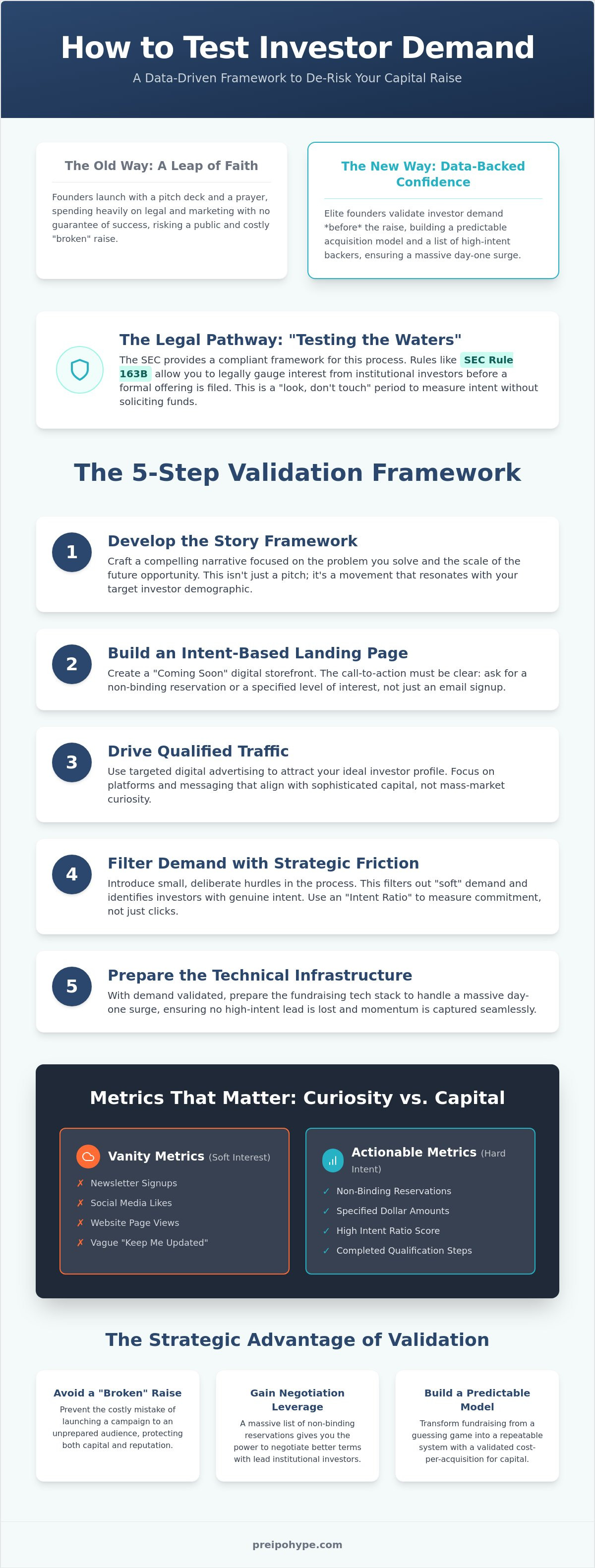
The core of this process is distinguishing between soft interest and hard intent. A newsletter signup is a vanity metric; it's soft interest. Hard intent is a non-binding reservation where an investor specifies a dollar amount they intend to commit. This data-driven approach moves the fundraising process from a guessing game into a predictable acquisition model. By introducing slight friction during this phase, you filter out the curious and identify the capital.
The Legal Framework of TTW
Compliance is the foundation of any elite raise. Under SEC Rule 163B, companies can gauge market interest from Qualified Institutional Buyers (QIBs) and institutional accredited investors. For retail-facing raises under Reg CF, specific rules apply. You can't accept money during this phase. Every communication must include mandatory disclaimers stating that no offer to buy securities is being made and no money is being solicited. It's a "look but don't touch" period that protects both the founder and the future cap table.
Why Founders Cannot Afford to Skip Validation
The most expensive mistake in private markets is a "broken" raise. This happens when a company launches a full-scale campaign, spends heavily on legal and marketing, but fails to hit its minimum target because the audience wasn't primed. Validation data informs your final valuation. If demand signals are weak, you adjust your terms before they're set in stone. Conversely, a massive reservation list gives you the leverage to negotiate better terms with lead institutional investors. You aren't asking for money; you're inviting them to join a movement that's already validated. To manage this influx of day-one interest, many founders deploy a robust fundraising tech stack to ensure no lead is lost in the noise.
The 5-Step Framework to Test Investor Demand
Speed is a currency in venture capital. To win, you need a repeatable system that moves beyond guesswork. Elite founders don't wait for a launch date to see if their message works. They use a structured methodology to validate interest early. Understanding how to test investor demand requires shifting your focus from selling to measuring. This transition is supported by the regulatory clarity of SEC Rule 163B, which allows companies to engage in these vital conversations before a formal filing.
The 5-step framework for pre-raise validation consists of:
- Step 1: Story Framework. Develop a narrative that resonates with your target demographic. It's about the problem you solve and the scale of the future opportunity.
- Step 2: "Coming Soon" Landing Page. This is your digital storefront. It needs a clear, intent-based CTA that asks for a non-binding reservation or a specific interest level.
- Step 3: Targeted Advertising. Drive qualified traffic. Use data-driven campaigns to reach specific investor segments rather than casting a wide, expensive net.
- Step 4: Lead Scoring. Don't treat all signups equally. Use a Custom Investor CRM to score leads based on their interaction depth and financial profile.
- Step 5: Engagement Analysis. Analyze the data to forecast conversion. If a significant percentage of your traffic makes a reservation, you have a validated model.
Crafting the Minimum Viable Pitch
Your testing pitch shouldn't be a 50-page technical manual. It must focus on the Future State. Investors aren't buying your past EBITDA; they're buying their share of your future milestones. A Minimum Viable Pitch is a high-stakes value proposition that triggers immediate curiosity. By leaning into elite exclusivity, you create a sense of urgency that drives early email captures and high-intent reservations. This isn't just marketing; it's a filter to find the most ambitious capital in the market.
Omnichannel Traffic Acquisition
Relying on a single channel like Facebook is a strategic failure in 2026. High-growth markets move too fast for a mono-channel approach. To truly understand how to test investor demand, you must deploy omnichannel outreach across LinkedIn, programmatic display, and premium newsletter sponsorships. This approach balances retail excitement with institutional credibility, ensuring your message reaches the right eyes on the platforms they trust. If you're unsure which channels will yield the highest ROI for your specific sector, you might want to schedule a strategy session to map out your acquisition path.
Metrics That Matter: Distinguishing Curiosity from Capital
Stop looking at "likes" and "page views" as indicators of success. In the high-stakes world of private equity, vanity metrics are a dangerous distraction. If 10,000 people view your landing page but zero commit to a non-binding reservation, your campaign is a failure. Learning how to test investor demand correctly means focusing on deep-funnel intent. You need to know exactly who is clicking, why they're clicking, and how much they're willing to deploy when the round goes live.
The "Intent Ratio" is the elite founder's secret weapon. It measures the conversion efficiency from a simple landing page visit to a high-friction action, such as an email capture or a reservation click. This ratio tells you if your story framework actually resonates with the market's wallet. High traffic with low intent suggests your messaging is too broad. Low traffic with high intent suggests you've found a lucrative niche that's ready to be scaled with aggressive newsletter outreach to targeted audiences.
Identifying "Whale" investors early in the testing phase is critical for cap table strategy. By using sophisticated lead scoring within your CRM, you can flag individuals who demonstrate patterns of institutional-level interest. This allows you to prioritize high-touch omnichannel outreach for those most likely to lead your round. Attribution tracking then closes the loop, revealing which specific channels, whether it's a LinkedIn ad or a programmatic display, are delivering the investors with the highest potential lifetime value.
The Psychology of the "Reservation"
Asking for a non-binding dollar amount is the ultimate demand signal. It forces a potential investor to move from passive observer to active participant. When someone specifies they intend to invest $25,000, they've made a psychological commitment to your brand. Analyzing the "Drop-off Rate" between the initial email signup and this dollar-amount reservation reveals the true strength of your value proposition. These hard figures are what you'll use to build a valuation calculator that stands up to the scrutiny of lead VCs and institutional partners.
Benchmark Conversion Rates for 2026
In the current market, elite private equity ads typically see a Click-Through Rate (CTR) between 1.5% and 3.0%. Anything lower suggests your creative isn't cutting through the noise. For "Test the Waters" landing pages, you should target a conversion rate of 15% to 25% for email captures. Most importantly, the industry average for TTW-to-Capital conversion is often cited between 10% and 30%. This means if you have $10 million in non-binding reservations, you can reasonably forecast $1 million to $3 million in actual funded capital. If your numbers fall below these benchmarks, it's time to refine your content creation and strategy before launching the full raise.
Strategic Risk Management: Avoiding the "False Positive" Trap
The biggest threat to a successful capital raise isn't a lack of interest; it's the illusion of it. Many founders fall into the "false positive" trap by amassing thousands of email signups that never materialize into actual checks. This is soft demand. To master how to test investor demand, you must learn to distinguish between casual fans and committed capital. If your data doesn't include specific intent signals, you're essentially flying a plane without a fuel gauge.
Stress-testing your demand requires introducing intentional friction. While traditional marketing focuses on reducing friction to increase conversion, investor acquisition requires the opposite. High-intent backers are willing to complete detailed surveys or verify their accredited status. If a lead drops off when asked about their investment timeline, they were never going to fund your round. This filtering process ensures your CRM is filled with high-conviction targets rather than digital window shoppers.
Compliance remains the gatekeeper of your reputation. The SEC "Gun Jumping" rules are strict; you cannot make specific offers or imply guaranteed returns during the pre-raise phase. Managing this "Quiet Period" requires a sophisticated communication strategy that maintains momentum without crossing legal boundaries. If you are concerned about navigating these regulatory hurdles while building your funnel, you should consult with an advisor to audit your messaging framework.
Pivoting Based on Demand Data
Negative results are often more valuable than positive ones during the validation phase. Identifying a "Market-Message Mismatch" early can save you six figures in wasted marketing spend and months of stalled momentum. A failed demand test is not a failed company; it is a strategic signal that the current fundraising narrative requires immediate recalibration. Use this data to refine your story framework, focusing on the specific value propositions that actually trigger reservation clicks among your target demographic.
Maintaining Investor Momentum
Velocity is everything in a capital raise. You cannot let your validated leads go cold while your legal team finalizes the offering documents. A consistent newsletter outreach strategy is the most effective way to nurture early interest without violating SEC communications rules. By sharing company milestones and industry growth data, you keep your brand top-of-mind. Use engagement metrics to identify your most active leads and create a sense of impending exclusivity, signaling that the opportunity for early participation is a rare event that requires decisive action.
Scaling Validated Demand into a Successful Equity Raise
Validation is the dress rehearsal for the main event. Once you've mastered how to test investor demand, the transition to a live raise should feel like an inevitable conclusion rather than a desperate reach. You aren't launching to a cold audience. You're activating a pre-primed list of high-intent backers who've already indicated their commitment levels. This data is your most powerful asset when approaching institutional anchors. Lead investors want to see that the market is already moving; they aren't looking to start the fire, they're looking to fuel it.
Managing the day-one surge requires a sophisticated technical bedrock. Deploying Foundation Infrastructure ensures that your platform can handle high-volume transactions and data capture without friction. This isn't just about stability. It's about maintaining the perception of an elite, high-stakes environment where the opportunity is finite. By positioning your raise as a movement, you shift the power dynamic. Investors shouldn't feel like they're doing you a favor; they should feel fortunate to have secured a seat at the table.
The Custom Investor CRM Advantage
Generic CRMs are designed for slow-moving sales cycles, not the rapid-fire momentum of a capital raise. They fail at tracking 60-day attribution or providing the granular lead scoring necessary to distinguish a retail enthusiast from a "Whale." Using Custom Investor CRM technology allows you to automate the transition from "interested" to "invested" via omnichannel mastery. You get real-time dashboards that monitor capital inflow against marketing spend, giving you the visibility to scale your winners and cut your losers instantly.
Executing the "Hype Cycle"
The "Big Bang" launch is a coordinated effort that triggers once your demand is fully validated. This is where you close the gap between curiosity and capital. High-frequency retargeting keeps your offering in front of those who showed intent during the testing phase. Leveraging consulting and advisory services during this final push can mean the difference between a stalled round and an oversubscribed raise. It's about fine-tuning the narrative and ensuring every omnichannel touchpoint reinforces the urgency of the moment. You've already done the hard work of validation; now it's time to execute with precision.
Master the Momentum of Your Next Raise
The days of launching a capital raise on a wing and a prayer are over. By implementing a data-driven framework, you've learned how to test investor demand using SEC-compliant pathways and high-intent digital signals. You now understand that a successful round isn't about the size of your email list; it's about the depth of the intent ratio and the technical infrastructure that manages it. Validating your narrative before you file isn't just a safety measure. It is a strategic advantage that gives you the leverage to dictate terms and secure institutional anchors.
Don't leave your valuation or your reputation to chance. We've facilitated over $100M in funding for high-growth startups by deploying omnichannel mastery and a Custom Investor CRM built specifically for 60-day attribution. It's time to turn your pre-raise validation into a market-moving event that investors are eager to join. Book a strategy session with Jeff "Fuzzy" Wenzel to validate your raise and ensure your launch is backed by hard evidence. The market is moving fast, and the most lucrative opportunities belong to those who act with calculated precision. Your future cap table starts with the data you collect today.
Frequently Asked Questions
What is the "Test the Waters" (TTW) provision?
The "Test the Waters" provision is a regulatory framework that allows companies to solicit non-binding interest from potential investors before filing a formal registration statement. Under SEC Rule 163B and regulations like Reg CF or Reg A+, you can communicate with both institutional and retail prospects to validate your market-message fit. This ensures you don't waste capital on a raise that lacks initial appetite.
How long should I test investor demand before launching a raise?
A typical validation phase lasts between 30 and 60 days. This window is long enough to collect meaningful data across multiple omnichannel touchpoints but short enough to maintain the "hype cycle" and sense of urgency. If you haven't reached your reservation targets by day 60, it's a signal to recalibrate your story framework rather than pushing forward with a cold launch.
Can I accept money from investors while testing demand?
No, you cannot accept any capital while you are testing demand. Every interaction during this phase is strictly non-binding, meaning investors are indicating intent rather than executing a transaction. Accepting funds before your offering is officially live is a serious regulatory violation that could jeopardize your entire capital raise and trigger SEC scrutiny.
What are the best digital channels for testing investor interest in 2026?
In 2026, the most effective strategy involves an omnichannel approach that combines LinkedIn's professional targeting with programmatic display and premium newsletter sponsorships. Relying on a single platform is a strategic risk. By diversifying your traffic sources, you can reach both sophisticated institutional players and ambitious retail investors where they already consume financial content.
How much does it cost to run a demand validation campaign?
The cost of a campaign depends entirely on your target reservation goal and the competitiveness of your sector. You'll need to budget for digital advertising spend, content creation, and the technical infrastructure required for lead scoring. While costs vary, the goal is to establish a predictable cost-per-acquisition (CPA) model that allows you to scale your marketing spend efficiently once the raise goes live.
Is investor demand testing mandatory for Reg CF or Reg A+?
No, demand testing is not a mandatory requirement for Regulation Crowdfunding or Regulation A+ offerings. However, elite founders treat it as an essential phase of their capital raise strategy. Skipping this step increases the risk of a "broken" raise, where a company spends heavily on legal and filing fees only to find there is no market interest at their chosen valuation.
How do I know if my testing results are good enough to launch?
You'll know you're ready when your "Intent Ratio" aligns with industry benchmarks, typically seeing a 10% to 30% conversion rate from non-binding reservations to funded capital. If you've gathered enough data on how to test investor demand to forecast a successful minimum raise, you can launch with confidence. High engagement depth and a low drop-off rate between email capture and reservation are the ultimate green lights.
What disclaimers are required when testing investor demand?
All demand-testing communications must include specific SEC-mandated disclaimers. These disclaimers must clearly state that no money is being solicited, no offer to buy securities can be accepted yet, and any indication of interest is non-binding. Failing to include this language can lead to "gun jumping" violations, which may force a mandatory cooling-off period and stall your fundraising momentum.
Disclaimer
Educational only. Not investment, tax, or legal advice. Pre-IPO Hype is investor relations infrastructure for Regulation CF and Regulation A+ raises. We are not a broker-dealer, funding portal, or investment adviser, and we do not offer or sell securities or make investment recommendations. Any securities offering is made only by the issuer, through its own offering documents and, where required, a registered intermediary.


