Investor Acquisition Cost in Crowdfunding: The Founder’s Guide to Engineering ROI
Is your capital raise a calculated engine for growth, or is it just an expensive exercise in hope? Most founders treat their marketing budget like a slot machine. They watch their advertising burn rate climb while conversion remains a total black box. You've likely felt the sting of high platform fees and marketing costs that don't seem to correlate with the capital hitting your escrow account. It's a common trap in the current market. Many issuers struggle to distinguish between platform overhead and the real investor acquisition cost crowdfunding requires to scale successfully.
This guide will show you how to move past the guesswork and master the economics of your raise. You'll learn how to engineer a high-performance campaign that turns every dollar of spend into a predictable influx of capital. We'll break down a framework for scaling efficiently, clarify the tech stack needed for 60-day attribution, and provide a model for a predictable IAC that ensures your equity crowdfunding campaign delivers a true ROI. It's time to treat your raise like the financial engineering project it actually is.
Key Takeaways
- Identify the "North Star" metrics that separate elite capital raises from high-burn failures, starting with the $0.10 to $0.20 per dollar raised benchmark.
- Break free from the "Platform Trap" by shifting your focus from passive organic traffic to active, direct-to-investor acquisition strategies.
- Optimize your investor acquisition cost crowdfunding model by implementing a Custom Investor CRM to track 60-day attribution and score leads with precision.
- Leverage Foundation Infrastructure and omnichannel outreach to synchronize your marketing channels and close "curious" leads with automated efficiency.
- Engineer a predictable, scalable capital engine that allows you to transition seamlessly from Reg CF milestones to large-scale Reg A+ rounds.
What is Investor Acquisition Cost (IAC) in Equity Crowdfunding?
Capital formation is a precision sport. If you can't define the price of your capital, you shouldn't be raising it. In the elite circles of venture and equity crowdfunding, the most successful founders don't just hope for investment; they engineer it. They understand that every dollar committed to their vision has a specific price tag attached to it. This isn't about marketing fluff; it's about the hard math of market momentum.
This is where the concept of investor acquisition cost crowdfunding becomes your most vital asset. While most entrepreneurs are familiar with the standard customer acquisition cost used to track product sales, IAC is a different animal entirely. It represents the total marketing and operational spend required to secure a single investing participant. It's the North Star metric for anyone navigating Reg CF or Reg A+ rounds because it determines your ultimate ROI and scalability.
To better understand this concept, watch this helpful video:
SEC regulations heavily influence these economics. With the Regulation Crowdfunding limit set at $5 million on a rolling 12-month basis, your ability to maximize that cap depends entirely on acquisition efficiency. If your IAC is too high, you might hit your funding goal but find yourself with zero working capital left for actual growth. Recent SEC guidance from February 2026 reinforces that this $5 million cap is calculated on a rolling basis for each closing, making real-time tracking of your investor acquisition cost crowdfunding metrics essential for long-term planning.
The Components of Your Acquisition Spend
Securing capital requires a multi-layered financial commitment. You aren't just paying for clicks; you're paying for trust and institutional-grade positioning. Your spend typically splits into three categories:
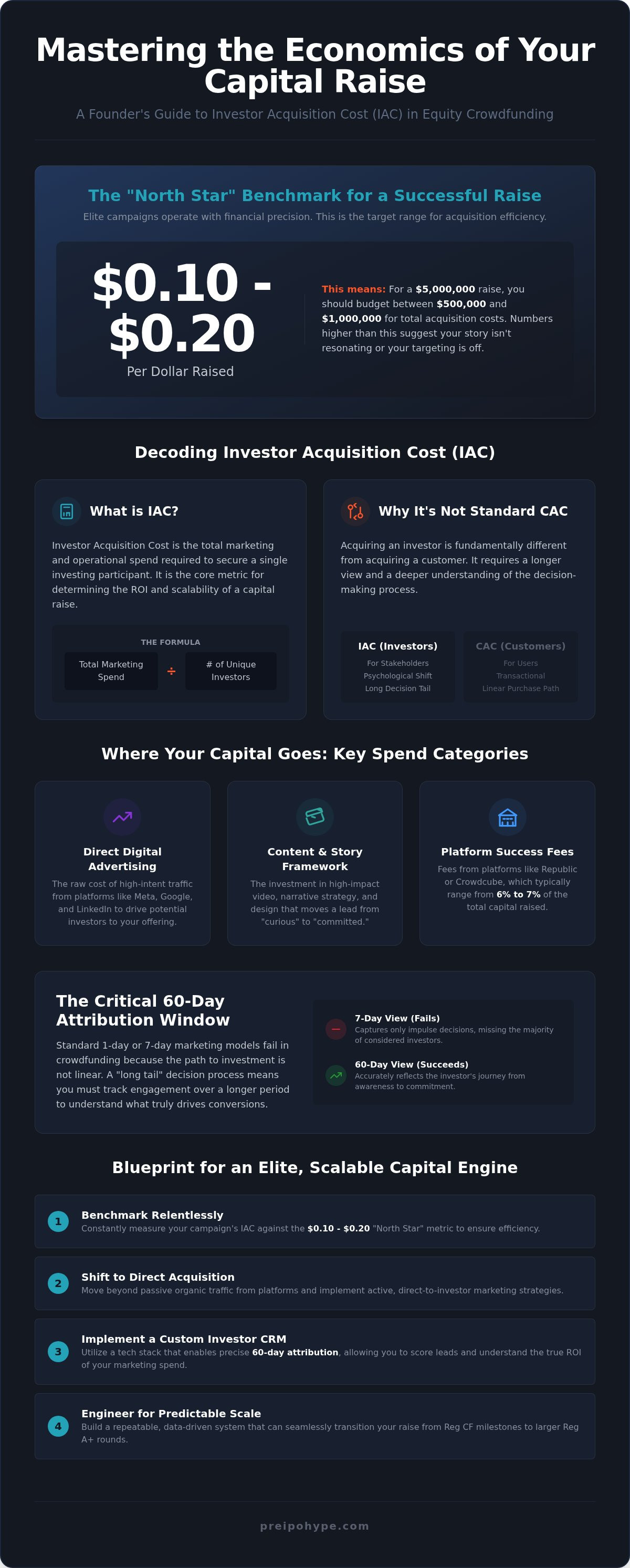
- Direct Digital Advertising: The raw cost of high-intent traffic from Meta, Google, and LinkedIn.
- Content and Story Framework: The investment in high-impact video and narrative strategy that moves a lead from "curious" to "committed."
- Platform Success Fees: Fees from platforms like Republic or Crowdcube, which can range from 6% to 7% of the total raised plus additional equity or transaction fees.
Why Traditional CAC Models Fail in Crowdfunding
Standard marketing models assume a linear path to purchase. Crowdfunding is rarely linear. The decision to invest involves a deep psychological shift from consumer to stakeholder. This creates a "Long Tail" of decision-making where 1-day or even 7-day attribution models fail to capture the truth. You need a 60-day window to see the true impact of your spend. Investor Acquisition Cost is the total marketing spend divided by the number of unique investors.
Benchmarking IAC: What Should Your Raise Actually Cost?
Hope is not a strategy. In the world of high-growth capital, benchmarking your investor acquisition cost crowdfunding performance is the difference between a successful exit and a quiet collapse. If you don't know what you should be paying for each dollar of capital, you're likely overpaying for it. Most founders fly blind, unaware that elite campaigns operate with the precision of a high-frequency trading desk.
In the current market, the standard for a Regulation Crowdfunding (Reg CF) raise is an IAC between $0.10 and $0.20 per dollar raised. This means if you're aiming for a $5 million cap, you should budget between $500,000 and $1,000,000 for total acquisition and related costs. If your numbers climb higher, your story isn't resonating or your targeting is off. If they're lower, you've found a market arbitrage opportunity that you should exploit immediately.
IAC by Funding Regulation
The math changes as you move up the regulatory ladder. Each framework offers a different cost-to-capital profile:
- Reg CF: The entry point. While total costs can hit 15% to 20% of the amount raised, the digital-first nature allows for rapid testing and optimization.
- Reg A+ (Tier 2): Built for scale. While the legal and audit setup costs are higher, the larger raise limits allow you to achieve significant economies of scale. Once the "momentum engine" is running, the per-investor cost often drops significantly compared to smaller rounds.
- Rule 506(c): Targeting the heavy hitters. For programs focused on accredited investors, expect a cost-per-investor in the $1,500 to $5,000 range. It's a higher upfront cost per head, but the individual check sizes change the ROI calculation entirely.
The 3:1 vs. 5:1 ROI Framework
We measure success through capital efficiency. At a minimum, your campaign should maintain a 3:1 Return on Ad Spend (ROAS). This means for every dollar spent on digital acquisition, you should see three dollars committed to your escrow. However, elite campaigns—the ones that dominate the leaderboards—aim for a 5:1 return. Achieving this level of performance requires more than just ads; it requires a sophisticated investor acquisition platform that tracks every touchpoint in the 60-day decision cycle.
The "Hype Cycle" also dictates your spend. Costs typically spike during the first 14 days and the final 7 days of a campaign. During the middle "trench," your IAC might rise as you move from early adopters to the broader market. If your IAC remains elevated without a corresponding surge in momentum, it's a red flag. It usually indicates a "failing story" where the value proposition isn't strong enough to overcome investor inertia. If you're seeing these red flags in your own data, it might be time to schedule a strategic audit to recalibrate your acquisition engine before the burn rate consumes your runway.
Platform Fees vs. Direct Acquisition: The Real Math
Organic discovery is a myth. Many founders fall into the "Platform Trap," believing that simply listing on a major equity crowdfunding portal will trigger a flood of capital. It won't. While these portals offer a regulated environment and a sleek interface, the reality is that the issuer remains the primary engine for growth. If you rely solely on a portal's internal algorithm, you're gambling with your runway. The real math of investor acquisition cost crowdfunding requires looking beyond the dashboard and into the friction of hidden overhead.
Beyond the headline success fees, hidden costs often erode your net capital. Listing fees, escrow services, and compliance reviews can quickly add up. In the current 2026 market, US founders often face flat fees of around $10,000 just to launch, plus additional percentage-based costs. When you add these to your marketing spend, your effective acquisition cost can spiral if not managed with precision. This is why elite founders are moving toward hosted Foundation Infrastructure, allowing them to run direct-to-founder raises that bypass high portal dependency and keep more capital on the balance sheet.
Platform Success Fees Explained
Portal fees are often the largest line item in your budget, typically ranging from 7% to 12% of the total capital raised. While these are success-based, they significantly impact your effective investor acquisition cost crowdfunding. You must also account for equity warrants. Many portals demand 2% or more in equity as part of their compensation. This is an invisible cost that dilutes your cap table long after the campaign ends. To navigate these complexities, many founders choose to work with a specialized equity crowdfunding marketing agency to ensure their direct acquisition strategy outpaces portal fees.
The Value of Owning Your Data
Renting an audience is a tactical error. When you acquire an investor through a third-party portal, that portal often retains the primary relationship with the lead. This creates a liability for future Series A rounds where you'll need direct, frictionless access to your previous backers. By building a private database through a Custom Investor CRM, you secure long-term value that stays with the company. Owning your investor data drastically reduces the cost of subsequent raises, as you aren't paying to re-acquire the same individuals. It transforms a one-time transaction into a permanent capital asset.
Strategies to Lower Your Investor Acquisition Cost
Efficiency is the only hedge against market volatility. While your initial investor acquisition cost crowdfunding might start high, your goal is to drive that number down through aggressive optimization. This isn't a "set and forget" process. It requires a relentless focus on data and a willingness to cut underperforming channels the moment they fail to deliver. Optimization is about engineering a path of least resistance for the capital you need.
One of the most effective ways to lower costs is by leveraging 60-day attribution tracking. Most platforms only show you the last click, which ignores the weeks of research an investor performs before committing. By tracking the full journey, you can distinguish between low-value retail noise and the high-performing "whales" who drive the majority of your capital. This visibility allows you to reallocate your budget toward the specific ads and platforms that actually move the needle for your balance sheet.
Strategic newsletter exposure, such as through Invst Guru, provides a shortcut to high-intent audiences. Instead of paying to find new leads from scratch, you're tapping into a pre-vetted list of active investors who are already primed for early-stage opportunities. This lowers your IAC by placing your opportunity directly in front of the people most likely to act decisiveley, bypassing the expensive "awareness" phase of a traditional funnel.
Engineering Momentum with Omnichannel Outreach
Omnichannel mastery is about being everywhere your investor is without being annoying. By synchronizing email, social, and retargeting, you keep your story top-of-mind during the critical decision-making window. Retargeting, in particular, is a high-leverage tool that reduces IAC by focusing your spend on leads who have already expressed interest. When paired with a sophisticated "Story Framework," these touchpoints increase conversion rates at the top of the funnel. Implementing a Custom Investor CRM is the only way to manage this complexity at scale. Data-driven founders who master this omnichannel approach frequently report a substantial reduction in their overall acquisition costs compared to those relying on a single traffic source.
Lead Scoring and Strategic Outreach
Not all leads are created equal. Using proprietary Foundation infrastructure for lead scoring allows you to prioritize high-intent leads that deserve manual attention while automating the "nurture" sequence for everyone else. This reduces the burden of manual consulting and advisory hours, allowing your team to focus on closing the largest checks. Automating these sequences ensures your campaign converts leads while you sleep, turning your marketing spend into a 24/7 capital engine. If you're ready to stop guessing and start engineering your raise, book a performance audit today to see how we can optimize your acquisition math.
Building the Foundation: Your Tech Stack for Elite Raises
Spreadsheets are for hobbyists. If you’re targeting a multi-million dollar raise, your data needs to live in a high-performance environment, not a static document. Foundation Infrastructure is the bedrock of a predictable investor acquisition cost crowdfunding model. It’s the difference between a campaign that sputters and one that scales with surgical precision. Without a centralized technical foundation, you aren't fundraising; you're just spending money and hoping for the best.
Integrating your Custom Investor CRM with platform APIs allows for real-time attribution that most founders only dream of. This technical bridge ensures that every dollar spent on Facebook or LinkedIn is tracked directly to a specific investment event on the platform. A centralized dashboard for monitoring omnichannel performance is a necessity. It provides the visibility required to shift budgets in real time toward the channels that are actually converting leads into capital. Pre-IPO Hype’s custom marketing systems automate this entire investor journey, moving leads from awareness to commitment without manual friction.
The 60-Day Attribution Model
The biggest lie in crowdfunding is the "one-day click." Most founders misattribute their most expensive leads because they don't look far enough back into the funnel. Tracking the first touchpoint to the final investment signature requires a 60-day window. An investor might see an ad in week one, join your newsletter in week three, and finally sign the subscription agreement in week eight. If you only track the final click, you'll kill the very ads that started the journey. Explore our fundraising tech stack to see how we map this complex decision cycle.
Ready to Optimize Your Raise?
The transition from "Hype" to "Capital" is where most campaigns fail. You've built the momentum; now you must execute the final push. This requires a transition from broad awareness to aggressive, data-driven closing. If your current acquisition strategy feels like a black box, it’s time for a technical audit. You can't fix what you can't measure, and you can't scale what you don't control. The market moves fast, and the window for early-stage opportunity is always smaller than it appears. Decisive action is the hallmark of elite founders. Book a strategy session with Pre-IPO Hype to engineer your raise and lock in a predictable ROI for your next round.
From Market Participant to Capital Leader
Engineering a successful capital raise is no longer a matter of luck. It's a matter of infrastructure. By shifting your focus toward a predictable investor acquisition cost crowdfunding model, you move from being a participant in the market to a leader of it. Owning your investor data and utilizing a 60-day attribution window are the only ways to ensure your marketing spend translates into real-world realization events. This is the difference between a campaign that survives and one that dominates.
Pre-IPO Hype has facilitated over $100 million in funding by applying these exact principles of omnichannel mastery and lead scoring. The elite investment circles you're aiming for require this level of technical sophistication. Don't let your burn rate dictate your future. It's time to build a foundation that turns curious leads into committed stakeholders while you scale your vision with confidence. The opportunity is within reach for those who act decisively.
Access the Custom Investor CRM and scale your raise to secure the capital your growth demands. Your next milestone is waiting for those who act with precision.
Frequently Asked Questions
What is a good investor acquisition cost for a Reg CF campaign?
A high-performance benchmark for a Reg CF campaign is an investor acquisition cost of $0.10 to $0.20 per dollar raised. If you're spending more than 20% of your target on marketing and platform fees, your story likely isn't resonating or your targeting is inefficient. Elite founders aim for the lower end of this range to maximize their final balance sheet.
How do you calculate IAC in equity crowdfunding?
To calculate IAC, divide your total marketing and operational spend by the total number of unique investors who committed capital. This provides a clear price tag for each participant in your raise. Tracking this investor acquisition cost crowdfunding metric allows you to evaluate the efficiency of specific channels like Meta or LinkedIn with total precision.
Do platform fees count toward my investor acquisition cost?
Yes, platform fees are a critical component of your acquisition math. Whether it's a 7% success fee or a flat launch fee, these costs directly impact your net capital. Founders often separate direct ad spend from platform fees to see which lever is driving the most friction in their total ROI calculation.
Can I lower my IAC by using a Custom Investor CRM?
Implementing a Custom Investor CRM is one of the most effective ways to drive down costs. By using 60-day attribution and lead scoring, you can identify high-value leads and automate the nurturing process for retail investors. This prevents you from wasting budget on audiences that don't convert while focusing your energy on the biggest checks.
What marketing channels have the lowest IAC for startups?
Retargeting and established investor newsletters typically offer the lowest IAC. Channels like Invst Guru provide access to pre-vetted, active investors who are already primed for early-stage opportunities. This allows you to skip the expensive awareness phase and move straight to the commitment stage, which significantly lowers your burn rate.
How does omnichannel outreach impact my crowdfunding ROI?
Omnichannel outreach synchronizes your story across email, social, and digital ads to eliminate gaps in the investor journey. It ensures your brand stays top-of-mind during the weeks-long decision cycle. This strategy can reduce your investor acquisition cost crowdfunding by up to 30% by increasing conversion rates at every digital touchpoint.
Is it cheaper to raise capital via Reg CF or Reg A+?
Reg CF is cheaper to launch, but Reg A+ is more capital-efficient at scale. While Reg CF setup costs are minimal, all-in costs often reach 15% to 20% of the raise. Reg A+ requires significant upfront legal and audit fees, but the ability to raise up to $75 million allows you to achieve massive economies of scale.
What is the "hype cycle" and how does it affect acquisition costs?
The "hype cycle" refers to the predictable surge and dip in investor interest during a 60 to 90-day campaign. Costs are usually highest during the initial launch and the final "closing" push when urgency is at its peak. Understanding these rhythms allows you to allocate your budget effectively, avoiding overspend during the middle "trench" of the campaign.
Disclaimer
Educational only. Not investment, tax, or legal advice. Pre-IPO Hype is investor relations infrastructure for Regulation CF and Regulation A+ raises. We are not a broker-dealer, funding portal, or investment adviser, and we do not offer or sell securities or make investment recommendations. Any securities offering is made only by the issuer, through its own offering documents and, where required, a registered intermediary.