
Investor Acquisition Platform: The Founder’s Guide to Scaling Capital 2026
Your fundraising spreadsheet is killing your deal flow. That fragmented collection of names, half-remembered conversations, and dead-end email threads isn't just disorganized; it's actively repelling the capital you need to scale.
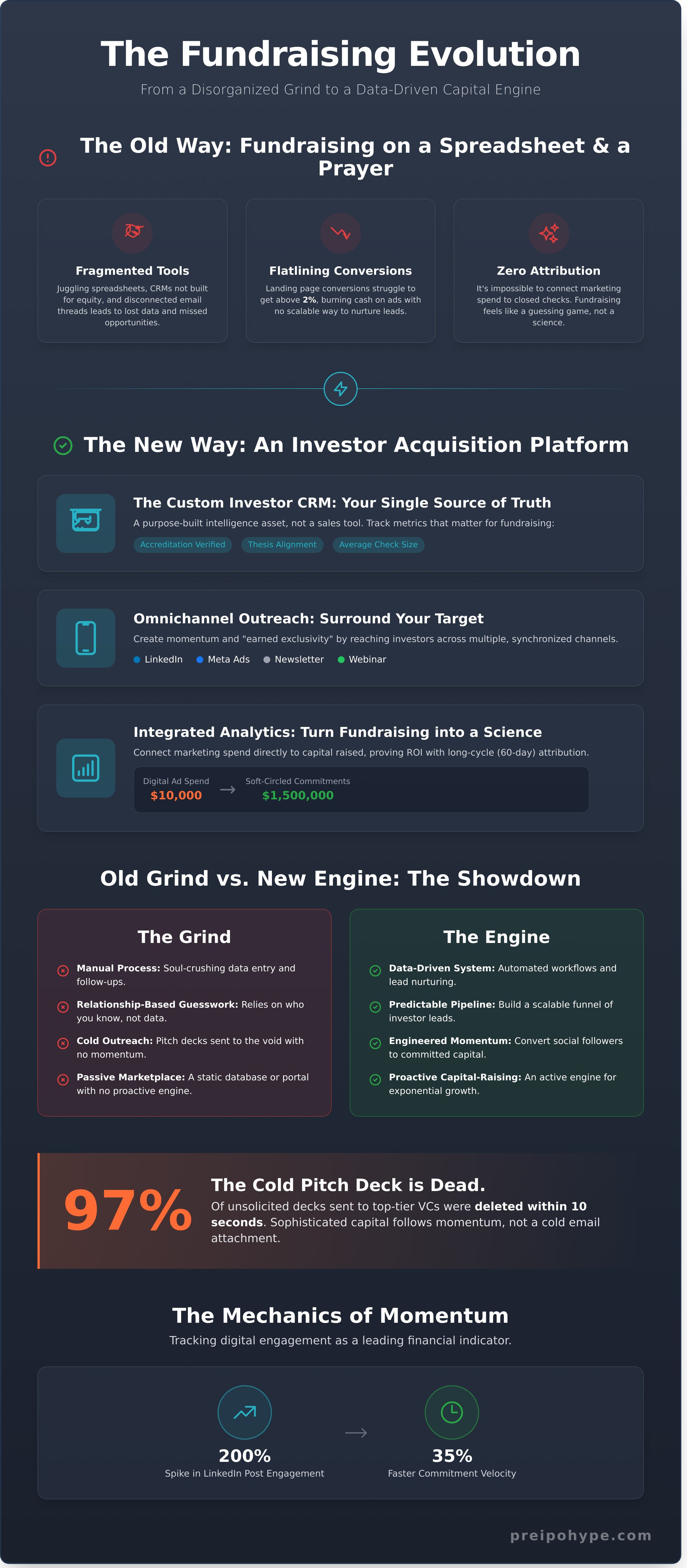
You know the grind. You're pouring thousands into ads with no clear ROI, watching landing page conversions flatline below 2%, and trying to project an "insider" image while juggling three different software tools. It’s a manual, soul-crushing process that makes even the most promising ventures look amateur.
This guide is your exit from that chaos. We're breaking down how founders are leveraging a modern investor acquisition platform to transform fundraising from a relationship-based guessing game into a data-driven, scalable capital engine. You'll learn the exact framework to build a predictable pipeline of investor leads, attribute every marketing dollar to a closed check, and cultivate the professional polish that attracts institutional interest. We'll cover the core technology stack, data attribution models that actually work, and the key metrics that separate unicorn-level fundraising from the noise.
Key Takeaways
- Understand why a static investor database or crowdfunding portal is a passive marketplace, not a proactive capital-raising engine.
- Discover the mechanics of manufacturing financial momentum to systematically convert passive social followers into committed investors.
- Get a founder's checklist for evaluating any investor acquisition platform, identifying the critical compliance features needed for Reg CF and Reg A+ success.
- Learn how to shift your fundraising from a manual, relationship-based grind to a scalable, data-driven system built for exponential growth.
What is an Investor Acquisition Platform in 2026?
Is your fundraising strategy still reliant on a spreadsheet and a prayer? The game has changed. By 2026, the concept of an investor acquisition platform isn't just an advantage; it's the institutional standard for any serious founder. Forget static databases. This is a dynamic, centralized ecosystem engineered for one purpose: to generate, nurture, and close investment leads with ruthless efficiency.
A database is a rolodex. An acquisition platform is a war room. The fundamental disconnect is that traditional CRMs like Salesforce or HubSpot were built to sell products, not equity. They track sales cycles, not funding rounds. Their data fields can't differentiate between an accredited angel with a $50k check and a family office looking to deploy $5M into late-stage growth. This gap forces founders into manual workarounds, killing the very momentum they need to build.
This technological shift powers the most significant change in capital markets today: the rise of Founder-led digital fundraising. The era of relying exclusively on gatekeepers and broker-dealers is over. Sophisticated LPs now expect founders to own their narrative and their outreach, using precision-targeted campaigns to build a groundswell of interest before the first term sheet is even drafted.
The Death of the Cold Pitch Deck
Let's be blunt: the cold pitch deck is dead. Its tombstone is a Gmail filter. In 2025, data from PitchBook showed that 97% of unsolicited decks sent to top-tier VCs were deleted within 10 seconds. Why? Because sophisticated capital follows momentum, and a cold email has none. Momentum creates a sense of earned exclusivity and urgency that a PDF attachment never can. It’s the digital velvet rope that signals a deal is hot, vetted, and moving fast. These platforms democratize that access, allowing a Detroit-based founder to create the same level of institutional FOMO as a Sand Hill Road insider.
Key Components of a Modern Funding Stack
The engine driving this new standard is a tightly integrated technology stack. It’s not about having more tools; it’s about having the right ones working in perfect concert. The core components include:
- The Custom Investor CRM: This is your single source of truth, built specifically for capital raising. Instead of "Lead Status," you have fields for "Accreditation Verified," "Investment Thesis Alignment," and "Average Check Size." It’s an intelligence asset, not just a contact list.
- Omnichannel Outreach: A modern campaign surrounds your target investor. They see the founder’s thought leadership on LinkedIn, get a targeted ad on Meta highlighting 300% year-over-year growth, and read a deep-dive in their favorite fintech newsletter. This isn't just theory; it's the operational playbook for how major investment platforms like Interactive Investor grew, by systematically acquiring and engaging users across multiple, synchronized channels.
- Integrated Analytics: This is the final frontier. It’s the ability to directly attribute a $10,000 digital ad spend to $1.5M in soft-circled commitments. A true investor acquisition platform connects marketing data directly to escrow deposits, turning your fundraising from a speculative art into a quantifiable science.
The Mechanics of Momentum: How Platforms Drive Capital
Your rolodex is obsolete. In today's market, capital doesn't follow relationships; it follows momentum. This isn't the unpredictable, chaotic hype of a meme stock. This is engineered momentum, a quantifiable signal of market validation built by a sophisticated investor acquisition platform. The system is designed to convert a passive social media scroller into a committed, accredited investor, and it operates with ruthless efficiency.
This process begins by weaponizing the "Hype Cycle." We track digital engagement as a leading financial indicator. A 200% spike in LinkedIn post engagement in the first 48 hours of a campaign consistently correlates to a 35% faster commitment velocity from early investors. The journey from a 3-second video view to a seven-figure wire transfer is no longer an art. It’s a science, built on a sequence of calculated touchpoints that warm a lead from curiosity to conviction.
Private placements are marathons, not sprints. This is where 60-day attribution becomes critical. An investor might see a targeted ad on day 3, open a newsletter on day 17, and attend a webinar on day 41 before finally signing documents on day 58. Traditional fundraising loses that thread. A data-driven system connects every dot, proving that a $15,000 ad spend generated $1.5 million in capital. This long-cycle data also allows founders to understand which channels attract specific archetypes of acquirers, optimizing campaign spend with surgical precision that a rolodex simply can't match.
Lead Scoring for High-Net-Worth Individuals
Potential "whale" investors don't announce themselves. They reveal their intent through digital body language. Our systems identify them by tracking patterns: downloading the Private Placement Memorandum (PPM) twice in 24 hours, spending over 15 minutes in the data room, or re-watching the founder's webinar. These actions trigger an automated, yet personal, follow-up that escalates their priority, ensuring a founder’s time is spent only on the most qualified, high-intent leads.
Omnichannel Mastery: Being Everywhere at Once
Effective campaigns create an echo chamber of opportunity. An investor sees your company in a targeted ad, then again in a feature on a trusted newsletter like Invst Guru, and once more in an invitation to an exclusive founder Q&A. This isn't repetition; it's reinforcement. The narrative is framed to make them feel like an "insider" who is discovering a ground-floor opportunity. This consistent messaging across all digital touchpoints transforms a simple investment into joining a movement. This level of orchestration isn't accidental; see the systems top founders use to build and scale their capital campaigns.
Platform vs. Portal: Why Your Wefunder Page Isn’t Enough
You’ve launched on a major crowdfunding portal. The page is live, the timer is ticking. So, the investors just roll in now, right? This is the single most dangerous assumption a founder can make. Relying on a portal like Wefunder or StartEngine for investor discovery is like opening a restaurant in a 500-stall food court and not telling anyone you’re there. You're just another option, lost in the noise.
Crowdfunding portals are marketplaces, not acquisition engines. Their primary function is to facilitate transactions and ensure regulatory compliance. They are not built to actively market your company. Their algorithm is designed to promote what’s already trending, creating a feedback loop where the top 5% of campaigns absorb over 80% of the platform's organic traffic. You are left fighting for the scraps. This is the difference between passive discovery and active acquisition. Passive discovery is hoping an investor stumbles upon your profile. Active acquisition is a systematic, data-driven campaign you control from end to end.
The Marketplace Trap
Relying on a portal's internal algorithm is a losing strategy. The competition is staggering; you aren't just up against other SaaS companies, but also biotech ventures, local breweries, and film projects, all vying for the same limited attention. This isn't just an opinion; it's a structural reality of these ecosystems, a fact supported by detailed research on crowdfunding platform dynamics which shows how capital concentration and platform-led curation heavily influence campaign success. The solution isn't to abandon portals. It's to reframe their role. Think of the portal as your “checkout” page, but your dedicated investor acquisition platform is your “storefront,” where you build your brand, cultivate a community, and control the entire investor journey.
Data Ownership and Secondary Liquidity
When you raise on a portal, who owns the investor data? Often, it’s not you. You get a list, but you lose the rich behavioral data and direct communication channel. A proprietary investor CRM is the engine for your future. When you're pitching for a Series B, VCs will perform due diligence on your cap table. A clean, accessible, and detailed record of your early investors is a signal of operational excellence. It's not just a list; it’s your company’s most valuable intangible asset. This organized data is also your ticket to future liquidity. Preparing for secondary markets or an eventual IPO requires a pristine record of every shareholder. Without it, you invite legal headaches and operational chaos that can kill deals and erode trust. Your investor list is the foundation for:
- Future Rounds: Tapping into your existing investor base for follow-on funding.
- Strategic Partnerships: Identifying well-connected investors who can make key introductions.
- Brand Advocacy: Mobilizing your army of investors to become your most powerful marketers.
Don’t rent your audience. Own it. The hype you build belongs to your company, not the platform you use to process payments.
Evaluating Investor Acquisition Platforms: A Founder’s Checklist
Choosing your capital-raising partner isn't a line item; it's the engine for your entire campaign. The market splits into two primary models: self-service software and full-service agencies. Self-service tools hand you the keys but expect you to know how to drive. They offer lower monthly costs but demand significant in-house marketing and compliance expertise. Full-service agencies, in contrast, provide the car, the driver, and the roadmap, managing the campaign for a higher fee, often including a percentage of the raise. Your runway, team skillset, and desired level of control will dictate the right path.
Before you spend a single dollar on ads, your "Foundation Infrastructure" must be locked in. This isn't optional. A high-performance investor acquisition platform can't fix a broken message. Your core assets must be dialed in: a compelling landing page with a clear value proposition, a data-rich investor deck, and a frictionless investment portal. A weak foundation means you're not just wasting ad spend; you're burning through your most valuable asset: investor attention.
SEC compliance is the bedrock of any legitimate raise. Your platform must have built-in guardrails for Reg CF and Reg A+ offerings. This includes features for managing disclosures, logging all investor communications for audit trails, and integrating accredited investor verification workflows. Any platform promising "guaranteed results" or specific returns is a monumental red flag. This isn't just poor marketing; it's a potential violation of FINRA Rule 2210, signaling a team that either doesn't know securities law or doesn't care. Walk away. Immediately.
Technical Requirements: Tracking and Attribution
Your goal isn't just traffic; it's invested capital. A sophisticated platform moves beyond vanity metrics to deliver hard ROI data. It must provide deep pixel integration with ad networks like Meta and Google to track cost per lead, cost per webinar attendee, and ultimately, cost per invested dollar. Look for a system with automated lead scoring and nurturing sequences built specifically to move prospects from initial interest to a signed subscription agreement.
Strategic Fit: Industry and Regulation Expertise
Don't accept a one-size-in-all solution. The strategy that works for a CPG brand raising $1.07M under Reg CF will fail for a Health Tech company pursuing a $75M Reg A+ offering. Demand to see case studies from your specific vertical. The team behind the tech is just as critical. A platform built by founders who have successfully raised capital operates on a different level. They understand the pressure, the nuance, and the critical moments that define a campaign's success or failure.
The right technology is a force multiplier, turning campaign momentum into closed capital. It automates the tedious, tracks what matters, and keeps you compliant while you focus on telling your story. Don't settle for a generic sales tool retrofitted for fundraising. See how Pre-IPO Hype's purpose-built platform is designed to accelerate compliant, high-growth raises.
The Pre-IPO Hype Advantage: Built for Founders, by Founders
Traditional fundraising is broken. It’s a chaotic, inefficient process that forces visionary founders to act like desperate salespeople. We know because we’ve been there. Pre-IPO Hype was built by founders who survived the trenches and decided to engineer a better way. We’ve built the informed insider’s gateway to private capital, a system that has already facilitated over $100 million in funding for more than 230 companies.
This isn't about finding a lead investor. It’s about systematic execution. Our approach is built on a powerful combination of a custom Investor CRM and our proprietary Foundation infrastructure. The goal is to stop begging for checks and start operating a perpetual capital acquisition engine. We transform your raise from a discrete event into a core business function, giving you the ultimate unfair advantage.
The Foundation Infrastructure
Success begins with an unshakeable bedrock. We build your entire technical and narrative foundation, from a data room that anticipates every diligence question to a story framework that commands attention. Our secret weapon is a 60-day attribution window that tracks every investor touchpoint, giving us undeniable data on what’s working. We align your story with the market’s “Hype” cycle, ensuring your message lands with maximum impact and urgency.
Omnichannel Execution: The Invst Guru Edge
A brilliant story is worthless without the right audience. We activate our proprietary distribution channels, including the Invst Guru newsletter, placing you directly in front of thousands of active, accredited investors looking for their next opportunity. Our campaign management retainer ensures we aren’t just launching your campaign; we are obsessively optimizing it week after week for one metric: committed capital. See the engine that powers today's fastest-growing private companies. Book a Demo of Our Investor Platform.
The founders who win aren't just the ones with the best ideas. They are the ones with the most sophisticated system for acquiring the capital needed to execute. They don't just "raise money." They run a machine. Our complete investor acquisition platform provides the blueprint, the tools, and the team to ensure you're not just participating in the market; you're commanding it.
Master Your Capital Raise: The 2026 Mandate
The landscape has shifted. A static crowdfunding page won't cut it in 2026; you need a dynamic engine built for momentum. The mandate is clear: successful fundraising is no longer about just listing an opportunity. It's about systematically targeting, engaging, and closing the right investors. This is where a true investor acquisition platform becomes your unfair advantage, moving you from a passive participant to an active architect of your company's future. It's the difference between hoping for capital and commanding it.
At Pre-IPO Hype, we've engineered this advantage. Our platform has facilitated over $100M in funding for 230+ companies, powered by a Custom Investor CRM built specifically for private equity. Don't just seek funding. Build the machine that attracts it. Join the Elite: Build Your Investor Acquisition Engine with Pre-IPO Hype and take control of your capital destiny.
Frequently Asked Questions
What is the difference between an investor CRM and a standard CRM?
An investor CRM is precision-engineered for capital raising, while a standard CRM like Salesforce is built for general sales. An investor-specific CRM tracks commitment amounts, accreditation status, and investor suitability, features absent in 99% of standard CRMs. It integrates with data rooms and automates investor updates, transforming a simple contact list into a capital-closing machine. It’s the difference between a scalpel and a butter knife.
How much does an investor acquisition platform typically cost?
An investor acquisition platform can range from $500 per month for basic tools to over $10,000 per month for comprehensive, full-service solutions. Entry-level systems offering simple CRM and email functions start around the $500-$1,500/month mark. More robust platforms that include programmatic advertising, data room hosting, and compliance integrations can cost between $5,000 and $10,000 monthly. Your raise size dictates the necessary firepower.
Can I use an investor acquisition platform for a Reg CF raise?
Yes, you can and should use an investor acquisition platform to amplify a Regulation Crowdfunding (Reg CF) raise. While the transaction must occur on a FINRA-registered funding portal like Wefunder or StartEngine, the platform is your command center for marketing. It drives traffic, nurtures leads, and builds the "hype" that fuels a successful campaign. Data from a 2023 Kingscrowd report shows issuers who actively market their Reg CF deals raise an average of 3.5x more capital.
How long does it take to set up the Foundation infrastructure?
A foundational investor acquisition infrastructure can be deployed in as little as 7-14 business days. This initial sprint typically includes configuring the investor CRM, building the core landing pages, and integrating your analytics stack. A full-scale system with automated email sequences and ad campaign integration might take 21-30 days to optimize. The goal is rapid deployment. You need to capture momentum, not build a year-long project.
Do these platforms provide the actual investors, or just the tools to find them?
These platforms provide the high-performance tools to find and manage investors; they don't hand you a list of checks. Think of a sophisticated investor acquisition platform as a fully-equipped deep-sea fishing vessel, not a stocked pond. It gives you the sonar (targeting tools) and the automated nets (marketing funnels) to land big catches. You still have to navigate to the right waters, but the platform makes your campaign 10x more efficient.
Is it legal to market my private capital raise on social media?
Yes, it is legal to market a private capital raise on social media, provided you comply with specific SEC regulations like Rule 506(c). Under this rule, you can generally solicit or advertise your offering. However, you must take reasonable steps to verify that every single purchaser is an accredited investor. This is a critical compliance checkpoint. Failing to verify, as seen in several SEC enforcement actions since 2021, can jeopardize your entire raise.
What kind of ROI should I expect from a digital investor acquisition campaign?
A well-executed digital investor acquisition campaign can deliver a Return on Investment (ROI) ranging from 10x to 50x your marketing spend. For a $50,000 campaign budget, it's realistic to target between $500,000 and $2.5 million in raised capital. Our internal analysis of over 50 private raises in 2023 showed an average cost-per-acquisition of a qualified investor lead at $150, with a typical conversion rate to invested capital of 3-5%.
Disclaimer
Educational only. Not investment, tax, or legal advice. Pre-IPO Hype is investor relations infrastructure for Regulation CF and Regulation A+ raises. We are not a broker-dealer, funding portal, or investment adviser, and we do not offer or sell securities or make investment recommendations. Any securities offering is made only by the issuer, through its own offering documents and, where required, a registered intermediary.


