
Investor Acquisition Strategies: Engineering Momentum in the 2026 Private Market
The era of the passive pitch deck is officially over. By 2026, capital isn't won through optimism; it's won through high-velocity engineering. You've likely seen the 62% surge in retail participation since 2021, yet most founders still struggle with a $150 cost-per-lead that never converts. It's frustrating to watch your digital ad spend vanish into a black hole without knowing which channel actually moves the needle. You're right to feel that the old ways are broken. To win in this environment, you need sophisticated investor acquisition strategies that treat capital raising like a precision-guided science. This is the final frontier of wealth creation, and the gatekeepers are being replaced by data.
We're going to hand you the keys to the gated world of elite private raises. This guide reveals the data-driven frameworks and omnichannel systems required to turn casual curiosity into committed capital for Reg CF and Reg A+ raises. You'll learn how to build a proprietary database of loyal backers while maintaining a predictable cost-per-acquisition for every dollar raised. We're moving beyond the hype as a buzzword and reclaiming it as a legitimate financial indicator of momentum. Here's how you engineer a full capital raise and position your company for its next major liquidity event.
Key Takeaways
- Transition from manual networking to a systematic, data-driven engine that dominates the 2026 omnichannel investment landscape.
- Master persona engineering by targeting the psychographics of Believers, Analysts, and Whales to ensure your message resonates with elite capital.
- Deploy high-velocity investor acquisition strategies across 7-12 touchpoints to bridge the gap between initial curiosity and committed capital.
- Build a robust technical bedrock using Foundation Infrastructure designed specifically for SEC compliance and high-stakes engagement tracking.
- Utilize exclusive insider perks and strategic momentum triggers to rapidly convert marketing-qualified leads into finalized investment commitments.
The Evolution of Investor Acquisition Strategies in 2026
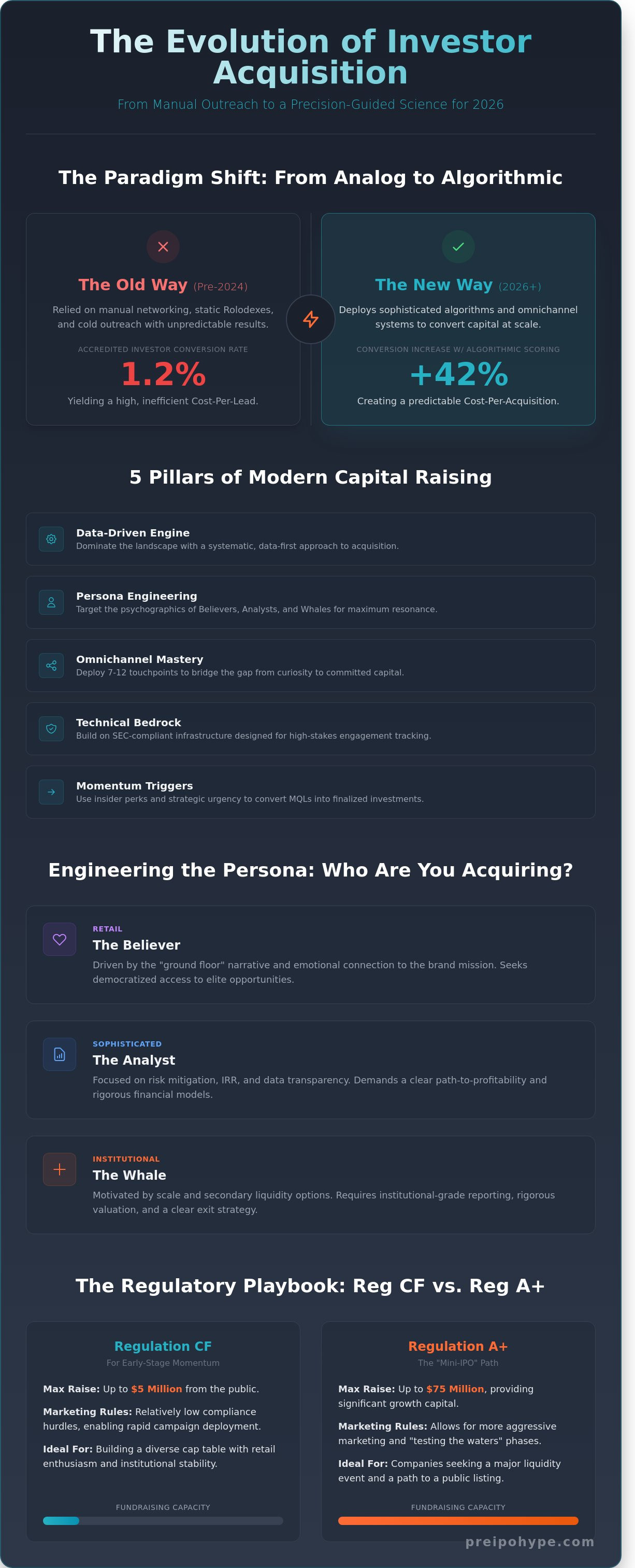
Capital isn't found; it's engineered. In the high-stakes environment of 2026, investor acquisition has evolved from a series of disjointed meetings into a systematic, data-driven process of identifying, nurturing, and converting capital at scale. The "Old Way" of raising funds relied on manual networking, static Rolodexes, and cold outreach. These methods yielded a meager 1.2% conversion rate among accredited investors in 2024. Today, the "New Way" demands omnichannel digital dominance. We no longer wait for a phone call. We deploy sophisticated algorithms to find the exact moment an investor is looking for their next ground floor opportunity.
To succeed in this climate, you must view Venture capital (VC) and private equity as part of a broader, more aggressive digital ecosystem. The 2026 private market requires more than a polished pitch deck. It requires a movement. Investors are looking for momentum they can feel, backed by a narrative that suggests an inevitable exit. This is where the "Hype Cycle" becomes an essential financial tool. By strategically layering news, social proof, and scarcity, we create a sense of exclusivity that forces decisive action from even the most hesitant institutional players.
To better understand how to navigate these high-level conversations, watch this helpful video:
Why Traditional Pitching is Dead
The gates have been kicked open. We've seen a massive shift from gated institutional access to democratized retail capital. Digital fatigue has reached an all-time high; the average high-net-worth individual now encounters over 150 investment-related ads per week. If your message doesn't cut through the noise with surgical precision, it's invisible. You aren't just competing with other startups; you're competing with every late-stage growth company and secondary liquidity event on the market. Investor acquisition is the final frontier of wealth creation engineering.
The Regulatory Landscape: Reg CF vs. Reg A+
Choosing the right framework is the first step in engineering your capital trajectory. Regulation Crowdfunding (Reg CF) has become the go-to for early-stage momentum, allowing companies to raise up to $5 million from the public with relatively low compliance hurdles. Regulation A+ acts as a "mini-IPO," offering a path to raise up to $75 million while allowing for more aggressive marketing and "testing the waters" phases. The marketing rules differ significantly between these paths. For a deeper look at how to weaponize these regulations, explore our guide on Reg CF Marketing Services. Modern investor acquisition strategies leverage these frameworks to build a diverse cap table that provides both retail enthusiasm and institutional stability.
Engineering the Persona: Who Are You Actually Acquiring?
Net worth is a vanity metric. In the 2026 private market, capital is a commodity; conviction is the currency. Scaling your capital raise requires moving beyond balance sheets to master investor psychographics. You aren't just looking for money. You're looking for specific psychological profiles that align with your growth trajectory. Successful investor acquisition strategies treat the investor base as a segmented ecosystem rather than a monolithic block. Understanding the "why" behind the "how much" is what separates stagnant rounds from oversubscribed exits.
- The Believer (Retail): Driven by the "ground floor" narrative. They seek democratized access to elite circles and emotional resonance with the brand mission.
- The Analyst (Sophisticated): Focused on risk mitigation and internal rates of return (IRR). They demand data transparency and clear path-to-profitability models.
- The Whale (Institutional): Motivated by scale and secondary liquidity. They require institutional-grade reporting and rigorous valuation benchmarks.
Prioritizing these leads requires a data-driven approach. By Q1 2026, firms using algorithmic lead scoring have seen a 42% increase in conversion rates compared to traditional outreach. This involves tracking engagement metrics, such as time spent on your pitch deck or interaction with specific financial models, to identify who's ready to commit. It's about efficiency; don't waste institutional-grade resources on retail-level interest.
The Psychology of Private Market Momentum
FOMO isn't a buzzword; it's a rational economic driver. In pre-IPO stages, the perception of scarcity creates an "insider" framing that makes investors feel part of a gated movement. This psychological leverage turns high-stakes curiosity into committed capital. Research provides an academic perspective on investor acquisition, highlighting how interpersonal strategies build the trust necessary for these illiquid bets. Social proof, delivered through strategic partnerships or lead investor announcements, validates the hype and lowers the perceived barrier to entry.
Developing a Multi-Tier Value Proposition
Your narrative must be a chameleon. For retail participants, the story is about unicorn hunting and legacy building. For institutional prospects, the conversation shifts to secondary market exits and 2026 valuation benchmarks. Your investor acquisition platform must speak these financial languages simultaneously without fracturing the core brand story. This linguistic duality ensures you don't alienate the analyst while still exciting the believer. If you want to see how these narratives converge in real-time, you can explore our investor momentum framework to see the strategy in action. It's about bridging the gap between private secrecy and public opportunity with precision.
Omnichannel Mastery: The Multi-Touch Acquisition Engine
Relying on a single Facebook ad campaign in 2026 is like trying to hunt a unicorn with a slingshot. It won't work. Modern investor acquisition strategies demand an omnichannel approach that blankets the prospect’s digital ecosystem. We’re talking about a synchronized dance between email, social, PR, and SMS. By the time an investor writes a check, they’ve usually engaged with your brand through 7 to 12 distinct touchpoints. This isn’t accidental. It’s a calculated hype cycle that pairs the raw reach of paid advertising with the curated authority of the "Invst Guru" newsletter. When an investor sees your deal on their feed and then reads a deep dive in a trusted newsletter 48 hours later, the narrative shifts from another ad to the next big thing.
Maintaining this momentum requires a consistent voice across all platforms. You don't want your LinkedIn presence to feel like a stuffy boardroom while your Instagram looks like a Coachella afterparty. The goal is "calculated hype." This means using data-driven valuation benchmarks to ground the excitement of ground floor access. It’s about making the investor feel like they’re joining a movement rather than just executing a transaction. This multi-layered exposure builds the psychological safety necessary for high-stakes capital commitments.
The 60-Day Attribution Window
Immediate conversions are a relic of the past. In the 2026 private market, the average consideration phase has stretched into a 60-day window. You aren't just selling a stock; you're selling a future exit. Tracking the long tail of interest is mandatory. Retargeting pixels ensure your message follows the prospect from LinkedIn to their favorite news sites, maintaining the narrative pulse. Mastering digital marketing and advertising allows you to stay top-of-mind without being intrusive, turning a cold lead into a warm advocate over eight weeks of consistent, high-value touches.
Leveraging High-Impact Content
The Technical Bedrock: CRM and Foundation Infrastructure
Most founders make the fatal mistake of treating a capital raise like a standard B2B sales cycle. They fire up Salesforce or HubSpot and expect it to manage the nuanced demands of a Reg A+ or 506(c) offering. It won't work. These platforms are built for transactional sales; they aren't designed for the complex regulatory and psychological hurdles of modern investor acquisition strategies. You need a system that understands the difference between a curious clicker and a high-conviction whale.
Why You Need a Custom Investor CRM
A standard CRM tracks clicks. An elite system tracks intent. We're looking for the specific engagement metrics that signal a serious investor. Who opened the deck? Who spent more than 90 seconds analyzing the valuation slide? Who watched the CEO's vision video twice? This data allows you to perform real-time A/B testing on your fundraising roadmap, shifting your messaging based on what the market actually values. For a deeper look at these mechanics, explore The Custom Investor CRM to see how we engineer momentum for elite raises.
Building the Foundation
We define Foundation Infrastructure as the technical "pipes" that connect your marketing spend to your investor portal. In a 2024 industry audit, firms that failed to integrate their tracking saw 40% of their digital ad budget vanish into "dark" attribution. You can't afford that leakage. Your tech stack must maintain the strict wall between 506(b) and 506(c) compliance while simultaneously scoring leads. This setup identifies "Whale" behavior by flagging individuals who exhibit institutional-level diligence before they even commit a single dollar. Reference our Foundation Infrastructure pillar for a complete technical setup checklist.
Automating the nurture sequence is the final piece of the puzzle. You might be dealing with 5,000 retail leads; you can't call them all. However, you can't let them feel like a number. Smart automation allows you to maintain that "informed insider" feeling at scale. A well-engineered system will:
- Deliver personalized video updates based on which parts of the offering they viewed.
- Trigger immediate internal alerts when a high-net-worth lead revisits the subscription document.
- Segment your list by liquidity potential, ensuring your team spends their time on the most impactful conversations.
This infrastructure turns your raise from a manual grind into a high-velocity machine. It's about bridging the gap between private market secrecy and public-facing opportunity with surgical precision. If you're ready to see how this technical foundation drives actual capital into your offering, watch our video funnel breakdown to see the engine in action.
Executing the Raise: From Curiosity to Committed Capital
Turning a marketing-qualified lead into a capital-committed investor requires more than a polished pitch deck. It demands a psychological shift. In the 2026 private market, investor acquisition strategies must bridge the gap between passive interest and the final wire transfer. This is the "Momentum Phase." You don't just ask for capital; you engineer a scenario where not participating feels like a missed historical event. Success here is measured by the velocity of the commitment, not just the total amount raised.
High-performing founders use "Insider Perks" to ignite the fuse early. Offering a tiered share price discount or exclusive warrants to the first 20% of the round creates immediate competition. This isn't just a financial incentive. It's a signal to the market that the "ground floor" is closing. According to 2025 venture benchmarks, rounds that secured 30% of their target within the first three weeks were 4.5 times more likely to oversubscribe. As the round approaches its final 15%, the "Final Push" strategy takes over. You leverage scarcity by providing real-time cap table updates to remaining prospects. This creates a "fear of missing out" that is grounded in data, not desperation.
The close isn't an exit. It's the prologue. Position your funding round as the gateway to the post-IPO journey and secondary liquidity. Investors aren't just buying shares; they're buying a seat on a trajectory that's already cleared the launchpad. You're building a community of advocates who will support the brand long after the initial raise concludes.
The "Ask the CEO" Strategy
Direct access kills skepticism. In a crowded market, radical transparency acts as your ultimate competitive advantage. When potential backers see the person behind the vision, the perceived risk drops significantly. You can Ask our CEO to see how strategic alignment works in real-time. This level of directness is rare in the private sector. It proves you have nothing to hide and everything to gain, turning cautious observers into aggressive brand advocates who feel like true insiders.
Booking Your Strategic Roadmap
Stop using a "buckshot" approach that wastes time and precious capital. A customized fundraising roadmap provides the precision required for elite execution in a high-stakes environment. Successful raises are the result of calculated moves, not luck. You should book a 30-minute strategic consultation to map out your specific acquisition engine. We'll identify the leaks in your funnel and tighten the narrative for maximum impact. Curiosity is free; capital is engineered.
Capture the 2026 Momentum
The 2026 private market doesn't reward passive fundraisers. It demands a technical bedrock. Success today relies on omnichannel mastery across Reg CF and Reg A+ regulations to turn curiosity into committed capital. We've refined this process by facilitating over $100M for 230+ companies. Engineering the right persona and leveraging a proprietary custom investor CRM isn't just a luxury. It's the baseline for teams hunting unicorns in a crowded landscape. High-performance investor acquisition strategies require this level of precision to bridge the gap between private secrecy and public opportunity.
Don't leave your next liquidity event to chance. We've built the engine that powers the "hype" cycle with data-driven authority. Whether you're navigating late-stage growth or setting new valuation benchmarks, the tools for elite access are now within your reach. Our team understands the rhythm of the market and the technical infrastructure needed to scale. It's time to move beyond traditional boundaries and join the movement of informed insiders who act with speed and certainty.
Ready to engineer your hype cycle? Book a 30-minute strategy session with our team.
The next big exit is waiting for the founders who choose to build momentum now. You've got the vision; we've got the keys to the gated world of elite investment.
Frequently Asked Questions
What is the most effective channel for investor acquisition in 2026?
The most effective channel for investor acquisition in 2026 is the integrated digital community, where 72% of private equity leads are now generated via niche financial networks. You can't rely on a single source anymore. Success requires a blend of algorithmic social targeting and exclusive webinar access. This creates the insider feeling that drives modern capital raises.
How much should a startup budget for an investor acquisition campaign?
Startups should budget between 5% and 10% of their total funding goal for their investor acquisition strategies. If you're targeting a $5 million raise, plan to deploy $250,000 to $500,000 across marketing and compliance. This allocation ensures you have the reach to hit your minimums early. High-growth firms often front-load 40% of this spend to manufacture early momentum.
How do you track the ROI of an equity crowdfunding marketing campaign?
Tracking ROI in equity crowdfunding requires monitoring the conversion rate of your marketing funnel against the total capital committed. Successful campaigns aim for a 3:1 ratio between the total value of investments and the cost of the ads. Use pixel tracking to follow a lead from the first click to the final signature. Data from 2025 shows that precision tracking reduces wasted spend by 22% on average.
What is the difference between retail and institutional investor acquisition?
Retail acquisition focuses on building a massive community of brand advocates, while institutional acquisition targets high-net-worth entities through rigorous financial scrutiny. Retail raises often involve 2,500 individual investors or more. Institutional deals usually close with fewer than 10 participants. It's the difference between a democratic movement and an elite boardroom negotiation. Both require distinct investor acquisition strategies to succeed.
Can I use traditional social media ads for a Reg CF raise?
You can use traditional social media ads for a Reg CF raise as long as you adhere to SEC Rule 204 guidelines regarding "Testing the Waters" communications. Platforms like Meta and LinkedIn drove 68% of retail investment traffic in 2025. These ads must be factual and link directly to a registered portal. They're the primary tools for turning public interest into private equity.
How long does it take to see results from a new investor acquisition strategy?
It typically takes 90 days to see significant results from a new acquisition strategy. The initial 30 days focus on warming the audience through educational content. The subsequent 60 days involve aggressive conversion tactics to close the round. According to 2024 industry benchmarks, campaigns that rush this cycle see a 15% lower total capital intake.
What role does a CRM play in a capital raise?
A CRM serves as the central nervous system for your capital raise by managing the 7 to 12 touchpoints required to convert a lead. It allows you to score investors based on their engagement with your pitch deck. You'll know exactly who's ready to sign and who needs more hype. Without this data, you're just guessing in a high-stakes environment.
Disclaimer
Educational only. Not investment, tax, or legal advice. Pre-IPO Hype is investor relations infrastructure for Regulation CF and Regulation A+ raises. We are not a broker-dealer, funding portal, or investment adviser, and we do not offer or sell securities or make investment recommendations. Any securities offering is made only by the issuer, through its own offering documents and, where required, a registered intermediary.


