
Investor Communication Strategy for Startups: Engineering Capital Momentum in 2026
Investor communication is no longer a polite conversation. It's a high-stakes marketing funnel where data determines who gets funded and who gets forgotten. With over $400 billion invested in the first half of 2026 alone, the capital is there, but it's gravitating toward founders who treat their raise like a precision engine. If you're struggling with an investor communication strategy for startups that feels more like manual chaos than a repeatable system, you're likely losing millions to simple friction. You know the frustration of a lead going cold after a great meeting or the exhaustion of tracking outreach in a spreadsheet that hasn't been updated in weeks.
It's time to stop guessing which channels drive your capital. This article will teach you how to engineer a data-driven strategy designed to convert curiosity into committed capital with clinical efficiency. You'll learn to build a professional, elite brand image that builds immediate trust while achieving full attribution for every dollar spent on marketing. This level of professionalism should extend to every physical touchpoint, where a premium corporate promotional products supplier can help you create high-end branded assets that resonate with sophisticated investors. We're moving past the "hope and pray" model to a repeatable system for investor acquisition that positions your company as a primary vehicle for wealth creation.
Key Takeaways
- Transform your investor outreach into a high-performance marketing funnel to overcome the follow-up friction that typically costs startups the majority of their potential capital.
- Deploy a sophisticated investor communication strategy for startups that utilizes lead scoring to distinguish high-net-worth "whales" from mere curiosity seekers.
- Establish a technical "Foundation" using a Custom Investor CRM to ensure every digital interaction is tracked, attributed, and converted into measurable momentum.
- Combine narrative mastery with omnichannel acquisition, including targeted digital advertising and elite newsletter exposure, to dominate the competitive 2026 venture landscape.
Why Your Investor Communication Strategy is the Difference Between Funding and Failure
Fundraising in 2026 isn't about the "perfect pitch." It's about the perfect funnel. Most founders obsess over the deck but ignore the delivery, falling into the trap of sending one-off emails that disappear into the noise. An effective investor communication strategy for startups treats every lead like a high-value customer in a sophisticated sales cycle. If you aren't tracking engagement metrics, you're flying blind. Capital follows clarity, and clarity requires institutional-grade infrastructure.
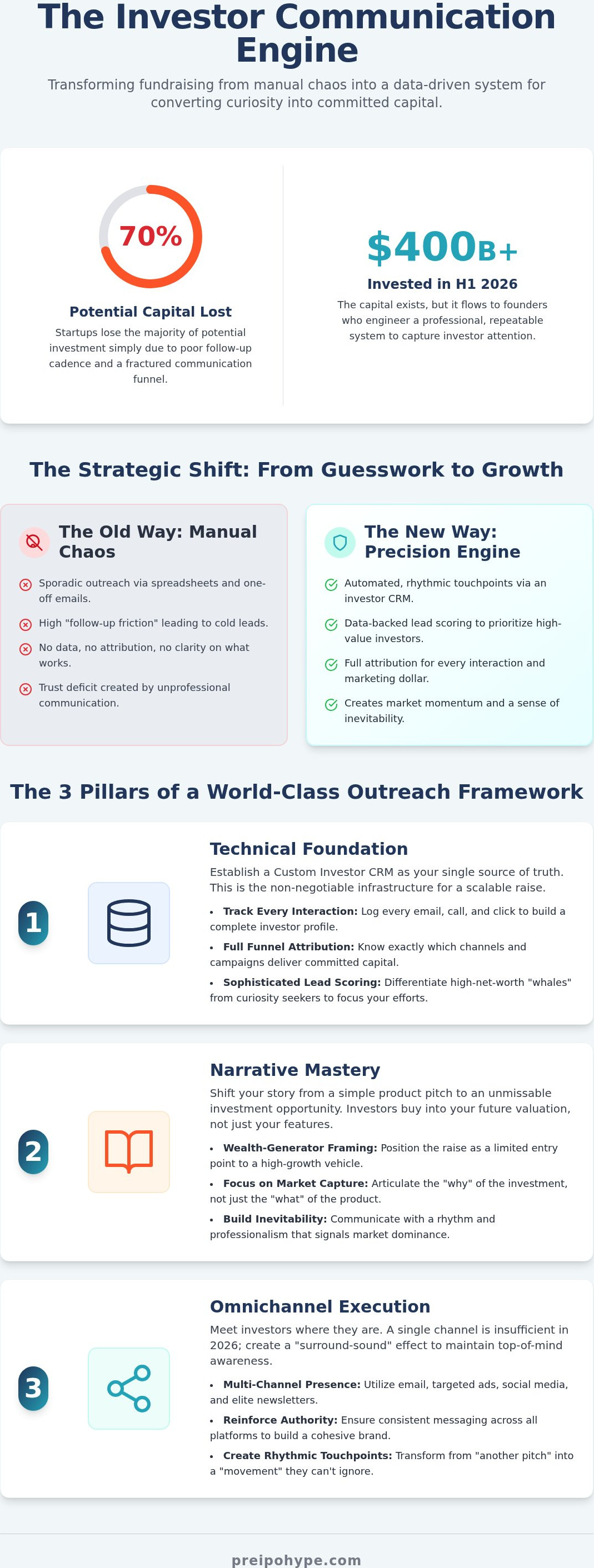
The "Trust Deficit" is where capital goes to die. Data suggests that startups lose up to 70% of potential investment simply because of a poor follow-up cadence. It isn't that the investors aren't interested; it's that they've been forgotten. In a market where over $400 billion was deployed in just the first half of 2026, the competition for attention is brutal. You need a system that builds "Hype" through consistent, data-backed touchpoints rather than manual, sporadic outreach. Transitioning to an automated fundraising tech stack is no longer optional for those targeting elite capital.
Moving from manual outreach to data-backed acquisition is the only way to scale. This requires understanding venture capital dynamics while applying modern digital marketing tactics. The goal is to move beyond the "interested" phase and into "invested" by engineering a sense of inevitability around your raise. When communication is rhythmic and professional, it creates the market momentum necessary to close oversubscribed rounds.
The Psychology of the Modern Private Market Investor
Institutional gatekeepers no longer hold all the keys. We've seen a massive shift toward democratized equity crowdfunding, where retail and accredited investors alike demand radical transparency. They don't just want a quarterly report; they want to feel the pulse of the company in real-time. In this environment, transparency and frequency are the new currencies of trust. Investor momentum is a measurable metric of engagement frequency that tracks how often a lead interacts with your brand before closing.
Regulatory Boundaries: Communicating Under Reg CF and Reg A+
Speed must be balanced with compliance. When executing your investor communication strategy for startups, you must navigate SEC "Testing the Waters" rules carefully. The July 2026 proposal for "Regulation E-Delivery" suggests a shift toward digital-first communication as the standard, but the legal fundamentals remain. Never use "guaranteed return" language. Instead, build excitement through verified milestones and clear growth trajectories. Consistency across all public-facing platforms isn't just good branding; it's a regulatory necessity to avoid FINRA scrutiny and maintain your elite status.
The 3 Pillars of a Sophisticated Startup Investor Outreach Framework
Engineering a successful capital raise isn't a matter of luck. It's a matter of structural integrity. A world-class investor communication strategy for startups is built on three non-negotiable pillars that work in concert to move capital from the sidelines into your bank account. Without these pillars, your outreach is just noise. With them, you create a sense of inevitable market dominance. You must integrate these components before you spend a single dollar on acquisition, or you risk leaking high-value leads through a fractured funnel.
The third pillar, Omnichannel Execution, ensures you meet investors where they actually live. In 2026, a single email won't cut it. You need a rhythmic presence across email, social platforms, and even SMS to maintain top-of-mind awareness. This isn't about spamming; it's about creating a surround-sound effect that reinforces your brand's authority. When an investor sees your milestone update on LinkedIn and then receives a personalized follow-up in their inbox, you aren't just another pitch. You're a movement.
Narrative Mastery: From Problem-Solver to Wealth-Generator
Investors aren't buying your product; they're buying into your future valuation. Your story framework needs to shift from technical specs to aggressive market capture. While competitors focus on the "what" of their product, you must articulate the "why" of the investment opportunity. If you position your raise as a limited entry point into a high-growth sector, you trigger the psychological scarcity that drives decisive action. This narrative must resonate with both retail participants and institutional whales by framing your startup as the primary vehicle for significant wealth creation. It's about moving from "we built this" to "we're winning this."
Technical Infrastructure: The Foundation of Your Raise
Spreadsheets are the silent killer of momentum. They lack the real-time feedback loop needed to score leads effectively and leave your team drowning in manual follow-ups. By implementing foundation infrastructure, you gain total visibility into investor intent. You need to know who opened your deck three times in the last hour, as that is your "whale" signal. A generic sales CRM won't cut it; you need a custom investor CRM built for the nuances of private market capital raises. This tech stack ensures no lead falls through the cracks and allows you to attribute every dollar of marketing spend to actual capital raised. If you're ready to stop guessing and start engineering your raise, you can book a strategy session to audit your current infrastructure.
Leveraging a Custom Investor CRM for Attribution and Lead Scoring
Most founders treat their CRM as a digital rolodex. That is a mistake that kills momentum. A generic sales CRM is built for linear transactions, but a capital raise is a complex, multi-touch psychological journey. To master your investor communication strategy for startups, you need a dedicated system that understands equity dynamics. While Hubspot or Salesforce might track a sales lead, they fail to account for the specific attribution windows required in private offerings. You need to know which specific ad, email, or social post actually triggered the investment, not just who opened a mailer.
Lead scoring in the private markets is about identifying "Whales" before you ever pick up the phone. By tracking digital behavior, such as how many times a lead views your executive summary or watches your pitch video, you can separate the high-net-worth individuals from the curiosity seekers. This data allows you to optimize your investor acquisition platform in real-time, shifting your budget toward the channels that produce the highest quality capital rather than just the most clicks. Precision is the difference between a stalled round and an oversubscribed one.
The 60-Day Attribution Window: Why It Matters
Investors rarely commit on the first touch. The decision to deploy capital often spans weeks of due diligence and psychological warming. Understanding the long tail of this decision-making process is vital for maintaining a healthy funnel. You must track engagement across multiple touchpoints, from the initial top-of-funnel awareness to the final click on the subscription agreement. Attribution tracking prevents wasted ad spend in capital raises by identifying the exact sequence of events that builds enough trust for a lead to move from "interested" to "invested."
Automated Follow-Ups with a Human Touch
Automation should never feel robotic. It should feel like a concierge service. By setting up trigger-based emails for deck downloads or webinar views, you ensure that your brand stays top-of-mind without requiring 24/7 manual labor. High-urgency updates via SMS, such as "Round Closing in 48 Hours," can drive immediate action from leads who have been sitting on the fence. For your largest potential checks, you must balance this automation with high-level consulting and advisory services. This hybrid approach ensures that while the system handles the volume, your most critical relationships receive the elite, personalized attention they expect from a market leader.
Executing an Omnichannel Investor Acquisition Campaign
A single-channel approach is a recipe for a stalled raise. In the current 2026 market, where investors are bombarded with AI-generated pitches, you need an investor communication strategy for startups that surrounds the target. This is the "7 Touches" Rule in action. Most investors won't even consider a deep dive into your data room until they've seen your brand across multiple trusted platforms. You're building a psychological narrative of inevitability, moving from a cold lead to a committed check through a deliberate, three-step funnel.
Your journey begins with Step 1: Top-of-Funnel awareness. This is achieved through aggressive digital marketing and advertising designed to capture intent and spark initial curiosity. Once that interest is captured, Step 2 moves them into Middle-of-Funnel nurturing, primarily through the Invst Guru newsletter. Finally, Step 3 secures Bottom-of-Funnel conversion. This is where high-frequency retargeting and SMS updates create the necessary urgency to close the deal. If you're ready to engineer this level of precision in your raise, schedule your acquisition audit today.
Newsletter Exposure: Borrowing Authority and Trust
Direct ads are effective, but third-party validation is the ultimate accelerant. When your startup is featured in the Invst Guru newsletter, you're borrowing the trust that publication has built over years with its audience. The secret lies in crafting a "featured opportunity" that provides genuine market insight rather than a desperate sales pitch. You can measure the ROI here by tracking the conversion rate of newsletter subscribers against cold social media traffic. The difference in capital commitment levels is often stark because the trust is already established before the first click.
Social Media as a Trust Signal, Not Just a Traffic Source
LinkedIn is your digital headquarters for founder authority. It's where institutional and sophisticated retail investors go to verify that you're a legitimate market leader, not just a flashy deck. If you're using major equity crowdfunding portals, your social presence must be active and responsive. The "Comment Section" isn't a nuisance; it's a conversion tool. By managing these communities with fast, transparent communication, you turn skeptics into your most vocal advocates. This real-time engagement is a core component of a modern investor communication strategy for startups, ensuring your momentum stays high through the final hours of the round.
Scaling Your Raise with Pre-IPO Hype’s Strategic Framework
The "Hype Cycle" isn't a happy accident. It's a calculated engineering feat. Most founders treat their raise as a series of sporadic events; we treat it as a high-performance engine. Having facilitated over $100 million in funding for more than 230 companies, we've refined an investor communication strategy for startups that removes the guesswork from capital acquisition. Static lists and generic "investor databases" are relics of a slower era. In 2026, you need a dynamic platform that responds to investor behavior in real-time.
Our Custom Investor CRM outpaces generic industry tools by focusing specifically on the long-tail attribution windows of private market offerings. It isn't just about tracking a lead's contact info. It's about engineering capital momentum. By moving from a manual "plan" to our integrated platform, you gain the visibility required to dominate your sector. We provide the technical bedrock that allows you to see which specific touchpoints are moving the needle, ensuring your resources are always deployed for maximum impact.
The Pre-IPO Hype Ecosystem: CRM + Marketing + Advisory
Our omnichannel mastery is the secret to drastically reducing the cost of investor acquisition. By synchronizing digital ads, email nurturing, and SMS urgency, we create a surround-sound effect that builds immediate trust. This ecosystem provides a gateway to an elite Club of investors who are actively looking for the next market leader. Every successful raise we've supported began with our "Foundation" infrastructure. This setup ensures that your data is clean, your tracking is precise, and your brand is positioned for institutional-grade interest from day one.
Ready to Engineer Your Raise?
The difference between a stalled round and a record-breaking raise often comes down to the systems running behind the scenes. If you're ready to stop managing messy spreadsheets and start managing momentum, we invite you to book a strategy session with our team. We'll audit your current framework and show you how to leverage our proprietary tech stack to close your round with clinical efficiency. For immediate fundraising clarity, you can also explore our Ask the CEO portal. Don't just raise capital; dominate your market with a platform built for the future of finance.
Engineered Momentum: The Path to Your Oversubscribed Round
The era of "spray and pray" fundraising is dead. In a market where capital is abundant but attention is scarce, your investor communication strategy for startups must operate with the precision of an institutional trading desk. Just as high-frequency traders require the best forex broker for scalping for technical precision, we've explored how narrative mastery, robust foundation infrastructure, and a dedicated Custom Investor CRM transform a chaotic raise into a predictable acquisition engine. By moving your outreach into a sophisticated omnichannel funnel, you don't just find investors; you engineer an environment where they compete to participate.
Pre-IPO Hype has facilitated over $100 million in funding and supported more than 230 companies since 2015. We don't deal in static lists or generic advice. We provide the proprietary technology and strategic advisory required to dominate the 2026 venture landscape. If you're ready to stop chasing curiosity and start closing capital, it's time to professionalize your approach and build a brand that commands immediate trust.
Book your 30-minute fundraising strategy session with Pre-IPO Hype to audit your current systems and unlock the momentum your vision deserves. The future belongs to those who act decisively.
Frequently Asked Questions
What is the most important part of an investor communication strategy?
The most critical element is treating your outreach as a high-performance marketing funnel rather than a series of isolated pitches. A successful investor communication strategy for startups relies on institutional-grade infrastructure to track every digital engagement. Without a data-driven system, you can't identify which leads are ready to close, leading to wasted effort and missed capital. Precision in tracking intent is what separates winners from also-rans in a crowded market.
How often should a startup communicate with potential investors during a raise?
Consistency is the primary driver of capital momentum. You should aim for a rhythmic cadence that maintains a steady pulse of opportunity across multiple platforms. This doesn't mean spamming; it means providing high-value updates that reinforce your narrative of market dominance. Regularity builds the trust necessary to move a lead from curiosity to a committed check by proving your company hits its milestones in real-time.
Can I use a standard sales CRM for my investor outreach?
Standard sales CRMs are generally insufficient because they lack the specific attribution windows and lead-scoring logic required for private offerings. Fundraising involves complex, multi-touch psychological journeys that generic tools can't track. You need a system designed to score "whales" based on digital behavior and attribute every dollar of marketing spend to actual capital raised. Generic tools often leak data, which leads to leaked capital.
What are the SEC rules for communicating with investors during a Reg CF campaign?
Compliance requires navigating "Testing the Waters" rules and ensuring all public-facing messages are consistent across platforms. You must avoid "guaranteed return" language and stick to verified milestones. With the proposed "Regulation E-Delivery" in 2026, digital communication is the standard, but you must still file retail communications with FINRA if you're a registered broker-dealer. Professionalism in compliance is a trust signal for sophisticated investors.
How do I track which marketing channels are driving the most investment?
Attribution mastery is achieved through a Custom Investor CRM integrated with your advertising platforms. By using specific tracking links and 60-day attribution windows, you can identify exactly which email, ad, or social post triggered the final investment. This allows you to optimize your acquisition budget in real-time, focusing only on the highest-performing channels. It's about engineering a return on every marketing dollar spent.
What is omnichannel outreach in the context of fundraising?
Omnichannel outreach is a surround-sound strategy that meets investors where they live: email, LinkedIn, and SMS. It ensures your brand remains top-of-mind by reinforcing your message across different digital environments. This integrated approach creates a sense of inevitability around your raise, making your startup feel like an unstoppable movement rather than just another transaction. It closes the gap between awareness and investment.
Is email marketing still effective for finding high-net-worth investors in 2026?
Email remains a primary tool for middle-of-funnel nurturing and high-touch conversion. While social media drives initial awareness, email allows for the deep-dive storytelling required to build institutional-grade trust. In 2026, personalized, automated sequences remain the most effective way to manage a high volume of leads without losing the human touch or professional authority. It's the engine room of the investor communication strategy for startups.
How do I handle negative comments or skepticism from retail investors?
Transparency is your best defense against public skepticism. Fast, professional community management turns skeptics into advocates by addressing concerns with verifiable data and a confident tone. Don't ignore negative feedback on public investment portals; use it as an opportunity to demonstrate your leadership and commitment to radical transparency. When you respond with institutional discipline, you build trust with the silent majority watching the exchange.
Disclaimer
Educational only. Not investment, tax, or legal advice. Pre-IPO Hype is investor relations infrastructure for Regulation CF and Regulation A+ raises. We are not a broker-dealer, funding portal, or investment adviser, and we do not offer or sell securities or make investment recommendations. Any securities offering is made only by the issuer, through its own offering documents and, where required, a registered intermediary.


