
Investor CRM for Startups: Engineering Momentum for Elite Capital Raises in 2026
Why are you still managing your legacy on a spreadsheet when 82% of successful Series A founders in 2024 credited their closing speed to a dedicated investor CRM for startups? You’ve likely felt the sting of a campaign launch that starts with high energy but quickly fades into a manual grind of tracking interest across four different platforms. It’s exhausting to shout into the void, never knowing which lead is a tire-kicker and which is ready to commit seven figures. You know that in the private markets, momentum is the only currency that truly matters.
We’re going to show you how to transform your raise into a high-velocity engine by engineering a sophisticated digital architecture. We’ll move beyond basic contact lists to build a centralized command center that identifies commit-ready capital through real-time behavioral data. You’re about to learn the strategy behind automated follow-ups that feel personal and the data-driven insights that turn silence into a competitive feeding frenzy. This is how you secure the keys to the elite investment circles that define the 2026 landscape of unicorns.
Key Takeaways
- Transition from manual spreadsheets to a high-velocity investor CRM for startups engineered to handle the unique logic of institutional capital pipelines.
- Implement advanced lead scoring models to prioritize elite high-net-worth individuals and maintain momentum through automated, omnichannel outreach.
- Leverage the "Hype Cycle" to transform early curiosity into actionable FOMO by capturing leads across social, search, and private newsletters.
- Identify the hidden costs of fragmented "free" tools and why unified data infrastructure is critical for $100M+ fundraising success.
- Eliminate technical friction in your capital raise with the "Foundation" system, bridging the gap between private secrecy and public opportunity.
Beyond Spreadsheets: Why Your Startup Needs a Specialized Investor CRM in 2026
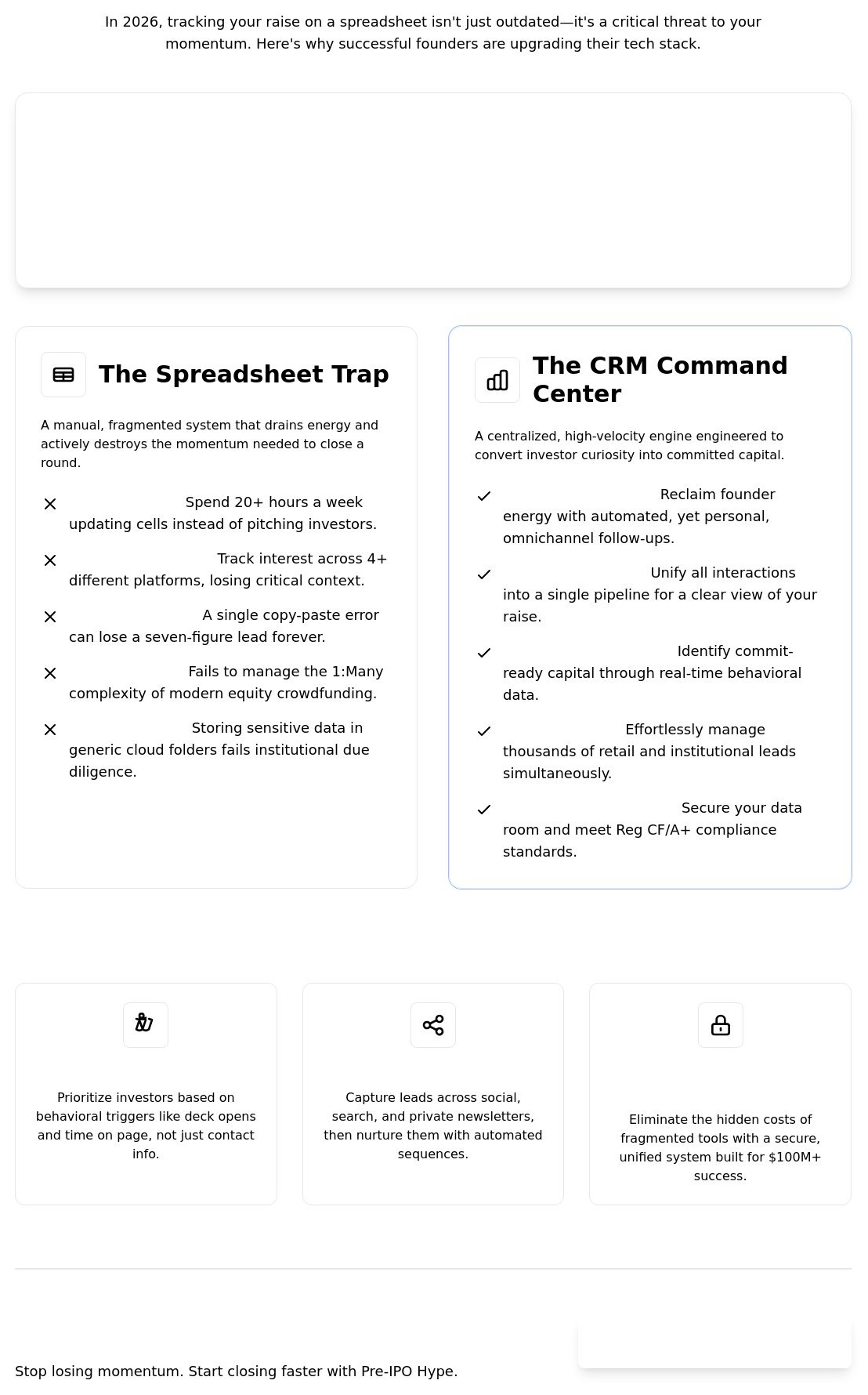
The era of the messy spreadsheet is over. If you're still tracking your capital raise on a Google Sheet in 2026, you're not just behind; you're actively losing momentum. An investor CRM for startups isn't just a digital Rolodex. It's a specialized engine designed to manage the high-velocity pipelines of institutional and retail capital. Unlike traditional Customer Relationship Management (CRM) software designed for selling SaaS subscriptions, these systems prioritize the unique logic and timing of a funding round. They provide the "insider" edge needed to turn a list of names into a closed round of financing.
To better understand the core mechanics of managing these complex relationships, watch this breakdown on building your pipeline:
Standard platforms like Salesforce or HubSpot often fail because they don't account for the non-linear nature of a raise. Investment isn't a simple transaction; it's a long-term alignment of interests. The high-stakes nature of a 2026 capital raise means you can't afford to lose a lead to a manual entry error. Founder burnout is a real threat to your valuation. When you spend 20 hours a week updating cells instead of perfecting your pitch, your energy suffers. Investors notice that drop in "hype" and momentum immediately. Furthermore, the landscape has shifted from exclusive 1:1 VC meetings to the 1:Many reality of equity crowdfunding. Managing 2,000 retail leads requires a level of automation that generic sales tools simply can't handle.
The High-Stakes Difference: Fundraising vs. Sales
Investor leads require data points that sales teams never touch. You need to track 60-day attribution to see which webinar or exclusive event actually triggered a wire transfer. Standard tools can't map the multi-touch journey of a family office that follows your secondary liquidity news for months before committing. The Investability Gap is the critical disconnect that occurs when standard CRMs fail to capture the specialized data points required to turn a casual lead into a committed capital partner.
Regulatory Compliance and Data Security
Managing data for Reg CF or Reg A+ raises puts your startup directly under the SEC spotlight. You can't store sensitive investor documents in a generic cloud folder without risking your entire raise. Utilizing Foundation Infrastructure is the technical bedrock of any secure raise, ensuring your data room and investor logs meet institutional security standards. This isn't just about organization; it's about building a secure gateway for elite investment circles. When you demonstrate this level of technical sophistication, you signal to the market that your startup is ready for the ground floor of a major exit.
Architecting the Pipeline: Essential Features of a High-Performance Investor CRM
Fundraising isn't a game of volume; it's a game of conversion. To dominate the private market, you need more than a digital Rolodex. You need a command center. A high-performance investor CRM for startups transforms raw data into a narrative of momentum, ensuring you don't just find investors, but you capture the right ones. It is about moving beyond the noise to find the signal in the secondary liquidity market.
Advanced Lead Scoring for Private Markets
Ranking investors requires a surgical approach. Traditional CRMs fail because they treat every contact as a lead. In the world of unicorn hunting, you must rank investors based on active engagement and social proof. If an individual opens your deck three times in 48 hours, they are no longer a "prospect"; they are a "ready-to-wire" priority. Behavioral triggers, such as clicking on a specific valuation benchmark or spending 4 minutes on your exit strategy slide, should automatically escalate their score.
This data-driven prioritization is the only way to maintain a lean, aggressive fundraising team. Lead scoring ensures your team spends 90% of their time on high-conviction leads, effectively eliminating the drain of investor ghosting by focusing only on those with verified intent. By filtering for high-net-worth individuals over casual observers, you protect your most valuable asset: time.
Communication Automation That Feels Exclusive
The 60-day fundraising journey is a sprint that requires constant touchpoints. However, generic blasts destroy the "insider" feel of elite opportunities. Your investor CRM for startups must handle automated omnichannel outreach that feels like a personal invitation to the ground floor. This involves custom email sequences that trigger based on specific interactions, ensuring the hype stays alive without manual clicking for every follow-up.
Sophisticated founders use this automation to bridge the gap between private secrecy and public opportunity. Integrating newsletter exposure is a critical tactic here; it keeps leads warm between rounds by providing consistent, high-value updates. For those looking to master these interactions, the Ultimate Guide to Investor Relationship Management provides a framework for maintaining these high-stakes connections.
Efficiency doesn't have to sacrifice exclusivity. When your CRM tracks exactly which slides an investor spent time on, your follow-up isn't a guess; it's a targeted response to their specific concerns. Coupled with integrated data rooms, you provide a secure environment where 85% of institutional investors can perform due diligence with zero friction. To see how these high-velocity funnels operate in real-time, you can explore our investor engagement strategy to optimize your own pipeline.
The Omnichannel Advantage: Capturing Curiosity Across the Hype Cycle
Hype isn't a distraction. In the private markets, it's a leading indicator of momentum. To capture this energy, an investor CRM for startups must act as a high-frequency sensor across every digital touchpoint. Most retail investors don't write a check after the first LinkedIn post. They enter a cycle that begins with early curiosity and peaks at the "Fear of Missing Out" (FOMO). Data shows it takes 7 or more touchpoints to convert a casual observer into a committed stakeholder. Your CRM is the only tool capable of orchestrating this journey without losing the narrative.
Modern capital raising requires a strategic investor relationship management framework that moves beyond static contact lists. By integrating social signals, search intent, and private newsletter engagement, you can fuel A/B testing that refines your messaging in real time. If a specific cohort of investors engages more with secondary liquidity talk than product roadmaps, your CRM data identifies that shift instantly. This allows you to pivot your digital marketing spend toward the creative assets that are actually moving the needle. It's about moving from broad-spectrum noise to precision-guided capital acquisition.
Engineering Momentum with Omnichannel Mastery
Success depends on synchronizing LinkedIn outreach, automated email sequences, and retargeting ads into a single source of truth. We utilize a 60-Day Attribution rule to track the long path from an initial click to a finalized investment. This holistic view is essential for digital marketing and advertising strategies that aim for private market dominance. Without this connectivity, your marketing spend is a black hole. With it, every dollar spent on retargeting becomes a calculated step toward a closed round. You aren't just sending emails; you're architecting a journey.
Capturing the Retail Investor Surge
Managing a Reg CF offering requires a different architectural approach than a traditional Series A. You're dealing with thousands of potential leads rather than dozens of institutional VCs. A robust investor CRM for startups automates the heavy lifting of turning these casual observers into brand evangelists. High-volume funnels, such as those driven by the Invst Guru newsletter, require structured engagement to maintain the sense of exclusivity that high-net-worth individuals crave. By segmenting these leads based on their interaction history, you ensure your most potent "insider" updates reach the most motivated capital first. This turns a faceless crowd into a loyal community of backers.
Choosing the Right Infrastructure: Comparing Free Tools vs. Custom Investor CRMs
Infrastructure is the silent engine of every successful exit. Many founders begin their journey by scraping free databases like OpenVC to identify potential targets. While these directories provide the "who," they fail to provide the "how." Relying on a static spreadsheet creates data silos that stifle momentum. Structured management tools like Foundersuite offer a step up by organizing the pipeline, yet even these can become digital graveyards if they aren't tailored to your specific deal flow. For raises exceeding $1M, the stakes are too high for fragmented data. You need a system that doesn't just store contacts but actively drives the narrative toward a closing.
The hidden costs of "free" tools manifest as missed conversion opportunities. When a lead goes cold because a follow-up was missed, you aren't just losing a contact; you're losing the potential for secondary liquidity and long-term partnership. A custom investor CRM for startups ensures that your data remains fluid and actionable, allowing you to move with the speed of the private markets.
The "Build vs. Buy" Debate for Founders
Generic CRMs treat investors like retail customers. That's a fundamental strategic error. A Custom Investor CRM ensures your brand voice remains consistent and sophisticated across every touchpoint. It transforms a standard outreach into an exclusive invitation to join an elite circle. While a generic tool might track a lead, a custom solution engineers the "hype" necessary for a successful round. This distinction becomes critical as you scale. Your CRM must handle the transition from a Seed round to a Reg A+ offering, where regulatory compliance and investor volume can increase by over 400%.
Evaluating ROI: Cost of Acquisition vs. Capital Raised
Disorganized pipelines are a direct tax on your equity. When 15% of your investor follow-ups fall through the cracks, your cost of capital acquisition skyrockets. An integrated investor CRM for startups pays for itself by plugging these leaks and maintaining the urgency of the raise. The math is simple; if a specialized platform facilitates just a 1% increase in your total conversion rate on a $5M raise, that represents an additional $50,000 in secured capital. This return easily justifies the initial setup costs of a professional-grade infrastructure.
- Lower Cost of Capital: Efficient tracking reduces the time spent on dead-end leads.
- Pipeline Velocity: Automated triggers keep your deal at the top of an investor's inbox.
- Data Integrity: Centralized notes prevent embarrassing duplicate reaches or conflicting information.
Pre-IPO Hype: The Custom CRM Built for $100M+ Fundraising Success
Standard software often fails when it meets the high-velocity demands of a venture capital raise. Founders don't need another place to store contact info; they need a machine that manufactures momentum. The Pre-IPO Hype custom investor CRM for startups is engineered specifically for this purpose. It bridges the gap between raw potential and institutional-grade execution. We don't just provide a tool. We provide a tactical advantage.
Our "Foundation" system eliminates the technical friction that typically stalls capital raises. Instead of manually tracking emails or guessing which VC opened your deck, our architecture provides a clear view of your fundraising funnel. We've used this exact framework to facilitate over $100 million in funding for more than 230 companies. This isn't a theory. It's a proven engine for capital close that handles the heavy lifting of data management while you focus on the vision.
We take a full-stack approach to your raise. It starts with your story framework and ends only when the capital hits your bank account. By integrating high-stakes financial authority with cutting-edge automation, we turn the fundraising process from a desperate search into a calculated campaign. Every touchpoint is tracked, every follow-up is optimized, and every investor interaction is designed to move the needle closer to a closed round.
The Insider Advantage: Why Founders Choose Pre-IPO Hype
Success in the private markets depends on who you know and how you're perceived. Our systems combine data-driven marketing with elite CRM architecture to ensure you're seen as a market leader. You get direct access to exclusive investor circles and the Invst Guru network. We don't just manage your data; we help position your company as the next "unicorn" through strategic hype management. This is about creating a sense of inevitability around your success by leveraging the same tools used by the world's most aggressive growth companies.
Take Control of Your Raise Today
Waiting to set up your investor CRM for startups is a recipe for a failed round. If you're building your infrastructure while you're pitching, you've already lost the lead. You need your fundraising command center operational before the first meeting occurs. Don't let your next round become a cautionary tale of missed follow-ups and lost interest.
You can ask our CEO anything about your next raise to get immediate clarity on your strategy. If you're ready to build your foundation now, book a strategy session to see how we can scale your vision. The market doesn't wait for the unprepared; it rewards those who act with precision and speed.
Own the Narrative and Secure Your $100M+ Exit
The era of managing high-stakes capital raises on static spreadsheets is over. In the 2026 market, winning requires a sophisticated investor CRM for startups that tracks the entire hype cycle from initial curiosity to final wire transfer. We've seen how the right infrastructure transforms a struggling raise into a competitive event. Pre-IPO Hype has already facilitated $100M+ in funding and helped 230+ companies scale their operations through data-driven precision. Our proprietary 60-day attribution tracking technology gives you the insider advantage by identifying exactly where your momentum is building.
Success in the private markets isn't a matter of luck; it's a result of engineered urgency and elite data management. It's time to stop guessing and start executing with the same tools used by the world's most successful late-stage growth companies. You've built the vision, now build the pipeline that brings it to life. Ready to engineer your raise? Book a 30-minute strategy session with our team.
The next great liquidity event is waiting for the founder who acts decisively today.
Frequently Asked Questions
Is a standard sales CRM like HubSpot enough for a startup raise?
A standard sales CRM works for basic contact management, but it often fails to handle the nuances of a sophisticated capital raise. Data from 2023 industry reports suggests 85% of founders find sales-focused tools lack specialized investor fields, such as LP tracking or dry powder metrics. You'll likely spend dozens of hours manually customizing a tool that wasn't built for the high-stakes world of venture capital.
How much does a specialized investor CRM typically cost for a startup?
According to 2024 pricing benchmarks from Software Advice, specialized platforms often start between $150 and $200 per user every month. These costs reflect the advanced relationship intelligence and automated data enrichment that standard tools don't provide. Investing in this infrastructure early ensures you aren't flying blind when trying to secure your next $2 million in seed funding.
Can an investor CRM help with SEC compliance during a Reg CF raise?
Yes, specialized platforms automate the rigorous record-keeping required under SEC Rule 506(c) and Regulation Crowdfunding. They track the 12-month rolling investment limits for every participant to ensure your company stays within the $5 million annual cap. This digital paper trail is your best defense if the SEC audits your offering documents or investor accreditation processes.
What is the difference between an investor database and an investor CRM?
An investor database is a static library of 100,000+ potential leads, whereas an investor CRM for startups is the engine that drives those relationships forward. Databases provide the raw contact info, but the CRM manages the momentum of your deal flow. It's the difference between owning a phone book and having a private line to the most active gatekeepers in Silicon Valley.
How does lead scoring work for potential investors?
Lead scoring assigns a numerical value to an investor based on their engagement with your materials. For example, if an angel investor opens your pitch deck 3 times in 24 hours, the system might assign them a score of 85. This data allows you to prioritize high-intent leads who are showing real interest in your ground floor opportunity rather than wasting time on passive browsers.
What happens if I don’t use a CRM for my equity crowdfunding campaign?
You risk a 40% drop in conversion rates because you can't effectively manage hundreds of micro-investors simultaneously. Without a centralized system, follow-up emails slip through the cracks and the "hype" surrounding your launch quickly evaporates. Managing a crowd requires institutional-grade automation to turn casual interest into committed capital before the 30-day momentum window closes.
Can a CRM help me track my pitch deck engagement?
Yes, a high-performance investor CRM for startups integrates with document tracking tools to show you exactly which slides capture the most attention. If a VC spends 90 seconds on your "Financial Projections" but skips the "Team" slide, you know exactly what to emphasize in your next meeting. This insider data gives you a psychological edge during the negotiation phase.
How do I integrate my digital marketing ads with an investor CRM?
You can use Zapier or native API connectors to funnel leads from Meta or LinkedIn Lead Forms directly into your investor pipeline. This automation ensures that an investor who clicks your ad on June 1st receives a personalized teaser deck within 5 minutes. Speed is the ultimate currency in the private markets; delaying your response by even 2 hours can kill the deal.
Disclaimer
Educational only. Not investment, tax, or legal advice. Pre-IPO Hype is investor relations infrastructure for Regulation CF and Regulation A+ raises. We are not a broker-dealer, funding portal, or investment adviser, and we do not offer or sell securities or make investment recommendations. Any securities offering is made only by the issuer, through its own offering documents and, where required, a registered intermediary.


