
Investor CRM for Startups: What to Look For in Campaign Software
For a fundraising team, an investor CRM for startups should organize investor prospects, track conversations and next steps, and keep campaign information accessible to the team. Investor-focused platforms serve a different workflow, such as managing deal flow or portfolio relationships from the investor’s side. Choose a system based on who will use it and what they need to track.
Comparing platforms can feel like a choice between a familiar spreadsheet and a system built for every fundraising task. The useful question is not which tool has the longest feature list, but whether its workflow fits your raise and team.
This guide explains how to compare pricing models, core features, integrations, collaboration tools, and founder-focused versus investor-focused platforms. You’ll also see what to track in investor records and when a spreadsheet may be enough. The goal is to help you choose software that fits your process, including campaign support for Regulation CF or Regulation A+.
Key Takeaways
- Choose software built for the person using it: founders managing a raise need a different workflow from investors tracking deals or portfolios.
- Keep each investor record useful by connecting conversations, documents, ownership, and next steps in one place.
- Compare free tiers and paid plans against the work your team actually needs; a spreadsheet may still suit a small, simple pipeline.
- Assess integrations and collaboration tools by how well they fit your existing process and keep shared information current.
- Set up your pipeline before outreach so your team can qualify prospects, record activity, and coordinate follow-ups consistently.
How does it integrate with Investor Lists and Pitch Deck Tracking?
The right CRM connects investor records with outreach, calendars, and pitch deck activity. Choose a platform with email, calendar, LinkedIn, and deck analytics connections that fit your existing workflow.
Outreach and Follow-Up Tracking
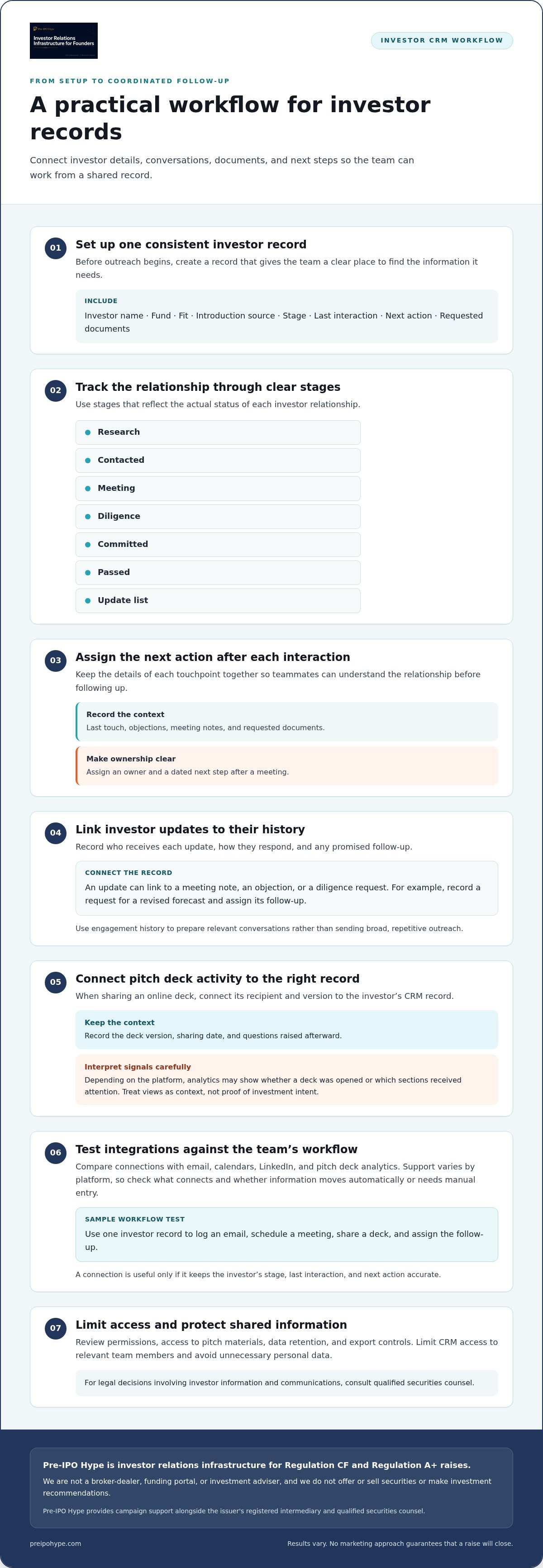
For each investor, track the next action, owner, follow-up date, last touch, objections, and requested documents in one record. Use clear stages such as research, contacted, meeting, diligence, committed, passed, and update list. After a meeting, assign an owner and a dated next step. Log each touchpoint within 24 hours, so another teammate can see the relationship’s history before contacting the investor.
Investor Updates and Engagement
Record which investors receive each update, how they respond, and any promised follow-up. A shared CRM record can link an update to a meeting note, objection, or diligence request. For example, if an investor asks for a revised forecast, record the request and assign the follow-up. Tie updates to evidence and use engagement history to prepare relevant conversations, rather than sending broad, repetitive outreach.
Pitch Deck Sharing and View Tracking
When sharing an online pitch deck, connect its recipient and version to the investor’s CRM record. Depending on the platform, view analytics may show whether a deck was opened or which sections received attention. Treat these signals as context, not proof of investment intent. Record the deck version, sharing date, and any questions raised afterward. This helps the team distinguish a document view from a substantive response.
Email and calendar connections can attach messages, meeting details, and follow-up tasks to investor records. LinkedIn and pitch deck analytics support vary by platform, so compare the integrations directly and test a sample workflow. Check whether data flows automatically or requires manual entry. A connection is useful only if it keeps the investor’s stage, last interaction, and next action accurate.
Privacy and security risks include excessive access, unnecessary personal data, and unclear handling of shared documents. Limit CRM permissions to relevant team members, review who can view pitch materials, and understand the platform’s data retention and export controls. For a Regulation CF or Regulation A+ raise, consult qualified securities counsel on legal decisions involving investor information and communications.
Before outreach begins, create a consistent investor record. Include the investor’s name, fund, fit, introduction source, stage, last interaction, next action, and requested documents. Then test the workflow with one record: log an email, schedule a meeting, share a deck, and assign the follow-up. This shows whether the database supports your team’s actual fundraising process.
Pricing and free tiers
Compare CRM plans by the fundraising work they cover, not the length of their feature lists. For example, a startup preparing for diligence may need shared records and document workflows, while an early team may need only a simple target list and follow-up reminders. Start with your current process, then identify which limits would interrupt it.
A free tier can help test whether the software fits your workflow before adding a paid plan. Try it with a real investor record: log an outreach action, schedule a meeting, assign an owner, and update the stage. Note whether the plan supports the team’s essential tasks, or restricts a capability your process already depends on. Avoid paying for features the team has not outgrown.
For a startup with fewer than five active prospects, a spreadsheet may be sufficient. As records, owners, and follow-ups grow, compare the effort of maintaining that sheet with the CRM’s free-tier limits. Another practical trigger is about 30 active prospects or hiring a second sales representative. These are decision points, not automatic rules; a complex diligence workflow can create a need earlier.
Review how each platform defines its plan limits. Check whether the free tier restricts users, records, integrations, automation, or reporting. Then map those limits against your fundraising workflow: who updates the investor stage, who owns each action, and how the team prepares for a meeting. Include cap table references and diligence documents in the process, while keeping sensitive materials in systems designed to manage them.
Compare the full plan structure before choosing. A platform may offer different tiers for team size, advanced workflows, or integrations. Write down the features your team uses now and those it expects to need as outreach expands. Ask whether moving between tiers preserves records, activity history, and permissions. A CRM that makes exporting difficult can create extra work when your process changes.
- Test the free tier: run one investor record through outreach, meeting preparation, and follow-up.
- Track the limits: note which user, integration, or workflow restrictions affect real tasks.
- Set a review trigger: revisit the spreadsheet when prospects, owners, or diligence steps become harder to coordinate.
Choose a plan based on active use, not a projected fundraising pipeline. If the free tier supports today’s process, keep using it; upgrade when a specific limit blocks a necessary task. That keeps CRM selection tied to operational needs rather than unused capacity.
CRM features and collaboration
An investor CRM for startups is a shared system for organizing investor relationships and fundraising activity. Look for structured records, pipeline stages, assigned owners, interaction notes, and reporting that supports the team’s next actions.
Begin with a pipeline that reflects actual startup fundraising steps. Stages might include research, intro requested, contacted, meeting, diligence, committed, passed, and update list. Each stage should have a clear meaning, so founders can distinguish an early warm introduction from active diligence. Avoid labels that suggest progress without a recorded conversation or action.
Useful records connect investor details with the work around each relationship. For example, capture the investor’s name, fund, thesis, fit, introduction source, current status, last interaction, next action, objections, and requested documents. A CRM can also record interactions among founders, investors, and third parties. This gives teammates context before they follow up or prepare materials.
For collaboration, assign an owner to every open action and keep shared notes specific. A CEO might own a meeting while another teammate prepares diligence materials. Record who is responsible, what needs to happen, and the relevant date. This division helps prevent duplicate outreach and keeps introductions from disappearing in separate inboxes. Use permissions that match each teammate’s role, especially for sensitive fundraising documents.
- Pipeline: Use stages that describe observable activity, such as “meeting” or “diligence.”
- Ownership: Assign one accountable teammate to each next action.
- Context: Attach notes, objections, and document requests to the relevant investor record.
- Review: Compare open actions with meeting notes and update records after conversations.
Reporting should help the team identify stalled work, not suggest stronger investor interest than the evidence supports. For example, review records with no next action, unresolved document requests, or repeated objections. Use those patterns to improve the pitch, metrics, and diligence packet. A term sheet or committed stage should reflect the team’s actual status, not a forecast or informal signal.
Keep the workflow useful by agreeing on a consistent record format before multiple teammates begin updating it. Test a sample investor record from first contact through a meeting and diligence. Confirm that another teammate can understand the relationship history and take the assigned action without relying on private notes. This review shows whether the CRM supports coordinated work around capital and fundraising conversations.
Founder-focused versus investor-focused platforms
Choose a platform around the user’s daily work. Founders need to manage an investor pipeline for their company’s raise. Investors need to assess opportunities, organize deal flow, or monitor portfolio relationships. A system designed for one side may not support the other side’s records and decisions.
For founders, the central record is the investor relationship. It can connect the investor list to outreach, meeting notes, pitch decks, diligence requests, and assigned actions. For example, a founder can see that an advisor made an introduction, the investor requested updated materials, and a teammate owns the follow-up. This keeps the company’s fundraising activity together.
Investor-focused software typically organizes information from the investor’s perspective. A venture firm might use it to review companies, compare opportunities against its thesis, and coordinate internal discussions. That workflow may prioritize deal sourcing and portfolio tracking over the founder’s next outreach step. A startup evaluating such a tool should check whether its records center on the company’s own pipeline.
Spreadsheets remain useful for a straightforward investor list, especially when one founder manages the process. But separate sheets for introductions, meetings, and pitch decks can create conflicting versions. A CRM brings those records into a shared workflow, with clear owners and current stages. Advisors can contribute context about an introduction without taking responsibility for the company’s entire pipeline.
Compare platforms using a real fundraising task. Start with one prospective investor and trace the record through outreach, a meeting, a diligence request, and a later update. Ask whether the system can:
- Show the investor’s fit, introduction source, and current relationship stage.
- Connect meeting notes and pitch deck versions to that record.
- Assign the next action to a founder or teammate.
- Separate company fundraising records from investor-side deal reviews.
For successive rounds, preserve useful relationship history while creating a clear view of the current pipeline. A founder may need to distinguish a prior conversation from current interest, or record that an investor passed previously but still receives company updates. The CRM should make those distinctions visible without treating old activity as present intent.
The practical takeaway is direct: founders managing their own raise should prioritize founder-focused software. Investor-focused platforms suit investors coordinating deal flow and portfolio work. If advisors, founders, and teammates share fundraising tasks, assess collaboration around company-owned records rather than assuming an investor-side product will fit.
Pre-IPO Hype: Custom Investor CRM
Pre-IPO Hype provides investor relations infrastructure for Regulation CF and Regulation A+ raises. We are not a broker-dealer, funding portal, or investment adviser, and we do not offer, sell or recommend securities. This article is educational only and is not legal, tax or investment advice. Pre-IPO Hype fees are never tied to investment results. FWSC and Pre-IPO Hype are paid per form filled out and per meeting booked, with no commission, equity or share of the raise.
Our Custom Investor CRM supports lead scoring and attribution tracking. For issuers preparing outreach and campaign workflows, Pre-IPO Hype provides campaign support alongside the issuer’s registered intermediary and qualified securities counsel. This can fit when a team needs CRM support as part of its investor relations process.
Results vary. No marketing approach guarantees that a raise will close.
Visit preipohype.com to discuss campaign support for your raise.
Build a CRM around the way your team works
Before choosing an investor CRM for startups, write down how your team will use it during the raise. Identify who maintains investor records, who owns follow-up, and how decisions or changes in responsibility are recorded. A clear operating plan makes it easier to assess whether software supports your team’s actual process.
Next, define what information belongs in the CRM and what belongs in separate systems. For example, your team can set rules for access to pitch materials and agree on how advisors contribute notes. Keep legal decisions about Regulation CF or Regulation A+ with qualified securities counsel.
Use the platform as a working system, not simply a place to store contacts. Set a regular review rhythm, assign ownership for updates, and adjust the workflow as the team’s needs change. A well-chosen tool can support more consistent coordination as fundraising moves forward, while the team remains responsible for accurate records and communications.
Choose a process your team can maintain, then build on it as your needs evolve.
Frequently Asked Questions
Which Investor CRM Should You Actually Use?
Use a founder-focused system if your team needs to manage its own fundraising relationships. Before selecting one, run a realistic handoff: a founder records a meeting, assigns a follow-up, and another teammate takes over. Check whether the history remains understandable and whether records can be exported in a usable format. If your process is simple and one person owns it, a spreadsheet may still fit.
How Do Investor CRMs Compare Feature by Feature?
Compare the same workflow across each platform instead of relying on feature names. For example, test whether a calendar event connects to the correct investor, whether teammates can see who owns the next action, and whether permissions separate internal notes from shared materials. Also assess how the system handles duplicate contacts, company records, and exports. These details reveal practical differences beyond a product’s headline features.
So, Which CRM Is Right for Your Startup?
The right choice depends on who maintains investor information and how the team works together. A solo founder may prefer a simple setup with minimal administration. A team sharing investor conversations needs clear ownership, consistent records, and access controls. Consider a real fundraising task, then select the tool that supports it without adding steps the team will not maintain.
What Should I Track in a Fundraising Pipeline CRM?
Track enough context to understand each relationship without relying on one person’s memory. Alongside contact and activity records, note the investor’s relevant decision-maker, the business or fund they represent, and the source and date of important information. If an advisor provides context, record it as an attributed note. This helps the team distinguish verified conversation history from assumptions or outdated contact details.
Which CRM Is Best for Fundraising Founders?
A CRM built around company fundraising is generally a closer fit than software designed for an investor’s deal review or portfolio management. Look for records that connect people to their firms, preserve company-specific conversation history, and support collaboration with founders and advisors. For a Regulation CF or Regulation A+ raise, coordinate campaign communications with the issuer’s registered intermediary and direct legal questions to qualified securities counsel.
What Are the Best Investor CRM Tools for Startups in 2026?
There isn’t one best tool for every startup, and a dependable ranking depends on the team’s needs. Compare platforms using a consistent test: enter a sample contact, record a discussion, assign an owner, and review the resulting history. Assess usability, access controls, integration fit, and data export. Choose based on how well the workflow serves your team, not on a broad “best” label.
Disclaimer
Educational only. Not investment, tax, or legal advice. Pre-IPO Hype is investor relations infrastructure for Regulation CF and Regulation A+ raises. We are not a broker-dealer, funding portal, or investment adviser, and we do not offer or sell securities or make investment recommendations. Any securities offering is made only by the issuer, through its own offering documents and, where required, a registered intermediary.