
Investor Engagement Metrics: The Founder’s Guide to Predicting Capital Conversion in 2026
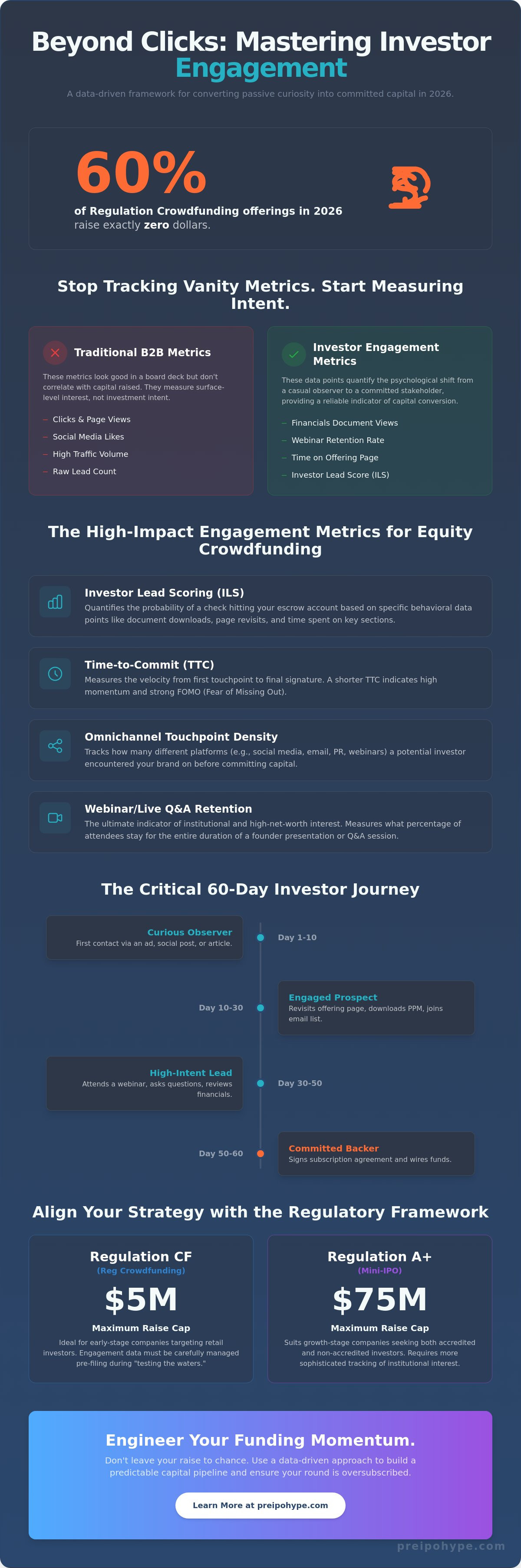
Did you know that 60% of all attempted Regulation Crowdfunding offerings in 2026 raise exactly zero dollars? It's a sobering reality for founders who mistake passive "looky-loos" for serious backers. To avoid becoming another statistic, you need a precise command of your investor engagement metrics. You can't afford to waste capital on marketing that doesn't move the needle or leave the board questioning your ROI. You need to know which digital signals translate into a signed subscription agreement before the clock runs out on your 12-month raise limit.
You've likely felt the frustration of watching traffic spike while your escrow account stays stagnant. It's exhausting to operate in the dark during the critical 60-day investor journey. This guide will show you how to master the data-driven indicators that transform passive curiosity into committed capital for your next funding round. We'll provide a clear framework for investor lead scoring and show you how to predict capital intake based on top-of-funnel activity, ultimately reducing your cost per acquisition for every dollar raised.
Key Takeaways
- Understand why traditional B2B lead generation fails in private equity and how to track the psychological shift from a curious observer to a committed backer.
- Master the "Big Five" investor engagement metrics, including Investor Lead Scoring (ILS), to quantify the exact probability of a check hitting your escrow account.
- Discover why the 60-day attribution window is the secret to capturing high-net-worth capital that short-term tracking tools often overlook.
- Access 2026 performance benchmarks to see how your engagement stack ranks against elite retail and institutional crowdfunding standards across various industries.
- Learn to re-allocate your advertising spend in real-time by identifying the specific narrative frameworks that drive the highest momentum and capital velocity.
Beyond Clicks: Why Investor Engagement Metrics Dictate Your Raise Success
Traditional B2B lead generation is built on a solution-seeker model. You have a problem; I have a tool; you buy the tool. Private equity doesn't work that way. When a founder launches a Reg CF or Reg A+ round, they aren't selling a product; they're selling a future. If you apply standard marketing KPIs to a capital raise, you'll likely find yourself with a database full of leads who have zero intention of ever signing a subscription agreement. Vanity metrics like 10,000 clicks look great in a board deck, but they are meaningless if they don't move the needle on liquidity. You need a higher standard of data.
To truly understand the momentum of your round, you must look at investor engagement metrics. These data points measure the velocity at which a person moves from a casual observer to a stakeholder. It's the difference between someone liking a social post and someone spending twenty minutes reviewing your financial disclosures. In the high-stakes world of 2026 fundraising, engagement is the only reliable leading indicator of capital conversion.
To better understand how these digital signals are captured in the modern era, watch this helpful video:
The Anatomy of an Investor Lead
High-intent capital providers behave differently than casual observers. While a standard B2B lead might stay in a funnel for months, investor intent decays with brutal speed. If the deal doesn't feel hot or exclusive, they move on to the next opportunity. This is where FOMO becomes a measurable data point rather than just a buzzword. By tracking how quickly a user returns to your offering page after receiving a newsletter update, you can quantify the psychological shift from a user to a potential owner. Understanding shareholder rights and responsibilities is often the final hurdle before a lead converts; they want to know exactly what they own and how they can influence the company's trajectory before committing their hard-earned capital.
Regulatory Context: Reg CF and Reg A+ Engagement
Your marketing strategy must be a mirror of your legal framework. In 2026, the SEC's oversight of digital solicitation means every click must be compliant. Tracking investor engagement metrics before your Form C filing is a delicate dance of "testing the waters" without making a formal offer. Once active, your engagement data must align with the specific limits of your raise, whether it's the $5 million cap for Reg CF or the $75 million threshold for Reg A+. We define the Investor Hype Cycle as a function of measurable momentum where the frequency of high-value interactions predicts the exact moment of capital conversion. Mastering this cycle requires a sophisticated fundraising tech stack that captures every touchpoint from the first ad view to the final signature.
The Big Five: High-Impact Engagement Metrics for Equity Crowdfunding
How do you separate the signal from the noise? In the 2026 private markets, you don't guess. You measure. While generic B2B marketing focuses on lead volume, your raise depends on lead quality and capital readiness. The following five investor engagement metrics represent the difference between a stalled round and a fully oversubscribed offering. They provide the visibility needed to move beyond hope and into the realm of predictable capital intake.
- Investor Lead Scoring (ILS): This quantifies the probability of a check based on specific behavioral data points.
- Time-to-Commit (TTC): This measures the velocity from the first touch to the final signature.
- Omnichannel Touchpoint Density: This tracks how many platforms an investor encountered your brand on before committing.
- Webinar/Live Q&A Retention: This serves as the ultimate indicator of institutional interest and deep-dive due diligence.
- Referral Coefficient: This tracks how effectively your current backers are bringing their own networks into the fold.
Deep Dive into Investor Lead Scoring
Not all actions are created equal. In a sophisticated investor engagement metrics framework, a pitch deck download is weighted 10x more heavily than a simple email open. It requires a higher level of intent and a significant time investment. We also use negative scoring to filter out professional "tire-kickers" who consume resources but never convert. By identifying high-intent capital providers early, you can prioritize manual outreach for high-net-worth individuals who require a more personal touch. If you need help refining your scoring model to focus on the right leads, you can book a technical review to audit your current funnel.
The Velocity Metric: Time-to-Commit
Speed is the lifeblood of momentum. In 2026, the standard attribution window for a private placement has solidified around 60 days. If an investor hasn't moved from interest to commitment within this timeframe, the probability of conversion drops significantly. TTC data allows you to identify specific "chokepoints" where your narrative might be failing. For instance, if leads stall after the webinar but before the closing room, your closing documentation or follow-up sequence needs immediate optimization. You can use this data to adjust your omnichannel outreach strategy in real-time. This ensures you are hitting the right investors with the right message at the peak of their excitement, preventing capital from cooling off.
Attribution and Lead Scoring: Turning Curiosity into Capital
Why do most founders fail to scale their raises? They treat investor acquisition like selling a subscription box. They look at 7-day click-through windows and panic when the checks don't arrive. In the elite circles of private equity, capital has a longer gestation period. You need multi-touch attribution to understand how your newsletter exposure, digital ads, and CRM outreach converge to create a single investor. Without this visibility, you're effectively flying blind, unable to prove marketing ROI to your board.
Success in 2026 requires integrating robust Foundation Infrastructure into your raise. This technical bedrock ensures that every interaction is logged and weighted properly. By using investor engagement metrics across a full 60-day window, you can finally see the big checks that short-term tracking misses. Lead scoring acts as the bridge between the initial marketing hype and the sophisticated investor relations required to close the deal.
The 60-Day Investor Journey
The path to a signed subscription agreement isn't a straight line; it's a calculated progression through three distinct psychological phases. Understanding this timeline allows you to tailor your messaging to the investor's current state of mind.
- Phase 1: Awareness and the "Invisible" Investor (Days 1-15). The lead consumes content from the shadows. They see your ads and read your newsletter, but they haven't raised their hand yet.
- Phase 2: Deep Due Diligence and Technical Engagement (Days 16-45). This is where they download the pitch deck and review financials. They are looking for reasons to say no, requiring high-fidelity data to keep them moving forward.
- Phase 3: The Commitment Trigger and Closing (Days 46-60). The investor moves from observation to action. Momentum peaks, and the fear of missing out drives the final wire transfer.
Technical Setup for Accurate Tracking
The privacy-first landscape of 2026 makes traditional cookie-based tracking obsolete. You must implement server-side tracking to maintain data integrity and capture high-fidelity investor engagement metrics. Your custom investor CRM must serve as the "Single Source of Truth," consolidating every touchpoint into a unified profile. Lead scoring prevents capital leakage during a raise by identifying when a high-intent prospect stalls, allowing your team to intervene before the interest cools. This level of precision is what separates the market leaders from the "looky-loos" who never quite reach the finish line.
Benchmarking Performance: What 'Elite' Engagement Looks Like in 2026
Benchmarks are the only way to know if your raise is on a trajectory toward a $5 million cap or if it's part of the 60% of Reg CF offerings that raise zero dollars. In the 2026 market, "good" isn't enough. You need to hit elite status to capture the attention of sophisticated capital. Investor engagement metrics vary significantly by sector. For instance, Q1 2026 benchmarks show that retail sectors enjoy a 3.9% engagement rate on LinkedIn, while the tech sector hovers around 3.6%. If your campaign is underperforming these industry averages, your narrative isn't resonating with the market's current appetite.
We track the "Hype Threshold" as the specific moment when your referral coefficient exceeds 1.0. This is the point where your existing backers become your most effective marketing channel, making the raise self-sustaining. However, high engagement can be a trap. If you see massive click volume without a corresponding rise in escrow, you're likely attracting "looky-loos" rather than investors. This red flag usually indicates a disconnect between your ad creative and the technical depth of your offering page.
Retail Investor Benchmarks
Retail velocity is driven by frequency and accessibility. For an investment under $1,000, we typically see an average of seven to ten digital touches before a commitment is made. High-momentum Reg CF ads should aim for a click-through rate (CTR) that aligns with the 3.9% retail benchmark to stay competitive. The impact of newsletter exposure cannot be overstated here. It provides the consistent, low-friction touchpoints required to keep your brand top-of-mind during the early stages of the investor journey.
Institutional and Accredited Benchmarks
Large checks require a different set of investor engagement metrics. Here, volume is secondary to depth. An institutional investor might only engage three times, but those touches involve deep-dive due diligence, such as 45-minute webinar retention or multiple pitch deck downloads. Acceptance rates for cold outreach in this class currently sit between 40% and 50%, highlighting the need for precision. Much of this activity happens in "Dark Social" circles, private groups and direct messages that traditional tracking misses. This is where one-on-one consulting becomes vital to bridge the gap between digital interest and a high-six-figure wire transfer. If you're ready to see how your current numbers stack up against the market leaders, you should schedule a benchmarking audit today.
Engineering Momentum: Optimizing Your Engagement Funnel
Data without action is just an expensive hobby. In the final stages of a high-stakes raise, your investor engagement metrics must do more than just sit in a dashboard; they must dictate your tactical moves in real-time. If your analytics show that leads coming from specific institutional newsletters are converting at 3x the rate of general social traffic, you re-allocate your ad spend immediately. You don't wait for a month-end review. You move with the speed of the market to capture liquidity while the window is open.
A/B testing in 2026 has evolved beyond simple creative tweaks. You're now testing the story framework itself. Does your audience respond more aggressively to a narrative of "rare, gated access" or one of "proven market disruption"? By tracking which narrative drives higher lead scores, you refine your omnichannel approach to mirror the market's current psychological appetite. This creates a "Retargeting Loop" that keeps potential backers immersed in your momentum. You're no longer just asking for capital; you're positioning your raise as an elite, time-sensitive opportunity that the informed crowd is already claiming. This sense of urgency is what transforms passive interest into a frantic rush to sign the subscription agreement before the cap is reached.
The Role of the Custom Investor CRM
A high-performance raise lives or dies by the intelligence of its database. Your custom investor CRM shouldn't just store contact information; it should automate your outreach based on specific engagement triggers. If a lead returns to your offering page three times in 48 hours, that's a high-intent signal that requires an immediate, personalized touchpoint. Pre-IPO Hype’s Investor Data systems power these optimizations by personalizing the investor experience at scale. This ensures that a high-net-worth individual receives a different level of technical detail than a retail investor, maximizing the conversion probability of every lead in your funnel without manual bottlenecks.
Next Steps for Founders
The path to a fully oversubscribed round starts with a technical audit. You must identify the engagement gaps in your current stack and ensure your data flow is seamless from the first digital touch to the final wire transfer. Interpreting these complex signals requires more than just software; it demands the insight of professionals who understand the rhythm of private capital. Utilizing consulting and advisory services can help you bridge the gap between raw data and a successful realization event. If you're ready to stop guessing and start scaling your capital intake, it's time to act. Book a strategy session to engineer your investor hype cycle and secure the capital your vision deserves.
Secure Your Stake in the Future of Private Capital
The era of guessing your way to a successful raise is over. By mastering the 60-day investor journey and prioritizing deep-dive due diligence over superficial clicks, you position your company at the center of market momentum. You've seen how high-impact investor engagement metrics like Lead Scoring and Time-to-Commit act as the ultimate predictors of liquidity. Now, it's time to turn these insights into a scalable engine for growth.
Elite founders don't leave their funding to chance; they engineer their own success. We've facilitated over $100 million in funding by leveraging proprietary 60-day attribution tracking and omnichannel mastery for high-growth startups. If you're ready to move beyond "looky-loos" and start closing committed capital, we're here to provide the technical edge you need to dominate your next round. It's time to stop chasing leads and start commanding the attention of the world's most sophisticated investors.
Master Your Raise with the Custom Investor CRM
The window for early entry into 2026's most exclusive investment circles is narrowing. Act now to ensure your vision is the one the market chooses to back. Your future shareholders are waiting for the right signal; make sure it's yours.
Frequently Asked Questions
What are the most important investor engagement metrics for a Reg CF raise?
The most critical metrics are Investor Lead Scoring (ILS), Time-to-Commit (TTC), and pitch deck retention rates. These indicators quantify real intent rather than just surface-level traffic. While clicks show interest, ILS weights deeper actions like financial disclosure views 10x more heavily. Tracking these specific investor engagement metrics allows you to identify which leads are actually moving toward a wire transfer.
How does investor lead scoring differ from traditional B2B lead scoring?
Investor scoring focuses on capital readiness and regulatory compliance rather than product-solution fit. In B2B, a lead might stay in a funnel for six months; however, investor intent decays with brutal speed if momentum stalls. Your scoring model must account for "Hype Cycle" velocity and specific commitment triggers that signal a lead is transitioning from a curious observer to a stakeholder.
Why is a 60-day attribution window necessary for tracking investor ROI?
Private equity capital has a much longer gestation period than standard retail purchases. High-net-worth individuals often require 45 to 60 days of "invisible" engagement, deep due diligence, and technical review before signing a subscription agreement. Short-term windows like 7 or 14 days fail to capture the multi-touch journey, leading you to incorrectly kill ad campaigns that are actually driving large checks.
Can engagement metrics predict the total amount of capital a company will raise?
Yes, by establishing a "Referral Coefficient" and tracking top-of-funnel velocity against historical conversion rates. If your data shows a high density of repeat visits and deep-dive retention, you can forecast capital intake with significant accuracy. This transforms your fundraising from a hopeful guessing game into a predictable data model where top-of-funnel activity dictates your final escrow balance.
What is a "good" engagement rate for a startup pitch deck?
Elite startups aim for a retention rate above 40% through the first five slides and multiple downloads per unique visitor. While LinkedIn benchmarks for the finance sector hover around 3.2%, your internal deck engagement must be significantly higher to signal institutional interest. If investors are dropping off before they reach your "Use of Funds" slide, your narrative requires an immediate strategic pivot.
How do I track investor engagement across multiple social media platforms?
You must implement server-side tracking and an omnichannel attribution model to maintain data integrity. This allows you to follow an investor from an initial LinkedIn ad to a newsletter touchpoint and finally to your offering page. Consolidating these investor engagement metrics into a single source of truth prevents data fragmentation and ensures you're crediting the right channels for every dollar raised.
What role does a CRM play in managing investor engagement?
A custom investor CRM acts as the technical bedrock of your raise, automating outreach based on specific behavioral triggers. For example, it can automatically trigger a personal follow-up or a technical whitepaper after a lead's third deck view. This allows you to personalize the investor experience at scale, ensuring that high-intent leads never stall in your funnel due to lack of manual oversight.
How can I increase investor engagement during a slow period in my raise?
Deploy targeted retargeting loops and exclusive live Q&A sessions to re-ignite the market's excitement. Slow periods usually happen when the initial "hype" cools or the narrative becomes stagnant. Use your engagement data to identify stalled leads and hit them with time-sensitive milestones or new partnership announcements to re-establish a sense of urgency and exclusivity within your investor circle.
Disclaimer
Educational only. Not investment, tax, or legal advice. Pre-IPO Hype is investor relations infrastructure for Regulation CF and Regulation A+ raises. We are not a broker-dealer, funding portal, or investment adviser, and we do not offer or sell securities or make investment recommendations. Any securities offering is made only by the issuer, through its own offering documents and, where required, a registered intermediary.


