
Investor Lead Generation for Startups: Engineering Momentum in the 2026 Capital Markets
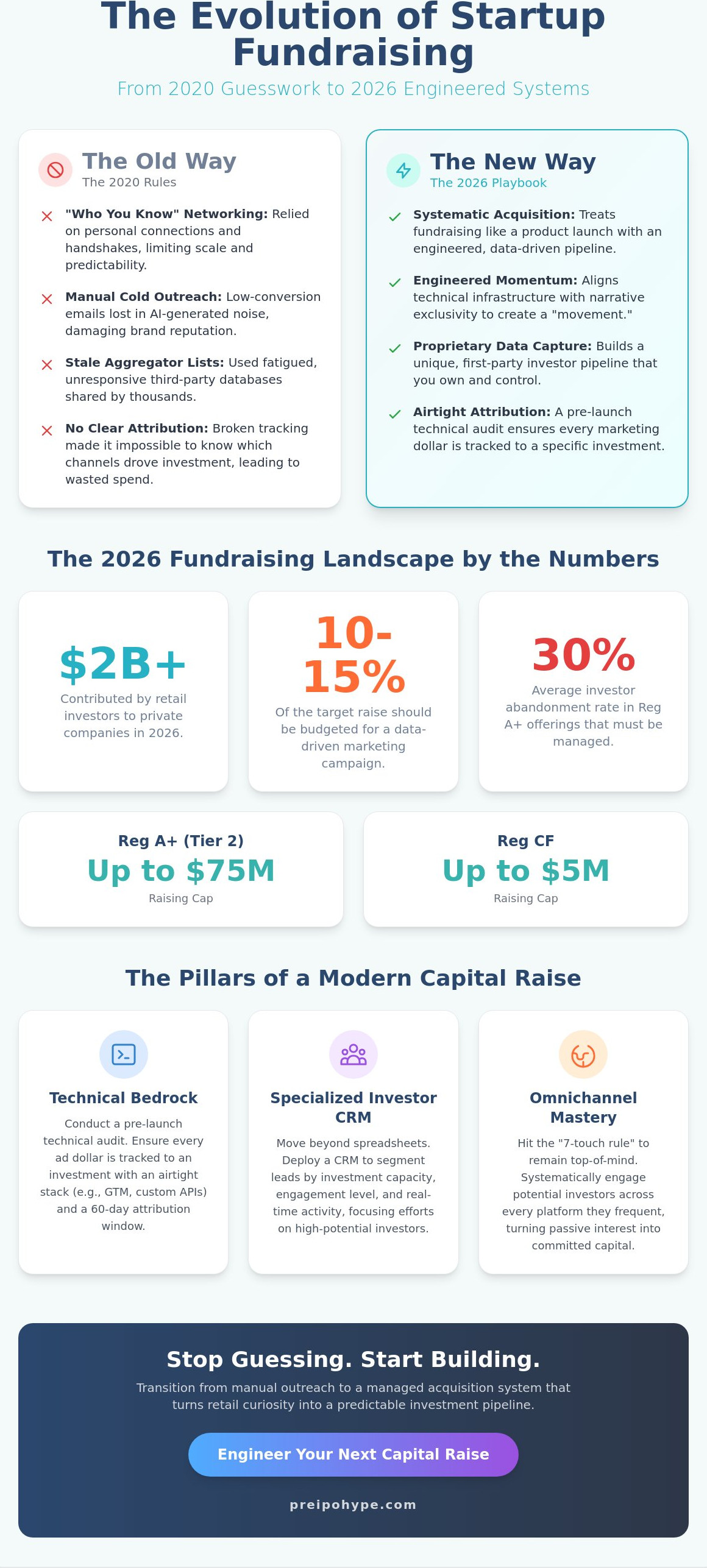
The era of the "lucky" capital raise is over. In a 2026 market where retail investors contributed over $2 billion to private companies, momentum is no longer a happy accident; it's a result of precise engineering. Successful investor lead generation for startups has evolved into a high-stakes data game where institutional curiosity must be systematically harvested, tracked, and converted. If you've struggled with low conversion rates from cold outreach or felt the frustration of managing thousands of retail leads without clear attribution, you aren't alone. Most founders are still playing by 2020 rules in a 2026 environment.
It's time to stop guessing which channels drive investment and start building a predictable pipeline. This article promises to help you master the data-driven systems and omnichannel strategies required to turn passive interest into committed capital. We'll explore the infrastructure needed to handle the rigorous 30 percent abandonment rate often seen in Reg A+ offerings and how to budget the 10 percent to 15 percent of your target raise effectively. You'll learn how to transform your next raise from a desperate struggle into a high-visibility event that commands market attention.
Key Takeaways
- Stop treating fundraising as a networking exercise and start viewing it as a systematic acquisition process designed for the competitive 2026 market.
- Conduct a pre-launch technical audit of your tracking stack to ensure every dollar spent on marketing is attributed to a specific investment outcome.
- Deploy a specialized CRM tailored for investor lead generation for startups to segment leads by investment capacity and real-time engagement levels.
- Leverage an omnichannel strategy to hit the "7-touch rule," ensuring your brand remains top-of-mind across every platform your target investors frequent.
- Transition from manual outreach to managed acquisition systems that turn retail curiosity into committed capital at scale.
The Evolution of Investor Lead Generation in 2026
The capital markets of 2026 have officially outpaced the "who you know" era. In this high-velocity environment, networking has transitioned from a primary strategy to a secondary supplement. Investor lead generation for startups is no longer a series of handshakes; it's a systematic acquisition process built on data and precision. We've moved from the erratic, exhausting founder-led grind toward a platform-led model that treats capital as a product to be sold through engineered discovery.
This evolution is fueled by the maturation of SEC regulations that have democratized lead sources. With Regulation Crowdfunding (Reg CF) allowing raises up to $5 million and Regulation A+ Tier 2 limits at $75 million, the pool of potential backers has exploded. While traditional Venture Capital Financing still plays a vital role, the most successful raises now leverage "engineered discovery" to capture institutional and retail interest at scale.
To better understand how this systematic approach scales, watch this analysis of the lead generation model:
From Cold Outreach to Engineered Momentum
Cold emails are failing. In 2026, the sheer volume of AI-generated noise has made traditional outreach nearly invisible to high-net-worth individuals. The psychological game has changed. You aren't just seeking funding; you're inviting investors to join a movement. This shift moves the narrative from a plea for capital to a showcase of inevitable growth. Engineered Momentum is the strategic alignment of technical infrastructure and narrative exclusivity.
Why Aggregator Databases Are No Longer Enough
Relying on stale, third-party investor lists is a recipe for low conversion. These databases are hit by thousands of startups daily, leaving leads fatigued and unresponsive. The hidden cost of "cheap" lists is the damage to your brand's reputation before you even secure a meeting. Elite founders are pivoting to proprietary data capture and first-party investor lead generation for startups. By leveraging foundation infrastructure, you build a unique competitive advantage that turns cold curiosity into a warm, trackable pipeline that you own entirely. This ownership allows you to track every engagement metric, ensuring you don't waste time on leads that won't convert.
The Technical Bedrock: Foundation Infrastructure and Attribution
The "Foundation" concept is about setting up the digital environment for multi-million dollar raises. It involves more than just a CRM. You need Google Tag Manager integrated with custom API hooks to capture every movement in your funnel. This allows for a seamless data flow between your advertising platforms and your internal tracking systems. This level of technical readiness is what separates elite raises from those that fizzle out. While researching various Startup Funding Options, remember that your ability to track ROI is your greatest leverage.
The 60-Day Attribution Window: Tracking Curiosity to Capital
The investor journey is rarely linear. A lead might engage with a social media ad, read three blog posts, and join a newsletter before finally committing capital. This process takes time. If your tracking only looks at a 7-day window, you'll misattribute your most valuable leads. You'll end up cutting off the very channels that introduce you to your biggest backers.
60-day attribution is the only way to calculate true CAC (Customer Acquisition Cost) for investors. Mapping this path ensures you understand the relationship between top-of-funnel awareness and bottom-of-funnel conversion. It reveals the "invisible" touches that build trust over weeks. This data allows you to optimize your spend based on actual capital raised rather than just surface-level clicks.
Building the Foundation: Technical Setup for High-Stakes Raises
Our Reg CF marketing services provide the technical execution needed to maintain aggressive marketing velocity without sacrificing data integrity. If you're ready to audit your current infrastructure, you can ask our CEO for a deep-dive consultation on your tracking stack. High-stakes raises require high-performance tech. Don't launch until your foundation is solid.
Beyond the Spreadsheet: The Role of a Custom Investor CRM
Why are you still using a sales tool for a capital raise? Standard CRMs like Salesforce or HubSpot are engineered for shipping products, not securing equity. They lack the nuanced tagging and behavioral tracking required for effective investor lead generation for startups. In a high-stakes raise, an investor isn't just another customer; they're a partner whose intent must be decoded through data. A generic spreadsheet can't tell you which lead has the liquidity for a $100,000 check versus a $1,000 retail contribution.
The advantage of a Custom Investor CRM lies in its ability to segment leads by investment capacity and real-time engagement levels. It allows you to automate the follow-up process, ensuring your brand stays top-of-mind without requiring hours of manual intervention. By using behavioral intelligence, you can identify "whales" within a large lead pool. If a prospect opens your pitch deck fifteen times in forty-eight hours, they shouldn't just get an automated email. They need a direct line to your executive team.
Lead Scoring and Behavioral Intelligence
Effective lead scoring goes beyond simple contact information. You need to track specific criteria: pitch deck views, total time spent on your offering page, and engagement with your newsletter. These intent signals allow you to prioritize your outreach based on who is actually leaning in. Integrating a custom investor crm is the only way to manage thousands of retail leads efficiently while ensuring no high-value opportunity slips through the cracks. It transforms a chaotic list of emails into a prioritized heat map of capital interest.
CRM Syncing: Integrating Outreach with Deal Flow Visibility
Your CRM must serve as the single source of truth for both your internal team and your marketing partners. When your outreach is synced with your deal flow visibility, you gain the power to optimize your ad spend in real-time. If a specific campaign is driving high-volume traffic but zero deck views, you can kill it instantly. This level of transparency prevents wasted capital and focuses your resources on the channels that actually move the needle. To see how this data-driven approach fits your specific raise, you can ask our CEO for a personalized CRM strategy audit. Stop guessing and start engineering your momentum with a system designed for the 2026 capital markets.
Omnichannel Mastery: Dominating the Investor Hype Cycle
Visibility is the currency of trust in the 2026 capital markets. If an investor sees your pitch once, you're just another founder in a crowded inbox. If they see you everywhere, you become a movement. Omnichannel mastery is the art of being omnipresent in your target investor's digital life. It's not about spamming; it's about strategic reinforcement. Successful investor lead generation for startups requires a unified "Hype Cycle" that coordinates email sequences, social advertisements, and high-tier PR into a singular, undeniable narrative of momentum.
The 7-touch rule is more relevant now than ever. An investor rarely writes a check after the first impression. They need multiple exposures across different platforms to validate your startup's legitimacy. We use niche newsletters like Invst Guru to provide that critical third-party validation. When an investor sees your deal mentioned in an elite financial newsletter after seeing an ad on LinkedIn, the psychological barrier to entry drops. You're no longer a stranger; you're an opportunity they can't afford to miss.
Multi-Touch Campaigns: Engaging Investors from Every Angle
Your outreach shouldn't exist in a vacuum. A lead who views your deck via a LinkedIn message should immediately be caught in a retargeting loop on Meta and programmatic financial news sites. This creates a synergy that keeps your deal top-of-mind during the long decision cycle. By layering these channels, you ensure that curiosity doesn't evaporate. You can explore our specific digital marketing and advertising tactics to see how we engineer these multi-touch environments.
Content as Capital: Framing the Narrative of Exclusivity
In the private markets, investor lead gen is fundamentally a content marketing problem. You aren't just selling shares; you're selling a future reality. This requires a "Story Framework" that speaks directly to institutional skepticism while fueling retail excitement. Your content must frame your raise as an exclusive event with a closing window. It's about creating a sense of rare access. To see this narrative framing in action, we recommend you watch our video funnel. It demonstrates how to transform technical data into an aspirational journey that converts.
Ready to dominate your sector's hype cycle? Book a 30-minute strategy session to map out your omnichannel roadmap today and stop leaving your visibility to chance.
Partnering for Liquidity: The Pre-IPO Hype Advantage
$100M+ Facilitated: A Data-Driven Track Record
Our methodology is backed by the weight of over $100M in facilitated funding for more than 230 companies. This isn't a result of luck. It's the byproduct of engineered momentum. We've seen firsthand how oversubscribed rounds are built by treating "Hype" as a time-sensitive asset that must be deployed with surgical timing. If you're currently vetting partners to help lead your next round, you should review our guide on how to hire an equity crowdfunding marketing agency to understand the selection criteria required for success in today's private markets.
Scaling Your Raise with Institutional Precision
The era of the struggling founder-led raise is over. If you're ready to evaluate your current lead gen pipeline and see where the leaks are costing you capital, it's time for a professional audit. Booking a strategy session is the final step in moving from a DIY mindset to institutional-grade execution. Remember, in 2026, capital isn't raised; it's engineered. The keys to the gated financial world are available to those who act with decisive ambition.
Secure Your Place in the New Capital Order
Capital is no longer a game of chance. We've explored how the shift from passive networking to engineered discovery allows you to capture institutional curiosity at scale. By leveraging proprietary 60-day attribution tracking and foundation infrastructure, you gain a level of clarity that your competitors simply don't have. It's about turning a fragmented list of leads into a high-velocity movement that commands market attention.
Book Your Strategic Fundraising Roadmap Session today and take command of your company's trajectory. Let's build your momentum together.
Frequently Asked Questions
What is the best way to generate investor leads for a startup in 2026?
The best way to generate investor leads in 2026 is through an engineered omnichannel ecosystem that combines digital advertising, content strategy, and automated retargeting. This approach moves beyond simple cold outreach by creating a "Hype Cycle" where prospects encounter your brand across multiple touchpoints. It's about building a systematic acquisition process that converts curiosity into committed capital through data-driven precision.
How much does investor lead generation usually cost for a Reg CF raise?
For a Regulation Crowdfunding (Reg CF) raise, industry data suggests startups should budget between 10 percent and 15 percent of their target raise for marketing and lead generation. This covers the necessary digital advertising, content creation, and foundation infrastructure required to reach the $5 million fundraising limit. Effective campaigns ensure every dollar spent is tracked through deep attribution to maximize your return on ad spend.
Can I use a standard sales CRM for my investor outreach?
You can use a standard CRM, but it's often a recipe for failure because those tools are built for product sales rather than equity transactions. A Custom Investor CRM allows you to tag leads by investment capacity and track specific behaviors like pitch deck views or subscription agreement progress. This level of granularity is essential for managing thousands of retail leads without losing high-value institutional prospects in the noise.
What is the difference between retail investor leads and institutional investor leads?
Retail investor leads are generally non-accredited individuals participating through Reg CF or Reg A+, while institutional leads represent accredited investors or firms with higher capital thresholds. In 2026, an accredited investor must have an annual income exceeding $200,000 or a net worth over $1 million, excluding their primary residence. Retail leads often require more volume and automated nurturing, whereas institutional leads demand high-touch, data-heavy engagement.
How long does it take to see results from an investor acquisition campaign?
You should expect to see top-of-funnel engagement almost immediately, but actual capital commitments usually follow a 60-day cycle. Investor lead generation for startups isn't an overnight process; it requires multiple "touches" to build trust. While your foundation infrastructure will track leads from day one, the "Hype Cycle" typically hits its stride after the first few weeks of consistent omnichannel presence and narrative reinforcement.
Is it legal to use digital advertising for investor lead generation?
It's legal to use digital advertising for investor lead generation provided you adhere to specific SEC guidelines like those for 506(c), Reg CF, or Reg A+ offerings. These regulations allow for general solicitation, meaning you can market your raise to the public. However, you must ensure all creative assets are compliant and that you're using the correct disclosures to avoid regulatory bottlenecks that can stall your momentum.
What are the most common mistakes founders make when reaching out to investors?
The most common mistake founders make is relying on a "founder-led" manual grind that doesn't scale. Many startups also fail to implement proper attribution, leaving them blind to which marketing channels are actually driving investments. Without a systematic approach, founders often burn out on cold LinkedIn messages instead of building a predictable, platform-led acquisition engine that handles the heavy lifting of lead qualification.
How do I track the ROI of my investor marketing spend?
Tracking the ROI of your investor marketing spend requires a proprietary 60-day attribution window and deep analytics integration. By using Google Tag Manager and custom API hooks, you can map the entire journey from the first ad click to the final wire transfer. This allows you to calculate a precise Customer Acquisition Cost (CAC) for every investor, ensuring your marketing budget is deployed with institutional precision and clear accountability.
Disclaimer
Educational only. Not investment, tax, or legal advice. Pre-IPO Hype is investor relations infrastructure for Regulation CF and Regulation A+ raises. We are not a broker-dealer, funding portal, or investment adviser, and we do not offer or sell securities or make investment recommendations. Any securities offering is made only by the issuer, through its own offering documents and, where required, a registered intermediary.


