
Investor Lead Scoring Models: Engineering Momentum for High-Growth Capital Raises
Most founders treat their CRM like a digital Rolodex when it should be functioning as a high-precision heat map for capital. In a market where the Reg CF annual offering cap sits at $5,000,000 and competition for attention is fierce, chasing every "interested" lead is a fast track to a stalled raise. You've likely felt the exhaustion of pitch calls with tire-kickers who dominate your calendar but vanish the moment the subscription agreement hits their inbox. It's a drain on your focus and a waste of your most valuable asset: momentum.
We agree that visibility into your funnel shouldn't be a luxury. You deserve to know exactly which marketing channels are driving actual investment rather than just vanity clicks. This article delivers the definitive framework for investor lead scoring models built for the 2026 fundraising landscape. You'll learn how to rank high-intent investors with institutional precision, scale personalized outreach, and trigger automated workflows that capture "hot" leads while they're still in the peak of their excitement. We're going to show you how to transform raw data into a momentum engine that converts digital curiosity into realized capital.
Key Takeaways
- Master the art of filtering market noise to isolate high-intent backers who are ready to commit capital immediately.
- Decipher the anatomy of momentum by leveraging both explicit demographic data and implicit behavioral triggers to identify your ideal investor profile.
- Implement advanced investor lead scoring models that assign precise point values to "Capital Intent" actions, ensuring your team only prioritizes the hottest opportunities.
- Discover how to scale your raise using Foundation Infrastructure and automated workflows that trigger personalized outreach at the exact moment of peak interest.
What is Investor Lead Scoring and Why Does It Drive Capital?
In the high-velocity world of equity crowdfunding, attention is the currency, but capital is the only metric that matters. Every founder knows the initial rush of a viral campaign launch, only to be met later with the crushing reality of a stagnant funding bar. This disconnect happens because most raises lack a sophisticated lead scoring methodology. Without a way to distinguish a casual observer from a committed backer, your Investor Relations team is essentially flying blind. You're treating every click as a conversion, which is a recipe for operational burnout.
Implementing investor lead scoring models allows you to rank prospective investors based on their statistical likelihood to participate in your round. It transforms your CRM from a static list of names into a dynamic engine of prioritization. By focusing your resources on high-intent "whale" leads, you drastically reduce the cost per dollar raised. You aren't just collecting data; you're engineering a psychological shift where curiosity is systematically converted into capital. This prioritization ensures that your most expensive resources are always aimed at the highest potential returns.
The Crisis of Unqualified Lead Volume
High-growth companies often fail to close rounds despite having massive email lists. They fall into the trap of treating a retail investor lead with a $2,500 limit exactly the same as a high-net-worth individual capable of a $124,000 commitment. This lack of differentiation creates a bottleneck that stifles growth. Investor Lead Scoring is the technical bedrock of elite capital raises.
Unqualified volume is noise that obscures opportunity. When your team spends hours answering basic questions from "tire-kickers," they miss the window to close a sophisticated backer who just downloaded your offering circular. A robust model identifies these high-value signals instantly. It ensures your most persuasive content reaches the right eyes at the right time, preventing your message from being buried in the inbox of someone who was never going to write a check.
The Momentum Factor: Why Timing is Everything
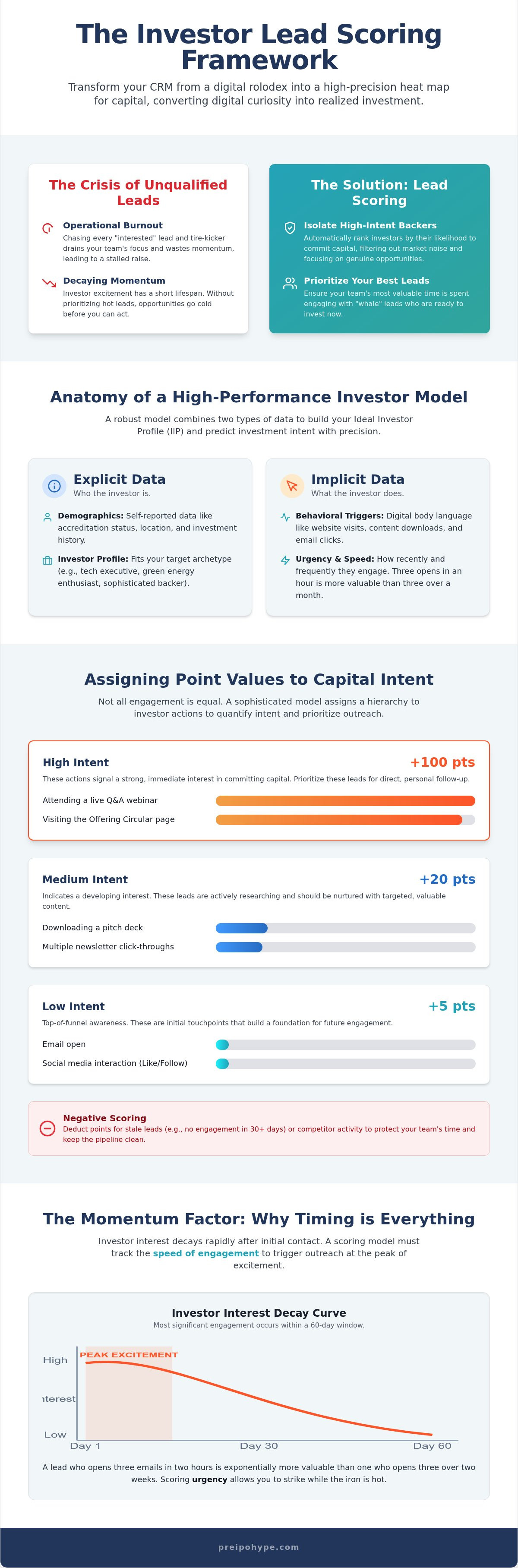
Fundraising is a game of physics. Investor interest begins to decay the moment a lead enters your funnel, typically following a sharp curve within the 60-day attribution window. If you don't strike while the excitement is high, the lead goes cold. You lose the chance to capitalize on the very momentum you worked so hard to build.
Your CRM must do more than track clicks; it must score the "speed" of engagement. A lead who opens three emails in two hours is exponentially more valuable than one who opens three emails over two weeks. By treating hype as a legitimate metric for market momentum, investor lead scoring models allow you to trigger automated outreach during the peak of investor enthusiasm. This isn't just marketing. It's the tactical application of urgency to secure your financial future before the window of opportunity closes.
The Anatomy of a High-Performance Investor Lead Scoring Model
Elite capital raises don't happen by accident. They're engineered. While generic SaaS platforms focus on job titles or company revenue, high-growth companies need a framework built for securities transactions. The architecture of high-performance investor lead scoring models rests on two distinct pillars: explicit and implicit data. Explicit data tells you who the investor is; implicit data reveals how badly they want in. Combining these creates your Ideal Investor Profile (IIP), a targeted archetype that varies by sector, whether you're raising for a pre-IPO tech play or a green energy project.
Not all engagement is created equal. A "like" on a LinkedIn post is a whisper; a 45-minute webinar attendance is a shout. In a sophisticated model, we assign a hierarchy to these signals to ensure your resources are spent on the most probable conversions.
- Low Intent (+5 pts): Email open or social media interaction.
- Medium Intent (+20 pts): Multiple newsletter click-throughs or downloading a pitch deck.
- High Intent (+100 pts): Attending a live Q&A or visiting the Offering Circular page.
You must also account for friction through negative scoring. Deducting points for stale leads who haven't engaged in 30 days or identifying competitors "mystery shopping" your raise protects your Investor Relations team's time. If you're struggling to map these signals within your current stack, it might be time to refine your scoring logic with a specialist.
Explicit Signals: Identifying the 'Power' Investor
Explicit signals are the non-negotiables of investor fit. For a Reg CF or Reg A+ raise, self-reported net worth and accredited status are the primary indicators of a "Power" investor. We look for historical patterns. Have they backed similar high-growth ventures before? Do they understand the 12-month rolling limits of Reg CF? Geographic alignment is equally vital. There's no sense scoring a lead highly if they're based in a jurisdiction restricted by Reg S or specific state blue-sky laws that don't align with your current filing.
Implicit Signals: Tracking the Digital Footprint
Digital body language is the ultimate predictor of capital commitment. Implicit signals track the omnichannel journey across Facebook ads, LinkedIn, and exclusive newsletters. We prioritize frequency and recency. A lead who visits your valuation calculator twice in 24 hours is a "Hot Lead" requiring immediate, personalized outreach. This math allows you to capture the peak of interest before the 60-day attribution window closes and interest naturally decays. High-performance investor lead scoring models turn these fleeting moments of digital curiosity into permanent entries on your cap table.
Investor Lead Scoring vs. Traditional B2B Models
Selling a software subscription is a linear process. Selling a piece of your company's future is a psychological event. While traditional B2B sales models focus on solving a current operational pain, investor lead scoring models must measure a lead's belief in a future realization event. This fundamental shift in "transaction type" means your scoring logic cannot simply mirror a standard sales funnel. In a capital raise, you aren't just looking for a user; you're looking for a partner who is willing to risk capital on your vision.
Regulatory constraints also create a unique environment for data collection. SEC compliance under Reg CF and Reg A+ dictates the boundaries of how you can engage with prospective backers. Unlike B2B marketing, where you might scrape every available data point for a cold outreach campaign, investor scoring must prioritize first-party data and self-reported signals to remain compliant. This necessitates a model that is both highly automated and legally sound, ensuring that your pursuit of momentum never compromises your regulatory standing.
The attribution window is another critical differentiator. While a B2B enterprise deal might take six months to close, the lifecycle of a retail investor lead is much shorter. We operate within a 60-day tracking framework because the "crowd" moves with the market. If a lead hasn't committed within that window, their interest has likely decayed. Your scoring system must be agile enough to capture this high-velocity movement before the window of opportunity closes.
Why HubSpot and Salesforce Often Fail Founders
Most founders reach for HubSpot or Salesforce because they are the industry standards for sales. However, these platforms often fail in a fundraising context because they lack native integration with major equity funding portals. Tracking "Investor ROI" becomes a manual nightmare without custom-built IR infrastructure. To maintain elite momentum, you need a Custom Investor CRM specifically designed to handle the nuances of securities transactions and real-time attribution.
Score Degradation in the Private Markets
An investor lead "cools" exponentially faster than a software lead. In the private markets, the half-life of a lead score is often measured in days. Market volatility can shift an investor's sentiment overnight; a dip in the broader indices might turn a "Hot" lead into a "Nurture" prospect instantly. Effective investor lead scoring models account for this by aggressively degrading scores for inactivity. This ensures your team is always focused on the leads who are currently active in the market, rather than chasing ghosts from three weeks ago.
How to Build Your Investor Scoring System for a Reg CF/Reg A+ Raise
Engineering a raise that breaks through the $5,000,000 Reg CF cap or scales toward a $75,000,000 Reg A+ Tier 2 offering requires more than just a large audience; it requires a structured hierarchy of engagement. Building effective investor lead scoring models is a five-step process designed to separate the signal from the noise. You start by auditing your existing data to identify the "Common Denominators" of your top 10% of backers. Are they repeat equity crowdfunding participants? Do they primarily engage with your content on weekends? These patterns form the baseline of your scoring logic.
Once the baseline is set, you must assign point values based on "Capital Intent." A lead clicking the "Invest Now" button on your portal is a +50 event, while a simple email open might only be a +2. This leads to Step 3: establishing the Marketing Qualified Lead (MQL) threshold. This is the "tripwire" that signals your Investor Relations team to initiate direct outreach. You then automate your omnichannel response based on these score tiers, sending an immediate SMS to "Hot" leads while keeping "Warm" leads in a high-value newsletter sequence. Finally, you must refine the model every 14 days. Use actual conversion data from the portal to see if your high-score leads are truly the ones signing the subscription agreements.
Integrating Omnichannel Mastery
To feed your scoring engine, you need a constant stream of high-quality data from your Digital Marketing and Advertising efforts. Your model should track the 60-day attribution path from the first hype-ad a lead sees on social media to their final digital signature. By leveraging strategic newsletter exposure, you can spike lead scores across your entire database simultaneously, creating a surge of momentum that funding portals reward with higher organic visibility. This isn't just about traffic; it's about tracking the movement of capital through every touchpoint.
Setting the Threshold for Direct Outreach
Founder time is your company's most expensive resource. You shouldn't be personally pitching to every retail investor. Instead, use high-value actions like the Ask the CEO link as a high-score trigger event. When an investor reaches out with a sophisticated question, they've likely crossed your MQL threshold. This allows you to balance automation with the "elite insider" feel required for high-net-worth raises. If you want to ensure your scoring logic is calibrated for maximum conversion, it's time to schedule a technical audit of your raise infrastructure.
Scaling Capital with Pre-IPO Hype’s Custom CRM
Engineering a high-growth raise isn't about luck; it's about the technical superiority of your stack. While the market discusses broad trends, elite founders are deploying investor lead scoring models that turn behavioral data into a competitive weapon. Our Foundation Infrastructure has become the industry standard because it treats fundraising as a precision science rather than a volume game. By integrating omnichannel signals into a single source of truth, we ensure that every dollar of your marketing spend is accounted for and every high-intent lead is captured before their interest cools.
The heart of this operation is our proprietary Custom Investor CRM. This isn't a generic sales tool; it is a specialized engine built to automate the Hype Cycle, moving leads from initial digital curiosity to a final capital commitment. To date, these investor lead scoring models have powered over $100M in funding for more than 230 companies. We don't just track leads. We engineer momentum by identifying the exact moment an investor is ready to commit, allowing you to scale your raise with institutional efficiency.
Data-Driven Fundraising: The Competitive Edge
Founders who master their data win. In a crowded market, the ability to see which newsletter blast or social ad drove a specific investment is the difference between a stalled round and a sell-out. Pre-IPO Hype provides the lens through which you view your entire investor acquisition strategy, creating an elite experience for both the founder and the backer. If your current system feels like a black box, it's time to audit your readiness with a strategic consulting and advisory session.
The Future of Investor Acquisition
Looking toward the 2026 landscape, the role of predictive AI in investor acquisition will only intensify. Scoring will move beyond simple point tallies to real-time sentiment analysis, predicting capital inflow before it even hits the portal. But technology is only half the battle. The goal is to move beyond the transaction and build a community of long-term backers who follow your journey from Reg CF to IPO. For those ready to lead this movement and gain insider access to the tools of the future, join the Pre-IPO Hype Club today.
Master the Science of Capital Momentum
The era of treating every CRM entry as an equal prospect is over. Elite founders realize that high-growth raises aren't won through volume; they're won through the surgical application of data. By implementing investor lead scoring models, you've moved beyond the "tire-kickers" to focus exclusively on the high-intent backers who drive your round toward success. You now have the framework to distinguish between casual curiosity and serious capital commitment using behavioral signals that generic tools simply miss.
Success in the 2026 fundraising landscape requires more than a great pitch; it requires the technical bedrock of specialized infrastructure. We've facilitated over $100 million in funding for 230+ companies by mastering the nuances of Reg CF and Reg A+ frameworks. Our proprietary 60-day attribution tracking ensures that no "hot" lead ever goes cold due to a lack of visibility. It's time to stop chasing ghosts and start engineering your company's future with institutional precision and infectious momentum.
Are you ready to transform your fundraising funnel into a high-conversion engine? Scale your capital raise with the Custom Investor CRM by Pre-IPO Hype. The market is moving fast; make sure you're the one setting the pace.
Frequently Asked Questions
What is a good lead score for a potential investor?
A "good" score is relative to your specific scale, but a "hot" lead typically crosses a threshold representing the top 10% of engagement activity. If your model uses a 100-point cap, any lead scoring above 80 should trigger immediate, personalized outreach. We define these benchmarks by analyzing the behavioral patterns of the most active backers in previous high-growth rounds.
How do you score an investor who hasn't provided financial data yet?
You bridge the data gap by tracking "digital body language" through implicit signals. High-intent actions, such as repeated visits to the offering circular page or engagement with valuation calculators, allow you to assign a high intent score before an investor self-reports their net worth. This predictive approach identifies potential "whales" early in the 60-day attribution window.
Can I use standard B2B lead scoring for my equity crowdfunding campaign?
No, standard B2B models are fundamentally insufficient for securities transactions. Investor lead scoring models must prioritize capital intent and regulatory fit rather than corporate job titles or company revenue. Equity crowdfunding requires tracking "hype" as a legitimate momentum metric, which standard SaaS-focused CRMs are not designed to quantify or automate effectively.
What is the difference between lead scoring and lead grading in fundraising?
Scoring measures interest while grading measures fit. Scoring is dynamic and based on behavioral data like email clicks and webinar attendance; grading is static and based on explicit data like accreditation status or geographic location. A high-scoring lead with a low grade is a "fan," whereas a high-scoring lead with a high grade is your primary target for capital commitment.
How often should I update my investor lead scoring model during a live raise?
You should refine your scoring logic every 14 days during an active campaign. This bi-weekly audit allows you to compare current lead scores against actual conversion data from your funding portal. If your high-score leads aren't committing capital, your point weights are likely misaligned and require immediate adjustment to protect your raise's momentum.
Does lead scoring help with SEC compliance and Reg CF regulations?
Yes, it provides a structured framework for managing communications within strict regulatory boundaries. By using investor lead scoring models, you can ensure that critical disclosures and offering updates are prioritized for high-intent leads. This systematic approach helps maintain compliance with "Test the Waters" and Form C standards by automating the delivery of required information based on engagement levels.
What are the best implicit signals to track for investor intent?
The most powerful signals include visiting the legal documents page, downloading the subscription agreement, or attending a live founder Q&A. Frequency and recency act as critical multipliers. A lead who engages across three different channels in 48 hours demonstrates exponentially more intent than a lead who opens a single newsletter once a week.
How does negative scoring prevent 'investor fatigue' in my newsletter list?
Negative scoring automatically cools down leads who stop engaging with your content over time. By deducting points for 30 days of inactivity, you can move these individuals into a lower-frequency "nurture" bucket. This prevents you from burning out your list with aggressive daily updates, preserving your brand's exclusivity and authority for when you reach major funding milestones.
Disclaimer
Educational only. Not investment, tax, or legal advice. Pre-IPO Hype is investor relations infrastructure for Regulation CF and Regulation A+ raises. We are not a broker-dealer, funding portal, or investment adviser, and we do not offer or sell securities or make investment recommendations. Any securities offering is made only by the issuer, through its own offering documents and, where required, a registered intermediary.


