
Investor Lead Scoring Models: Engineering Momentum in the 2026 Private Market
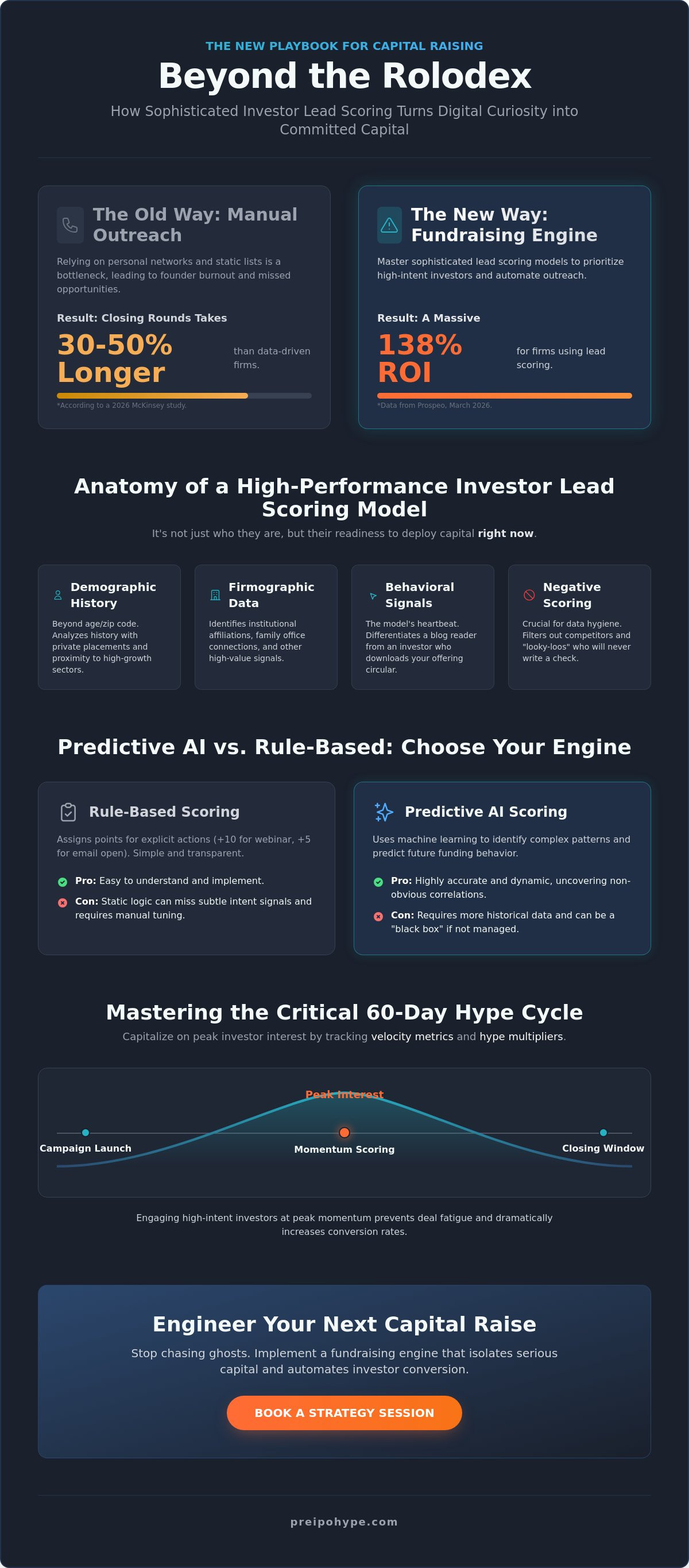
Why are some firms closing oversubscribed rounds in weeks while others spend months chasing ghosts? According to a 2026 McKinsey study, fund managers who rely exclusively on personal networks take 30 to 50% longer to close their offerings. In a market where capital is concentrating among high-conviction managers, the "warm intro" is no longer your greatest asset; it's your biggest bottleneck. You know the frustration of a packed newsletter list that yields zero checks and the sting of missing a high-intent signal during a 60-day hype cycle.
This predictive approach isn't limited to venture capital; in the digital asset space, Interfin Terminal uses similar AI-driven signals to track market momentum, which you can explore if you click here.
It's time to move beyond guesswork. By mastering sophisticated investor lead scoring models, you can achieve a 138% return on investment compared to firms that ignore data-driven prioritization. We'll show you how to engineer momentum by identifying high-net-worth interest the moment it surfaces. You'll gain a clear framework to automate outreach, isolate serious capital from "looky-loos," and drive higher conversion rates for your Reg CF or Reg A+ campaigns. We are diving into the exact technical architecture that turns digital curiosity into institutional-grade capital commitment.
Key Takeaways
- Shift from manual outreach to a methodology that ranks "intent-to-fund," ensuring your team prioritizes capital commitment over mere curiosity.
- Deploy advanced investor lead scoring models that integrate demographic history and firmographic data to isolate high-net-worth individuals within your funnel.
- Evaluate the performance gap between traditional rule-based scoring and predictive AI models to identify the most efficient engine for your specific fundraising goals.
- Master the use of velocity metrics and hype cycle multipliers to capitalize on peak investor interest during the critical 60-day campaign window.
- Leverage custom investor CRM systems and omnichannel outreach to convert scored leads into a movement of committed capital.
Beyond the Rolodex: Why Static Investor Lists Fail in 2026
The elite "little black book" is officially a relic. In the 2026 private market, relying on a static list of contacts is like bringing a paper map to a high-frequency trading floor. Capital moves faster than ever, and the sheer volume of digital noise has rendered manual outreach obsolete. If you're still cold-calling a spreadsheet of "potential" investors, you aren't just wasting time; you're actively hemorrhaging opportunity. High-growth firms now use data-driven marketing systems to facilitate over $100M in funding, moving far beyond the limitations of the traditional rolodex.
Success now demands a shift from passive profiling to active intent. This is where investor lead scoring models come into play. Unlike traditional B2B sales metrics that treat every lead as a "buyer," these frameworks rank "intent-to-fund" by measuring engagement velocity and capital readiness. It isn't just about who an investor is, but whether they're ready to deploy capital right now. Adopting a "spray and pray" approach doesn't just destroy your brand authority; it creates significant SEC compliance risks by failing to track sophisticated investor signals across the 60-day hype cycle.
To better understand the technical side of this framework, watch this helpful video:
The High Cost of Unscored Leads
Founder burnout is the silent killer of the modern capital raise. Chasing "looky-loos" who never intend to write a check drains your most valuable resource: focus. When you fail to prioritize, high-intent investors suffer from deal fatigue because they aren't engaged quickly enough. This inefficiency skyrockets your cost-per-acquisition (CPA). Data from Prospeo in March 2026 shows that teams using investor lead scoring models see a 138% ROI, while those without them struggle to maintain momentum during critical funding windows.
The 2026 Paradigm Shift: From CRM to Fundraising Engine
The 2026 market demands real-time engagement tracking over static profiling. We've moved from a world of institutional gatekeeping to democratized digital acquisition where speed is the primary currency. You don't need a database; you need a fundraising engine that identifies momentum as it happens. Investor lead scoring is the technical bedrock of elite capital raises, providing the precision needed to convert digital curiosity into immediate capital commitment. To see how this infrastructure fits your specific round, you can schedule a strategy session to review your current funnel.
The Anatomy of a High-Performance Investor Lead Scoring Model
Behavioral signals act as the heartbeat of your model. There is a fundamental difference between an individual who reads a blog post and one who downloads your offering circular. Negative scoring is equally critical. You must filter out professional tire-kickers and competitors who inflate your numbers without any intention of funding. This keeps your data clean and your outreach focused on capital realization. While competitors often treat investors like generic B2B buyers, elite models recognize that an investor is a partner in a regulated transaction, requiring specific compliance-based attributes.
Essential Fit Attributes for Private Placements
For offerings under Rule 506(c), your model must heavily weight accreditation status. Self-identified income and net worth thresholds are the gatekeepers of your funnel. Beyond wealth, look for industry alignment. Does this lead have a track record of backing the specific sector you dominate? A lead watching your full video funnel presentation is a high-intent signal that should trigger immediate prioritization in your outreach strategy. This level of granular tracking ensures you aren't wasting breath on those who lack the capacity or the mandate to invest.
Engagement Signals That Predict Funding
True intent reveals itself in the technical details. High-performance models track multiple visits to the Form C or Offering Circular pages as a primary indicator of serious interest. Interaction with a valuation calculator or ROI guide shows an investor is already modeling their potential position in your company. We also look at webinar attendance duration. A lead who stays for the full Q&A session is exponentially more valuable than one who simply registers and never shows. Since AI-powered diligence has reduced evaluation times by 60 to 70% in 2026, you must capture these signals instantly to stay ahead of the competition.
If your current system can't distinguish between a casual click and a committed check, it's time to audit your infrastructure with a specialist who understands the 60-day hype cycle.
Predictive vs. Rule-Based Models: Choosing Your Fundraising Engine
How do you decide between a rigid set of rules and a self-evolving algorithm? In the 2026 private market, your choice of investor lead scoring models determines whether you're leading the market or chasing it. Traditional rule-based scoring relies on human-defined values. You decide that downloading a deck is worth 50 points, while a newsletter signup is worth five. It's clean, transparent, and provides a clear audit trail for legal compliance. However, it often lacks the fluidity to account for the volatile sentiment and "hype" that drives modern Reg CF raises.
Predictive AI models bridge this gap. By using machine learning to identify hidden patterns, these systems recognize "lookalike" investors who mirror the digital footprint of your most successful previous backers. They don't just wait for an action; they predict the likelihood of funding based on subtle behavioral shifts. The most effective strategy is a hybrid approach. It combines your founder intuition with algorithmic precision, ensuring that the critical 60-day attribution cycle is fully optimized for maximum capital conversion. This is how elite firms manage the $28 billion projected to be deployed by corporate venture capital in 2026.
When to Use Rule-Based Scoring
Manual scoring is ideal for early-stage raises where your database is still growing. It allows your Investor Relations team to set firm Marketing Qualified Lead (MQL) thresholds that trigger specific omnichannel outreach events. This transparency is vital. It proves to regulators that your prioritization is based on objective engagement metrics rather than arbitrary selection. If your database is under 5,000 leads, a well-tuned rule-based system provides the clarity you need to keep your outreach team focused on high-probability targets without the complexity of a full AI integration.
The Power of Predictive Analytics in Elite Raises
Elite raises demand a more sophisticated engine that handles the rapid movement of high-growth markets. Predictive analytics can automate score degradation, instantly flagging leads that have gone cold so you don't waste energy on yesterday's interest. These models excel at spotting high-conviction investors who might not follow a standard path but exhibit the same behaviors as your top funders. To execute this at scale, you need a Custom Investor CRM designed to turn raw data into a prioritized strike list. This infrastructure allows you to act while momentum is at its peak, transforming a sea of signups into a movement of committed capital.
Implementing Momentum Scoring: Tracking the Investor Hype Cycle
Time is the primary enemy of any capital raise. In the compressed 60 to 90-day window of a Reg CF or Reg A+ offering, a lead that was "hot" yesterday can go cold by tomorrow morning. Traditional investor lead scoring models often fail because they treat engagement as a static value. To win in 2026, you must implement momentum scoring. This approach uses the Velocity Metric to measure how quickly a lead moves through your funnel. It's the difference between someone who opens three emails over a month and someone who watches your entire pitch video, clicks the offering circular, and visits the valuation calculator within twenty minutes.
We apply a "Hype Cycle" Multiplier to these high-velocity actions. As your campaign nears its closing date or hits specific funding milestones, the scoring weight for time-sensitive actions increases. This ensures your IR team isn't just calling the "best" leads, but the leads who are most likely to convert right now. Momentum scoring prevents capital leakage during the final 48 hours of a raise by ensuring high-velocity leads receive immediate, automated closing triggers when FOMO is at its peak. By integrating these scores across email, social, and SMS touchpoints, you create a seamless omnichannel experience that mirrors the rapid movement of high-growth markets.
Step-by-Step: Building Your Momentum Framework
Your framework begins by defining the "Active Window" for your raise. For most Reg CF campaigns, this is the 60-day hype cycle where interest is most volatile. You must assign heavy weight to time-sensitive actions like clicking the "Invest" button or interacting with the subscription agreement. To track this cross-channel velocity effectively, you need a robust Foundation Infrastructure that captures every touchpoint in real time. This technical bedrock allows you to see the movement of capital before it actually hits the escrow account.
Addressing the #1 Objection: "Is This Too Aggressive?"
We often hear concerns that real-time tracking feels too aggressive for the financial sector. It's vital to differentiate between "aggressive sales" and "sophisticated prioritization." In reality, high-performance scoring improves the investor experience. It reduces irrelevant noise for those who aren't ready while providing deep, timely information to those who are. You're simply respecting the investor's time by providing the right data at the moment of highest interest. We maintain strict ethical and legal boundaries by ensuring all behavioral tracking remains within the disclosure requirements of modern private placements.
If you're ready to stop losing capital to slow follow-ups, you can request a custom momentum audit to see where your funnel is leaking potential checks.
Engineering Capital: How Pre-IPO Hype Automates Investor Conversion
The most sophisticated investor lead scoring models are only as effective as the engine that executes them. At Pre-IPO Hype, we don't just categorize interest; we weaponize it. Our Custom Investor CRM is engineered specifically for the volatile 60-day hype cycle, ensuring that every high-intent signal triggers a precise, omnichannel response. Whether it's a personalized SMS follow-up or a targeted digital ad, our system ensures your brand remains the primary focus of your most valuable leads. This isn't just about tracking data. It's about turning curiosity into committed capital through a movement that feels both elite and accessible. We handle technical jargon and performance metrics with institutional precision while maintaining the aspirational energy that attracts early-stage backers.
Our track record is a testament to this data-driven approach. We've facilitated over $100M in funding for more than 230 high-growth companies by connecting restricted information with broader opportunity. We provide the "Insider Advantage" that was once reserved for institutional giants, now democratized for ambitious founders. By mastering the rhythm of high-growth markets, we help you maintain a steady pulse of opportunity that never feels frantic, only urgent. Our omnichannel mastery ensures that your message reaches the right desk at the exact moment an investor is ready to act, effectively automating the path from first click to final check.
From Lead to Legacy: Our Strategic Roadmap
We integrate scoring directly into your initial campaign setup, ensuring your Foundation Infrastructure is ready for day one. Refining these models requires more than just software; it requires the strategic insight found in our Consulting and Advisory Services. We analyze the behavioral signals unique to your industry to set thresholds that actually result in funding. As the market shifts, our management retainer ensures your scoring logic evolves, protecting your brand authority and maintaining your momentum toward future realization events. We don't just launch campaigns; we build the infrastructure for long-term capital acquisition.
Your Next Move in the Market
Stop guessing which leads matter and start engineering your raise with mathematical certainty. The difference between a failed round and a historic success often comes down to the speed and accuracy of your conversion engine. You can ask our CEO anything about your raise to see how these frameworks apply to your specific sector and goals. Decisive founders use our Reg CF Marketing Services to turn vision into a funded reality. The tools for elite fundraising are now within your reach, provided you act with the conviction the 2026 market demands.
Capture the Capital Movement Before the Window Closes
The 2026 private market doesn't reward the patient; it rewards the precise. Transitioning from static rolodexes to dynamic investor lead scoring models is the only way to maintain the velocity required for an oversubscribed raise. You've seen how tracking intent-to-fund and leveraging predictive analytics can transform a sea of window shoppers into a concentrated pool of committed capital. By isolating high-intent signals during your 60-day hype cycle, you ensure your outreach team hits the right desks at the exact moment of peak interest.
It's time to stop guessing and start closing. Secure your 30-minute fundraising strategy session with our team and start building your legacy. Your future cap table is waiting.
Frequently Asked Questions
What is the difference between an investor lead and a standard B2B lead?
An investor lead is a potential financial partner in a regulated equity transaction rather than a simple purchaser of goods. While B2B leads are scored on product fit and budget, investor leads require validation of accreditation status and historical backing of similar high-growth sectors. This distinction is critical because an investor's participation carries legal weight and long-term cap table implications that a standard customer does not.
Can lead scoring models be used for Regulation CF (Reg CF) campaigns?
Yes, investor lead scoring models are essential for Regulation CF campaigns due to the high volume of retail interest they generate. These models allow you to automatically separate casual observers from high-conviction backers who are ready to commit capital. By ranking leads based on their interaction with your Form C or valuation calculator, you can prioritize outreach to those most likely to close before your 60-day hype cycle ends.
How many points should I assign to an investor who downloads my pitch deck?
A pitch deck download typically warrants a high value, often 40 to 60 points, as it signals a transition from general curiosity to active due diligence. However, this action should be weighted less than downloading an offering circular or interacting with a subscription agreement. The goal is to create a hierarchy of intent where deep technical review outranks high-level marketing consumption.
Is predictive lead scoring better than manual rule-based scoring for startups?
Predictive scoring is superior for scaling firms with large databases, but manual rule-based scoring is often more effective for early-stage startups with limited data. Predictive models require a significant volume of historical conversion data to identify accurate patterns. Startups just beginning their raise should start with manual rules to establish a transparent baseline before integrating machine learning to handle larger, more volatile lead flows.
What is "score decay" and why is it important for fundraising?
Score decay is the automated reduction of an investor's lead score over a specific period of inactivity. This is vital for fundraising because it reflects the reality of the hype cycle where investor interest is highly time-sensitive. If a lead hasn't engaged with your content for 14 days, their score should drop to ensure your team focuses on fresh, high-momentum capital instead of chasing stale leads.
How does investor lead scoring help with SEC compliance?
Lead scoring assists with SEC compliance by providing a documented, objective framework for how you prioritize investor outreach. In Rule 506(c) offerings, it helps track and verify accreditation signals, ensuring you focus your solicitation efforts on qualified individuals. This data-driven approach proves that your firm is using a systematic methodology for investor acquisition rather than arbitrary or potentially discriminatory selection processes.
Can I implement lead scoring in a standard CRM like HubSpot or Salesforce?
You can implement basic scoring in HubSpot or Salesforce, but these platforms often lack the specialized fields required for private market transactions. Standard CRMs are built for sales cycles, not the high-velocity 60-day funding windows typical of Reg CF or Reg A+ rounds. For elite raises, a Custom Investor CRM provides the foundation infrastructure needed to track specific financial engagement signals that general-purpose software often misses.
How often should I update my investor lead scoring model during a raise?
You should audit and refine your model weekly during a live raise to account for shifting market sentiment. If you notice a specific action, like attending a live webinar, leads to a higher conversion rate, you must increase its point value immediately. Constant refinement ensures your investor lead scoring models remain aligned with the rapid movement of capital and the specific behaviors of your current backer pool.
Disclaimer
Educational only. Not investment, tax, or legal advice. Pre-IPO Hype is investor relations infrastructure for Regulation CF and Regulation A+ raises. We are not a broker-dealer, funding portal, or investment adviser, and we do not offer or sell securities or make investment recommendations. Any securities offering is made only by the issuer, through its own offering documents and, where required, a registered intermediary.


