
Investor Marketing Content Ideas for Reg CF and Reg A+ Campaigns
What if the clearest investor campaign starts with the questions founders hear most often? Choosing investor marketing content ideas can feel difficult when you’re explaining the business, avoiding unsupported claims, and trying to give prospective investors useful information without repeating the same message.
A product explainer, founder update, or FAQ can each serve a different purpose. The right format depends on the raise stage, the question readers need answered, and the information the issuer can support. No single format can answer every investor question.
This article offers practical content examples, a way to choose and sequence them, and a workflow for drafting and review. It covers company and market context, campaign communications, and coordination among the issuer, registered intermediary, and qualified securities counsel. Results vary. No marketing approach guarantees that a raise will close.
Key Takeaways
- Start with the company questions prospective investors need answered, then choose a format that explains each one clearly.
- Use investor marketing content ideas as a question-to-format guide, not a checklist of formats every issuer must use.
- Match content to the raise stage, audience, available evidence, and issuer priorities.
- Build a workflow from content brief to drafting, review, issuer approval, and distribution.
- Coordinate campaign support with the issuer’s registered intermediary and qualified securities counsel.
What investor marketing content needs to explain before a raise
Before a raise, founders need to explain what the business does and where it is going without leaning on unsupported promotional claims. Investor marketing content is issuer-created information that helps readers understand the company, its operations, and its plans. Aim for clarity, not persuasion at any cost. Readers should be able to distinguish what is true today from what the company hopes to accomplish.
Company education and information tied to a specific offering are not always the same. A product or operating-model explanation can help readers understand the business, while statements about the offering or its terms may need additional review. For equity crowdfunding context, see this overview of equity crowdfunding models. Send legal questions and offering-related content for review by qualified securities counsel.
Which founder and investor questions should content answer?
Organize the story around reader questions rather than starting with a list of formats. For each answer, use plain language and an example the issuer can support. A useful check is to ask whether a reader could understand the point without relying on an unstated assumption.
- Problem: What need does the company address? Describe a customer situation, not an unsupported claim about the size of the opportunity.
- Product: What does the product or service do? Explain a real use case and relevant limits.
- Customers: Who is the intended customer, and what evidence supports that description? Separate documented activity from assumptions about future demand.
- Operations and business model: How does the company deliver its product, and how does it expect to earn revenue? Explain the process simply, and label plans as plans.
For every specific claim about performance, customer activity, or future plans, identify the supporting information before drafting. If a statement could be understood as a claim about the offering, route it for qualified review before publication.
How can useful content build understanding without hype?
Use clear explanations and balanced updates. Describe progress accurately, including what remains in development. Avoid manufactured urgency, inflated traction, unsupported comparisons, or language that implies an investment outcome. Give each piece a distinct job instead of repeating a broad promotional message in different formats.
Choose a channel to suit the question. A concise product explainer may work for an introductory overview, while a detailed company update can provide more context. For a campaign-support perspective, see the digital marketing and advertising work. Campaign support should sit alongside the issuer’s registered intermediary and qualified securities counsel, with responsibilities and approvals clear.
Investor marketing content ideas: examples founders can adapt
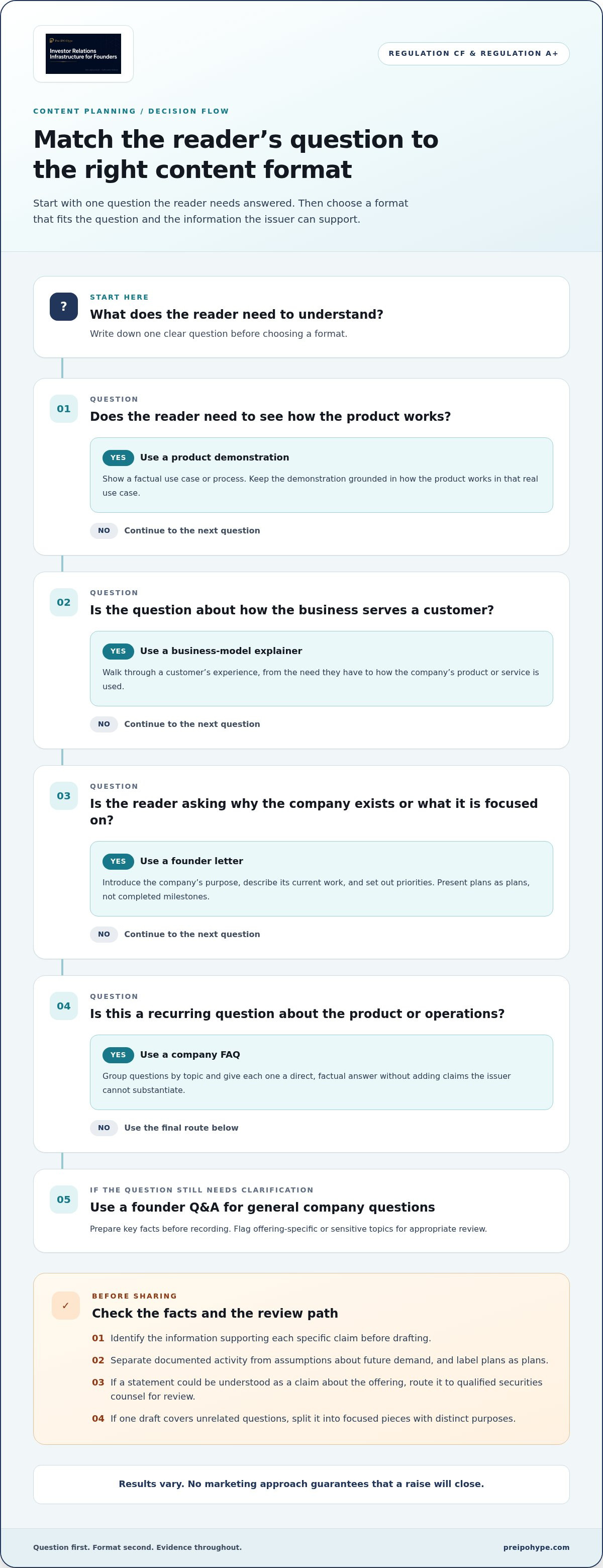
Choose a format by first writing down the question it should answer. A video is not automatically clearer than a written explanation, and a polished graphic cannot replace evidence. Consider the topic, the information the issuer can support, and what readers need to understand. If a draft tries to cover several unrelated questions, split it into focused pieces.
Written content ideas for explaining the company
A founder letter can introduce the company’s purpose, describe its current work, and set out its priorities without presenting plans as completed milestones. A business-model explainer can walk through a customer’s experience, from the need they have to how the company’s product or service is used. A company FAQ can address recurring product and operational questions with direct, factual answers. To keep an FAQ useful, group questions by topic and answer each one without adding claims the issuer cannot substantiate.
Video, visual, and live content ideas
A product demonstration can show how a feature works in a real use case without implying an investment outcome. A visual explainer can map the customer problem and the company’s approach. In a founder Q&A, answer general company questions and route offering-specific or sensitive topics for appropriate review. Before recording, prepare the key facts and decide how the issuer will handle questions that cannot be answered accurately in the moment.
| Format | Question it can address | Suitable purpose |
|---|---|---|
| Founder letter | Why does the company exist, and what is it focused on? | Set out purpose, current work, and priorities. |
| Business-model explainer | How does the business serve a customer? | Explain the model through a concrete use scenario. |
| Product demonstration | How does the product work? | Show a factual use case or process. |
| Founder Q&A | What do people want clarified? | Answer general questions and flag topics for review. |
Keep each piece grounded in information the issuer can substantiate. For Regulation Crowdfunding promotion, anyone the issuer pays to promote the offering on the platform must disclose that compensation each time (Rule 205). For Regulation CF, content outside the intermediary platform mentioning the offering terms is limited to tombstone style notice content under Rule 204, such as the offering terms, the intermediary name and a link to the offering page. For Regulation A+, test-the-waters and solicitation materials under Rule 255 state three things. No money is accepted. No sales happen until qualification. An indication of interest creates no obligation. After the Form 1-A is filed publicly, these materials also state where to find the preliminary offering circular. Some of these materials get filed with the SEC. Review the SEC guidance for Regulation Crowdfunding issuers, and send legal questions to qualified securities counsel. The campaign’s tools and workflow can also shape how content is organized, as outlined in this fundraising technology stack.
The content-planning conversation page is available for founders considering how to organize campaign content.
How to choose and sequence content for Regulation CF and Regulation A+
A useful content plan starts with a reader question and ends with a record of what was approved and shared. Keep the plan manageable: each item should have a distinct purpose, an owner, and a review path. A simple content tracker can prevent duplicate work and make it easier to see what still needs fact-checking or approval.
A five-step selection process
- Identify the question. Write down the specific point a reader needs clarified. Keep each piece focused rather than combining several topics.
- Select a format. Choose a written explanation when readers may want to revisit details, or a visual when seeing a process makes it easier to follow. A Q&A can address recurring questions.
- Draft factual content. Use information the issuer can support. Make clear which statements describe current operations and which describe future plans.
- Review the material. Check facts and supporting records. Route legal and offering-related questions to qualified securities counsel.
- Distribute appropriately. Coordinate campaign communications with the issuer’s registered intermediary, and use the approved channel for each item.
Sequence content without repetition
Begin with background that helps readers understand the company, then add focused pieces that address questions left open. Campaign-specific communications should follow the appropriate review process. For example, a company overview might establish context, while a later update explains a discrete operational development without restating the overview.
Before adding a new item, compare its purpose with existing material. If it answers the same question, update the original piece or give the new item a distinct role. The right sequence depends on the audience, the support available for claims, and the issuer’s priorities, not on a preset publishing pace.
Keep a tracker with the item’s owner, source material, reviewer, approval status, and distribution channel. For paid promotion on a Regulation Crowdfunding platform, include the Rule 205 disclosure requirement in the content approval process. Clear records help the issuer and its professional support coordinate handoffs.
Use this framework to turn investor marketing content ideas into a focused plan for your raise.
Put investor content into an issuer-led campaign workflow
A clear workflow gives each content item an owner, a review path, and a record of what was approved. That structure helps the issuer keep communications accurate as materials move from planning to publication. It also makes it easier to pause an item when a fact or approval is still outstanding.
Coordinate content creation, review, and distribution
- Prepare a brief. Note the question the content addresses, its intended audience, supporting information, and proposed channel.
- Draft the material. Keep it focused. Distinguish current facts from plans and avoid claims the issuer cannot support.
- Check the facts. The issuer verifies statements about its business and decides whether they are accurate and appropriate to share.
- Route for review and approval. Qualified securities counsel handles legal decisions. Coordinate offering-related review with the issuer’s registered intermediary, and leave final communication decisions with the issuer.
- Distribute and record the item. Share approved content through the appropriate channel and keep a record of the version and its destination.
For Regulation Crowdfunding platform promotion, account for the Rule 205 compensation disclosure requirement during review. Make this a clear checkpoint before distribution, rather than relying on someone to remember it after publication.
Campaign support can fit alongside the issuer’s registered intermediary and qualified securities counsel. The campaign support approach can be coordinated with the issuer’s team, with responsibilities and approvals kept clear. Organizing campaign tools around content status and review steps can also help the team follow the workflow.
Our Custom Investor CRM supports lead scoring and attribution tracking.
Pre-IPO Hype is investor relations infrastructure for Regulation CF and Regulation A+ raises. We are not a broker-dealer, funding portal, or investment adviser, and we do not offer, sell or recommend securities. This article is educational only and is not legal, tax or investment advice. Pre-IPO Hype fees are never tied to investment results. FWSC and Pre-IPO Hype are paid per form filled out and per meeting booked, with no commission, equity or share of the raise.
Keep your campaign story current as the business evolves
A raise brings company information into sharper focus, but the story doesn’t stop at launch. As the business changes, keep a working record of which facts have changed, which statements remain current, and which materials need another review before they are shared. Older content is not automatically accurate simply because it was approved before.
Use investor marketing content ideas as a starting point for this ongoing discipline. Before publishing an update, ask whether it reflects the company’s present position, whether supporting information is available, and whether the right people have reviewed it. If circumstances or offering-related details change, consult qualified securities counsel about appropriate next steps.
A clear, carefully maintained company story helps the issuer communicate consistently while keeping decisions with the issuer and its professional team. Start with a manageable plan, then adjust it as the company’s facts and communication needs change.
Thoughtful preparation is a practical next step for your campaign.
Frequently Asked Questions
Is investor marketing content the same as an offering document?
No. Investor marketing content can explain a company, its product, or its operations, while an offering document is a formal document associated with a securities offering. Marketing materials do not replace required offering documents or change their contents. Keep versions consistent, and do not use general company content to answer questions about offering terms. Ask qualified securities counsel which materials require legal review and how they should relate to the offering documents.
How often should a founder publish investor marketing content?
There is no universal publishing schedule. Set a pace the team can maintain while checking each update for accuracy and relevance. A useful trigger is a meaningful change in the company’s product, operations, or plans that can be explained with support. Avoid publishing simply to meet a calendar. For Regulation CF or Regulation A+, coordinate the timing and content of campaign communications with the issuer’s registered intermediary and qualified securities counsel.
Can founders reuse one content idea across different formats?
Yes, if each version remains accurate and fits its format. A written explanation of a customer workflow, for example, could become a diagram showing the steps or a demonstration of the product in use. Keep the underlying facts consistent, but adapt the detail and presentation for each format. Review every version separately, since editing or shortening content can change its meaning or remove important context.
What should a founder do when asked a question they cannot answer publicly?
Do not guess, speculate, or make an informal promise. Acknowledge the question and say the issuer will respond through an appropriate channel if it can. If it concerns the offering, sensitive company information, or a claim the team has not verified, pause and ask the registered intermediary or qualified securities counsel how to handle it. This keeps a live conversation from turning into an inconsistent public statement.
Who should review investor-facing content before it is published?
The issuer should verify company facts and make the final decision about its communications. Qualified securities counsel should address legal questions, including whether offering-related content needs review. Include the registered intermediary in coordination for campaign communications, particularly when content relates to its offering process. For investor marketing content ideas, define these review roles before drafting so the team knows who checks facts, who handles legal issues, and who approves publication.
Disclaimer
Educational only. Not investment, tax, or legal advice. Pre-IPO Hype is investor relations infrastructure for Regulation CF and Regulation A+ raises. We are not a broker-dealer, funding portal, or investment adviser, and we do not offer or sell securities or make investment recommendations. Any securities offering is made only by the issuer, through its own offering documents and, where required, a registered intermediary.


