
Investor Marketing Funnel Stages: Engineering Capital Momentum in 2026
In 2026, capital isn't "raised" by luck; it's engineered through a high-velocity momentum cycle that most issuers completely ignore. If you're still relying on fragmented spreadsheets and gut feelings, you're leaving millions on the table. Mastering the specific investor marketing funnel stages is the only way to scale a Reg CF or Reg A+ raise in a market that demands institutional-grade transparency and surgical precision.
It's exhausting to watch your cost per acquisition climb while you struggle to see which ads actually lead to signed checks. You likely recognize that modern funnels require 12 or more touchpoints before a conversion occurs, yet most campaigns lose momentum after the second or third click. This article provides the data-driven framework needed to convert cold interest into committed capital through every stage of the modern acquisition cycle. We'll show you how to build a predictable system for raising capital, gaining full visibility into investor attribution while driving down your total funding costs. We are moving beyond simple ads and into a world of omnichannel mastery and infrastructure-led growth.
Key Takeaways
- Learn why static pitch decks are obsolete and how to engineer a continuous digital momentum cycle that mirrors elite e-commerce behavior.
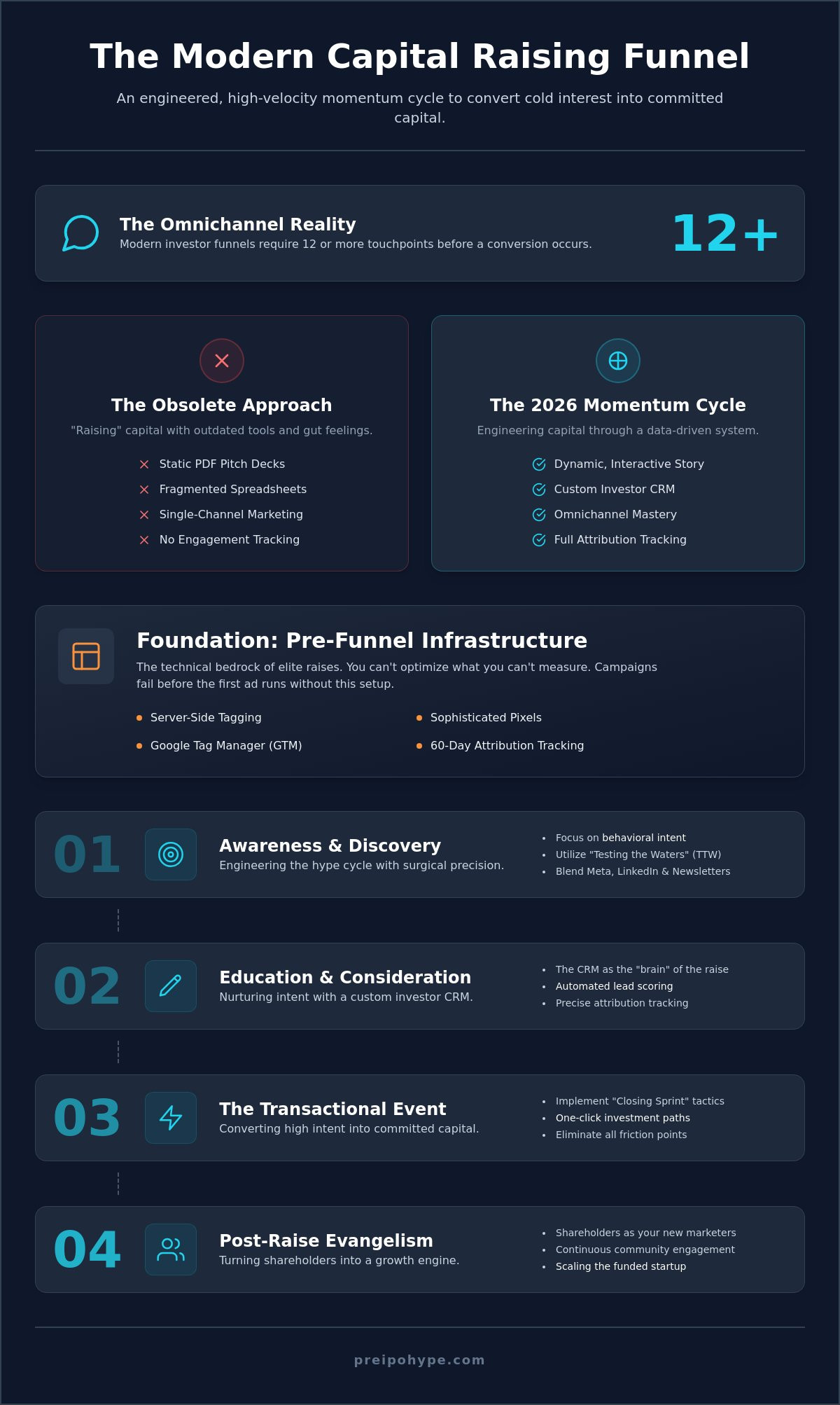
- Master the four critical investor marketing funnel stages to move cold leads through a high-velocity discovery and education process.
- Discover why a Custom Investor CRM is the essential "brain" of a modern raise, enabling automated lead scoring and precise attribution tracking.
- Implement "Closing Sprint" tactics and one-click investment paths to eliminate friction during the final 30 days of your offering.
- Turn your funding event into a growth engine by transitioning shareholders into a powerful, post-raise marketing department.
The Evolution of Capital Raising: Why Linear Funnels are Obsolete
Capital is no longer "raised" in the traditional sense. It's engineered through a continuous high-velocity cycle. The old model of sending a static PDF to a list of potential backers and hoping for a wire transfer is dead. In 2026, the digital landscape has shifted. Retail investor behavior now mirrors high-end e-commerce more than traditional venture capital. These investors don't just want a deal; they want to join a movement. They expect a sophisticated journey that builds trust through multiple digital touchpoints.
While the traditional purchase funnel might work for selling consumer goods, equity crowdfunding requires a more aggressive, momentum-based approach. We've moved beyond linear thinking. Today's most successful raises use a 5-stage framework designed to capture attention, nurture intent, and close capital at scale. This evolution is driven by the reality that only 34% of companies regularly optimize their sales funnels. For those raising under Regulation A+ (up to $75 million) or Reg CF (up to $5 million), the opportunity to outperform the competition by mastering these investor marketing funnel stages is massive.
The Death of the Static Pitch Deck
Static PDFs fail because they are silent. They don't track engagement, they don't retarget, and they certainly don't evolve with the market. Modern digital investors demand dynamic, interactive story frameworks. Your narrative should feel like an "Internal Access" pass to a gated financial world. It's about creating a sense of exclusivity and urgency that a flat document cannot convey. If your story doesn't change as you hit milestones or secure major partnerships, you're telling a stale tale. Successful issuers now use live data feeds and real-time updates to keep the momentum high and the "hype cycle" active throughout the entire raise.
Foundation: The Pre-Funnel Infrastructure
Most campaigns fail before the first ad ever runs because they lack a proper Foundation infrastructure. This is the technical bedrock of elite capital raises. You can't optimize what you can't measure. In a privacy-first 2026 environment, basic tracking isn't enough. You need server-side tagging, Google Tag Manager (GTM), and sophisticated pixels to maintain 60-day attribution tracking. This infrastructure acts as the "brain" of your raise, ensuring every dollar spent on investor marketing funnel stages is accounted for. Without this technical setup, you're flying blind, unable to distinguish between a casual browser and a high-intent investor ready to write a check. Aligning this tech stack with SEC compliance is the first step toward a predictable, scalable funding event.
Stage 1: Awareness & Discovery—Engineering the Hype Cycle
The first of the investor marketing funnel stages is not about casting a wide net. It is about surgical precision. In 2026, defining an "Investor Persona" based on age and zip code is a relic of the past. High-performing raises focus on behavioral intent. We track what they read, which sectors they track, and how they react to market volatility—noting that active participants often rely on technical resources like the SPX to SPY Converter to stay ahead. This allows us to engineer a hype cycle that feels like an invitation to an exclusive movement rather than a cold solicitation. By using provocative and aspirational language, we signal that this is an elite entry point for those who act decisively.
During this phase, many companies utilize the "Testing the Waters" (TTW) provision. This allows you to gauge market appetite and build a reservation list before a formal offer is live. It’s a low-stakes way to identify high-intent capital. Building an effective marketing funnel starts with this psychological framing. You aren't just looking for clicks. You’re looking for participants who want to be part of the next big realization event.
Omnichannel Mastery vs. Single-Channel Ads
Relying on a single platform is a recipe for a stalled raise. Data from Ordinal in January 2026 shows that modern funnels often require 12 or more touchpoints before a conversion occurs. If you only run Meta ads, you're missing the 63% of B2B buyers who discover new brands through diverse social media platforms. Successful discovery blends Meta’s visual storytelling with LinkedIn’s professional authority and targeted Newsletter Exposure. Our "Invst Guru" placement provides the third-party credibility that social ads lack. It positions your company within the flow of trusted financial news, making the opportunity feel vetted and significant. If you're unsure if your current channel mix is optimized, you can book a strategy audit to map your touchpoints.
The Lead Capture Pivot
The biggest mistake issuers make is driving expensive traffic directly to a third-party funding portal. This results in high bounce rates and zero data ownership. The Lead Capture Pivot is the critical bridge to the CRM. Instead of asking for a check on the first visit, we aim for the "Soft Commit." This lowers the friction for initial engagement. We capture the email and phone number on a dedicated, high-converting landing page first. This pivot ensures that even if the investor doesn't commit immediately, they are now inside your ecosystem. You own the data, not the platform. This shift in the investor marketing funnel stages ensures that every discovery dollar contributes to long-term momentum rather than a one-off click.
Stage 2: Education & Consideration—The Role of the Custom Investor CRM
Once you've engineered initial discovery, you enter the most critical phase of the raise. This is where curiosity is forged into commitment. In the high-stakes world of capital formation, a Custom Investor CRM acts as the central nervous system of your entire campaign. It's the brain that processes raw data into actionable intelligence. While a traditional investor funnel might rely on manual follow-ups, modern investor marketing funnel stages demand automated precision and real-time behavioral tracking.
The reality is that capital doesn't move instantly. Our proprietary 60-day attribution tracking reveals a complex web of interactions that precede every check. An investor might see a Meta ad, read an "Invst Guru" newsletter, and visit your site four times before ever clicking "invest." Without a specialized CRM, those connections are lost. You'll waste capital retargeting the wrong people while high-intent leads go cold. We solve this by providing full visibility into the long tail of investor decision-making. It's about knowing exactly which touchpoint finally broke the seal.
Lead Scoring and Behavioral Analytics
Not all leads are created equal. We use lead scoring to separate casual observers from serious backers. By tracking every email open, deck click, and webinar attendance, we assign a "Momentum Score" to every contact. This allows your team to focus outreach on the leads that are actually heating up. If an investor downloads your circular and then spends ten minutes on your team page, the CRM triggers a personalized retargeting ad or a high-priority email sequence. This level of personalization makes your raise feel like an elite, one-on-one opportunity rather than a mass-market blast. You're no longer guessing who is ready to commit; you're operating with data-driven certainty.
Nurturing Through Storytelling
The consideration phase is won through narrative momentum. We don't just send updates; we provide "Insider Access." By breaking your raise into specific milestones, you create a sense of forward motion that compels participation. Each update should feel like a chapter in a high-growth success story. Integrating a specialized investor acquisition platform ensures this communication is seamless across all channels. Automated drip sequences keep your story front-of-mind, moving investors from "interested" to "convinced" without manual intervention. It's about maintaining a steady pulse of opportunity until the investor feels that waiting any longer means missing out on the next big realization event.
Stage 3: The Transactional Event—Converting Interest into Capital
The transition from "interested" to "invested" is the most volatile period of the entire raise. In the final 30 days, often called the "Closing Sprint," the focus of your investor marketing funnel stages shifts from storytelling to surgical execution. This is where you convert the psychological momentum you've built into committed capital. If your technical workflow has even a hint of friction, you will lose investors at the finish line. High-intent leads expect a seamless, one-click path to participation, whether you are using DealMaker or other major equity crowdfunding portal integrations.
Conversion in 2026 relies heavily on "The Herd Effect." Digital fundraising is inherently social; investors are more likely to pull the trigger when they see a crowd already moving. We use real-time data to highlight recent investments and total capital raised, creating a sense of inevitability. Transactional retargeting plays a massive role here. We re-engage the "almost-investors", those who visited the investment page but didn't sign, with high-urgency creative that mirrors the rapid movement of the market. It’s about making the act of participation feel like joining a winning movement rather than just executing a transaction.
Engineering Urgency and Scarcity
Urgency isn't just a marketing tactic; it's a financial catalyst. We use early-bird terms and bonus shares to pull forward commitment dates, rewarding those who act decisively. As the "Raise Cap" countdown begins, the fear of missing out (FOMO) becomes a primary driver of capital. By leveraging real-time data from our investor acquisition campaigns, we show exactly how much of the round remains. This transparency creates a gated environment where the opportunity feels rare and restricted. When the round is 90% full, the psychological pressure on the remaining leads often triggers the largest influx of capital in the campaign's history.
The 'Check-in-Hand' Workflow
The final hurdle is the subscription agreement. Many raises stall because founders fail to handle the paperwork friction. We synchronize CRM notifications with funding portal status updates to ensure no lead is left behind. For high-net-worth (HNW) retail leads, this often requires a more personalized touch. Our automated follow-up sequences handle the "Subscription Agreement" hurdle by providing clear instructions and immediate support. If a lead stalls, the CRM flags it for direct outreach. This ensures that "checks in hand" actually turn into cleared funds. To ensure your closing mechanics are optimized for the final sprint, you should schedule a closing strategy session with our team.
Stage 4: Post-Raise Evangelism—Scaling the Funded Startup
The wire transfer clears, the portal closes, and the champagne is poured. Many founders think the work is done. They are wrong. In the sophisticated architecture of 2026 capital formation, the final investor marketing funnel stages are about transformation. You aren't just managing a cap table; you're mobilizing a private army. Turning 1,000 retail investors into a 1,000-person marketing department is the ultimate leverage. This is where you transition from "Lead" to "Shareholder" status within your Custom Investor CRM, initiating a "Secondary Hype Cycle" that prepares the ground for a Series A or a secondary market listing.
Maintaining this momentum requires more than just a quarterly financial statement. It demands consulting and advisory services to ensure long-term cap table health and strategic alignment. Data from January 2026 indicates that a 5% increase in retention can lead to profit increases of up to 95%, and the same logic applies to your investor base. A stagnant investor pool is a liability. An engaged one is a force multiplier that drives product adoption and market awareness.
The Shareholder Communication Loop
Elite firms design monthly updates that do more than report numbers. They drive action. By using your CRM to segment shareholders, you can target specific "asks" based on their professional backgrounds or behavioral data. Need five-star reviews for a new product launch? Want introductions to specific retail distributors? Your shareholders are your first and most loyal customers. This loop ensures that the excitement of the raise doesn't dissipate. It keeps the pulse of opportunity steady, making every shareholder feel like an informed insider who is directly contributing to the company's future valuation.
Preparing for the Next Realization Event
The strategic importance of a clean, engaged investor database cannot be overstated. Whether you are looking toward an M&A exit or an IPO, your investor relations history is a primary indicator of corporate health. We track shareholder sentiment and engagement levels throughout the post-raise period. This data is gold when you return to the market for future rounds. A high "Advocacy Score" among current backers signals to institutional players that your brand has true market stay-power. The funnel never truly closes for high-growth firms; it simply resets for the next, larger realization event. By treating your post-raise phase as a continuation of your momentum engineering, you ensure that capital isn't just a one-time injection but a recurring asset. Your investor marketing funnel stages should lead naturally into a permanent state of growth readiness.
Dominating the 2026 Capital Landscape
Capital formation in 2026 is an engineering challenge, not a marketing one. You've seen how the shift from static pitch decks to high-velocity momentum cycles can redefine your cost per acquisition. By mastering these specific investor marketing funnel stages, you move beyond the hope-based fundraising of the past and into a world of data-driven certainty. It's about building a technical foundation that supports omnichannel mastery and long-term shareholder evangelism.
We've facilitated over $100 million in funding for more than 230 company raises. Our proprietary Custom Investor CRM technology and SEC-compliant omnichannel marketing systems are designed to bridge the gap between restricted information and broader opportunity. You don't have to navigate this complex regulatory environment alone. The keys to this gated financial world are within reach for those who act decisively. The next realization event is already on the horizon, and the infrastructure you build today determines your valuation tomorrow.
Ready to engineer your next raise? Book a 30-minute strategy session with our CEO. It's time to turn your vision into committed capital and join the elite circle of funded innovators.
Frequently Asked Questions
What are the 4 main stages of an investor marketing funnel?
The core framework consists of Awareness & Discovery, Education & Consideration, The Transactional Event, and Post-Raise Evangelism. These investor marketing funnel stages are designed to move a cold lead from initial curiosity to a committed shareholder who actively promotes your brand. Each phase requires specific technical triggers and narrative shifts to maintain capital momentum.
How long does it take to move an investor through the funnel?
The typical cycle spans 60 to 90 days, though high-growth markets often see faster movement. Data from January 2026 suggests that modern investors require 12 or more touchpoints across multiple platforms before they feel confident enough to execute a transaction. This timeline is why consistent omnichannel outreach is more effective than short, aggressive ad bursts.
Why is a custom CRM better than a standard CRM for fundraising?
Standard CRMs aren't built for the regulatory complexity or the high-velocity attribution required in equity crowdfunding. A Custom Investor CRM acts as the "brain" of the raise, integrating directly with funding portals and tracking behavioral intent through lead scoring. It allows you to see exactly which touchpoints led to a signed check, providing visibility that generic sales tools simply can't offer.
What is the difference between Reg CF and Reg A+ marketing funnels?
Reg CF funnels are optimized for high-velocity retail volume with a $5 million annual limit. Reg A+ funnels are more complex, supporting raises up to $75 million and requiring institutional-grade infrastructure to manage larger ticket sizes and broader public disclosures. While the investor marketing funnel stages remain similar, the scale of the digital infrastructure and the depth of the education phase increase significantly for Reg A+ offerings.
How much should I budget for investor acquisition at each stage?
Successful issuers typically front-load their budgets into the Awareness and Discovery stage to build a massive top-of-funnel audience. A significant portion must also be reserved for Transactional Retargeting during the final 30 days of the raise. You should focus on your total cost per acquisition (CPA) rather than static stage costs to ensure your marketing spend is driving actual capital, not just clicks.
Can I use social media ads to find accredited investors?
Yes, by targeting specific behavioral intent and professional markers. In 2026, we reach accredited investors by identifying individuals with an annual income over $200,000 or those holding active Series 7, 65, or 82 licenses. Combining these filters with high-authority platforms like LinkedIn and Meta allows for surgical precision in finding high-net-worth participants.
What is 'Testing the Waters' and which funnel stage does it belong to?
Testing the Waters (TTW) is a regulatory provision that allows companies to gauge market interest before filing a formal offering. It belongs to the Awareness & Discovery stage. This phase is critical for building a reservation list of high-intent leads, allowing you to launch your formal raise with immediate, pre-engineered momentum.
How do I track investor attribution over a 60-day period?
Tracking requires server-side tagging, Google Tag Manager, and a specialized CRM capable of long-tail data retention. Most standard pixels lose data after a few days; however, our proprietary systems maintain attribution for a full 60 days. This ensures you know which initial ad from two months ago actually resulted in the check received today.
Disclaimer
Educational only. Not investment, tax, or legal advice. Pre-IPO Hype is investor relations infrastructure for Regulation CF and Regulation A+ raises. We are not a broker-dealer, funding portal, or investment adviser, and we do not offer or sell securities or make investment recommendations. Any securities offering is made only by the issuer, through its own offering documents and, where required, a registered intermediary.