
Investor Outreach Best Practices 2026: Engineering Capital at Scale
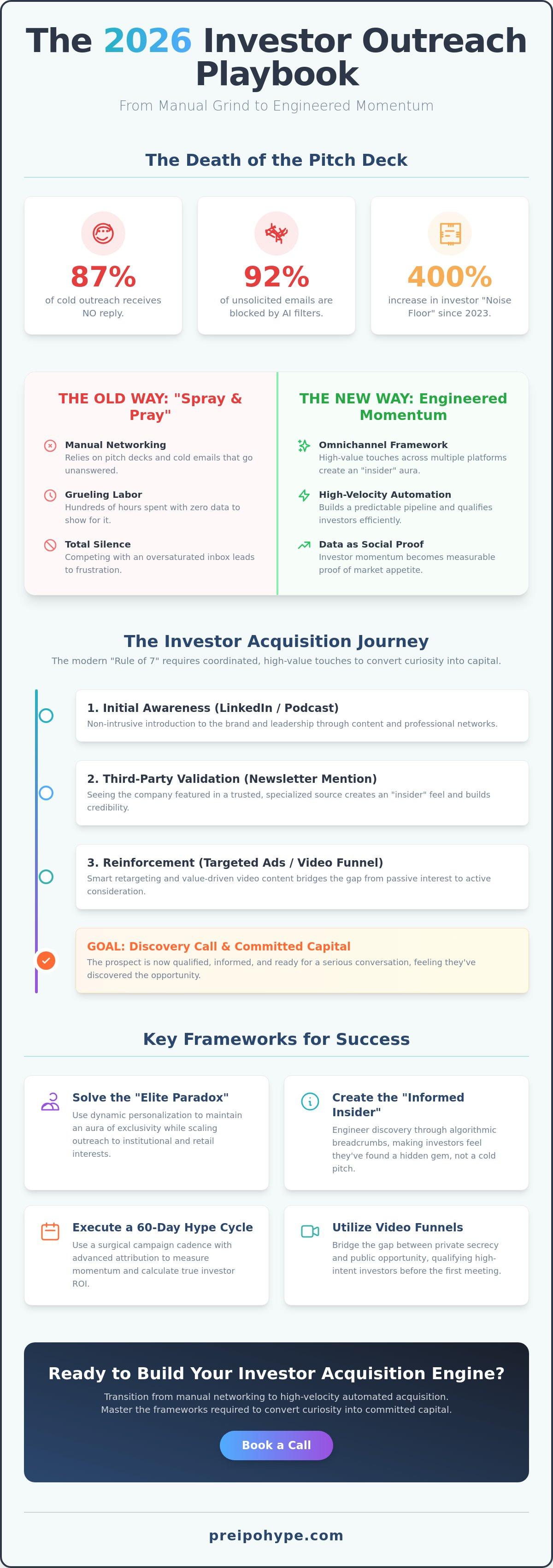
By 2026, the traditional pitch deck is no longer a tool; it's a relic. According to a 2024 analysis of private market trends, 87% of cold outreach never receives a reply. The difference between a stalled round and a sold-out Reg A+ offering is no longer about who you know, but how you engineer the momentum. You've likely felt the frustration of sending hundreds of manual emails only to be met with total silence and zero data to show for your effort. It's a common pain point that turns unicorn hunting into a grueling grind of manual labor.
This guide delivers the definitive investor outreach best practices for the 2026 landscape. We'll show you how to master the data-driven frameworks and omnichannel strategies required to convert casual curiosity into committed capital. You'll learn to move beyond the black box and build a predictable pipeline that provides hard proof of investor interest before you even ask for the check. From leveraging secondary liquidity narratives to automating your high-stakes communication, we're opening the gates to elite fundraising strategies once reserved for the institutional inner circle.
Key Takeaways
- Transition from manual networking to high-velocity automated acquisition to penetrate the noise floor of 2026’s elite financial circles.
- Master modern investor outreach best practices by deploying an omnichannel framework designed to move prospects from initial curiosity to committed capital.
- Solve the "Elite Paradox" by leveraging dynamic personalization to maintain an aura of exclusivity while scaling your outreach to institutional and retail interests.
- Execute a surgical 60-day hype cycle that utilizes advanced attribution tracking to measure momentum and calculate true investor ROI.
- Utilize specialized video funnels to bridge the gap between private secrecy and public opportunity, qualifying high-intent investors before the first meeting.
Beyond the Pitch Deck: Why Traditional Outreach Fails in 2026
The days of manual "spray and pray" networking have vanished. In 2026, engineering capital at scale requires a shift from manual networking to automated acquisition. Most founders still treat venture capital acquisition like a numbers game, but the "Noise Floor" has risen 400% since 2023. Standard cold emails are dead on arrival because elite circles have moved behind sophisticated digital moats. You aren't just competing with other startups; you're competing with the silence of an over-saturated inbox.
To better understand how the landscape of modern capital acquisition has shifted, watch this breakdown of the tactics that actually move the needle:
Modern investor outreach best practices prioritize the "Informed Insider" persona. These investors expect to discover opportunities through algorithmic breadcrumbs rather than direct solicitation. They want to feel they've found a hidden gem, not that they're one of 500 names on a BCC list. This discovery process requires a compelling story framework as the absolute prerequisite for any technical outreach system. Without a narrative that commands attention, your automation is just a faster way to be ignored.
The Death of the Cold Email
AI-driven spam filters now block 92% of unsolicited outreach before it reaches a human eye. The barrier to entry has shifted from who you know to how you bypass the gatekeeper. Exclusive access has replaced broad exposure as the primary driver of deal flow. To scale effectively, founders must implement foundation infrastructure to ensure their message lands where it matters. It's about precision, not volume.
Data as the New Social Proof
Valuations are secondary in the initial outreach phase. Today's investors look for engagement metrics and digital footprints that prove market appetite. They want to see the hype cycle in action before they commit. We focus on creating momentum, which makes the investment feel like a moving train that’s leaving the station. Investor Momentum is the measurable velocity of curiosity converting into capital. High-growth firms now use investor outreach best practices to engineer this feeling of inevitability, ensuring the raise is oversubscribed before the first formal meeting.
Building Your Investor Acquisition Engine: The Omnichannel Framework
Capital isn't found; it's engineered. By 2026, the traditional "spray and pray" email campaign has become a relic of the past. The modern private market demands an omnipresent strategy that commands attention without crossing the line into digital harassment. Achieving this requires a shift from linear outreach to a sophisticated omnichannel framework.
The 2026 "Rule of 7" dictates that an investor needs seven high-value touches before they'll commit to a discovery call. These aren't just seven emails. They're a coordinated sequence across LinkedIn, specialized newsletters, and retargeting ads. Your goal is to move the prospect through a specific psychological journey: from the first impression to genuine curiosity, and finally to the commitment of their time and capital. Founders often struggle with the sequence of these touches. Integrating a 9-Step Investor Outreach Guide into your workflow ensures your team isn't just sending messages, but building a narrative arc that mirrors the momentum of a late-stage growth round.
Effective investor outreach best practices now center on being everywhere your target investor looks, without being intrusive. If they see your CEO on a podcast, read about your valuation benchmarks in a newsletter, and then see a targeted ad regarding your secondary liquidity options, you've created an "insider" aura that cold outreach alone can't replicate.
The Role of the Custom Investor CRM
Standard sales CRMs like HubSpot often fail in high-stakes capital raises because they're built for transactional cycles. An elite investor CRM is different. It prioritizes lead scoring based on investor intent. In a Reg CF or Reg A+ raise, you don't have time to chase every lead. You need to know which "hot" leads re-opened your pitch deck three times in the last 48 hours. This data-driven attribution allows you to prioritize the 15% of your list most likely to convert, turning your outreach into a precision strike rather than a wide net.
Mastering Multi-Channel Touchpoints
Scaling your outreach doesn't mean losing the personal touch. LinkedIn automation must maintain an "insider" tone, focusing on shared industry insights rather than a hard pitch. Simultaneously, leveraging platforms like Invst Guru for newsletter exposure provides immediate reach to thousands of accredited investors. For those who viewed your deck but didn't book a call, retargeting ads serve as a gentle nudge, keeping your "unicorn hunting" opportunity top-of-mind. This layered approach is why modern investor outreach best practices rely on technology to bridge the gap between private secrecy and public opportunity. If you're ready to see how this engine looks in practice, you can ask our CEO for a direct breakdown of our current frameworks.
Personalization vs. Automation: Balancing "Insider" Exclusivity with Scale
Scaling a capital raise often feels like a contradiction. Investors want to feel like they are the only ones in the room, yet your growth targets require reaching thousands. By 2026, 74% of private equity firms will use some form of algorithmic outreach to manage their pipelines. The trick isn't avoiding automation; it's making the algorithm feel like a private invitation. This is the "Elite Paradox." You must automate the delivery while personalizing the soul of the message to maintain that velvet-rope atmosphere.
Modern investor outreach best practices rely on dynamic personalization. This goes beyond inserting a first name. It involves using data scrapers to segment leads by their specific sector history and past exit preferences. Institutional leads respond to secondary liquidity projections and 2027 valuation benchmarks. Retail investors, conversely, are driven by the "unicorn hunting" thrill and ground-floor access. If your message treats a family office like a crowd-funder, your reputation will suffer. Precision is the ultimate filter for quality.
Hype is often dismissed as noise, but it's actually a legitimate financial indicator of momentum. It represents the market sentiment that precedes major liquidity events. When backed by technical precision, hype signals to an investor that they're joining a movement. A 2024 industry survey found that engagement jumps by 40% when outreach references an investor's specific portfolio overlap. Automation doesn't kill your reputation; generic, lazy templates do. High-fidelity automation ensures you're relevant at scale.
Tiered Outreach Strategies
- Tier 1: This is high-touch, manual outreach. It's reserved for anchor investors and institutional leads who require 1-on-1 calls and bespoke due diligence packages.
- Tier 2: Semi-automated omnichannel outreach. This uses a mix of LinkedIn, email, and targeted ads to engage accredited retail investors who need 3 to 5 touchpoints before committing.
- Tier 3: Fully automated systems. These are designed for Reg CF crowd-building, where the goal is to convert high volumes of smaller checks through consistent, rhythmic updates.
Crafting the "Exclusive" Narrative
Success in 2026 requires a vocabulary shift. You aren't "asking for money." You're "offering early-stage growth access." This positioning changes the power dynamic. Your messaging should focus on secondary liquidity options and how your current valuation benchmarks align with industry leaders. It's about bridging the gap between private secrecy and public opportunity. To bridge this gap further and provide the direct access investors crave, tools like the Ask CEO page allow high-intent prospects to get their questions answered directly. This creates a feedback loop that feels personal, even when the system behind it is engineered for massive scale.
The 60-Day Hype Cycle: Mastering Campaign Cadence and Attribution
Capital isn't raised; it's engineered. In the private markets of 2026, a successful raise follows a precise 60-day rhythm that transforms cold interest into committed capital. This process isn't about sending a few emails. It's a structured momentum build that leverages investor outreach best practices to create a sense of inevitable success. Data from 2025 equity crowdfunding rounds shows that 42% of total capital is typically committed in the final 14 days. However, that surge only happens if the preceding 46 days were spent building a data-backed foundation. You're not just looking for investors; you're building a movement.
Phase 1: The Foundation & Discovery
Success starts with the technical pipes. Before the first ad goes live, you must align your brand with the final frontier of wealth. This means deploying tracking pixels across all touchpoints and integrating your CRM with lead scoring rules that flag high-intent activity. You're preparing the digital marketing and advertising assets that will dominate the narrative. 60-day attribution tracking is the only way to calculate true Investor ROI. It allows you to see how a LinkedIn click in week one becomes a $50,000 check in week eight. If you don't track the full 60-day window, you'll misattribute your most valuable leads.
Phase 2: Execution & Omnichannel Mastery
The Hype Cycle kicks off with 48-hour sprints across ads, email, and LinkedIn. Use A/B testing to refine your hooks. Does a "secondary liquidity" angle outperform "ground floor unicorn access"? If engagement analytics show a 15% drop-off on your deck page, pivot your strategy mid-campaign. As the deadline nears, shift to a closing cadence. Increase frequency. Use urgency markers. You're bridging the gap between private secrecy and public opportunity. This phase is about maintaining a steady pulse of opportunity that feels both elite and democratizing.
- Pre-launch: Focus on story framework and technical setup.
- Momentum: Use omnichannel sprints to find the winning "hooks."
- Final Push: Increase touchpoint frequency as the investment window closes.
By applying these investor outreach best practices, you ensure that every dollar spent on marketing is an investment in data. This approach turns the "black box" of private equity into a transparent, scalable machine. It's about acting decisively while the window of opportunity is open.
Executing Your Raise with Pre-IPO Hype’s Custom Investor CRM
The gap between private-market secrecy and public-market opportunity is where most founders lose momentum. Pre-IPO Hype bridges this divide by turning your capital raise into a high-velocity movement. Our custom investor CRM isn't just a database; it's a sophisticated engine designed to implement investor outreach best practices at a scale that manual efforts simply cannot match. We operate in the space where institutional precision meets the infectious energy of a ground-floor opportunity.
Central to this engine is the Video Funnel. This system qualifies investor interest before you ever jump on a call. It uses high-production storytelling and data-driven targeting to filter out the "tire-kickers." It identifies high-intent backers who are ready to commit capital, allowing your team to focus only on the most promising leads. To date, over 230 companies have utilized this proprietary framework to facilitate more than $100M in total funding. We don't just find investors; we engineer the momentum that makes your valuation benchmarks achievable.
Why a Specialized Agency Beats In-House Effort
Attempting to build a fundraising infrastructure while simultaneously scaling a company is a recipe for dilution and burnout. The cost of "learning on the fly" is too high when millions in growth capital are on the line. Instead of trial and error, you gain immediate access to our proven Reg CF marketing playbook. Our agency approach integrates investor outreach best practices directly into your brand's DNA, ensuring every touchpoint builds equity. This system leverages proprietary data and private investor networks that don't exist on LinkedIn or public forums. By outsourcing the hype cycle, you can focus on product innovation while we engineer the capital.
Secure Your Strategic Fundraising Roadmap
Moving from curiosity to a successful liquidity event requires a clear, technical path. Your journey begins with a strategy session with Jeff "Fuzzy" Wenzel. In this deep dive, we move beyond theory to build your specific roadmap to $1M+ raises. We cover the entire lifecycle, from the initial technical setup and compliance hurdles to the eventual exit strategies that your early backers demand. This isn't a generic consultation; it's an insider's look at how to dominate the private markets in 2026. It's time to stop guessing and start executing. Schedule your 30-minute fundraising strategy session today and lock in the insider advantage your competition lacks.
Own the Momentum: Engineering Your 2026 Capital Raise
The era of the static pitch deck ended years ago. In 2026, capital flows toward the most efficient acquisition engines. You've seen why an omnichannel framework beats single-channel noise and how a 60-day hype cycle creates the urgency required for secondary liquidity. Success now depends on balancing insider exclusivity with the precision of our proprietary Custom Investor CRM. Mastering these investor outreach best practices isn't just about communication; it's about engineering momentum. PreipoHype has already facilitated over $100M for 230+ companies by bridging the gap between private secrecy and public opportunity. We don't just find investors; we build a movement around your valuation benchmarks. The keys to the gated financial world are ready for those who act decisively.
Scale your capital raise with a custom investor acquisition strategy
The final frontier of wealth creation is open, and your next liquidity event is closer than you think.
Frequently Asked Questions
How many touches does it take to convert an investor in 2026?
Converting an investor in 2026 requires between 7 and 12 digital touchpoints across multiple channels before they commit capital. The era of the single-pitch close is dead. You need an omnichannel sequence that hits their LinkedIn feed, email inbox, and retargeting ads. This multi-layered exposure builds the necessary momentum to move a prospect from initial curiosity to a signed subscription agreement. High-stakes raises depend on this rhythmic frequency.
Is cold emailing still effective for investor outreach?
Cold emailing works only when it functions as the closing mechanism of a sophisticated warm-up strategy. Sending unsolicited pitches in 2026 often triggers spam filters and ruins your domain reputation. To implement investor outreach best practices, you must precede your emails with 3 to 5 social engagements or targeted ad impressions. This transforms a cold message into an insider follow-up that converts at a much higher rate.
What is the difference between Reg CF and institutional outreach?
Reg CF focuses on democratized capital by reaching 10,000 or more retail investors through broad digital marketing, while institutional outreach uses a sniper approach for 10 to 20 high-value relationships. Most successful 2026 raises use a hybrid model. This strategy secures the stability of institutional lead checks while leveraging the viral hype and secondary liquidity potential of a large retail base. It's about balancing volume with elite credibility.
How do I track investor engagement before they commit capital?
You track engagement using a specialized investor CRM equipped with 60-day multi-touch attribution. This technology allows you to monitor exactly which 15-second video ad they watched or how many times they opened your deck before signing. Data-driven founders use these insights to score leads. If an investor views your valuation slide 4 times in 48 hours, they're ready for a direct call to close the deal.
Should I use a standard CRM for my capital raise?
No, you shouldn't use a standard sales CRM because it lacks the architecture for SEC compliance and complex equity tracking. Standard tools don't account for the specific attribution needs of a 2026 equity crowdfunding campaign. A custom investor CRM provides the necessary lead scoring and data tags to manage thousands of potential backers without violating solicitation rules or losing track of your cap table. It's the difference between a generic tool and a financial weapon.
How do I personalize outreach at scale?
Personalization at scale is achieved through dynamic data tags and tiered messaging that delivers an insider narrative to thousands of leads simultaneously. You can automate the distribution of specific industry benchmarks or valuation data that match an investor's unique profile. This ensures your investor outreach best practices feel like a 1-on-1 conversation while you're actually engineering capital across a database of 5,000 prospects. It's about maintaining intimacy while driving massive volume.
Disclaimer
Educational only. Not investment, tax, or legal advice. Pre-IPO Hype is investor relations infrastructure for Regulation CF and Regulation A+ raises. We are not a broker-dealer, funding portal, or investment adviser, and we do not offer or sell securities or make investment recommendations. Any securities offering is made only by the issuer, through its own offering documents and, where required, a registered intermediary.


