
Investor Pipeline Management: The Elite Founder’s Engine for Closing Rounds in 2026
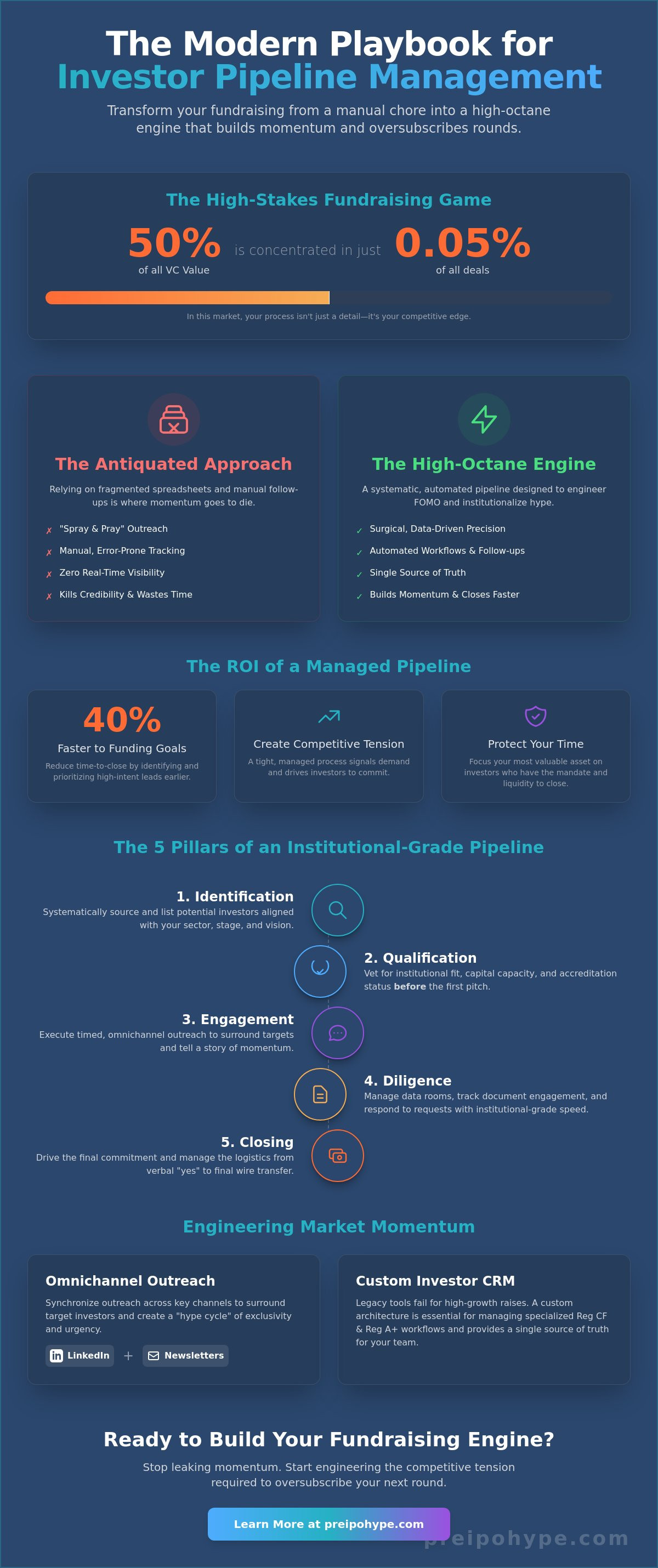
In a market where 50% of all venture capital value is concentrated in just 0.05% of deals, the difference between a failed raise and an oversubscribed round isn't your product; it's your engine. Most founders treat investor pipeline management like a digital filing cabinet, but elite operators know it's a high-octane marketing machine designed to institutionalize FOMO. If you're still relying on fragmented spreadsheets and manual follow-ups, you aren't just losing time. You're leaking the momentum required to close institutional capital in 2026.
It's frustrating to watch high-intent investors go cold because a follow-up slipped through the cracks or your data couldn't keep pace with the "flight to quality" currently dominating the US market. We'll show you how to master the strategic architecture of a modern pipeline, transforming your outreach into a structured, automated system that drives competitive tension. You'll learn how to engineer a high-octane capital raise that replaces "spray-and-pray" tactics with surgical precision, ensuring you have real-time visibility into every engagement milestone from the first touch to the final wire.
Key Takeaways
- Abandon antiquated "spray-and-pray" outreach to adopt a systematic framework that builds institutional credibility and protects your most valuable asset: time.
- Discover the five pillars of elite investor pipeline management to rank leads by stage and sector fit using data-driven lead scoring.
- Understand why legacy CRM tools fail high-growth raises and why custom architectures are essential for managing specialized Reg CF and Reg A+ workflows.
- Learn to synchronize omnichannel outreach across LinkedIn and premium newsletters to surround target investors and engineer a "hype cycle" of exclusivity.
- Integrate your technical bedrock to ensure your fundraising stack drives real-time engagement data and maximizes capital ROI.
The Strategic Shift: Why Investor Pipeline Management is Your Most Critical Fundraising Asset
Investor pipeline management is the systematic process of identifying, qualifying, and converting capital leads into committed partners. It isn't a passive contact list. It's a high-octane engine. In a market where 50% of all venture capital value is concentrated in just 0.05% of deals, your ability to manage these relationships determines your survival. Elite founders don't hope for interest; they engineer it through rigorous architecture.
The era of "spray-and-pray" outreach is a relic. Sending generic cold emails to every associate on LinkedIn doesn't just lead to low response rates; it actively kills your credibility. In 2026, the "flight to quality" means investors are looking for signals of institutional readiness before they even open your deck. When navigating the complexities of Venture capital financing, your pipeline signals that you aren't just a founder with a product, but a CEO with a plan.
To better understand this concept, watch this helpful video:
The psychological shift is simple but profound. You must treat your fundraise like a high-stakes customer acquisition campaign. This means applying the same precision to investor leads that you apply to enterprise sales. Every touchpoint must be tracked, every follow-up must be timed, and every data point must be leveraged to drive the narrative of accelerating momentum.
From Spreadsheets to Strategic Engines
Spreadsheets are where momentum goes to die. They lack automation, offer zero real-time attribution, and fail to provide the visibility required for a sophisticated team raise. Transitioning to a strategic engine creates a single source of truth. It allows you to track every interaction, ensuring you aren't just logging calls but telling a story of accelerating interest. To see how this integrates with your broader strategy, check our guide on building a fundraising tech stack.
The ROI of a Managed Pipeline
Speed is your greatest leverage. By identifying high-intent leads earlier, you reduce the time to close and keep the "hype cycle" tight. Industry benchmarks suggest that founders who implement structured investor pipeline management can reach their funding goals up to 40% faster than those using manual methods. Much like how enterprise-scale retailers rely on Ommni to streamline complex operational workflows and maintain speed, a managed pipeline prevents deal fatigue by maintaining a consistent outreach cadence that ensures your narrative stays fresh and urgent throughout the raise. This structured approach isn't just about efficiency; it's about creating the competitive tension required to oversubscribe your round.
The Architecture of an Institutional-Grade Investor Pipeline
Building an elite funding engine requires more than a contact list. It demands a rigorous architectural framework. High-stakes investor pipeline management is built on five distinct pillars: Identification, Qualification, Engagement, Diligence, and Closing. If any pillar is weak, the entire raise collapses under the weight of deal fatigue or missed follow-ups. You must treat this structure as your foundation, ensuring every lead moves through a validated workflow before you ever step into a pitch meeting.
Qualification is the most overlooked phase. In 2026, founders can't afford to waste time on "tourist" investors who lack the mandate or liquidity to close. Your pipeline must integrate compliance checks early, tracking investor accreditation status and sector alignment within the initial workflow. Just as you might explore Pre-Employment Background Checks to vet a new hire, this "foundation first" approach ensures that by the time a lead reaches the engagement phase, they've already been vetted for institutional fit and capital capacity.
Mapping the Investor Journey
An institutional-grade journey moves leads from "Cold" to "Committed" with surgical precision. Each stage requires clear exit criteria. A lead doesn't move to Diligence just because they asked a question; they move when they've engaged with your core data room assets. The "Nurture" stage is where you maintain competitive tension, using periodic market updates to keep your brand top-of-mind. This consistent pressure is what converts "Soft Circles" into hard, wired commitments when the closing window opens.
Lead Scoring and Attribution
Stop guessing which investors are interested. Modern pipeline engines use lead scoring to assign "warmth" values based on real-time behavior, such as document opens, email click-through rates, and webinar attendance. Implementing a rigorous lead scoring system ensures that founders allocate 80% of their limited bandwidth toward the top 20% of high-intent leads who are actually ready to wire funds.
Attribution is equally critical. A sophisticated 60-day attribution model reveals which marketing channel actually drove the capital. Did the lead originate from a LinkedIn retargeting campaign, or was it the result of a specific newsletter drop? Understanding this allows you to reallocate your acquisition budget to the channels with the highest conversion rates, turning your raise into a predictable science rather than a game of chance.
Technical Bedrock for Raises
Your pipeline is only as strong as the software powering it. Elite raises require a Foundation Infrastructure that ensures data security and SOC2 compliance, protecting sensitive investor information from day one. Connecting your workflow to a Custom Investor CRM allows for seamless automation and real-time visibility that legacy tools simply can't match. If you're ready to move beyond spreadsheets and architect a high-octane engine, you should book a strategic consultation to audit your current stack. This technical bedrock is what separates founders who struggle to close from those who engineer oversubscribed rounds.
Beyond the Spreadsheet: Custom Investor CRMs vs. Legacy Fundraising Tools
Generic CRMs like Salesforce or HubSpot are built for sales reps chasing high-volume transactions. They weren't designed for the nuanced, high-stakes world of capital raising. When you're managing a funding round, you aren't just tracking a sale; you're managing a complex web of compliance, sentiment, and momentum. Relying on legacy tools for investor pipeline management often leads to fragmented data and missed signals that can stall a raise before it even gains velocity.
To bridge this gap, many high-growth companies turn to API Pilot to build custom software architectures that integrate compliance and real-time behavioral data into a single, high-performance engine.
The advantage of a Custom Investor CRM lies in its ability to mirror the actual fundraising lifecycle. Elite systems provide tailored workflows specifically for Reg CF and Reg A+ offerings, ensuring that every lead is bucketed correctly based on their progress through the "hype cycle." Automation mastery is the key here. Instead of manual data entry, sophisticated triggers move investors through the pipeline based on their behavior. You transition from guessing who might be interested to knowing exactly who is ready to commit.
Real-time analytics provide the definitive edge. In a legacy spreadsheet, a lead is just a name. In a custom engine, that lead is a data point. You don't just "think" an investor is engaged. You know they opened your deck five times in the last 48 hours. This level of visibility allows you to strike while the iron is hot, transforming passive interest into active capital.
Evaluating the Fundraising Tech Stack
A professional tech stack must do more than store contact info. It needs to integrate your entire communication history, track document engagement, and simplify cap table modeling. "Cheap" tools often come with a hidden cost: dead leads. If your system doesn't offer seamless email integration or automated document tracking, you're leaking opportunities every day. Founders who want to win in 2026 should Explore the Fundraising Tech Stack that elite firms use to maintain their competitive advantage.
The Insider Advantage of Custom Systems
Customization allows you to track data points that generic tools ignore. You can create specific fields for an investor's typical check size, their preferred board seat status, or their historical interest in specific sectors like AI. This granularity transforms your investor pipeline management from a simple list into a strategic weapon.
We build systems that automate the "Investor Update" process, ensuring your leads receive a consistent drumbeat of news directly from the CRM. This maintains momentum without requiring hours of manual labor from the CEO. By connecting curiosity with capital through automated nurturing, these custom systems ensure that no high-intent lead ever goes cold. It's about building a machine that works while you sleep, keeping your round front-and-center for the investors who matter most.
Engineering Market Momentum: Omnichannel Outreach and Engagement Tracking
Fundraising isn't an administrative task; it's a war for liquidity. If you aren't actively engineering momentum, you're waiting for it, and in the 2026 venture landscape, waiting is fatal. Elite investor pipeline management utilizes a "surround sound" strategy to ensure your deal is unavoidable. By synchronizing LinkedIn activity, direct email, and targeted Newsletter Exposure, you create a narrative of inevitability. This isn't just outreach. It's a calculated psychological operation designed to move investors through the "Hype Cycle" toward a hard commitment.
Social proof is the primary currency of the private markets. A founder-led marketing approach leverages your digital footprint to drive pipeline volume, making your raise feel like a movement rather than a transaction. By monitoring how leads interact with your Investor Acquisition Platform, you can identify "hot" leads before they even send a reply. When you see a family office principal viewing your deck three times in one hour, the opportunity for a high-leverage follow-up is now. Closing is a choice, and it starts with data.
Surrounding the Investor
The "Rule of 7" in fundraising is absolute. An investor typically needs multiple touchpoints before they feel enough trust to wire capital. You can't rely on a single pitch deck or a lonely intro email. Use retargeting ads to follow investors across the web, keeping your deal top-of-mind long after the initial meeting ends. This Omnichannel Outreach ensures your brand remains omnipresent, creating an aura of exclusivity and market leadership that traditional founders simply can't replicate.
Identifying Silent Objections
Silence is the silent killer of deals. Most founders wait for a "no," but elite operators use data room analytics to find the "why" behind the stall. If multiple investors are spending an unusual amount of time on your risk disclosure or cap table slide, you've found a silent objection. Proactive follow-up allows you to address these friction points before they become deal-breakers. Real-time engagement data allows founders to "read the room" digitally by pinpointing exactly where an investor’s attention lingers or where their interest stalls.
Don't let your momentum evaporate in a sea of unread emails. Book a momentum audit today to see where your pipeline is leaking and how to plug the gaps before your next meeting.
Closing the Loop: Integrating Your Fundraising Tech Stack for Maximum ROI
A standalone pipeline is a liability, not an asset. If your tracking system isn't plugged into a fully integrated technical bedrock, you're flying blind during the most critical phase of the raise. Elite investor pipeline management requires a unified stack where marketing data flows seamlessly into your legal and financial workflows. This integration ensures that the momentum you've built through omnichannel outreach doesn't evaporate during the friction-heavy transition from a verbal commitment to a wired investment.
For founders leveraging Reg CF Marketing Services, synchronization is mandatory. In the high-volume environment of equity crowdfunding, you're managing thousands of potential touchpoints simultaneously. Your pipeline must automate the hype cycle while maintaining rigorous compliance with SEC standards. With global venture capital funding reaching $141 billion in the fourth quarter of 2025, the competition for quality deals is at an all-time high. An integrated stack allows you to track every dollar of acquisition spend directly to a specific investor's commitment, ensuring maximum ROI on your marketing efforts.
The Final Push: From Commitment to Cash
The closing phase is where many rounds stall due to administrative bottlenecks. A sophisticated CRM manages the heavy lifting of signatures, subscription agreements, and mandatory KYC/AML checks without manual intervention. Automation ensures that as soon as an investor commits, the closing sequence triggers, significantly reducing the window for buyer's remorse. Beyond the wire transfer, your pipeline transforms into a long-term investor relations asset. The best founders don't stop when the round closes; they use the data harvested during the raise to begin architecting the pipeline for their next milestone.
To further reduce friction during this phase, integrating open banking solutions like Wealthreader can automate the verification process, ensuring that financial data flows seamlessly between the investor and the company.
Ready to Engineer Your Raise?
Success in 2026 isn't about luck. It's about the quality of your engine. Our consulting and advisory services provide the strategic edge needed to audit and optimize your investor pipeline management before you ever go live. By leveraging Newsletter Exposure via Invst Guru, you can drive high-intent, qualified traffic directly into your managed ecosystem. This surrounding strategy ensures your deal is positioned as a rare, elite opportunity for those who act decisively.
Don't leave your capital raise to chance. The difference between an undersubscribed round and a market-moving success is the architecture behind the scenes. If you're ready to stop the spray-and-pray madness and implement an institutional-grade engine, it's time to talk. Book a 30-minute strategy session with Jeff "Fuzzy" Wenzel to optimize your investor pipeline and take control of your financial future.
Architecting Your Capital Future
The window for securing elite capital is tightening, and the current flight to quality means only the most prepared founders will thrive. You've seen how shifting from manual tracking to an institutional-grade engine transforms your raise from a guessing game into a predictable science. By mastering investor pipeline management, you replace the noise of cold outreach with the surgical precision of omnichannel engagement and 60-day behavioral attribution.
Don't let your vision stall because of an antiquated tech stack. We've facilitated over $100M for more than 230 companies by deploying custom CRM architectures and elite strategic outreach for Reg CF and Reg A+ raises. It's time to institutionalize your momentum and join the ranks of founders who don't just ask for capital; they command it. The market is moving fast. Ensure you're the one setting the pace.
Ready to engineer an oversubscribed round? Book a 30-minute strategy session with Fuzzy Wenzel to audit your architecture and take control of your fundraising trajectory. Your next milestone is within reach if you act decisively today.
Frequently Asked Questions
What is the best software for investor pipeline management?
The most effective software is a Custom Investor CRM designed to handle the specific regulatory and momentum needs of private capital raises. While generic tools can track basic contacts, they often lack the specialized workflows required for Reg CF and Reg A+ offerings. Elite founders use custom-architected engines that integrate behavior tracking and automated nurturing to maintain competitive tension throughout the funding cycle.
How do I build an investor pipeline from scratch?
Building a pipeline begins with defining your Ideal Investor Profile and sourcing high-fit leads from institutional databases and private networks. Once identified, these leads must be qualified and entered into a systematic investor pipeline management workflow. You then deploy targeted outreach campaigns to move these prospects from cold awareness to active engagement using a structured cadence of follow-ups.
What are the typical stages in an investor pipeline?
An institutional-grade pipeline typically follows five primary stages: Identification, Qualification, Engagement, Diligence, and Closing. Each stage requires strict exit criteria to ensure only high-intent capital moves forward. Many sophisticated founders also include a "Nurture" or "Retargeting" stage to maintain interest for leads that aren't ready to commit immediately but remain valuable for future milestones.
How do I track investor engagement with my pitch deck?
You track engagement by using document tracking software and real-time analytics embedded within your digital data room. This allows you to see which slides investors spend the most time on and how often they return to your deck. Monitoring these behavioral signals helps you identify "hot" leads and allows you to address silent objections before they become deal-breakers.
What is the difference between a traditional CRM and an investor CRM?
Traditional CRMs focus on linear sales cycles and high-volume transactions, while an investor CRM is built for relationship momentum and regulatory compliance. Investor-centric systems include specialized fields for check sizes, accreditation status, and specific fundraising regulations. They prioritize behavioral data to help you engineer a hype cycle rather than just logging calls and emails.
How many investors should be in my pipeline for a Seed round?
For a Seed round, you should aim for a top-of-funnel pipeline of 100 to 200 qualified investor leads. Fundraising is a numbers game where conversion rates often range between 5% and 10% for successful closes. Having a robust volume at the start ensures you maintain enough competitive tension to oversubscribe the round even if several high-profile leads drop out.
Should I use a spreadsheet to track my fundraising leads?
You can use a spreadsheet for your first few leads, but it's a dangerous strategy for a serious, high-stakes raise. Spreadsheets lack the automation, real-time attribution, and security features required for professional investor pipeline management. As your lead volume grows, manual tracking becomes a bottleneck that leads to missed follow-ups, fragmented data, and dead momentum.
How does omnichannel marketing help with investor pipeline management?
Omnichannel marketing surrounds target investors by synchronizing your message across LinkedIn, direct email, and premium newsletters. This creates a sense of ubiquity and exclusivity, making your deal feel like an inevitable market movement. By hitting multiple touchpoints, you build the trust and familiarity required to move sophisticated capital through your pipeline faster and with less friction.
Disclaimer
Educational only. Not investment, tax, or legal advice. Pre-IPO Hype is investor relations infrastructure for Regulation CF and Regulation A+ raises. We are not a broker-dealer, funding portal, or investment adviser, and we do not offer or sell securities or make investment recommendations. Any securities offering is made only by the issuer, through its own offering documents and, where required, a registered intermediary.