
Investor Pipeline Management: The Elite Founder’s Engine for Closing Rounds in 2026
In the first quarter of 2026, venture capital funding surged to a staggering $300 billion, yet the market is witnessing a paradoxical "flight to quality" where capital is concentrated into fewer, high-potential deals. This means your investor pipeline management isn't just a back-office filing system; it's the high-octane engine required to cut through the noise and capture institutional interest. If you're still relying on static spreadsheets to track high-stakes conversations, you're likely bleeding momentum and losing the race to the term sheet.
We understand the exhaustion of low response rates and the anxiety that comes with losing track of a high-intent lead. It's frustrating to watch market momentum slip away because of inefficient data management and missed follow-ups. We're going to show you how to master the strategic architecture of a pipeline that eliminates the spray-and-pray method once and for all. You'll learn to engineer a structured, automated system that drives genuine FOMO and provides real-time visibility into investor engagement. By incorporating the strategic branding insights of Victoria OHare into your outreach, you can ensure your message cuts through the noise. This is how you move beyond a simple capital raise and secure an oversubscribed funding round that defines your company's future.
Key Takeaways
- Transition from fragmented outreach to a systematic engine that preserves founder credibility in a competitive funding environment.
- Implement the five pillars of investor pipeline management to qualify leads by sector fit and check size with institutional precision.
- Deploy a Custom Investor CRM to automate high-growth workflows that generic, legacy sales tools simply cannot handle.
- Synchronize LinkedIn, email, and newsletter exposure to surround target investors and engineer an authentic sense of market momentum.
- Integrate your fundraising tech stack with specialized marketing services to create a seamless journey from initial discovery to a closed round.
The Strategic Shift: Why Investor Pipeline Management is Your Most Critical Fundraising Asset
Fundraising in 2026 is no longer about who you know; it's about how you manage who you know. Investor pipeline management is the systematic architecture of identifying, qualifying, and converting capital leads into committed partners. It’s the difference between a founder who begs for meetings and one who orchestrates a competitive round. The old "spray-and-pray" method is a relic of a less sophisticated era. In a market defined by a flight to quality, sending generic pitch decks to every VC on a list doesn't just fail; it actively destroys your credibility.
Elite founders treat their fundraise like a high-stakes customer acquisition campaign. You aren't just looking for a check; you're selling a vision of the future to a specific buyer. This psychological shift is vital. When you treat your pipeline as a strategic asset, you signal a level of institutional readiness that commands respect in Venture capital financing circles. It shows you have the operational maturity to handle their capital before they even sign the term sheet.
To better understand the mechanics of building this engine, watch this breakdown from the Hustle Fund:
From Spreadsheets to Strategic Engines
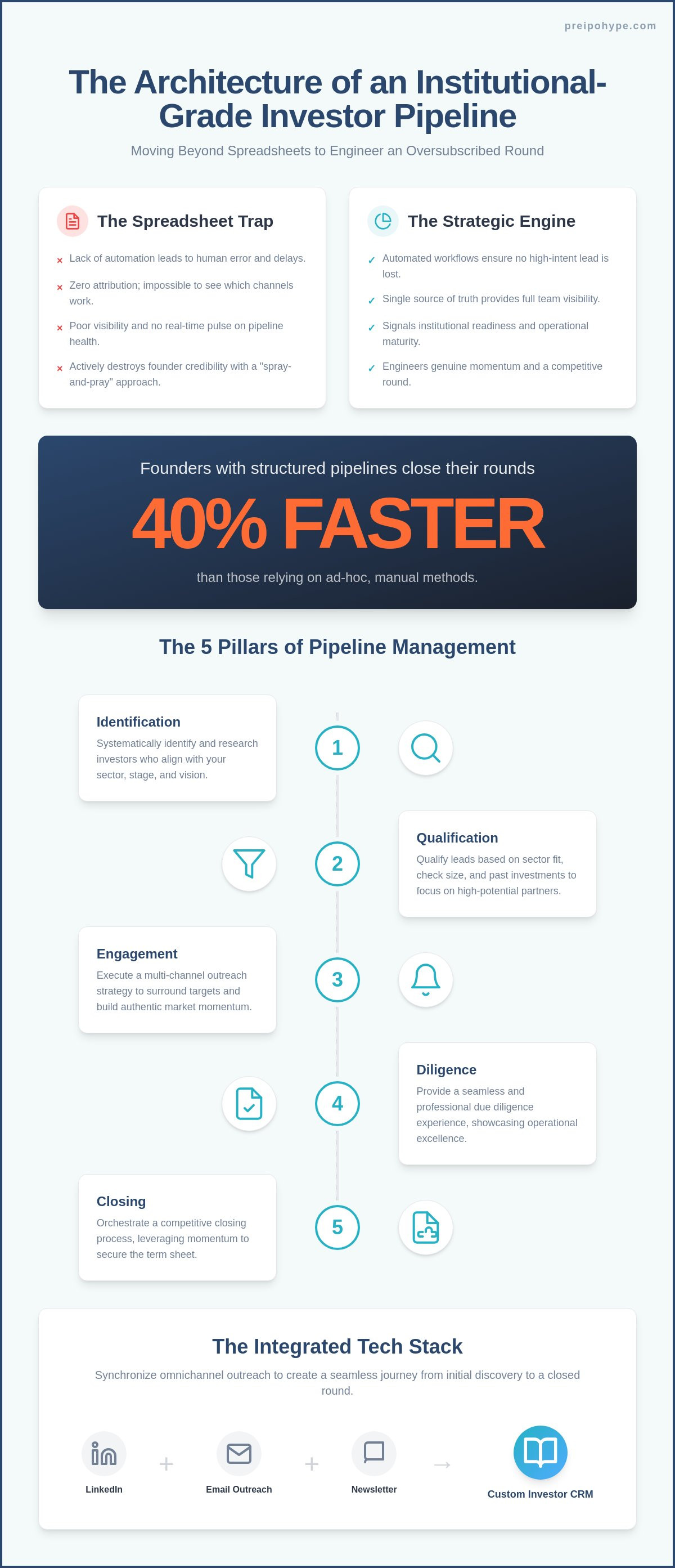
The traditional spreadsheet is where momentum goes to die. Manual tracking leads to several critical failures that modern systems solve:
- Lack of automation: Manual entry creates delays and human error.
- Zero attribution: You can't see which outreach channels are actually driving interest.
- Poor visibility: It's impossible to get a real-time pulse on your total pipeline health.
A modern system creates a single source of truth for your entire team, ensuring no high-intent investor falls through the cracks. This isn't just about organization; it's about narrative control. A well-managed pipeline allows you to tell a story of accelerating interest, using investor data to prove your round is heating up. You can find more about building this infrastructure in our guide to the fundraising tech stack.
The ROI of a Managed Pipeline
Efficiency is the ultimate currency in fundraising. By identifying high-intent leads early, you significantly reduce your "time to close" and keep your focus on the investors most likely to commit. Effective investor pipeline management prevents deal fatigue by maintaining a consistent outreach cadence that keeps your narrative fresh in the minds of target investors. Industry benchmarks indicate that founders who utilize structured pipelines often close their rounds 40% faster than those relying on ad-hoc methods. This speed doesn't just save time; it preserves your equity by allowing you to negotiate from a position of strength and momentum.
The Architecture of an Institutional-Grade Investor Pipeline
Building an elite round requires more than a pitch deck and a dream. It demands a rigorous architectural framework that mirrors the precision of institutional finance. Effective investor pipeline management is built upon five critical pillars: Identification, Qualification, Engagement, Diligence, and Closing. This structure ensures that every action taken serves the final goal of securing capital, rather than just filling a calendar with unproductive coffee chats. By following best practices for managing your investor pipeline, you transform a chaotic list of names into a predictable capital engine. You must build this technical infrastructure before the first pitch is ever sent to ensure you don't lose high-intent leads to administrative friction.
Mapping the Investor Journey
Every investor moves through a distinct lifecycle with clear exit criteria for each stage. We define these phases as Cold Lead, Qualified Prospect, Active Engagement, Diligence, and finally, Committed Capital. The "Nurture" stage is where most founders fail. It’s about keeping potential backers engaged with periodic updates and market news, creating a pulse of activity that builds trust over time. This consistent pressure is what eventually converts "Soft Circles" into hard, irrevocable commitments. If you haven't audited your current journey, you can book a strategic consultation to identify where your leads are dropping off.
Lead Scoring and Attribution
Lead scoring is your secret weapon for maintaining focus during a high-stakes raise. By assigning "warmth" scores based on document opens, email clicks, and webinar attendance, you gain real-time visibility into investor intent. This data-driven approach allows you to implement 60-day attribution, helping you understand which specific marketing channel actually drove the wire. Lead scoring allows founders to focus 80% of their energy on the top 20% of leads. This ensures that your limited time is spent on the institutional players most likely to lead the round rather than chasing low-conviction prospects.
Technical Bedrock for Raises
Your pipeline must sit on a solid Foundation Infrastructure designed for scale. This includes ensuring data security and SOC2 compliance, which are non-negotiable requirements for institutional investors and family offices. Integrating compliance checks directly into the workflow allows you to track investor accreditation status automatically, preventing last-minute regulatory hurdles during the closing process. For an elite setup that engineers market momentum, we recommend deploying a Custom Investor CRM. This specialized tool allows for tailored workflows that generic sales software simply cannot handle, providing the visibility needed to manage a complex, multi-million dollar raise with total confidence.
Beyond the Spreadsheet: Custom Investor CRMs vs. Legacy Fundraising Tools
Are you still trying to force an institutional-grade capital raise into a tool designed for selling software subscriptions? Generic CRMs like Salesforce or HubSpot often fail for high-growth capital raises because they lack the specific architecture required for sophisticated investor pipeline management. These legacy platforms are built for linear sales cycles, not the explosive, momentum-driven nature of a modern funding round. When you're engineering a hype cycle, you can't afford a system that treats a Tier-1 venture capitalist like a mid-market lead.
The definitive advantage of a Custom Investor CRM lies in its ability to handle tailored workflows for Reg CF and Reg A+ offerings. These aren't just digital rolodexes. They are automation engines that use triggers to move investors through the pipeline without constant manual entry. This level of automation mastery ensures that as soon as a lead hits a specific engagement threshold, they are moved to the next stage of the process. Real-time analytics provide the ultimate edge. There is a massive psychological difference between "we think they are interested" and "we know they opened the deck five times in the last hour."
Evaluating the Fundraising Tech Stack
Your technical bedrock must include more than just a contact list. Elite founders look for features like seamless email integration, granular document tracking, and integrated cap table modeling. The cost of using "cheap" or generic tools is often hidden in the missed opportunities and dead leads that result from poor data management. If your system can't tell you exactly which marketing channel drove a specific investor to your data room, you're flying blind. You can explore the fundraising tech stack required for elite raises to see how these components fit together.
The Insider Advantage of Custom Systems
Custom systems allow you to categorize leads with investor-specific data points that generic tools ignore. You need to track typical check sizes, preferred board seat status, and past co-investment history at a glance. Automating the "Investor Update" process directly from the CRM allows you to maintain momentum with zero friction. Pre-IPO Hype builds these custom systems specifically to convert curiosity into committed capital. We help founders move away from administrative chaos and toward a streamlined, data-driven engine that closes rounds faster. If you're ready to upgrade your infrastructure, you can learn more about our approach to building foundation infrastructure.
Engineering Market Momentum: Omnichannel Outreach and Engagement Tracking
Most founders treat investor pipeline management as a passive administrative task. They log calls, update statuses, and wait for the phone to ring. Elite founders do the opposite. They view their pipeline as a high-octane marketing engine designed to engineer market momentum. By synchronizing LinkedIn activity, direct email sequences, and Newsletter Exposure, you surround target investors with a consistent narrative of growth. This omnichannel approach ensures your deal isn't just another PDF in an inbox; it becomes a market event that demands attention.
You can use this structured pipeline to institutionalize the "Hype Cycle." By controlling the flow of information and timing your updates, you create a genuine sense of exclusivity and urgency. When an investor sees your progress validated across multiple platforms, their perceived risk drops while their fear of missing out rises. Tracking these interactions through a specialized Investor Acquisition Platform allows you to identify "hot" leads based on actual behavior rather than gut feeling. If you're ready to engineer your own market momentum, it starts with the technical ability to track every touchpoint.
Surrounding the Investor
The "Rule of 7" is just as relevant in fundraising as it is in enterprise sales. An investor often needs multiple touchpoints across different channels before they feel enough conviction to move to diligence. We use retargeting ads to keep your deal top-of-mind for those who have already viewed your deck, ensuring your brand stays visible during their decision-making process. This isn't about being pushy; it's about being present. You can master these strategies by exploring our playbook on Omnichannel Outreach to see how digital marketing dominates private markets.
Identifying Silent Objections
Data room analytics are the "X-ray vision" of investor pipeline management. If an investor opens your deck ten times but spends five minutes stuck on the "Competition" slide, you've identified a silent objection. Instead of waiting for them to ghost you, you can proactively reach out with a targeted update that addresses those specific concerns. This level of precision transforms your follow-up from a desperate "just checking in" to a strategic, data-driven conversation. Real-time engagement data allows founders to "read the room" digitally. By leveraging these insights, you can clear hurdles before they become deal-breakers, keeping your pipeline moving toward a successful close.
Closing the Loop: Integrating Your Fundraising Tech Stack for Maximum ROI
A standalone pipeline is essentially a static list of names and hopes. In the high-velocity market of 2026, a list isn't enough. You need a fully integrated technical bedrock that connects your acquisition efforts to your legal and financial closing tools. This is where elite investor pipeline management separates itself from amateur efforts. You have to synchronize your pipeline with your Reg CF Marketing Services to ensure that every marketing touchpoint is captured and used to drive conversion. If your marketing data is siloed from your investor tracking, you're losing the visibility required to optimize your spend and maximize your ROI.
The closing phase is the ultimate test of your infrastructure. Your CRM must do more than just record interest; it needs to facilitate the entire transition from a "yes" to cash in the bank. This involves managing digital signatures, wire transfer instructions, and the immediate onboarding of new shareholders. We specialize in helping founders audit their systems to identify bottlenecks before they go live. A pre-launch optimization ensures that when the hype hits its peak, your technical plumbing can handle the volume without leaking leads or delaying commitments.
The Final Push: From Commitment to Cash
Automating the closing sequence is the only way to maintain momentum during the final push. Your system should be programmed to trigger term sheets, subscription agreements, and mandatory KYC/AML checks the instant an investor confirms their commitment. Speed is a trust signal. Any delay in the paperwork gives an investor time to second-guess their decision. Beyond the wire, your pipeline transforms into a long-term investor relations asset. The best founders understand that fundraising never truly stops. They start building the pipeline for their next milestone the same day their current round closes, leveraging current success to fuel future growth.
Ready to Engineer Your Raise?
Success in the private markets requires a strategic edge that only an insider can provide. Pre-IPO Hype’s consulting and advisory services are designed to give founders that exact advantage. We don't just provide tools; we provide the roadmap to an oversubscribed round. By leveraging the reach of the Invst Guru newsletter, we drive qualified, high-intent traffic directly into your managed pipeline. This ensures you aren't just managing leads, but managing the right leads. Book a 30-minute strategy session with Jeff "Fuzzy" Wenzel to optimize your investor pipeline and turn your fundraising vision into institutional reality.
Mastering the Momentum of Your Next Raise
The window for generic fundraising has closed. In 2026, capturing institutional-grade capital requires a departure from manual tracking and a full embrace of sophisticated investor pipeline management. You've seen how a structured architecture, powered by custom CRM workflows and omnichannel outreach, transforms cold leads into high-conviction partners. This isn't just about organization. It's about engineering the market momentum that drives oversubscribed rounds and signals true institutional readiness.
We've facilitated over $100M for more than 230 companies by deploying these exact strategies. Our Custom Investor CRM provides the 60-day attribution tracking and elite outreach required for successful Reg CF and Reg A+ raises. You don't have to enter this gated financial world alone. When you act decisively, the opportunities that once felt inaccessible are suddenly within reach.
It's time to stop guessing and start engineering. Book a 30-minute strategy session with Fuzzy Wenzel to audit your current infrastructure and optimize your pipeline for maximum ROI. The future of your company depends on the engine you build today. Let's make your next round a definitive success.
Frequently Asked Questions
What is the best software for investor pipeline management?
The most effective software is a custom investor CRM or a platform specifically engineered for the high-stakes world of venture capital and private placements. While generic sales tools can store contact information, they often lack the specialized workflows required to track document opens, manage accreditation status, and coordinate complex diligence cycles. A tailored solution ensures your data remains secure and your outreach stays focused on high-intent leads.
How do I build an investor pipeline from scratch?
You build an elite pipeline by combining your existing professional network with aggressive investor acquisition campaigns. Start by auditing your immediate circle for warm introductions, then scale your reach using digital marketing and newsletter exposure to attract institutional interest. This dual-track approach ensures you have a steady flow of both familiar and new capital leads moving through your funnel from day one.
What are the typical stages in an investor pipeline?
A professional pipeline typically consists of five distinct stages: Identification, Qualification, Engagement, Diligence, and Closing. Each stage requires clear exit criteria, such as a lead investor signing a term sheet or a prospect completing a KYC check. Moving investors through these defined gates allows you to maintain visibility into the health of your round and accurately predict your closing timeline.
How do I track investor engagement with my pitch deck?
You track engagement by deploying document tracking tools that provide real-time alerts whenever your deck is opened, downloaded, or shared. Advanced systems offer slide-by-slide analytics, showing you exactly where an investor spends their time. This data is vital for investor pipeline management because it reveals silent objections, allowing you to address specific concerns in your next follow-up conversation.
What is the difference between a traditional CRM and an investor CRM?
A traditional CRM is built for linear product sales, while an investor CRM is engineered for the momentum-driven nature of capital raises. Investor-specific systems include features for cap table modeling, regulatory compliance tracking, and specialized communication triggers for Reg CF or Reg A+ offerings. These tools are designed to handle the unique psychological and technical requirements of converting a prospect into a long-term equity partner.
How many investors should be in my pipeline for a Seed round?
For a competitive Seed round, you should aim for a pipeline of 100 to 200 qualified investor leads. This volume accounts for the high attrition rates typical in early-stage fundraising and ensures you have enough active conversations to generate genuine FOMO. Having a broad base of leads allows you to be selective, focusing your energy on the top 20% of investors who show the highest conviction.
Should I use a spreadsheet to track my fundraising leads?
You shouldn't use a spreadsheet if you're serious about closing an institutional round in 2026. Spreadsheets are static, prone to human error, and lack the automation needed to manage hundreds of simultaneous conversations. Transitioning to professional investor pipeline management software provides a single source of truth that prevents follow-up fatigue and ensures no high-value lead ever falls through the cracks.
How does omnichannel marketing help with investor pipeline management?
Omnichannel marketing surrounds target investors with multiple touchpoints across LinkedIn, email, and newsletter platforms to build social proof. This strategy ensures your deal stays top-of-mind, making it feel like a significant market movement rather than an isolated pitch. By synchronizing these channels with your pipeline, you can track which interactions are driving the most engagement and adjust your strategy to maximize your capital intake.
Disclaimer
Educational only. Not investment, tax, or legal advice. Pre-IPO Hype is investor relations infrastructure for Regulation CF and Regulation A+ raises. We are not a broker-dealer, funding portal, or investment adviser, and we do not offer or sell securities or make investment recommendations. Any securities offering is made only by the issuer, through its own offering documents and, where required, a registered intermediary.


