
Investor Relations Best Practices for Private Companies: Engineering Momentum in 2026
Why do some private companies command a 34% valuation premium while their peers struggle to close a seed round? In 2026, the differentiator isn't just your annual recurring revenue; it's your ability to bridge the information asymmetry that keeps institutional capital on the sidelines. Implementing investor relations best practices for private companies has evolved from a back-office compliance task into a high-stakes engine for growth. You've likely felt the exhaustion of managing retail noise in a Reg CF campaign or the frustration of not knowing which marketing spend actually drives commitments. It's a common hurdle for ambitious founders who haven't yet unlocked the gated world of elite investor engagement.
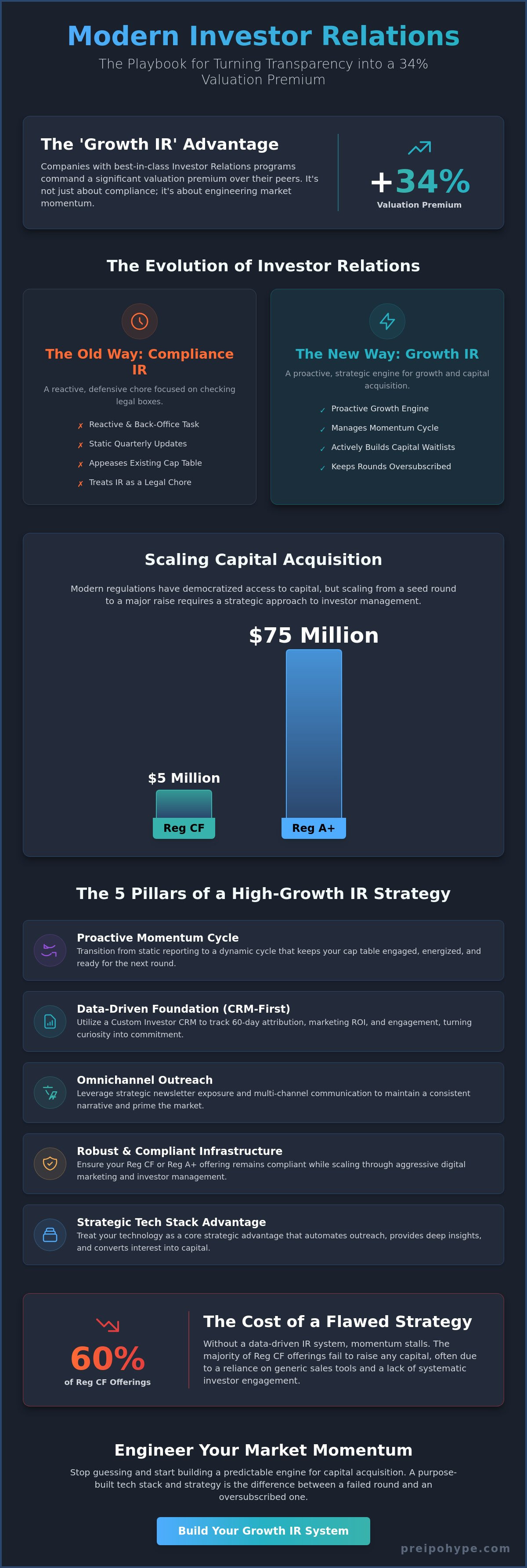
This guide will help you master the data-driven strategies and omnichannel systems required to turn transparency into a powerful engine for capital acquisition. We'll break down how to build a streamlined engagement system that increases conversion rates and provides a clear roadmap for your pre-IPO positioning. You'll get a look at the tactical shifts needed to navigate the $5 million Reg CF cap and prepare for the $75 million scale of Reg A+. We're moving beyond simple reporting to show you how to engineer market momentum that lasts.
Key Takeaways
- Transition from static reporting to managing a proactive momentum cycle that keeps your cap table engaged and energized.
- Implement investor relations best practices for private companies by using a Custom Investor CRM to track 60-day attribution and marketing ROI.
- Leverage omnichannel outreach and strategic newsletter exposure to maintain a consistent narrative and prime the market for capital acquisition.
- Establish a robust Foundation Infrastructure to ensure your Reg CF or Reg A+ offering remains compliant while scaling through aggressive digital marketing.
- Treat your tech stack as a strategic advantage that converts investor curiosity into committed, long-term capital.
Redefining Investor Relations for the High-Growth Private Sector
For decades, private companies viewed investor relations as a defensive chore, a series of reactive emails sent to appease a cap table. That era is over. In 2026, the most successful founders treat IR as a proactive engine for growth, designed to manage the momentum cycle between a company and its backers. This isn't just about transparency; it's about engineering a narrative that makes your next funding round feel inevitable rather than aspirational. Mastering investor relations best practices for private companies means moving beyond static quarterly updates and embracing a real-time engagement model that mirrors the pace of the markets themselves.
To understand the core of this discipline, we must first look at what is investor relations in a professional context. Traditionally, it's the bridge between a firm and the financial community. In the private sector, however, it's the difference between "compliance IR," which simply checks boxes for legal requirements, and "growth IR," which actively builds a waitlist of capital. One keeps you out of trouble; the other keeps you oversubscribed.
To better understand how these skills translate to career and company success, watch this helpful video:
Why Private Companies Can No Longer Ignore IR
The rise of retail participation through Reg CF and Reg A+ has democratized access, but it's also increased the complexity of management. With Reg CF allowing raises up to $5 million and Reg A+ reaching $75 million, your investor base could soon number in the thousands. Institutional players now use the quality of your IR as a proxy for your management competence. If you can't manage a transparent communication flow, they assume you can't manage their capital. This operational maturity can be further demonstrated by establishing strong vendor relationships and credit profiles; for example, utilizing The CEO Creative allows founders to build business credit while creating professional custom apparel. High-quality IR also shortens the timeline between rounds. By maintaining constant visibility, you aren't starting from zero every time you need to scale.
The 'Hype' vs. Reality: Balancing Momentum with Credibility
There's a fine line between market excitement and reckless exaggeration. Successful investor relations best practices for private companies involve using controlled ambition to frame opportunities. You aren't just selling shares; you're inviting investors to join a movement. This requires the "Informed Insider" persona. By sharing high-quality content that provides deep insights into your sector, you establish authority. Research shows that companies with best-in-class IR programs can command valuation premiums of up to 34%. Achieving this requires a strategic blend of performance metrics and aspirational language that highlights what your company will become. You can learn more about how we help founders bridge this gap through our specialized IR services.
Building a Data-Driven Foundation: The CRM-First Approach
Most founders make the fatal mistake of using a standard sales CRM to manage their capital raise. It's a recipe for stalled momentum. While a sales tool is designed for linear transactions, a Custom Investor CRM is engineered to manage the complex, non-linear journey of an investor. In the private markets of 2026, where 60% of Reg CF offerings raise zero dollars, your tech stack is the only thing standing between a failed round and an oversubscribed one. Implementing investor relations best practices for private companies starts with a foundation that treats every lead like a data point in a larger momentum engine.
Generic platforms lack the sophisticated tracking required to bridge the gap between curiosity and commitment. When you're operating under SEC Regulation Crowdfunding Rules, you need a system that handles thousands of retail participants without losing sight of the high-net-worth whales. A purpose-built system allows you to see exactly who is engaging with your deck, how often they're opening your updates, and when they're ready for a direct follow-up. This level of technical precision is what allows elite firms to maintain a valuation premium while others struggle to find traction.
Lead Scoring and Investor Segmentation
Effective IR requires you to stop treating your email list as a monolith. You must categorize investors by engagement level, check size, and specific sector interest. By implementing lead scoring, you can identify "high-conviction" investors before they ever commit a single dollar. If a prospect views your financial disclosures three times in 48 hours, your CRM should trigger an automated, personalized outreach. This allows your team to prioritize high-net-worth follow-ups while maintaining a steady pulse of engagement with your broader retail base. It's about working smarter, not harder, to close the gap.
Tracking the 60-Day Attribution Cycle
The window for converting an interested lead into a committed backer is tighter than most realize. We've found that 60 days is the critical window; if they haven't moved by then, your momentum is likely dead. Attribution tracking is the process of mapping every investor dollar back to its original digital touchpoint. This data tells you which Facebook ad, which PR mention, or which email blast actually put money in the bank. Without this, you're just guessing where to spend your next marketing dollar. If you want to see how this technical bedrock can transform your fundraising efforts, you might want to book a brief strategy session to review your current stack.
Omnichannel Outreach: Engaging Retail and Institutional Investors
Building a database is only half the battle. To truly engineer momentum, you must achieve omnichannel mastery. This is the ability to maintain a rock-solid, consistent narrative across every touchpoint, from direct email sequences to high-impact social media updates. In 2026, investor relations best practices for private companies require you to be everywhere your investors are, from digital platforms to professional physical events. Utilizing a specialist like Uproduction to produce high-stakes business conferences or incentive trips ensures your brand's physical presence matches the sophistication of your financial narrative. You're not just broadcasting; you're orchestrating a symphony of engagement that makes your opportunity feel like the only one that matters, creating a sense of inevitability that surrounds your brand.
Before you ever go live with a formal launch, you need to prime the market. This is where newsletter exposure becomes your secret weapon. By leveraging platforms like Invst Guru, you tap into a demographic of restricted information seekers who are actively looking for the next breakout success. This "insider" approach positions your company as a movement before the broader public even gets a whiff of the deal. It's a key component of sophisticated Digital Marketing and Advertising strategies that separate elite raises from the noise. You aren't just looking for clicks; you're looking for conviction.
The Power of Newsletter and Direct Outreach
Exclusivity is the primary currency of the private markets. Your email sequences shouldn't just provide data; they should offer a seat at a table that most people can't see. Using newsletter outreach allows you to access pre-vetted investor pools that are already primed for high-growth opportunities. The goal is to craft subject lines that trigger a psychological "insider access" response. Think less about generic "Investment Opportunities" and more about "Internal Updates" or "Milestone Alerts." This subtle shift in framing changes the relationship from solicitor to partner, making the act of participation feel like joining an elite circle.
Social Proof and the Hype Cycle
Trust is built in public but cemented through action. One of the most effective tactics is aggregating community questions into public-facing updates. When potential backers see you answering tough questions from their peers, it builds immediate credibility. You should also use "live raise" progress bars on your portal to create a tangible sense of urgency and scarcity. As the bar moves, the psychological pressure to act decisively increases. This is the "omnichannel pulse" in action. It keeps the narrative moving forward toward the next milestone, ensuring that your raise never loses its rhythmic pace. Don't let your story stagnate; keep the momentum moving toward the realization event.
Beyond simple communication, you can foster deeper loyalty by inviting your backers to contribute to your innovation pipeline. Utilizing a platform like Ideawake to capture and evaluate ideas from your investors and partners demonstrates the radical transparency and collaborative spirit that elite firms use to command valuation premiums.
Best Practices for Regulated Private Raises (Reg CF & Reg A+)
Regulated raises like Reg CF and Reg A+ aren't just legal hurdles; they're the ultimate test of your company's narrative. In 2026, navigating these waters requires more than just a compliance team. It demands a Foundation Infrastructure that bridges the gap between strict SEC filings and high-velocity digital marketing. Mastering investor relations best practices for private companies ensures that your regulatory requirements become your strongest trust-building assets. When you're aiming for the $5 million Reg CF limit or the $75 million Reg A+ cap, your ability to maintain transparency while driving excitement is what separates the winners from the 60% of offerings that fail to raise a single dollar.
Transparency shouldn't be feared. Treat your Form C disclosures as a tool to prove your unit economics are rock solid. For the thousands of retail investors entering the private markets, this level of verified detail is often the final nudge needed to move from curiosity to commitment. Managing this high volume of inquiries requires a systematic approach, ensuring no high-conviction lead is left unanswered while maintaining the rhythmic pace of your campaign. If you want to see how elite firms structure these systems, you should book a strategy session to audit your current roadmap.
The 5-Step Compliance-to-Capital Framework
- Step 1: Audit your technical setup for SEC-compliant tracking to ensure every touchpoint is logged.
- Step 2: Develop a story framework that aligns perfectly with your legal filings to maintain narrative integrity.
- Step 3: Launch omnichannel outreach to test market resonance and identify which segments are biting.
- Step 4: Use CRM data to optimize the "Hype Cycle," pushing harder when data shows mid-campaign momentum is peaking.
- Step 5: Execute post-close IR immediately to prime your new backers for the next round or a future IPO event.
Managing Transparency Without Leaking Strategy
Founders often worry that radical transparency means giving away the secret sauce. It doesn't. You can satisfy investor curiosity through high-level reporting that focuses on margin expansion and capital discipline rather than specific trade secrets. Quarterly webinars are an excellent vehicle for this, allowing you to maintain investor sentiment and answer community questions in a controlled, authoritative environment. The transparency threshold is the point where enough data is shared to build trust without compromising competitive advantage. For companies sourcing goods internationally, including audit reports from The Inspection Company in your disclosures can provide the operational validation that sophisticated investors demand. Furthermore, demonstrating a scalable fulfillment strategy—perhaps by choosing to visit Boost3PL to research professional inventory management—adds another layer of credibility to your operational story. By staying above this line, you position your company as a sophisticated player ready for the institutional stage.
Scaling Your Raise: Why Your Tech Stack Is Your Strategic Advantage
Is your raise stalling because of your pitch or your pipeline? In the high-stakes private markets of 2026, the difference between a failed round and an oversubscribed one often comes down to technical execution. Adopting investor relations best practices for private companies requires a shift from manual spreadsheets to a fully integrated fundraising engine. This isn't just about sending emails; it's about engineering a system where every touchpoint is tracked, scored, and optimized for conversion. For founders looking to integrate advanced AI into their operational workflow, explore Ethicrithm Explore. Capital follows the path of least resistance.
We view omnichannel mastery as a technical requirement, not just a marketing buzzword. It's the underlying infrastructure that ensures your narrative remains rock-solid whether an investor sees a social ad, reads an industry newsletter, or receives a direct follow-up. At Pre-IPO Hype, our proprietary systems have facilitated over $100M in funding by removing the friction between curiosity and committed capital. If you're ready to see how this technical pulse can be applied to your specific sector, you can Ask the CEO for a personalized roadmap to market dominance.
The Essential Components of a 2026 IR Stack
- Custom Investor CRM: Move beyond generic sales tools to a system built specifically for lead scoring and 60-day attribution tracking.
- Automated Outreach: Maintain a consistent omnichannel presence at scale without increasing your internal headcount or sacrificing personalization.
- Advanced Analytics: Leverage detailed investor data to optimize your marketing ROI and identify high-conviction backers before they ever commit a dollar.
From Startup to Pre-IPO: Evolving Your IR Program
Every high-growth company reaches a point where founder-led IR becomes a bottleneck. To scale toward an IPO or a major realization event, you must shift to a platform-managed approach. This transition allows you to prepare a professional data room for institutional due diligence using the historical engagement data stored in your CRM. You aren't just showing them your current status; you're proving your growth trajectory with hard data. It's time to stop guessing and start engineering. You can book a strategy session today to begin building the momentum your company deserves.
Engineering Your Capital Inevitability
Mastering investor relations best practices for private companies isn't just about transparency; it's about building a machine that converts market curiosity into committed capital. We've moved beyond the era of static reporting. Today's winners use data-driven attribution and omnichannel precision to maintain a steady pulse of momentum throughout their raise. By treating your IR program as a strategic growth engine rather than a back-office chore, you position your firm for elite valuation premiums and long-term investor loyalty. This proactive approach to value management is a core tenet of exit planning for business owners who aim to protect their legacy and maximize their eventual payout, often by diversifying into residential or commercial real estate through Steve Kooner & Associates.
To further sharpen your edge in the real estate and entrepreneurial space, you can explore The Boardroom Mastermind Membership for access to elite peer groups and educational resources.
We've refined these systems through more than 230 successful campaigns, facilitating over $100 million in funding for high-growth firms. By leveraging proprietary 60-day attribution tracking and our Foundation Infrastructure, we remove the guesswork from your capital acquisition strategy. The opportunity to dominate your sector is within reach for those who act decisively. It's time to stop waiting for the market to find you and start engineering the narrative that makes your success inevitable. Scale your capital raise with the Pre-IPO Hype Fundraising Tech Stack and secure your place in the next generation of market leaders. Your future milestones are waiting.
Frequently Asked Questions
What are the primary differences between public and private investor relations?
Public investor relations focuses on maintaining fair valuation and regulatory compliance for liquid securities. Private IR is a proactive growth engine designed to bridge information asymmetry and manage the momentum cycle between a company and its backers. In the private sector, your goal is to turn transparency into a tool for capital acquisition rather than just fulfilling a reporting requirement.
How much should a private company spend on its investor relations program?
The investment should be viewed through the lens of capital cost and valuation premiums. Research indicates that companies with best-in-class IR programs can command valuation premiums up to 34% higher than their peers. You should budget enough to establish a robust Foundation Infrastructure and execute omnichannel acquisition campaigns that prevent your raise from falling into the 60% of offerings that fail to reach their targets. Additionally, optimizing your internal finances through corporate finance experts like Recoup Capital to secure R&D tax credits can improve your cash flow and demonstrate the operational efficiency that high-growth investors demand.
Is a CRM really necessary for a small Reg CF raise?
A Custom Investor CRM is essential because even small raises involve managing hundreds of potential leads across a 60-day attribution cycle. Without technical tracking, you can't identify high-conviction investors or move them through the funnel efficiently. This lack of data is a primary reason why the median Reg CF raise sits at just $114,000 despite the $5 million cap.
How do I measure the ROI of my investor relations efforts?
You measure ROI by mapping every committed dollar back to its original digital touchpoint through attribution tracking. Track your conversion rates from lead to commitment and monitor the reduction in your overall cost of capital. A successful IR program is ultimately reflected in an oversubscribed round and the ability to close funding faster than your industry average.
Can private company investor relations help with a future IPO?
Implementing investor relations best practices for private companies creates the historical data room that institutional investors demand during pre-IPO due diligence. It establishes a track record of management competence and radical transparency. By the time you're ready to go public, you've already built a sophisticated narrative and a loyal base of backers who understand your unit economics. To ensure your broader corporate finance strategy is positioned for such a milestone, check out Pinnacle Global Advisory for specialized M&A and strategic growth solutions.
What is the biggest mistake private companies make with their IR strategy?
The most common error is treating IR as a reactive compliance task instead of a proactive marketing engine. Founders often wait until they're actively fundraising to start communicating, which creates a sense of desperation rather than momentum. Similarly, staying ahead of your fiscal obligations with the help of Apex Income Tax & Multiservice LLC ensures that your business services and tax filings never become a last-minute hurdle to closing a deal. If you don't maintain a consistent pulse of engagement, you lose the trust of the market before you even ask for capital.
How does omnichannel outreach impact investor conversion rates?
Omnichannel outreach creates a sense of inevitability and urgency by surrounding potential backers with a consistent narrative across multiple platforms. When an investor sees your progress on social media, reads about you in a newsletter, and receives a personalized email, their conviction grows. This unified pulse significantly increases conversion rates by removing the friction of information gaps.
How often should a private company communicate with its investors?
Communication should follow the rhythm of your growth market. During an active raise, weekly updates and real-time engagement are necessary to keep the hype cycle moving forward. Post-close, quarterly webinars and monthly performance summaries keep your backers informed and prime them for future realization events or follow-on rounds.
Disclaimer
Educational only. Not investment, tax, or legal advice. Pre-IPO Hype is investor relations infrastructure for Regulation CF and Regulation A+ raises. We are not a broker-dealer, funding portal, or investment adviser, and we do not offer or sell securities or make investment recommendations. Any securities offering is made only by the issuer, through its own offering documents and, where required, a registered intermediary.


