
Investor Relations CRM Platform: The 2026 Buyer’s Guide for High-Growth Founders
In 2026, a static database is where capital goes to die. If you are still managing your outreach via fragmented spreadsheets, you aren't just disorganized; you are actively leaking secondary liquidity to more agile competitors. High-growth founders now realize that a modern investor relations CRM platform must function as a high-velocity conversion engine rather than a digital Rolodex. With the global IR software market projected to reach $2,952.31 million by 2033, the act of unicorn hunting requires sophisticated tools that bridge the gap between private secrecy and public opportunity.
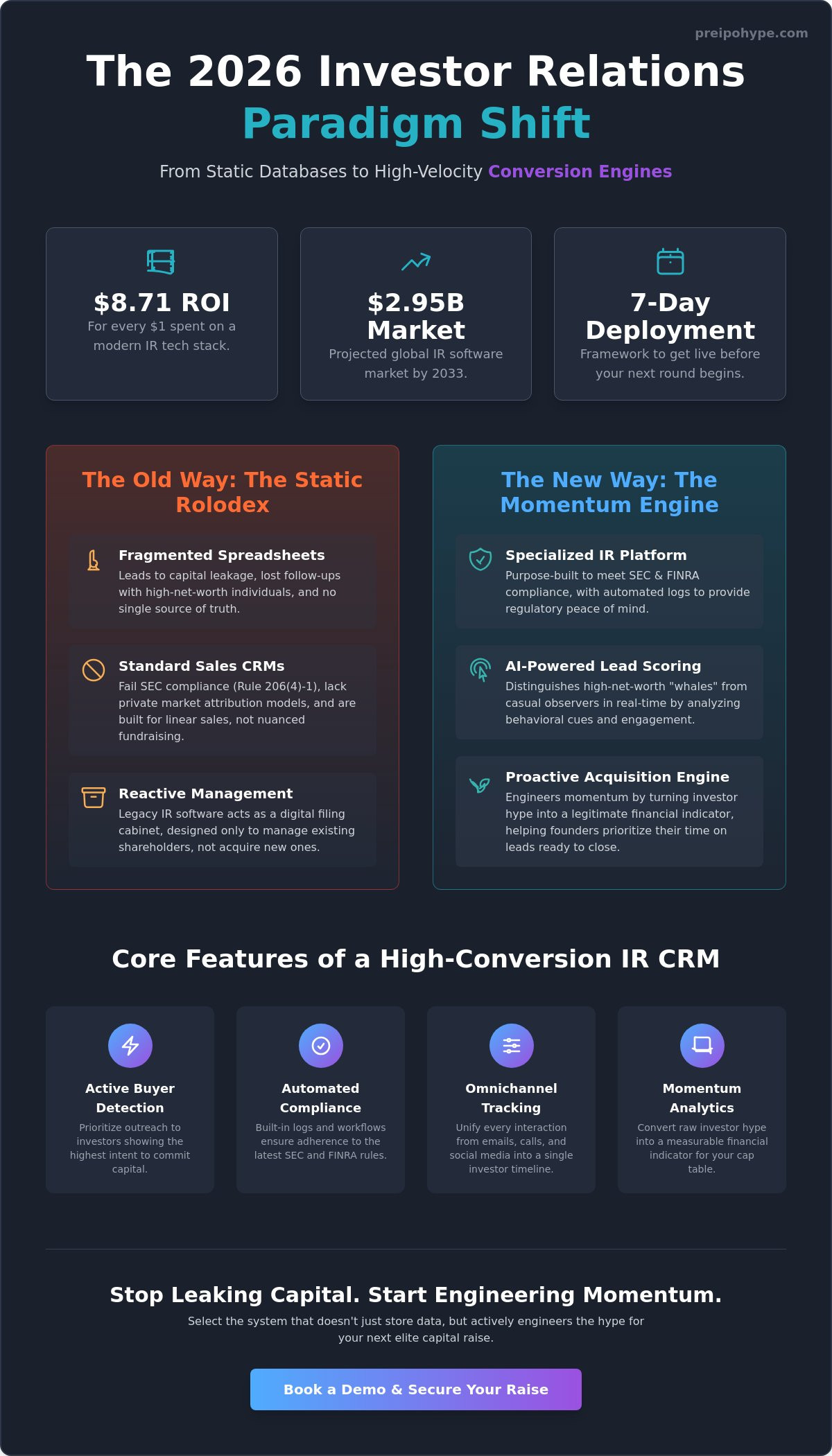
You likely feel the frustration of pouring capital into digital ads without seeing clear attribution or watching elite leads vanish into the noise of a crowded inbox. It's a common pain point in an era where the SEC updated its Marketing Rule FAQs on January 15, 2026, and FINRA filed for rule changes on February 10, 2026, to allow for projected returns. This guide promises to show you how to select a system that doesn't just store data, but actively engineers momentum. We will break down the shift to agentic AI, analyze the total cost of ownership for 2026's top-tier platforms, and show you how to secure the industry average ROI of $8.71 for every dollar spent on your tech stack.
Key Takeaways
- Learn why standard sales CRMs fail to meet SEC compliance and how a specialized investor relations CRM platform bridges the gap between digital interest and committed capital.
- Discover the mechanism behind automated lead scoring that distinguishes high-net-worth "whales" from casual window shoppers in real-time.
- Identify the critical differences between public market surveillance tools and private market acquisition systems designed for high-growth momentum.
- Master the 7-day deployment framework to ensure your investor engagement infrastructure is live and tracking attribution before your next round begins.
- Explore how integrating a custom conversion engine with foundational marketing infrastructure turns raw investor hype into a legitimate financial indicator.
Beyond the Rolodex: Why Your 2026 Capital Raise Demands a Modern IR CRM Platform
The era of the passive investor database ended with the regulatory shifts of early 2026. Today, an investor relations CRM platform is no longer just a place to store phone numbers; it's a specialized engine designed to track the high-stakes journey from a curious lead to a committed shareholder. This transition treats IR as a strategic management responsibility that integrates finance, communication, and marketing to achieve the highest possible valuation. Founders who treat their cap table as a static list are essentially flying blind in a market that now moves at the speed of social sentiment.
To better understand how modern technology simplifies these complex relationships, watch this helpful video:
Standard sales CRMs like Salesforce or HubSpot often fail high-growth founders during a raise. They're built for linear product sales, not the nuanced requirements of SEC Rule 206(4)-1, which saw critical marketing compliance updates on January 15, 2026. These general platforms lack the specific attribution models needed to track which marketing channels are driving actual capital rather than just "clicks." In the private market, timing and momentum are the new valuation benchmarks. If you can't track the hype cycle in real-time, you're leaving secondary liquidity on the table.
The Death of the Spreadsheet in Modern Fundraising
Managing a high-velocity Reg CF or Reg A+ raise on a spreadsheet is a recipe for funding leakage. As of March 8, 2026, 91% of companies with 10 or more employees utilize CRM systems, yet many founders still risk their rounds with manual data entry. Fragmented data across tabs leads to lost follow-ups with high-net-worth individuals who expect elite-level responsiveness. You need a single source of truth that captures every interaction, ensuring that institutional interest and retail enthusiasm are nurtured with the same precision through automated workflows.
Conversion vs. Management: A Critical Distinction
Legacy IR software was built for management; it was designed to keep existing shareholders quiet. Modern platforms are built for acquisition. They utilize Active Buyer Detection to help founders prioritize their limited time on the leads most likely to close. This shift from reactive logging to proactive engineering is explored deeply in our guide on The Custom Investor CRM: Engineering Momentum for Elite Capital Raises in 2026. In 2026, your investor relations CRM platform must be your most aggressive closer, not just your digital filing cabinet.
Engineering the Hype Cycle: Core Features of a High-Conversion Investor CRM
Building a ground-floor opportunity requires more than a compelling pitch; it requires a technological engine that can manufacture and sustain momentum. The right investor relations CRM platform doesn't just record history. It predicts the future by analyzing behavioral cues that signal a looming commitment. Understanding the Core Features of Modern IR Platforms is the first step toward automating your capital raise and ensuring no high-net-worth lead is left in the cold. In 2026, the elite standard involves omnichannel mastery, where every email open, social media interaction, and direct outreach attempt is unified into a single, chronological timeline.
Efficiency is the ultimate currency for a founder. Automated SEC compliance logs now provide regulatory peace of mind by documenting every interaction, a necessity following the January 15, 2026, updates to the SEC Marketing Rule. By capturing these touchpoints, your CRM creates a 60-day attribution window. This allows you to see the long-tail impact of your marketing spend, proving that a LinkedIn ad from two months ago was the actual catalyst for a million-dollar check today. If you're ready to see how this looks in practice, you can ask our CEO for a breakdown of our proprietary conversion models.
Lead Scoring and Behavioral Signals
Not all interest is created equal. Lead scoring is the process of assigning numerical values to investor actions to prioritize outreach. Instead of chasing every "window shopper" who clicks a link, your system should automatically flag "whale" investors based on specific behavioral signals. If a lead spends four minutes on your valuation page and downloads your pitch deck twice in 24 hours, their Investor Intent score should skyrocket. This proprietary ranking allows your team to focus their energy on the leads that are primed for a closing call, rather than wasting hours on low-intent retail curiosity.
Omnichannel Attribution: The Holy Grail of ROI
Connecting a Facebook ad click to a finalized investment on a crowdfunding portal is the final frontier of fundraising transparency. By utilizing custom tracking pixels and a robust "Foundation Infrastructure," your CRM can bridge the gap between digital hype and capital commitment. This level of precision is only possible when you integrate your Digital Marketing and Advertising strategy directly into the CRM conversion engine. With the broader CRM market expected to reach $126.2 billion in 2026, the winners will be those who use data to prove exactly which channels are engineering their success.
Strategic Differentiation: Public Market Surveillance vs. Private Market Acquisition
Public market investor relations is a game of surveillance; private market fundraising is a game of acquisition. While legacy tools like Q4 are excellent for public companies tracking earnings call sentiment or institutional ownership shifts, they are often overkill for high-growth startups. More importantly, they lack the aggressive "acquisition" features required to close a round. An investor relations CRM platform for the pre-IPO world must prioritize the "Growth" model, focusing on how to convert cold curiosity into committed capital rather than just monitoring existing shareholders.
Founders frequently ask if they can simply repurpose a generic sales tool like HubSpot. While HubSpot excels at moving a lead through a product funnel, it is fundamentally ill-equipped for the complexities of a 2026 capital raise. Generic pipelines don't account for the January 2026 CRM3 total cost reporting requirements or the specific attribution needed for Reg CF and Reg A+ offerings. You don't just need a sales pipeline; you need an investor-specific workflow that maintains an elite feel while managing the massive data volume of modern equity crowdfunding.
The Retail Investor Challenge
Managing five thousand retail leads requires a different technological bedrock than managing five institutional VCs. In the high-velocity environment of 2026, automation is the only way to scale personalized outreach without losing the "informed insider" energy that drives investment. A sophisticated system allows you to track engagement across thousands of touchpoints while flagging "secondary liquidity" opportunities. As private markets become more liquid, your CRM must be able to identify which retail investors are likely to increase their positions based on recent market momentum or company updates.
Institutional Outreach in a Digital Age
Institutional investors expect you to have your house in order. When preparing for high-stakes meetings with VC or Angel groups, your CRM data becomes your most powerful weapon. It allows you to walk into a room knowing exactly which partners have opened your deck and which sections they spent the most time analyzing. Are you using data to hunt unicorns or just waiting for them to find you? To master this proactive approach, founders are turning to the Investor Acquisition Platform: The Founder’s Guide to Scaling Capital 2026 to bridge the gap between digital hype and institutional commitment. In this final frontier of wealth creation, the right data doesn't just support the raise; it engineers the exit.
The 2026 Founder’s Framework: How to Evaluate and Select Your IR CRM
Selecting an investor relations CRM platform is a binary choice: either it's a strategic asset that accelerates your exit or it's a liability that drains your management time. In 2026, the evaluation criteria have shifted away from simple feature lists toward technical bedrock and integration capability. Does the system integrate natively with your "Foundation Infrastructure"? If your CRM exists in a vacuum, you're back to manual data entry and fragmented insights. Your platform must be the central hub where your story framework, technical pixels, and lead scoring converge to create a seamless investor journey.
Cost is the next major hurdle, but you shouldn't evaluate it based on "seats managed." That's a legacy sales metric. In the elite circles of private market fundraising, you evaluate a platform based on capital raised. With businesses earning an average ROI of $8.71 for every $1 spent on CRM systems as of December 2025, the sticker price is secondary to the conversion velocity. Whether you're looking at modern CRMs that cost a few thousand dollars per user or enterprise platforms requiring six-figure budgets, the only metric that matters is how quickly that tool turns curiosity into capital.
The 7-Day Deployment Test
Speed is your greatest competitive advantage. Enterprise-grade systems that require three months of implementation are the enemy of a successful raise. In a high-velocity market, your system needs to be live and tracking leads in under a week. A custom investor CRM setup should include your story framework and technical tracking pixels from day one. CRM setup time should never exceed 10% of your total fundraising timeline. If you aren't tracking attribution within seven days, you're losing data that could define your next valuation benchmark.
Evaluating Support and Advisory
A tool is only as powerful as the strategy behind it. The most sophisticated investor relations CRM platform will fail if it's configured with a weak narrative or poor lead-scoring logic. This is where consulting and advisory services become indispensable. You need an insider who can configure your system for maximum hype while ensuring compliance with the SEC updates from January 15, 2026. Don't leave your infrastructure to chance. You can schedule a strategy audit to ensure your tech stack is engineered for a successful close.
Executing the Elite Raise: Why Pre-IPO Hype is the Final Frontier of Investor CRM
The Pre-IPO Hype Custom Investor CRM isn't a retail product you find on a shelf. It's a proprietary, data-driven marketing system built specifically for the private market's final frontier. While others struggle with generic tools, elite founders use this platform as a gateway to secondary liquidity and exclusive investment circles. The true power lies in the synergy between our "Foundation Infrastructure" and the CRM conversion engine. It's a closed-loop system where every bit of hype is captured, quantified, and converted. In a year where the broader CRM market has reached $126.2 billion, the winners are those who don't just manage data but weaponize it.
Omnichannel mastery is no longer a luxury in 2026. Your investor relations CRM platform must be able to sync the massive exposure from the Invst Guru newsletter directly with automated follow-up sequences. This ensures that the momentum generated by high-traffic placements doesn't evaporate. Instead, it's funneled into a structured environment where institutional and retail leads are nurtured with surgical precision. By aligning your outreach with the SEC's January 15, 2026, Marketing Rule updates, you maintain compliance while being aggressively proactive. This is how curiosity becomes capital.
From Discovery to Capital
Transitioning from a curious lead to committed capital requires a narrative that never wavers. Our project-based setup fees cover the heavy lifting of technical integration, ensuring your story frameworks are embedded directly within the CRM. This consistency prevents the narrative drift that kills many early-stage raises. It's about maintaining that "informed insider" energy from the first touchpoint to the final exit. If you're facing unique hurdles in your current round or struggling with fragmented data, you should ask our CEO for a direct perspective on how to bridge your specific data gaps.
Your Fundraising Roadmap for 2026
The window for ground-floor opportunity moves fast. Your next step isn't to keep window shopping for tools; it's to execute your raise with the precision of an insider. Start by auditing your current "Foundation" to identify where you're losing high-net-worth leads in the noise. In a market where 91% of companies now use CRM systems, the advantage goes to those who use a specialized investor relations CRM platform to engineer their own exit. The time for passive observation is over. Decisive action is the only path to joining the elite movement of private market wealth creation. To see exactly how this conversion engine operates in a real-world scenario, watch our Video Funnel to see the CRM in action.
Engineering Your Exit Velocity: The Future of Capital Acquisition
The window for ground-floor opportunity in the private market is narrower than ever. You've seen why a generic sales tool fails to capture the high-velocity momentum of a Reg CF or Reg A+ raise. By prioritizing a specialized investor relations CRM platform, you transition from passive surveillance to active capital acquisition. This shift allows you to leverage omnichannel attribution over a 60-day window, ensuring every marketing dollar is tied to a specific commitment. We've facilitated over $100M in funding by replacing fragmented spreadsheets with a technical bedrock engineered for unicorn hunting.
It's time to stop window shopping for infrastructure and start executing your raise with insider precision. Our custom CRM is built for regulatory mastery, providing the data-driven insights you need to command the room. Don't leave your valuation to chance in a market that moves at the speed of social sentiment. To audit your current foundation, Book a 30-Minute Strategy Session with 'Fuzzy' Wenzel. The final frontier of wealth creation is now within reach for those who act decisively. Your next big exit starts with the data you capture today.
Investor Relations CRM: Frequently Asked Questions
What is the difference between a sales CRM and an investor relations CRM?
Sales CRMs are built to track product transactions, while an investor relations CRM platform is engineered to manage capital and compliance. Standard tools like HubSpot or Salesforce often lack the specific workflows needed for SEC Rule 206(4)-1 marketing compliance. Specialized IR systems focus on the unique journey from a curious lead to a committed shareholder, providing attribution models that general sales pipelines simply can't match.
How much does an investor relations CRM platform typically cost in 2026?
Pricing for these platforms as of March 2026 falls into three specific tiers. Modern, standalone CRMs typically cost between a few hundred and a few thousand dollars per user annually. Salesforce-based configurations often carry higher administrative costs, while enterprise-grade systems usually require five- or six-figure annual budgets once you factor in implementation, support, and custom modules for institutional engagement.
Can an IR CRM help with SEC compliance for Reg CF and Reg A+?
Yes, specialized platforms provide automated, timestamped logs for every investor interaction, which is vital for regulatory peace of mind. Following the SEC Division of Investment Management's updates on January 15, 2026, having a clean audit trail for marketing communications is non-negotiable. These systems ensure that your outreach for Reg CF or Reg A+ raises remains within the boundaries of the latest Marketing Rule FAQs.
Do I need a CRM if I am only raising from a few angel investors?
You need a CRM to maintain the "informed insider" energy that elite investors expect. Even with a small group of angels, losing track of a high-net-worth lead in a messy spreadsheet signals a lack of professional authority. A CRM ensures you provide high-touch, personalized responsiveness, proving to your backers that you have the technical bedrock required to scale toward a major exit.
How does an IR CRM track investor attribution from social media ads?
Modern platforms utilize custom tracking pixels and "Foundation Infrastructure" to bridge the gap between digital hype and capital commitment. By creating a 60-day attribution window, the system can link a specific LinkedIn or Facebook ad click directly to a finalized investment on your crowdfunding portal. This allows you to measure the actual ROI of your digital ad spend with institutional precision.
Is it difficult to migrate data from spreadsheets to an investor CRM?
Migration is typically a streamlined process that can be completed in under 7 days with a project-based setup. The key is mapping your existing data to investor-specific fields like accreditation status, secondary liquidity interest, and engagement history. Once the technical integration is complete, you eliminate the "funding leakage" that occurs when fragmented data leads to poor follow-up during high-velocity raises.
What "smart" features should I look for in a modern IR platform?
In 2026, the gold standard is "agentic" AI that proactively identifies and ranks investment targets. Look for features like automated lead scoring, which uses behavioral signals like pitch deck downloads to flag "whale" investors. Predictive analytics and peer group analysis are also vital, as they help you forecast which investors are most likely to increase their positions before you even initiate contact.
Can the CRM integrate with my existing website and pitch deck?
Elite CRMs integrate natively with your digital presence to capture "Active Buyer Detection" signals in real-time. By tracking how long a lead spends on your valuation page or which slides of your deck they view most, the system assigns an Investor Intent score. This integration ensures your story framework remains consistent across all touchpoints, turning your website into a high-conversion engine.
Disclaimer
Educational only. Not investment, tax, or legal advice. Pre-IPO Hype is investor relations infrastructure for Regulation CF and Regulation A+ raises. We are not a broker-dealer, funding portal, or investment adviser, and we do not offer or sell securities or make investment recommendations. Any securities offering is made only by the issuer, through its own offering documents and, where required, a registered intermediary.


