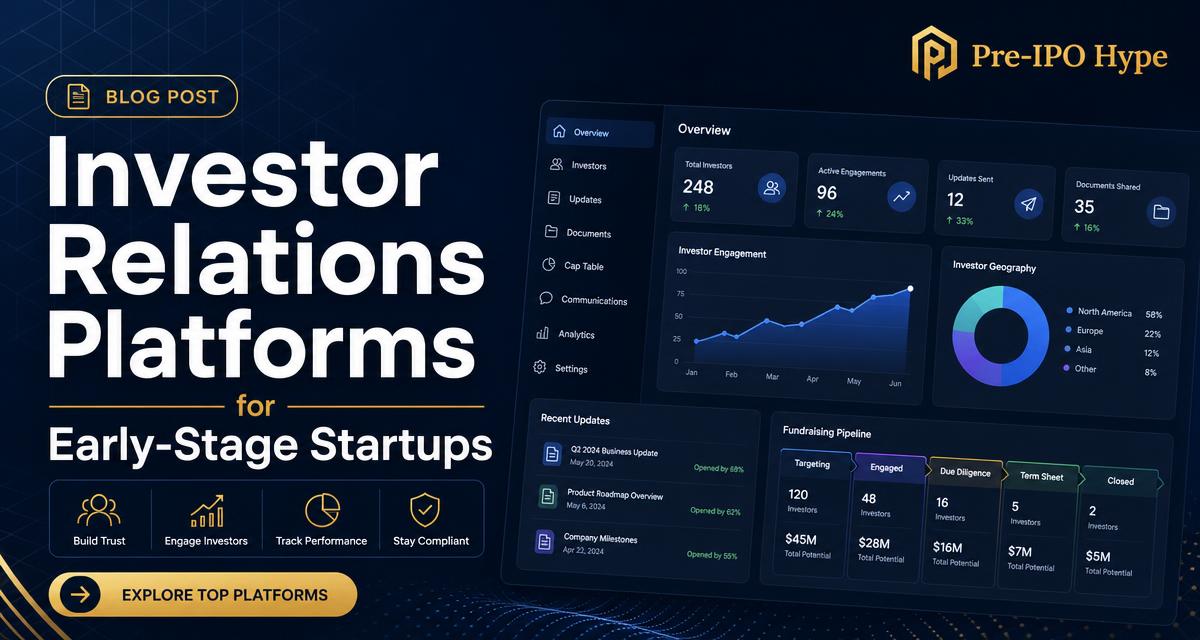
Which Platforms Offer Robust Investor Relations Management for Early-Stage Startups?
Early-stage founders rarely struggle because they lack ambition. More often, they struggle because investor communication becomes fragmented exactly when the company needs credibility, consistency, and momentum the most. A fundraising conversation starts in one inbox, diligence files live in another folder, ownership data sits in a spreadsheet, and quarterly updates are drafted from scratch every time. That creates friction for founders and uncertainty for investors.
If you are evaluating which platforms offer robust investor relations management for early-stage startups, the best answer is not simply “pick the tool with the most features.” The right platform depends on your fundraising stage, reporting discipline, data complexity, stakeholder count, and need for secure document sharing.
Bottom line: early-stage startups usually need a platform that combines investor updates, document sharing, permission controls, cap table visibility, and communication history in one workflow. As you grow, auditability, access controls, and integrated reporting matter more.
Want the story behind the software to be as strong as the workflow? Pre-IPO Hype provides investor readiness support and investor-facing content services that sit alongside whichever IR platform you pick.
On this page
- What robust IR management means
- The three platform types to compare
- Capability comparison table
- Choosing by startup stage
- The 10 evaluation criteria
- What founders get wrong
- Recommended investor update structure
- Founder scorecard
- Selection framework
- Final recommendation
Executive summary
For most early-stage startups, a robust investor relations platform should help you centralize investor communications, share diligence documents securely, control who sees what, track investor engagement, reduce manual update work, and improve fundraising readiness.
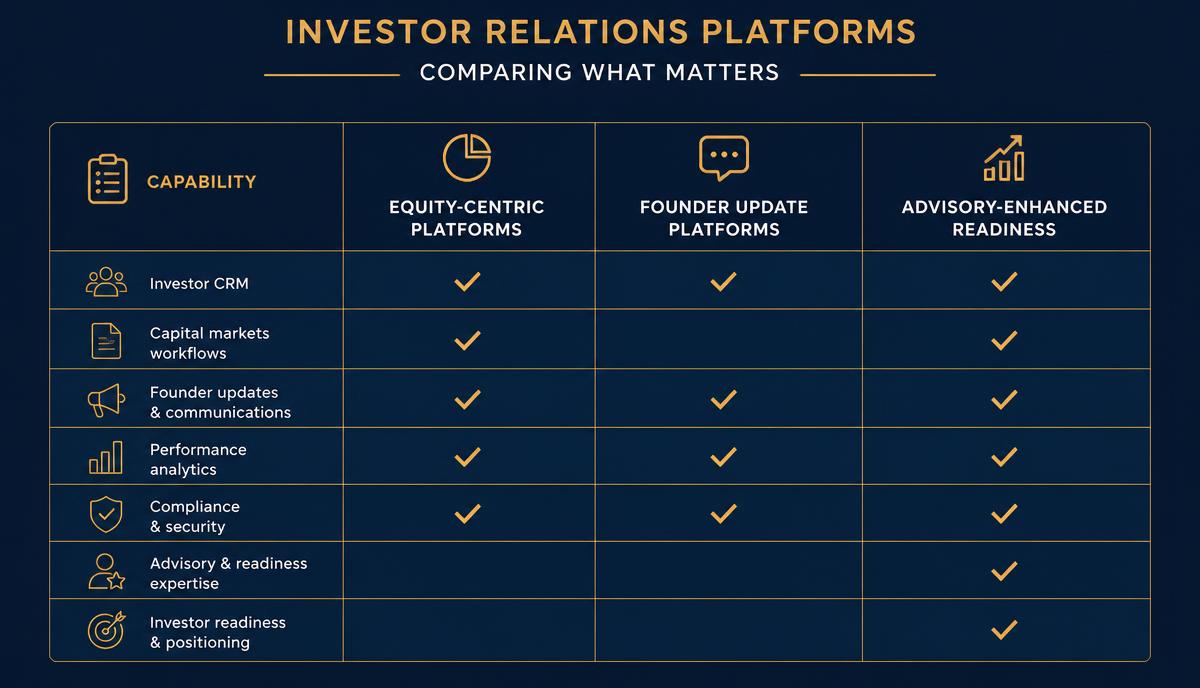
The strongest solutions fall into three categories: equity-and-governance centered platforms, founder communication and update platforms, and broader fundraising readiness ecosystems that pair software with advisory and narrative support.
What “robust investor relations management” means for an early-stage startup
Investor relations at the startup stage is very different from investor relations at a public company. You are not running earnings calls. You are building trust through disciplined, transparent, and efficient information sharing. A robust solution should support five core jobs.
1. Ongoing investor updates
- Revenue or growth milestones
- Product progress
- Hiring updates
- Burn and runway context
- Key asks or introductions needed
- Upcoming fundraise milestones
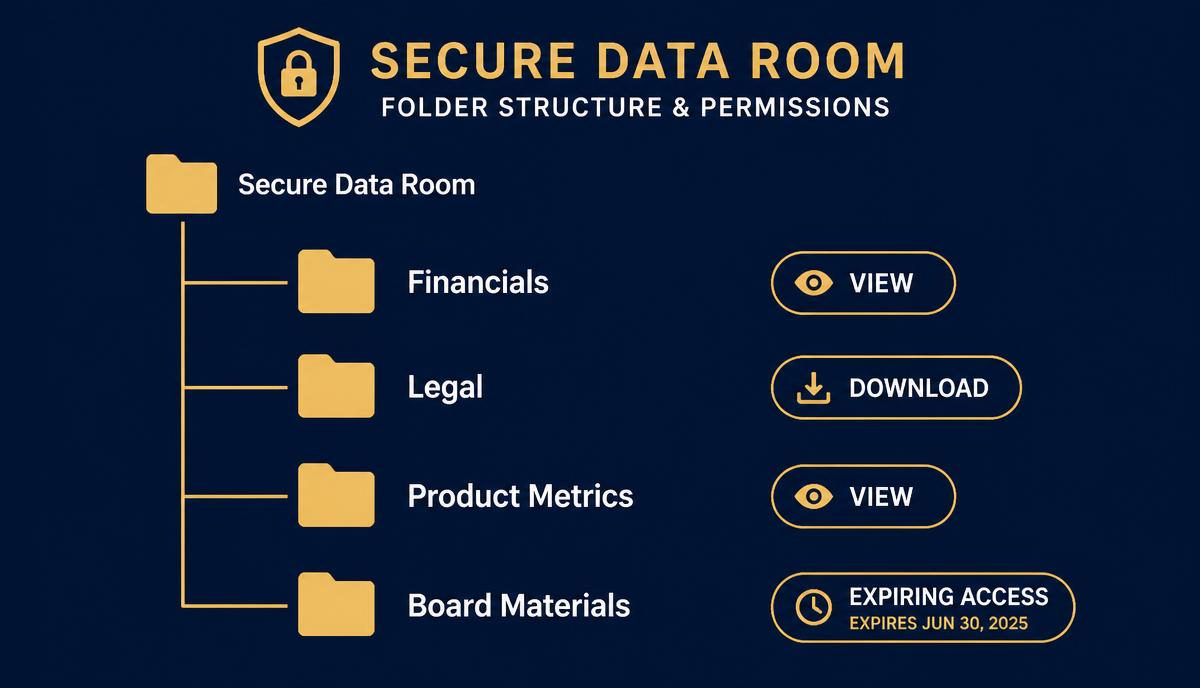
2. Secure due diligence sharing
- Financial statements and forecasts
- Pitch materials
- Legal documents
- Customer metrics
- Board materials and historical fundraising records
3. Stakeholder access management
- Different access levels by user
- Bulk and individual permissions
- Expiration settings for sensitive information
- Visibility controls for current vs. prospective investors
4. Ownership and cap table awareness
Even if your startup uses a separate equity tool, investor relations works better when stakeholders understand ownership, dilution context, and financing history without endless manual explanation.
5. Communication history and accountability
Which investors received the last update? Who opened it? Which documents were shared? Which requests are outstanding? What was promised in the previous round? That record becomes more valuable with every financing event.
The key platform types founders should compare
1. Equity-centric investor relations platforms
Strongest when investor relations is tightly connected to ownership records, access permissions, and fundraising administration. Typical strengths include investor portal access, ownership visibility, permission-based document sharing, and better control over sensitive financing records. They can feel heavier than a pre-seed team needs and require operational discipline to use fully.
Best fit: you already have multiple investors, are managing SAFEs or priced rounds, and want a more formal investor experience.
2. Founder update and relationship management platforms
These focus on recurring communications, metric dashboards, data room support, and fundraising pipeline tracking. They are quick to set up and repeatable, but may be lighter on formal governance controls and cap table administration.
Best fit: your immediate need is building trust through excellent updates and efficient fundraising communication. A dedicated investor CRM often lives in this category.
3. Advisory-enhanced IR readiness solutions
Software alone does not fix a weak investor narrative. Many early-stage startups also need support with positioning, messaging, content, and perceived credibility. Pre-IPO Hype fits here as a founder communication strategy layer: sharper messaging, more compelling investor-facing content, better startup fundraising visibility, and credibility signals across owned media.
Comparison table: what early-stage startups should look for
| Capability | Why it matters | Priority | Earliest stage | Scaling startups |
|---|---|---|---|---|
| Investor update workflow | Keeps communication consistent | Must have | Yes | Yes |
| Secure data room | Supports diligence and follow-ups | Must have | Yes | Yes |
| Granular permissions | Protects sensitive information | Must have | Helpful | Essential |
| Communication history | Prevents missed context | Must have | Yes | Yes |
| Cap table visibility | Connects ownership with access | High | Helpful | Essential |
| Engagement tracking | Shows who read updates or files | High | Helpful | Yes |
| Metrics dashboard | Faster, data-driven updates | High | Yes | Yes |
| Fundraising pipeline tracking | Manages prospective investors | Helpful | Yes | Yes |
| Expiring file access | Improves diligence security | Helpful | Helpful | Essential |
| Advisory and content support | Strengthens investor confidence | High | Yes | Yes |
How to choose the right platform by startup stage
Pre-seed
Speed matters more than complexity: a lightweight update workflow, a basic but organized data room, a home for fundraising materials, and a repeatable cadence. Choose simplicity over heavy administration.
Seed
Investors expect better reporting and cleaner diligence workflows: polished recurring updates, structured document access, stakeholder segmentation, cap table context, and a history of prior promises. Prioritize permissioning and integration between updates, documents, and investor records.
Series A readiness
Fragmented tools start creating risk. You need formal data room processes, investor-grade reporting discipline, clean ownership visibility, version control, and auditability. Move toward a system that supports scale, not just hustle.
The 10 most important evaluation criteria
- Can you send structured investor updates quickly? The tool should reduce manual work, not add it.
- Does it support secure document sharing? Role-based access, not open folders in email threads.
- Are permissions granular? Control by individual, group, and document type.
- Can investors self-serve basic information? Fewer repetitive requests means a more scalable process.
- Is there a record of communication? Institutional memory matters at the next round.
- Does it integrate with metrics or financial reporting? Manual reassembly makes updates inconsistent.
- Can it support both current and prospective investors? Relationship continuity plus fundraising execution.
- Will it still work 18 months from now? Avoid a migration during a critical raise.
- Does it improve the investor experience? Founder-friendly is good; investor-friendly is better.
- Does it support your broader fundraising story? Software cannot compensate for weak messaging.
Decision matrix for founders
| If your main problem is… | You likely need… | Priority |
|---|---|---|
| Sending consistent investor updates | Communication-focused platform | High |
| Managing sensitive diligence files | Secure data room and permissions | High |
| Confusion about ownership and stakeholders | Equity-centric platform | High |
| Raising while tracking warm leads | Fundraising pipeline workflow | Medium |
| Building a more credible investor narrative | Strategic messaging support | High |
| Preparing for institutional investors | Formal governance and access controls | High |
What founders often get wrong
- Buying for features, not workflow. The real question is whether the platform matches your monthly communication rhythm.
- Treating the data room as separate from investor relations. It is part of the trust-building experience.
- Ignoring permissions until diligence begins. Waiting until sensitive requests arrive creates chaos.
- Failing to create communication consistency. Modest updates sent consistently outperform sporadic polished ones.
- Underestimating narrative quality. How you frame progress, setbacks, and next steps matters as much as the metrics.
Recommended investor update structure
- Headline summary — one paragraph on the month or quarter
- Key metrics — growth, retention, burn, runway, usage, pipeline
- Wins — meaningful milestones achieved
- Challenges — honest, concise explanation of issues
- Asks — introductions, hires, partnerships, customer leads
- Next milestones — what to expect before the next update
Sample founder scorecard
| Category | Score 1 | Score 3 | Score 5 |
|---|---|---|---|
| Ease of setup | Hard to launch | Moderate | Live quickly |
| Investor update workflow | Manual | Semi-structured | Highly repeatable |
| Data room quality | Basic storage | Organized folders | Secure, permissioned, investor-ready |
| Permissions | Minimal | Some controls | Granular and scalable |
| Reporting | Manual exports | Partial dashboards | Integrated and presentation-ready |
| Cap table alignment | None | Limited | Strong visibility and access linkage |
| Investor experience | Clunky | Acceptable | Professional and intuitive |
| Scalability | Temporary fix | Works for now | Supports next rounds |
Suggested platform selection framework
Step 1: Define your use case. Decide what matters most over the next 12 months — investor trust, fundraising execution, diligence readiness, governance maturity, or reporting speed.
Step 2: Audit your current workflow. Map where investor contacts, financial data, cap table records, update drafts, legal documents, and pipeline currently live. Where fragmentation is highest, platform value is highest.
Step 3: Pair technology with communication quality. Once the workflow is defined, improve the founder narrative and digital credibility. See our seed-round IR tools comparison and case studies for real examples.
All-in-one platform or flexible stack?
Choose an all-in-one solution if you want fewer systems, already have investor complexity, value centralized permissions and records, or are approaching a larger institutional raise. Choose a flexible stack if you are very early, your investor base is small, and you want best-of-breed tools for updates, equity, and messaging. For many early-stage startups the answer is hybrid: one core system for investor records and secure sharing, plus external support for content, positioning, and startup narrative positioning.
Final recommendation
Focus less on brand labels and more on operational fit. The strongest options combine centralized investor communication, secure permission-based document sharing, visibility into stakeholder information, efficient recurring updates, and readiness for future rounds. For the earliest startups, simplicity and update consistency matter most. For scaling startups, governance, permissions, and integrated investor access become increasingly important.
Ready to improve your startup’s investor readiness? Use your investor relations platform to organize the workflow — and use Pre-IPO Hype to strengthen the story behind it. We have powered 303+ deals and reach a 4.1 million investor database.
Book a strategy call → | Explore investor CRM | See case studies
Pre-IPO Hype is a marketing and investor communications infrastructure provider. We are not a broker-dealer, funding portal, or investment adviser, and we do not facilitate investments, offer securities, or provide investment advice. Nothing here is a recommendation to buy or sell any security.


