
Investor Relations Software for Private Companies: Engineering Momentum in 2026
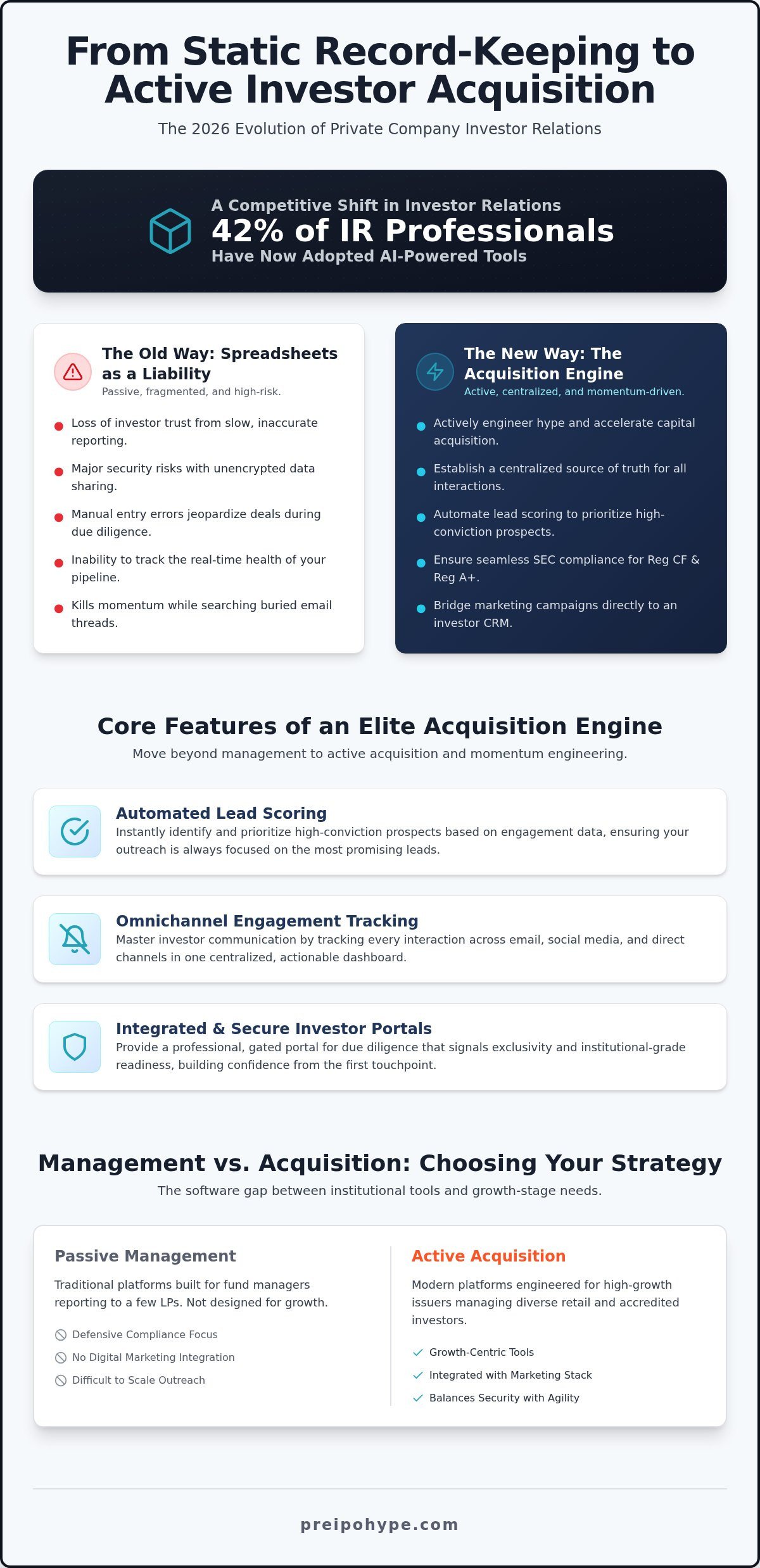
Why are most private firms still treating their cap table like a static filing cabinet when the 2026 market demands a high-velocity acquisition engine? You've likely felt the friction of tracking investor interest across fragmented spreadsheets and buried email threads. It's a common pain point for founders who need to prove the ROI on their digital fundraising spend but lack the infrastructure to do it. The standard approach to investor relations software for private companies is no longer enough to stay competitive in a landscape where AI adoption has surged to 42% among IR professionals.
We agree that your technology should work as hard as your capital. This guide shows you how elite private companies are moving beyond passive record-keeping to active investor acquisition and momentum engineering. You'll discover how to establish a centralized truth for every interaction, use automated lead scoring to prioritize high-net-worth outreach, and create a seamless bridge between your digital marketing campaigns and your investor CRM. It's time to stop managing data and start driving the narrative of your next raise.
Key Takeaways
- Shift your perspective from passive record-keeping to active momentum engineering by transforming your cap table into a high-velocity acquisition engine.
- Identify and prioritize high-conviction prospects instantly using automated lead scoring within your investor relations software for private companies.
- Distinguish between simple management tools and elite acquisition strategies designed to engineer hype and close new capital with precision.
- Establish a robust Foundation Infrastructure to ensure seamless SEC compliance across Reg CF and Reg A+ frameworks while scaling your outreach.
- Master the art of omnichannel engagement by tracking investor interactions across email, social, and direct channels through a centralized source of truth.
The Evolution of Private Company Investor Relations in 2026
The traditional view of Investor relations (IR) has been one of defensive compliance and quiet record-keeping. In 2026, that passive model is dead. For high-growth issuers, investor relations software for private companies has transformed into a comprehensive system for managing cap tables, streamlining communications, and, most importantly, accelerating capital acquisition. It's no longer about just keeping the books; it's about engineering the momentum required to reach the next milestone. Building a fundraising tech stack that actually scales requires moving beyond the legacy systems of the past.
The surge in Reg CF and Reg A+ offerings has redefined the investor landscape. These frameworks allow for a democratized pool of capital, but they also bring a level of administrative complexity that manual systems can't handle. Sophisticated tracking isn't just about compliance; it's about visibility. You need to know which lead sources are converting and which investors are ready for the next round. Modern investor relations software is a growth-centric tool specifically engineered to navigate the complexities of the pre-IPO journey.
To better understand this concept, watch this helpful video:
Why Spreadsheets Are a Liability for Modern Founders
Founders often rely on spreadsheets because they're familiar, but in a live fundraising round, they're a liability. Fragmented data leads to manual entry errors that can jeopardize a deal during due diligence. In an era of strict data privacy and SEC scrutiny, a leaked or outdated CSV file is a compliance nightmare. When you're trying to close a round, searching through buried email threads for an investor's latest wire confirmation kills your momentum. The hidden costs of these manual processes include:
- Loss of investor trust due to slow or inaccurate reporting.
- Security risks associated with unencrypted data sharing.
- Inability to track the real-time health of your fundraising pipeline.
The Institutional vs. Growth-Stage Software Gap
There's a massive gap between institutional tools and what a growth-stage company actually needs. Traditional platforms like Dynamo were built for private equity fund managers who need to report to a handful of LPs. They weren't designed for the issuer who needs to scale, integrate with digital marketing, and manage a diverse base of retail and accredited investors simultaneously. Elite founders require investor relations software for private companies that reflects high-stakes financial authority while maintaining the agility of a tech startup. This gap is where most companies lose their edge, failing to find a tool that balances institutional-grade security with growth-stage marketing integration. Choosing a platform that understands the pre-IPO trajectory is the only way to ensure your technology supports your ambition rather than hindering it.
Core Features of an Elite Investor Acquisition Engine
The difference between a growing company and a stagnant one often comes down to the efficiency of its capital pipeline. If your investor relations software for private companies only records transactions after they happen, you aren't managing a raise; you're just auditing a failure. An elite acquisition engine must proactively identify, track, and convert interest before the momentum of your round fades. This requires a shift from passive data entry to active intelligence gathering across every digital touchpoint.
To win in 2026, your infrastructure must master three pillars: automated lead scoring, omnichannel tracking, and integrated investor portals. A professional, gated portal isn't just for due diligence. It's a psychological trigger that signals exclusivity and institutional-grade readiness. When an investor enters your ecosystem, they should feel they've stepped into an elite circle where information is restricted, valuable, and moving fast. Tracking that engagement across email, social media, and direct outreach allows you to maintain a steady pulse of opportunity without losing a single lead to the cracks of a fragmented system.
Attribution Tracking: The Holy Grail of Fundraising ROI
Most founders treat digital marketing spend like a black hole. They see traffic, but they can't link a LinkedIn ad click to a $50,000 wire transfer. High-performance systems solve this by implementing a technical mechanism that tracks the entire investor journey from the first click to the final wire. By utilizing 60-day attribution, you can see exactly which marketing touchpoint converted a curious lead into committed capital weeks later. This level of precision allows you to optimize your digital fundraising spend by doubling down on what works and cutting the fat. 60-day attribution prevents capital leakage in long-cycle raises by ensuring you don't abandon high-conviction leads just because they didn't convert on the first visit.
Lead Scoring and Automated Outreach
Not all interest is created equal. An elite CRM uses engagement metrics to automatically trigger personalized follow-ups based on behavior. If an institutional lead downloads your pitch deck three times in 24 hours, your system should flag them for immediate, high-touch outreach. This balance between automated efficiency and the "insider" personal touch ensures you're spending your time on the 20% of leads that will provide 80% of your capital. By reducing friction in the conversion funnel for both retail and accredited investors, you turn a chaotic process into a predictable machine. If you're ready to see how this technical bedrock can transform your next raise, you might want to discuss your specific infrastructure needs with a specialist who understands the pre-IPO trajectory.
Management vs. Acquisition: Choosing Your Strategy
Most founders mistakenly view investor relations as a back-office function, a necessary evil to keep the cap table clean and the tax documents moving. This is the "Management" strategy. It's fundamentally defensive. It focuses on reporting, existing maintenance, and historical data. While essential for compliance, this approach does nothing to fuel your growth. If you're preparing for a significant capital event, you need an "Acquisition" strategy. This model treats investor relations as a front-office growth lever designed to engineer hype, track high-conviction leads, and close new capital with surgical precision.
High-growth companies on the pre-IPO trajectory require a hybrid system, but the acquisition funnel must be the priority. Your choice of investor relations software for private companies should reflect the specific demands of your raise. A Reg CF round involving thousands of retail investors requires massive automation and seamless marketing integration to handle volume. Conversely, a Reg A+ or a large Private Placement demands a more sophisticated, gated experience that mirrors the high-stakes financial authority of an institutional roadshow. Evaluating software based on these specific needs prevents you from buying a tool that manages your current status while ignoring what your company will become.
The 'Passive' IR Software Trap
A digital filing cabinet won't help you hit a $50M target. The danger lies in choosing software that operates in a silo, disconnected from your marketing stack. When your IR tool doesn't talk to your ad platforms or email sequences, you lose the ability to track the investor journey. You also risk falling for "vampire features"—complex administrative tools that suck up your team's time without contributing a single dollar to the bottom line. If a feature doesn't directly help you identify a high-net-worth lead or close a wire, it's likely a distraction that kills your fundraising momentum.
Engineering Momentum for the Pre-IPO Journey
Positioning your firm as an elite opportunity requires more than a good pitch deck. It requires a professional presentation that signals you're ready for the public markets. A Custom Investor CRM bridges the gap between marketing and finance by turning raw data into actionable intelligence. This seamless experience has a profound psychological impact on investors. When the onboarding process is frictionless and the data is transparent, it builds the trust necessary for follow-on funding. You aren't just executing a transaction; you're inviting them to join a movement. This level of technical sophistication turns a simple raise into a gated financial event that people are eager to enter before the window closes.
Building Your Foundation Infrastructure: A Setup Checklist
Deploying the right investor relations software for private companies isn't merely an IT checkbox. It's a strategic operation to build a capital-raising arsenal. Before you activate your marketing engine, you need a basin that doesn't leak. Use this five-step checklist to ensure your infrastructure can handle the high-velocity demands of a 2026 raise.
- Step 1: Audit Data and Cap Table Accuracy. Start with a clean slate. Inaccurate investor records or messy cap tables are immediate red flags during institutional due diligence.
- Step 2: Define Your Roadmap and Compliance Framework. Whether you're pursuing Reg CF, Reg A+, or a Private Placement, your software must be configured to the specific legal and reporting requirements of that framework from day one.
- Step 3: Integrate Marketing Pixels. Connect your CRM to your advertising platforms. This creates the essential data loop required to track the investor journey and prove ROI.
- Step 4: Establish Automated Lead Scoring. Build workflows that flag high-conviction prospects. If a lead opens your pitch deck five times, your outreach team needs to know instantly.
- Step 5: Launch a Custom-Branded Portal. Provide a secure, professional environment for document access and wire execution. This signals that your company is ready for elite-level participation.
The Technical Bedrock of Elite Capital Raises
Launching public marketing without a solid base is a recipe for wasted capital. Establishing your Foundation Infrastructure is the critical first step before any outreach begins. This system ensures SEC compliance through automated record-keeping and immutable data trails, protecting you from future regulatory friction. By using data-driven marketing systems, you transform your raise from a guessing game into a scalable machine. It's the technical nervous system that allows you to maintain control over your narrative as you move toward a realization event.
Omnichannel Outreach Mastery
Confidence is built through consistency. Your investor relations software for private companies must sync seamlessly with email, LinkedIn, and paid media to deliver a unified message. Maintaining the hype cycle requires a steady pulse of data-backed updates that keep your company top-of-mind for potential backers. To feed the top of your IR funnel with fresh, high-intent leads, you can leverage Newsletter Exposure to reach audiences already searching for rare, early-stage opportunities. This integrated approach ensures that every touchpoint reinforces the sense of exclusivity and momentum surrounding your brand.
If you're ready to ensure your technical setup is bulletproof before your next round, book a strategy session to review your current infrastructure and identify any gaps in your acquisition engine.
The Pre-IPO Hype Advantage: Custom Investor CRM
Generic, off-the-shelf cloud platforms are built for the status quo. They offer stability for firms that have already arrived, but they lack the aggressive velocity required for companies still on the ascent. When you choose investor relations software for private companies, you're choosing the speed of your trajectory. A custom solution doesn't just store data; it connects restricted, high-value information with broader market opportunity. For a private issuer, your tech must be more than a database. It must be a catalyst that transforms your cap table into a strategic asset.
Our results speak to the power of this approach. Since 2015, we've served over 230 companies and facilitated more than $100 million in funding. This isn't a theoretical framework; it's a battle-tested infrastructure designed to turn passive onlookers into committed stakeholders. By leveraging elite tech, you bridge the gap between a private company's internal vision and the public market's appetite for growth. This is how you move from curiosity to capital, by providing a structured, high-trust environment where investors feel they're gaining access to a gated world of opportunity.
Strategic Outreach and Omnichannel Mastery
Identifying your most loyal advocates requires more than just a list of names. It requires a system that tracks every nuance of engagement. The synergy between our Custom Investor CRM and our digital marketing expertise allows you to see the invisible threads connecting your content to your capital. You aren't just sending emails; you're orchestrating a movement. This mastery of omnichannel outreach positions your firm as a forward-thinking guide, signaling to the market that you possess the technical sophistication required for a successful public transition.
Taking the Next Step Toward Your Exit
The window for market momentum is often narrower than founders realize. Waiting for the perfect time to upgrade your infrastructure usually means missing the peak of investor interest. Acting decisively now, before your next funding milestone, ensures that your basin is ready for the flood of capital. Our Consulting and Advisory Services are designed to audit your current path and optimize your software setup for maximum impact. We help you identify the specific friction points that might be draining your team's focus or leaking potential leads. Don't let an inferior investor relations software for private companies be the bottleneck for your growth. If you're ready to engineer a high-stakes raise that reflects your company's true potential, schedule a strategy session with Fuzzy Wenzel today. It's time to move beyond record-keeping and start engineering your exit.
Command Your Capital Trajectory
The window of opportunity in high-growth markets is a rare asset that requires precision to capture. You've seen how the right technical bedrock transforms a static cap table into a high-velocity acquisition engine. By prioritizing the acquisition funnel over simple record-keeping, you position your firm as an elite participant in the private markets. This transition isn't just about efficiency; it's about engineering the trust and hype necessary to reach your next realization event.
Choosing the right investor relations software for private companies is the difference between managing a raise and leading a movement. We've facilitated over $100 million in funding for more than 230 companies since 2015, specializing in the specific complexities of Reg CF, Reg A+, and Private Placements. Your future milestones are within reach for those who act with speed and technical authority.
If you're ready to move beyond fragmented data and own your narrative, it's time to build your foundation. Secure Your Capital Future: Get the Custom Investor CRM and start engineering your momentum today. The market moves fast; don't let your infrastructure be the reason you stay behind.
Frequently Asked Questions
What is the best investor relations software for a private company in 2026?
The best software is one that functions as an acquisition engine rather than a digital filing cabinet. High-growth issuers should prioritize platforms that integrate lead scoring and marketing attribution directly into their cap table management. You need a solution that handles the high velocity of a live raise while maintaining the institutional-grade security required for an elite pre-IPO trajectory.
How does investor CRM software help with Reg CF or Reg A+ raises?
It automates the management of thousands of retail investors while maintaining strict SEC compliance. For Reg CF and Reg A+ frameworks, the software acts as a central truth for communication and document delivery. This automation allows your team to focus on high-touch outreach for institutional checks without getting bogged down in the administrative friction of a democratized raise.
Can IR software integrate with my existing digital marketing tools?
Yes, elite investor relations software for private companies should connect directly with your advertising pixels and email marketing stacks. This integration allows you to see which specific campaigns are driving actual capital rather than just vanity traffic. It creates a closed-loop system where marketing data informs your fundraising strategy in real-time, allowing for rapid optimization of your outreach spend.
Is it possible to track investor ROI and attribution within a CRM?
Modern systems use 60-day attribution to link specific marketing touchpoints to final wire transfers. By tracking the entire investor journey from the first click to the final signature, you can calculate the exact ROI of your digital fundraising spend. This level of data-driven marketing ensures that every dollar spent on acquisition is optimized for maximum capital conversion.
How do I move my investor data from spreadsheets to a professional platform?
The transition starts with a comprehensive audit of your current cap table and contact records to ensure data integrity. A professional implementation involves mapping your existing data fields to a structured CRM environment to ensure no historical interaction is lost. Moving away from spreadsheets eliminates manual entry errors and provides the technical bedrock required for a serious capital raise.
What is the difference between an investor portal and an investor CRM?
An investor portal is the outward-facing gated environment where backers access documents; the CRM is the internal engine that tracks those interactions. While the portal provides a professional experience for the investor, the CRM gives the issuer the intelligence needed to prioritize high-conviction leads. Both are essential components of a robust Foundation Infrastructure designed for scaling.
Does IR software help with SEC compliance and record-keeping?
It provides an immutable data trail and automated record-keeping that are critical for passing regulatory scrutiny. Using investor relations software for private companies ensures that all communications and offerings are tracked according to SEC requirements. This systematic approach reduces the risk of compliance friction during the due diligence process of a major funding round or an eventual exit.
How much does it cost to set up a custom investor CRM?
Costs vary based on the complexity of your fundraising roadmap and the number of stakeholders you need to manage. Rather than looking for a flat fee, founders should evaluate the setup as a strategic investment in their capital-raising infrastructure. The right system pays for itself by identifying high-conviction leads and preventing capital leakage during long, high-stakes raise cycles.
Disclaimer
Educational only. Not investment, tax, or legal advice. Pre-IPO Hype is investor relations infrastructure for Regulation CF and Regulation A+ raises. We are not a broker-dealer, funding portal, or investment adviser, and we do not offer or sell securities or make investment recommendations. Any securities offering is made only by the issuer, through its own offering documents and, where required, a registered intermediary.