
Investor Relations Software for Startups: Engineering Capital Momentum in 2026
Is your fundraising strategy a high-performance engine, or is it just a collection of fragile spreadsheets and missed LinkedIn messages? In the 2026 market, the gap between a stalled seed round and a breakout success isn't just your product. It's the infrastructure you use to manage the momentum. You likely feel the friction of manual tracking and the frustration of low engagement on updates that took hours to draft. It's a common struggle for high-growth teams trying to prove ROI on their marketing spend while data remains fragmented across email and pitch decks.
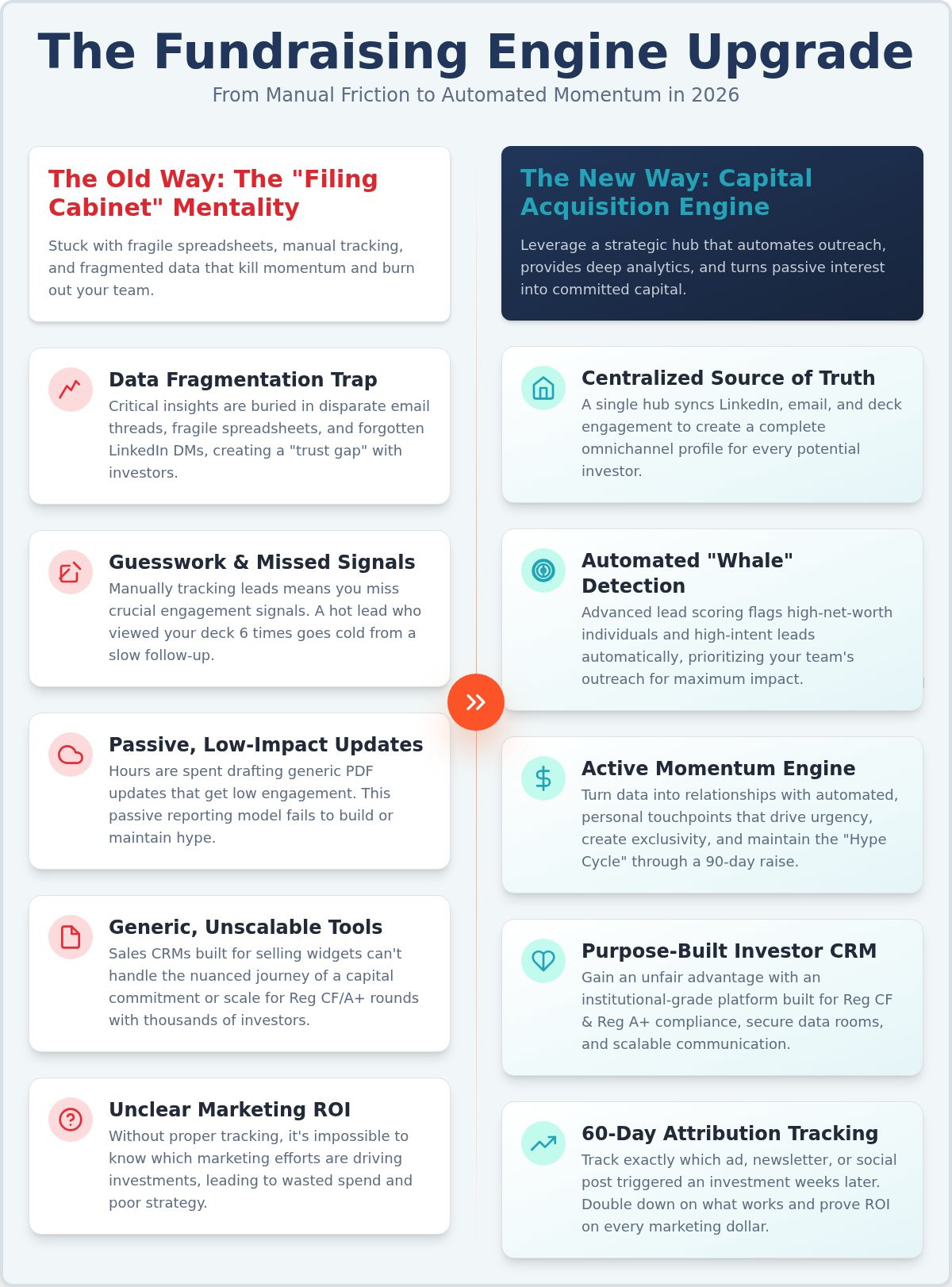
We're here to show you how the right investor relations software for startups transforms passive reporting into a high-octane capital acquisition engine. By moving past the "filing cabinet" mentality, you can engineer a centralized source of truth that automates personal outreach and mirrors the rapid movement of elite investment circles. Discover how to leverage omnichannel mastery and SEC-compliant digital shifts, such as the 2026 Regulation E-Delivery proposal, to convert curious leads into committed capital. We will break down the technical bedrock needed to scale your raise and keep your team from burning out.
Key Takeaways
- Stop the "data fragmentation" trap by evolving your fundraising from a passive spreadsheet into a strategic capital acquisition hub.
- Identify high-net-worth "whales" automatically through advanced lead scoring and omnichannel profiles that sync LinkedIn and email engagement.
- Discover why the most successful high-growth ventures prioritize investor relations software for startups that focuses on acquisition rather than just administrative management.
- Build a scalable fundraising foundation by implementing technical infrastructure that ensures every marketing dollar is backed by 60-day attribution tracking.
- Gain an unfair advantage in Reg CF and Reg A+ rounds by using a Custom Investor CRM built for institutional-grade momentum.
Beyond the Spreadsheet: Why Startups Need Dedicated IR Software
Why are you still treating your cap table like a grocery list? For years, founders relied on static spreadsheets to track their leads, but in the high-stakes environment of 2026, that's a recipe for a stalled round. Modern investor relations software for startups isn't just a digital filing cabinet. It's a strategic hub designed for both capital acquisition and long-term retention. While basic definitions explain what investor relations entails as a mix of finance and communication, for a high-growth company, it's the engine that powers your entire fundraising tech stack. It's the difference between chasing checks and attracting them.
The shift from institutional-only rounds to inclusive Reg CF and Reg A+ raises has changed the rules of engagement. You're no longer just managing five venture capitalists; you're often managing five thousand retail advocates. This democratization requires a move from the "passive reporting" model of the past to an "active momentum" model. Elite founders don't just send quarterly PDFs. They use integrated data to drive urgency, create exclusivity, and keep the market's attention locked on their growth trajectory. If your data is fragmented across email and LinkedIn, your momentum is already leaking.
The Hidden Cost of Manual Investor Management
Manual tracking is a silent killer of startup momentum. Every minute you spend manually updating a lead's status in a cell is a minute you aren't closing capital. This creates a "data fragmentation" trap where critical insights are buried in disparate email threads or forgotten LinkedIn DMs. When communications are inconsistent or late, you trigger a "trust gap." Investors want to see institutional-grade precision, not a frantic founder who forgot they already sent the pitch deck. Generic Sales CRMs fail here. They're built for selling widgets, not for tracking the nuanced, multi-touch psychological journey of a capital commitment.
IR Software as a Competitive Advantage in 2026
Data-driven founders use dedicated platforms to identify high-intent whales before the first discovery call. If an investor opens your deck six times in forty-eight hours, your investor relations software for startups should flag them for an immediate, personal follow-up. This level of intelligence is how you maintain the "Hype Cycle" across a 90-day raise, ensuring the energy never dips. It's about turning cold data into warm relationships through automated, omnichannel touchpoints that feel deeply personal. Investor relations software is the technical bridge between a founder's vision and an investor's wallet.
Core Features of High-Growth Investor Relations Platforms
If your fundraising strategy feels like a game of chance, you're missing the data-driven precision of the modern era. Choosing the right investor relations software for startups means moving beyond simple contact lists into the world of predictive behavior. Elite platforms don't just store names; they prioritize your time. Through automated lead scoring and qualification, these systems identify the "whales" in your database by analyzing every interaction. When an accredited investor visits your deck multiple times or engages with your LinkedIn content, the software flags them for immediate, high-priority outreach. You stop guessing who is interested and start closing those who are already leaning in.
For startups navigating the complexities of Reg CF or Reg A+ rounds, the stakes are even higher. You need 60-day attribution tracking to understand the long tail of a retail raise. Most generic tools lose the trail after a few days, but high-growth platforms track exactly which ad, newsletter, or social post triggered an investment weeks later. This level of insight allows you to double down on what works and cut the waste. Combined with automated data rooms that provide secure, trackable access to your financial documents, you create a professional environment that screams institutional readiness. You can book a strategy session to see how this technical bedrock can stabilize your next raise.
Advanced Attribution and Engagement Analytics
Successful founders track curiosity long before it becomes capital. By utilizing heatmaps and view-time metrics within your pitch deck software, you can see exactly which slides investors linger on and where they drop off. If 80% of your leads stop reading at the "Financials" slide, you know exactly what needs fixing. This granular data is the heart of modern investor data strategies. It allows you to anticipate questions before the first meeting, positioning you as an informed insider who is always two steps ahead of the market.
Omnichannel Outreach Automation
Your IR software shouldn't live in a vacuum; it must communicate directly with your marketing stack. By syncing email, LinkedIn, and social engagement into a single profile, you gain a 360-degree view of your prospects. This allows for automated "nudge" sequences that feel personal because they're based on real behavior. If a prospect clicks a link in your latest update but doesn't commit, the system can automatically trigger a LinkedIn message or include them in targeted newsletter exposure to keep the momentum alive. It's about maintaining a steady pulse of opportunity without burning out your internal team.
Management vs. Acquisition: Why Your IR Stack Must Do Both
Most founders treat investor relations as a post-raise administrative chore. They're wrong. In the high-velocity market of 2026, the most successful ventures understand that investor relations software for startups must be an acquisition-first tool. There is a fundamental difference between managing an existing cap table and aggressively hunting for new capital. While traditional IR tools focus on compliance and public reporting, a startup's primary survival metric is acquisition. You don't just need to keep your current investors informed; you need a machine that consistently converts cold interest into confirmed wires.
This is where a Custom Investor CRM becomes your most valuable asset. It bridges the gap between high-ticket marketing and institutional finance. From an informed insider perspective, an elite capital raise looks less like a series of dry meetings and more like a sophisticated, multi-channel marketing campaign. You're selling a vision of future wealth, and your software stack must track that narrative across every touchpoint. If your IR strategy doesn't include a robust acquisition engine, you're essentially running a high-growth company on a legacy operating system.
Converting Curiosity into Capital
The psychological journey of a retail investor is a delicate path from the "first touch" to the final commitment. It starts with curiosity, often sparked by a targeted ad or a newsletter feature. High-performance investor relations software for startups uses behavioral data to create a sense of exclusivity and urgency. By tracking how a prospect interacts with your materials, you can trigger automated sequences that highlight limited-time opportunities or "insider-only" updates. This strategy isn't theoretical. We've seen this acquisition-first approach facilitate over $100 million in funding across more than 230 company raises. It turns passive observers into active participants in your company's movement.
Maintaining Follow-On Interest
Your IR stack shouldn't stop working once the current round closes. It should be priming your database for Series B or potential exit events from day one. High-growth startups use automated updates to eliminate "investor ghosting," a common problem during bridge rounds where momentum can easily stall. By maintaining a steady pulse of professional, data-driven communication, you keep your brand top-of-mind for the next realization event. If you're unsure how to position your company for this level of long-term momentum, you can ask the CEO for a strategic deep dive into elite positioning. Building this foundation now ensures that when you're ready to scale, your capital engine is already warmed up and ready to fire.
Building Your Fundraising Foundation: A Technical Roadmap
Building a high-performance capital engine requires more than just a login. Many founders fall for the "plug-and-play" myth, assuming that simply subscribing to investor relations software for startups will solve their funding gaps. It doesn't. Success in 2026 is reserved for those who treat their fundraising foundation with the same technical rigor as their product architecture. To engineer true momentum, you must follow a structured implementation plan that moves beyond the superficial setup that traps less experienced founders. This roadmap ensures your data is accurate and your outreach is undeniable.
- Step 1: Audit your existing data and scrub your investor lists to ensure high deliverability. This means removing outdated contacts and warming up your domain so your updates don't end up in the spam folder during the heat of a raise.
- Step 2: Implement Foundation Infrastructure to lock in your tracking and attribution before the first ad goes live. This technical layer ensures every dollar spent is visible and measurable across the entire 60-day window.
- Step 3: Integrate your CRM with your omnichannel marketing channels, including Meta, LinkedIn, and specialized newsletters like Invst Guru. This creates a unified profile for every prospect, allowing for seamless cross-platform engagement.
- Step 4: Set up lead scoring parameters that reflect your ideal investor profile. You need to distinguish between casual browsers and high-intent whales who are ready to commit significant capital.
- Step 5: Launch your "Hype" sequence to warm up your database. Creating a sense of movement and exclusivity before the round officially opens is what drives early oversubscription and market FOMO.
The Foundation Infrastructure Requirement
Most investor relations software for startups fails not because of the software itself, but because the underlying technical setup is hollow. Without Google Tag Manager (GTM), properly fired tracking pixels, and deep API integrations, your data is just a guess. This is particularly critical for Reg CF and Reg A+ rounds, where you need to track retail behavior across a multi-touch journey. You must achieve omnichannel mastery within the first 30 days of your raise to ensure no lead is left behind. Foundation Infrastructure is the technical bedrock of any elite capital raise.
Lead Scoring for Founders
Your time is your most finite resource during a raise. Effective software allows you to define the difference between "Engagement" and "Intent" in your dashboard. An investor who opens every email shows engagement, but the investor who downloads the term sheet and reviews the data room shows intent. By setting these parameters early, you can prioritize founder time for high-value institutional follow-ups rather than chasing low-intent leads. You can explore the full fundraising tech stack to see how these tools work in tandem to filter your pipeline. If you are ready to stop guessing and start engineering your raise, schedule your technical foundation audit today.
The Pre-IPO Hype Advantage: Custom Investor CRM
Generic SaaS platforms offer a one-size-fits-all solution that often fits no one well. For founders targeting Reg CF and Reg A+ dominance, a Custom Investor CRM acts as a specialized acquisition engine rather than a mere digital filing cabinet. It isn't just about tracking names; it's about the seamless integration of data-driven marketing with institutional-grade IR. This system allows you to manage thousands of retail advocates with the same precision a hedge fund uses for ten LPs, ensuring no high-value lead falls through the cracks of a fragmented process.
We don't just hand you a login and wish you luck. Our Omnichannel Outreach is a managed service that layers expert strategy over the technical stack. While standard investor relations software for startups provides the pipes, we provide the fuel and the navigator to ensure your message hits the right desks at the right time. This managed approach removes the operational burden from your internal team, allowing you to focus on high-level growth while we engineer the momentum in the background.
Tailored for High-Growth Sectors
High-growth sectors like Tech, CPG, and Robotics operate on vastly different capital cycles and investor expectations. A robotics firm needs to demonstrate technical milestones and IP security, while a CPG brand relies on consumer velocity and retail distribution data. Our configurations are built by founders, for founders. Since our inception in 2015, we've facilitated over $100 million in funding by understanding these nuances. Having managed over 230 company raises, we know that the right technical foundation is the ultimate trust builder for sophisticated investors who demand transparency and real-time data.
Scaling Beyond the Raise
Your capital journey doesn't end when the wire hits. The long-term value of a clean, engaged investor database is your most potent asset for future realization events. Whether you are preparing for a Series B or the final excitement of an IPO, our investor relations software for startups keeps your audience primed and ready for action. It transforms your cap table into a loyal community that can be activated at a moment's notice.
Decisiveness is the hallmark of a successful founder. The window for elite market entry is often narrow, and those who hesitate on their infrastructure are usually the ones left behind. Don't wait for your fundraising momentum to stall before fixing your technical bedrock. You can book a strategy session today to architect the foundation your vision deserves and secure your place in the next wave of market leaders.
Own the Momentum: Your Next Capital Milestone Awaits
The era of managing capital raises through static spreadsheets is over. To dominate in 2026, you must transition from passive administration to a high-octane acquisition model. You've seen how the right technical bedrock, built on Foundation Infrastructure and proprietary 60-day attribution tracking, transforms curiosity into committed capital. By prioritizing lead scoring and omnichannel mastery, you position your startup as an elite opportunity that sophisticated investors can't ignore.
The choice of investor relations software for startups is the pivot point between a stalled round and a breakout success. We've facilitated over $100 million in funding by treating every raise like a high-stakes marketing campaign. It's time to stop guessing and start engineering your growth with a partner who understands the mechanics of hype and the rigor of finance.
Architect your elite fundraising engine with a Custom Investor CRM and take control of your market narrative. The future belongs to those who act with institutional precision and entrepreneurial speed. Your vision is ready for the global stage; ensure your infrastructure is too.
Frequently Asked Questions
What is the best investor relations software for early-stage startups?
The best platform depends on your specific fundraising goals and regulatory pathway. While generic tools like Visible.vc offer basic reporting starting around $59 per month, high-growth ventures often require a Custom Investor CRM to manage the aggressive acquisition needs of Reg CF or Reg A+ rounds. You need a solution that doesn't just store data but actively engineers market momentum through integrated marketing and lead scoring.
Can I use HubSpot or Salesforce as an investor CRM?
You can, but these platforms are built for sales cycles rather than capital raises. They often lack the specialized tracking for investment intent and the secure data room integrations required for institutional-grade rounds. Using a dedicated investor relations software for startups ensures you capture the psychological nuances of an investor's journey, which a standard sales widget is simply not designed to handle.
How much does investor relations software typically cost for a startup?
Industry pricing varies based on the level of relationship intelligence and automation you require. According to August 2026 market data, entry-level platforms start near $59 per month, while real estate-focused tools like Agora begin at $749 per month. Institutional-grade relationship intelligence platforms, such as Affinity, can cost approximately $2,000 per user per year. High-growth startups should view this as a core infrastructure investment rather than a simple software expense.
Does IR software help with SEC compliance for Reg CF or Reg A+?
Yes, dedicated IR software is essential for maintaining the transparency required by the SEC. This became even more critical following the July 16, 2026, proposal for Regulation E-Delivery, which aims to make electronic communication the default for investor relations. Using professional software ensures your digital delivery methods remain compliant while streamlining the communication process for thousands of retail investors simultaneously.
What is the difference between a data room and an investor CRM?
A data room is a secure vault used to store and share sensitive financial documents during due diligence. An investor CRM is the active engine that manages the relationship, tracks engagement, and drives the acquisition process. While a data room is a passive repository, the CRM is an investor relations software for startups that identifies high-intent leads and automates the outreach needed to close them.
How does investor relations software improve fundraising ROI?
It improves ROI by identifying "whales" automatically and ensuring your marketing spend is directed toward high-intent prospects. By using lead scoring and automated nudge sequences, you stop wasting time on casual browsers and focus your energy on investors who are ready to wire funds. This technical precision reduces the cost of capital acquisition and shortens the overall time your team spends in the fundraising trenches.
Do I need IR software if I only have a few angel investors?
Professionalism is a currency in the elite investment world. Even if you only have a handful of angels today, using dedicated software signals that you're preparing for institutional-grade growth and future realization events. It builds a foundation of trust and ensures that when you're ready to scale to a Reg A+ or Series B, your data is already clean, organized, and ready for scrutiny.
What is 60-day attribution tracking in investor relations?
This is a proprietary tracking method that identifies which specific ad, newsletter, or social post triggered an investment up to two months after the initial touchpoint. It's vital for startups because the journey from curiosity to capital is rarely instant. Understanding this long-tail behavior allows you to accurately measure the performance of your fundraising marketing and double down on the channels that actually deliver results.
Disclaimer
Educational only. Not investment, tax, or legal advice. Pre-IPO Hype is investor relations infrastructure for Regulation CF and Regulation A+ raises. We are not a broker-dealer, funding portal, or investment adviser, and we do not offer or sell securities or make investment recommendations. Any securities offering is made only by the issuer, through its own offering documents and, where required, a registered intermediary.


