
Investor Relations Software for Startups: Engineering Momentum in 2026
Why are some founders closing oversubscribed rounds in weeks while others spend months drowning in manual spreadsheets and unreturned LinkedIn messages? The difference isn't just the product; it's the engine behind the outreach. You've likely felt the productivity drain of manual data entry and the frustration of having zero visibility into which investors are actually engaged. In the high-velocity market of 2026, fragmented communication across email and pitch decks is no longer just an inconvenience. It's a liability that signals you aren't ready for elite capital.
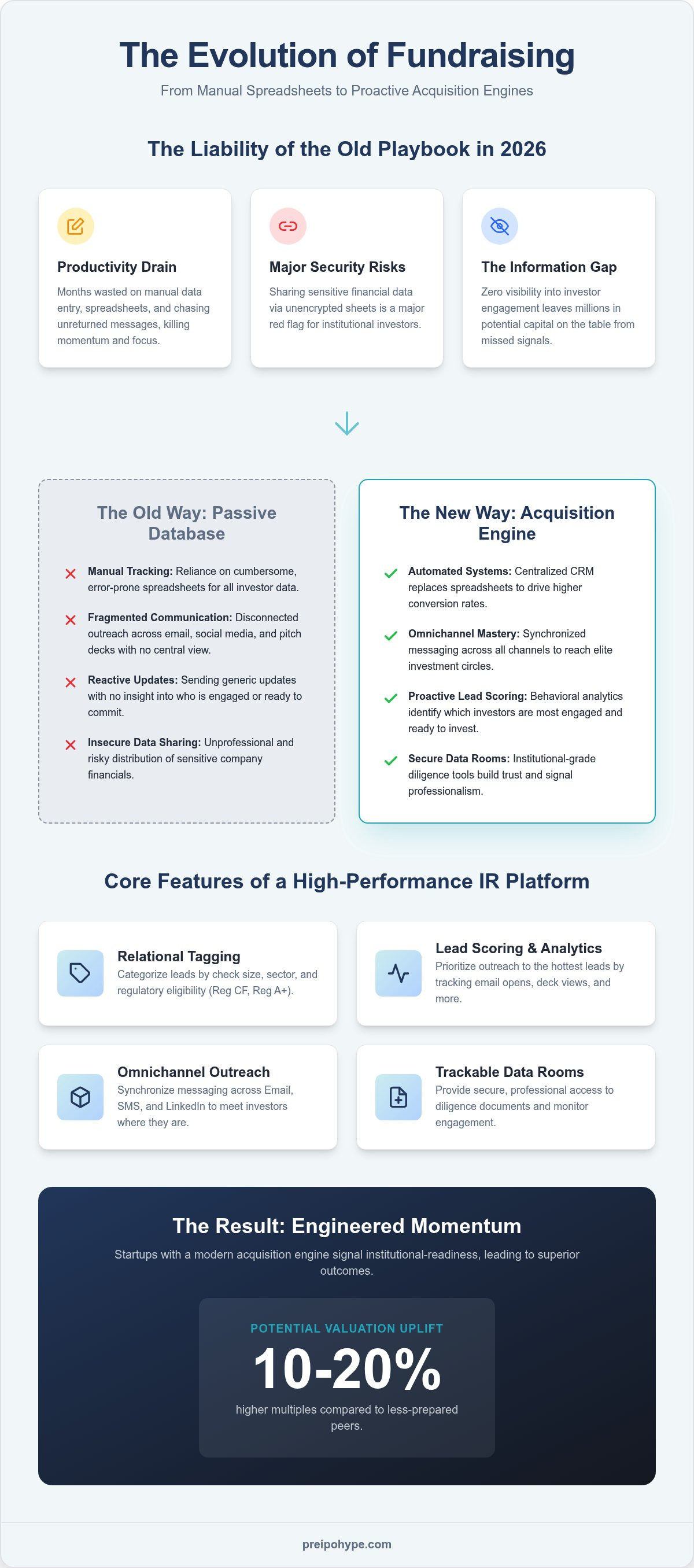
This article explores how modern investor relations software for startups has evolved from a simple database into a high-octane acquisition engine designed to engineer momentum. We'll show you how to replace manual tracking with automated systems that drive higher conversion rates from the first pitch to the final check. You'll discover how to deploy institutional-grade reporting that positions your startup as a sophisticated, future-focused investment, potentially commanding valuation multiples 10-20% higher than your less-prepared peers.
Key Takeaways
- Learn why the passive database model died in 2025 and how to transition to a proactive acquisition engine that drives market momentum.
- Identify the critical features of high-performance investor relations software for startups, including relational tagging and trackable data rooms for due diligence.
- Discover the "Omnichannel Mastery" approach that synchronizes your CRM data with digital advertising to reach elite investment circles.
- Audit your fundraising tech stack to ensure your infrastructure supports specific regulatory paths like Reg CF, Reg A+, or 506(c).
- Understand how proprietary lead scoring and 60-day attribution tracking transform your investor communications into a predictable capital engine.
The Evolution of IR Software: From Databases to Acquisition Engines
The 2025 market shift fundamentally rewired the fundraising landscape. Investors no longer settle for a pitch deck and a prayer; they demand a level of professional execution that matches their capital commitment. The era of the passive database, where contact info sat gathering digital dust, is officially over. Modern investor relations software for startups has transformed into a proactive tool designed to hunt capital rather than just house it. It's the difference between a static filing cabinet and a high-octane acquisition engine.
To better understand how this shift impacts your capital raise, watch this helpful video on investment preparation:
Effective Investor relations (IR) now relies on data-driven marketing to create a steady pulse of momentum. By utilizing consistent, automated touchpoints, founders can engineer investor hype that feels organic but is entirely systematic. This isn't about spamming a list. It's about staying top-of-mind with high-value prospects through strategic updates and performance metrics that build a narrative of inevitable growth. Research indicates that companies with dedicated programs like this often trade at 10-20% higher valuation multiples than their less-organized peers.
Why Spreadsheets Are a Liability in 2026
Managing a multi-million dollar raise on a spreadsheet is like trying to navigate a high-speed chase with a paper map. In 2026, manual attribution is a productivity killer that leads to broken links and missed opportunities. Beyond the inefficiency, there's a massive security risk. Sharing sensitive financial data via unencrypted sheets is a major red flag to institutional-grade investors who expect professional-grade diligence. The Information Gap occurs when a founder’s lack of real-time behavioral data prevents them from identifying which high-net-worth prospects are ready to commit, effectively leaving millions in uncashed checks on the table.
The 'Acquisition Engine' Framework
A true acquisition engine moves you from reactive updates to proactive lead scoring. It identifies which investors are opening your emails, clicking your deck, and spending time on your financials. This level of investor data visibility allows you to prioritize your outreach toward the hottest leads. By integrating your CRM data with digital marketing, you gain 360-degree visibility into the investor journey. It's about building a fundraising tech stack that facilitates institutional-level professionalism from day one, signaling to the market that you're ready for elite capital.
Core Features Startups Need in an IR Platform
Selecting the right investor relations software for startups isn't about buying a digital Rolodex. It's about building a command center. In 2026, the baseline has shifted. You need a centralized Investor CRM that utilizes relational tagging to categorize leads by check size, sector interest, and regulatory eligibility. Whether you're pursuing a Reg CF raise or a Reg A+ offering, your software must handle the specific compliance nuances of these paths while maintaining a seamless user experience. It's about turning a list of names into a pipeline of committed capital.
Modern platforms must offer omnichannel outreach capabilities. This means synchronizing your messaging across Email, SMS, and LinkedIn to ensure you're meeting investors where they actually spend their time. While the duties of an IR professional traditionally focused on manual reporting, today’s technology automates the heavy lifting. You should look for automated update templates that don't just share news but actively drive engagement through embedded calls-to-action. If your software doesn't help you close the gap between interest and investment, it's just an expensive filing cabinet.
Lead Scoring and Behavioral Analytics
The most valuable asset in a capital raise is time. You can't afford to chase every "maybe." High-performance IR platforms use lead scoring based on real-time engagement metrics to identify "hot" investors before they ever reply to an email. If a prospect opens your pitch deck five times in 48 hours, they are a priority. Tracking time-on-page for specific slides allows you to tailor your follow-up conversations to the exact points that caught their interest. By integrating proprietary 60-day attribution, you can finally understand the true source of your capital, whether it's a specific ad campaign or a newsletter mention.
The Secure Data Room: Your Digital Vault
A chaotic due diligence process kills deals. Your IR platform must include secure, trackable data rooms that act as a digital vault for your most sensitive documents. Version control is often the thin line between a "Yes" and a "Maybe." If an investor sees an outdated cap table, your credibility evaporates instantly. Granular permission settings allow you to show institutional-grade data to VCs while keeping a simplified view for retail investors in a crowdfunding round. This level of control signals that your startup is operated with professional rigor.
Setting up this level of technical sophistication is part of your foundation infrastructure. It ensures that every document is encrypted and every access point is logged. If you're ready to move beyond curiosity and start engineering actual capital inflow, it might be time to book a strategy session to audit your current setup and ensure your tech stack is built for momentum.
Omnichannel Mastery: Why Traditional CRMs Fail Modern Fundraising
Why do so many founders still believe a BCC email blast constitutes a fundraising strategy? In the high-stakes environment of 2026, relying solely on email is a tactical error that leaves your round vulnerable. Traditional CRMs were built for sales cycles, not for the complex, psychological warfare of modern capital raises. They act as passive filing cabinets, storing data without ever putting it to work. To win, you need investor relations software for startups that operates across every digital touchpoint your prospects frequent.
The modern investor doesn't live in their inbox alone. They are on LinkedIn, they are reading niche financial newsletters, and they are scrolling through market analysis on social media. If your brand only appears when you send a monthly update, you've already lost the battle for attention. Omnichannel mastery is about creating a "surround sound" effect. It ensures that once an investor enters your orbit, your narrative follows them with institutional-grade authority across the entire web. This level of consistency signals market momentum and professional rigor that a standard CRM simply cannot replicate.
Retargeting and Digital Presence
The most sophisticated founders use their CRM data to power custom audiences on platforms like LinkedIn and Meta. This isn't about generic advertising; it's about precision retargeting. When a high-net-worth individual spends three minutes in your data room, your software should automatically trigger a sequence that places your latest milestone or founder interview directly in their social feed. This repeated exposure leverages the psychology of familiarity. Omnichannel outreach bridges the gap between digital discovery and financial commitment by systematically converting passive curiosity into capital through strategic repetition. It makes your startup feel like the only opportunity that matters in a crowded market.
The Role of Newsletters and Third-Party Exposure
Relying on your own list is a slow game. To accelerate a raise, you must leverage third-party authority. Integrating external leads from platforms like Invst Guru directly into your custom CRM allows you to bypass the friction of manual data entry. This creates an immediate pipeline of qualified prospects who are already primed for investment. By utilizing strategic newsletter outreach, you can inject fresh liquidity into your funnel at critical moments. Your tech stack should not just manage the people you know; it should be the primary vehicle for reaching the elite circles you haven't accessed yet. Maintaining brand authority across these fragmented channels is what separates the oversubscribed rounds from the ones that fizzle out in silence.
Building Your Fundraising Tech Stack: A 2026 Checklist
A high-growth startup is only as fast as its infrastructure. If you're still relying on disparate tools that don't talk to each other, you're bleeding momentum. Building a modern fundraising tech stack is about creating a unified system where your investor relations software for startups serves as the central nervous system. This isn't a weekend project; it's a strategic deployment. Follow this checklist to ensure your "Foundation" is ready for elite capital.
- Step 1: Audit your current data. Before you scale, you must clean. Ensure your existing investor lists are segmented and your foundation infrastructure is technically sound.
- Step 2: Align with your regulatory path. Whether you're pursuing Reg CF, Reg A+, or a 506(c) private placement, your CRM must be capable of handling the specific compliance requirements of that path.
- Step 3: Deploy trackable assets. Move away from static PDFs. Integrate pitch decks and data rooms that provide real-time alerts when a prospect engages with your financials.
- Step 4: Activate lead scoring triggers. Configure your software to automatically flag investors who show high-intent behaviors, such as multiple deck views or repeat visits to your data room.
- Step 5: Launch omnichannel campaigns. Once the pipes are laid, turn on the flow. Use your CRM data to drive targeted outreach across email, LinkedIn, and digital ads.
Regulatory Compliance and Software
Compliance isn't an afterthought. In 2026, the SEC's focus on digital communication means your CRM must handle investor verification and electronic delivery with precision. Managing the "Hype Cycle" requires a delicate balance of aggressive marketing and legal boundaries. You need a system that logs every interaction to provide a clear audit trail. For a deeper dive into the legalities of momentum, explore our guide on Reg CF marketing services to see how we engineer hype without crossing the line.
Integration with Funding Portals
Many founders make the mistake of leaving their data trapped on third-party crowdfunding portals. While these platforms are excellent for initial discovery and transaction processing, you must sync that data with your internal investor relations software for startups. Owning your data is the only way to maintain a long-term relationship with your backers and fuel future rounds. A robust Fundraising Tech Stack ensures that when the portal's job is done, your acquisition engine is just getting started.
Is your current setup ready to handle a high-velocity raise, or is it holding you back? Don't leave your infrastructure to chance. Book your technical stack audit today and let’s ensure your foundation is built for oversubscription.
Pre-IPO Hype: The Custom CRM for Engineering Investor Momentum
Why settle for off-the-shelf tools when you can deploy a custom-built acquisition engine? At Pre-IPO Hype, we don't just provide investor relations software for startups; we build the technical bedrock for elite capital raises. Our proprietary Custom Investor CRM is the core of our Foundation infrastructure, designed specifically to handle the velocity of high-growth markets. We've moved beyond simple tracking to facilitate true Omnichannel Mastery, ensuring your narrative dominates the digital space where high-net-worth individuals live and work.
The real power lies in our proprietary 60-day attribution tracking. Most founders guess where their capital comes from; our partners know. By identifying exactly which ad, newsletter, or social touchpoint triggered a check, we allow you to optimize your marketing ROI with surgical precision. This data-driven approach is why more than 230 companies have trusted our systems to engineer their momentum, facilitating over $100 million in funding to date. We've turned the art of fundraising into a repeatable, scalable science.
The Pre-IPO Hype Advantage
We offer more than just software. We provide a strategic gateway to restricted investment circles that were previously inaccessible. Our technical excellence ensures that your outreach isn't just consistent; it's impactful. We bridge the gap between technical infrastructure and strategic execution, allowing you to focus on leading your company while our systems manage the pipeline. If you want to cut through the noise and speak directly to the source of momentum, you should Ask the CEO for a direct consultation on your current trajectory.
Getting Started with the Elite
Success in 2026 requires a shift in identity. You aren't just a founder; you're a Market Leader. Our project-based setup fees are designed to provide a clear roadmap to that status, moving you away from the chaos of manual tracking and into a world of automated, institutional-grade professionalism. This is about more than just a capital raise. It's about building the infrastructure that supports what your company will become. The elite circles are waiting for those who act with decision. It’s time to stop managing curiosity and start engineering capital. Book a Strategy Session today to secure your place at the front of the market.
Dominate the 2026 Fundraising Landscape
The shift is final. Founders who treat their capital raise as a systematic acquisition process are the ones claiming oversubscribed rounds. You've seen how modern investor relations software for startups has evolved from a passive filing cabinet into a high-octane engine. It's about more than just tracking names; it's about leveraging custom 60-day attribution and omnichannel mastery to keep your narrative in front of elite capital circles. If your tech stack isn't actively hunting for you, you're already behind the curve.
We've facilitated over $100 million in funding by specializing in the technical nuances of Reg CF and Reg A+ compliance. This isn't just about software. It's about a Foundation infrastructure that turns curiosity into committed capital with professional, institutional-grade precision. You have the vision and the product. Now, you need the engine that ensures the market recognizes your potential.
Ready to engineer your next round? Ask our CEO how we build custom investor engines.
The market moves fast. Your opportunity to lead is now. Don't let your infrastructure be the reason you're left behind. Build for the future you're creating.
Frequently Asked Questions
What is the best investor relations software for early-stage startups?
The best solution is one that moves beyond a static database to become a proactive acquisition engine. While legacy tools focus on maintenance, high-growth startups need a platform that integrates lead scoring and omnichannel outreach. A custom investor CRM tailored to your specific regulatory path ensures you aren't just storing contacts but actively engineering momentum toward an oversubscribed round.
Can I use a standard CRM like HubSpot for investor relations?
You can adapt standard CRMs, but they often lack the specialized infrastructure required for complex capital raises. Standard sales tools aren't built for trackable data rooms or SEC-compliant investor verification. Using a general CRM usually forces founders into manual workarounds that kill productivity and signal a lack of institutional-grade professionalism to sophisticated investors who expect a dedicated fundraising tech stack.
How much does investor relations software typically cost for a startup?
Pricing varies significantly based on technical sophistication and integrated features. Basic tools might start around $60 to $100 per user monthly, while comprehensive platforms with advanced automation and compliance features can reach several hundred dollars per month. Startups should prioritize the return on investment through closed rounds rather than just the monthly subscription fee, as the right software can command higher valuation multiples.
Does IR software help with SEC compliance during a Reg CF raise?
Yes, specialized investor relations software for startups is designed to handle the rigorous documentation and communication requirements of Reg CF and Reg A+. It provides a clear audit trail of all investor interactions and ensures electronic delivery of essential disclosures. This technical rigor protects the company from legal liabilities while maintaining the "Hype Cycle" within strict regulatory boundaries defined by the SEC.
How do I track which investors are actually looking at my pitch deck?
Modern IR platforms utilize trackable links that provide real-time alerts whenever an investor opens your deck. You can see specific engagement metrics, such as which slides they viewed and how much time they spent on your financial projections. This behavioral data is critical for prioritizing your follow-up outreach, allowing you to focus your energy on the "hot" leads who are actively performing due diligence.
Is a dedicated data room necessary for a Seed or Series A round?
A secure, dedicated data room is absolutely essential for signaling professional rigor during Seed and Series A rounds. It acts as a digital vault for sensitive cap tables and financial audits, ensuring that only authorized parties have access. Version control within a data room prevents the catastrophic error of sharing outdated documents, which can instantly evaporate trust with institutional-grade venture capitalists.
What is lead scoring in the context of startup fundraising?
Lead scoring is a data-driven method for prioritizing investor outreach based on real-time engagement triggers. Your software assigns points to prospects who open emails, click through to your pitch deck, or spend significant time in your data room. This system allows founders to move from "spray and pray" tactics to a calculated approach, focusing on individuals who have demonstrated a high level of intent.
How does omnichannel marketing integrate with an investor CRM?
Omnichannel integration ensures your CRM data powers your digital presence across LinkedIn, Meta, and niche financial newsletters. When an investor is tagged in your CRM, it can trigger targeted retargeting ads that keep your latest milestones in their social feed. This creates a "surround sound" effect that builds market momentum, systematically converting passive curiosity into financial commitment through strategic, repeated exposure across multiple digital channels.
Disclaimer
Educational only. Not investment, tax, or legal advice. Pre-IPO Hype is investor relations infrastructure for Regulation CF and Regulation A+ raises. We are not a broker-dealer, funding portal, or investment adviser, and we do not offer or sell securities or make investment recommendations. Any securities offering is made only by the issuer, through its own offering documents and, where required, a registered intermediary.


