
Legal Requirements for Equity Crowdfunding: The 2026 Insider Playbook
Most founders treat SEC compliance as a bureaucratic anchor, but the elite 1% of issuers recognize it as their most potent marketing engine. It's a common trap to view the legal requirements for equity crowdfunding as a series of obstacles designed to slow your growth. You're likely feeling the pressure of balancing aggressive investor acquisition with the strict solicitation rules that govern a $5 million Reg CF raise. It's natural to worry about the complexity of Form C filings or the career-ending risk of a "Bad Actor" disqualification.
This 2026 insider playbook transforms those regulatory hurdles into a high-velocity fundraising advantage. We'll provide a clear roadmap for Reg CF and Reg A+ compliance, incorporating the February 2026 SEC guidance on offering limits and secondary liquidity. You'll learn how to leverage foundational infrastructure to automate reporting and market your raise with total confidence. From mastering the $75 million Tier 2 limit to utilizing "testing the waters" provisions, we're giving you the keys to the gated world of elite capital.
Key Takeaways
- Identify the optimal funding path by comparing the $5 million Reg CF cap against the $75 million Reg A+ "Mini-IPO" framework.
- Master the essential legal requirements for equity crowdfunding to navigate Form C filings and financial audit thresholds with total precision.
- Calculate 2026 investor limits for non-accredited participants to maximize your reach while staying within SEC participation boundaries.
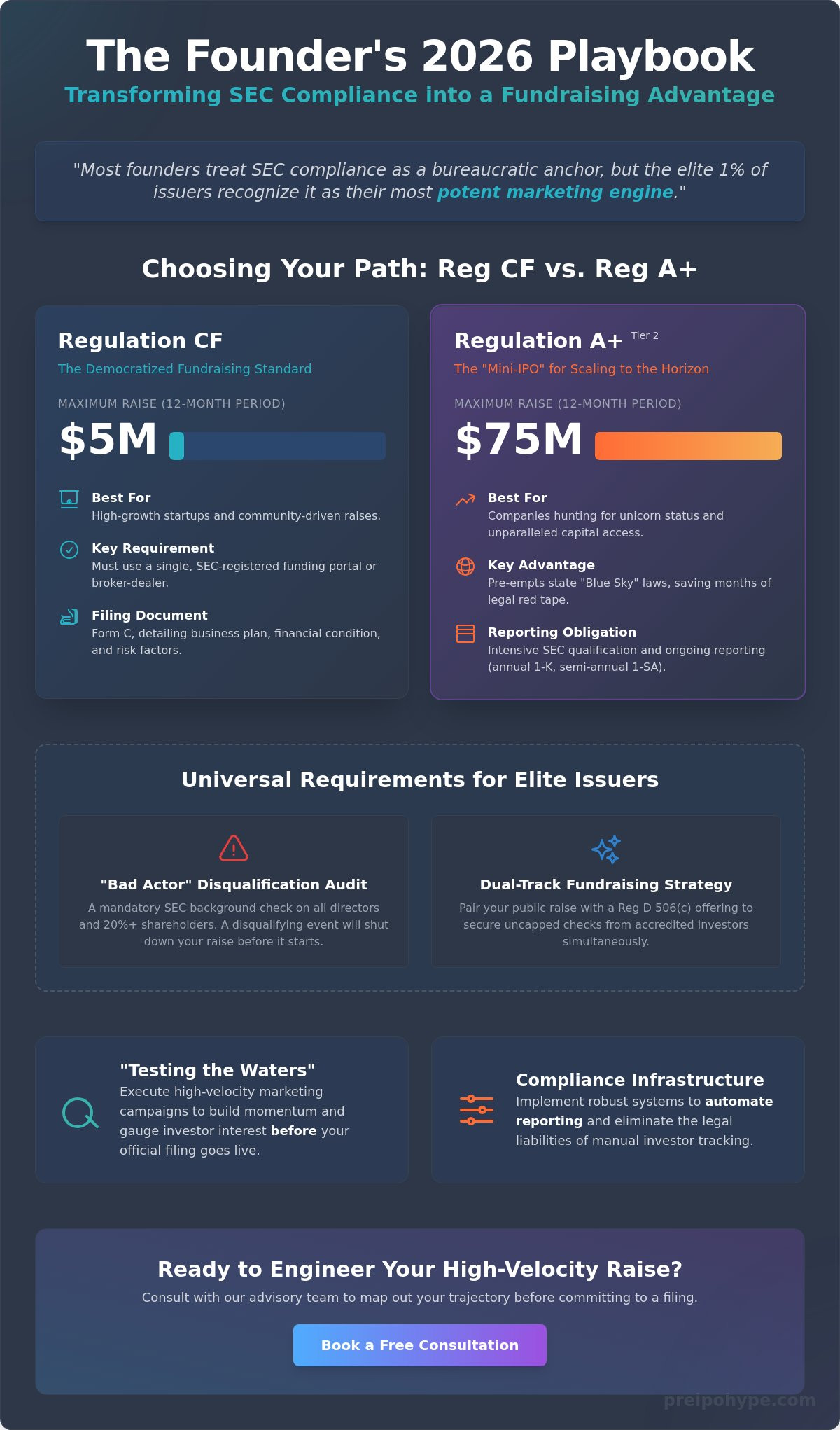
- Execute high-velocity marketing campaigns using "Testing the Waters" protocols to build momentum before your official filing goes live.
- Implement robust foundation infrastructure to automate reporting and eliminate the legal liabilities of manual investor tracking.
The Regulatory Landscape: Choosing Between Reg CF and Reg A+
Choosing your regulatory framework isn't just a legal checkbox; it's a strategic decision that determines your company's trajectory. As of May 2026, the gap between private secrecy and public opportunity has never been narrower. Understanding the Equity Crowdfunding Overview is essential for any founder looking to capitalize on this $316 billion market. If you're unsure which path fits your growth stage, you can consult with our advisory team to map out your trajectory before committing to a specific filing type.
The legal requirements for equity crowdfunding dictate whether you'll play in the $5 million Reg CF sandbox or scale toward a $75 million Reg A+ "Mini-IPO." Elite issuers don't just pick one path; they often engineer a dual-track strategy. This involves pairing a Reg CF or Reg A+ raise with a Reg D 506(c) offering. This allows you to leverage the hype of a public-facing campaign while securing uncapped checks from accredited investors. Before the first dollar enters your account, you must conduct a "Bad Actor" audit. The SEC is unforgiving here. Any disqualifying event by a director or 20% shareholder will shut down your raise before it starts.
To better understand how these rules impact your business, watch this helpful breakdown:
Reg CF: The Democratized Fundraising Standard
Reg CF is the ground floor for high-growth startups. Since the SEC raised the limit to $5 million in a rolling 12-month period, it has become the standard for community-driven raises. To qualify, your company must be a U.S. entity with a clear reporting history. You can't just take money on your own website; every transaction must occur through a single, SEC-registered funding portal or broker-dealer. This intermediary acts as the gatekeeper, ensuring your raise stays within the lines of federal law while you focus on building momentum and hunting for your next valuation benchmark.
Reg A+: Scaling to the $75M Horizon
If your ambitions exceed $5 million, Reg A+ Tier 2 is the elite pathway. It allows for raises up to $75 million and, crucially, pre-empts state Blue Sky laws. This means you don't have to register in every individual state where your investors live, saving months of legal red tape. However, the stakes are higher. You'll face an intensive SEC qualification process that mirrors a traditional IPO. Once live, you're committed to ongoing reporting, including annual 1-K and semi-annual 1-SA filings. It's a rigorous path, but for those hunting unicorn status, the access to both retail and institutional capital is unparalleled. Tier 1 remains an option for smaller, localized raises up to $20 million, but the lack of state pre-emption makes it a secondary choice for most high-velocity campaigns.
Core Issuer Requirements: The Anatomy of a Form C Filing
Form C is your fundraising manifesto. It isn't just a bureaucratic hurdle; it's the document that translates your vision into a language the SEC and elite investors understand. As the bedrock of the legal requirements for equity crowdfunding, Form C demands absolute precision. You'll detail your business plan, financial condition, and exactly how you'll deploy the capital to hit your next valuation benchmarks. This filing creates the legal framework for your 12-month raise cycle, and any material change requires a Form C/A amendment to keep your momentum alive.
The "Story Framework" is where most founders stumble. The SEC requires a candid disclosure of risk factors, from market volatility to technical debt. Elite issuers don't let these disclosures kill the hype. Instead, they frame risks as the very challenges their team is uniquely qualified to solve. By being transparent about the hurdles, you build the kind of insider trust that converts a casual observer into a lead investor. If you're struggling to balance compliance with a compelling narrative, you might want to speak with an advisor who understands the nuances of high-stakes disclosure.
Financial Transparency and Disclosure
Your financial disclosure level depends entirely on your target. For raises under $124,000, your principal executive officer can certify the statements. Once you cross that $124,000 threshold and aim for up to $618,000, you must provide financial statements reviewed by an independent CPA. For the heavy hitters targeting the $5 million limit, audited financials are mandatory unless it's your first crowdfunding offering. Disclosing your "Use of Proceeds" is equally critical. Investors aren't just looking for numbers; they're looking for a strategic roadmap that proves you're hunting for unicorn status, not just survival.
The Intermediary Mandate
You cannot host a Reg CF raise on your own island. Federal law mandates that every transaction occurs through an SEC-registered funding portal or broker-dealer. This intermediary serves as the legal firewall, managing the escrow process and ensuring all investor funds are handled according to strict regulatory standards. Choosing the right partner is vital. You need a portal that seamlessly aligns with your foundation infrastructure to ensure data flows correctly between your marketing efforts and the legal ledger. This integration prevents the manual spreadsheet errors that often trigger SEC red flags during high-volume acquisition campaigns.
The 12-month lifecycle of your raise doesn't end when the round closes. You're committed to filing a Form C-AR annual report to keep your investors and the SEC informed of your progress. This ongoing transparency isn't a burden. It's an opportunity to maintain the "hype" and prepare your cap table for the next major liquidity event.
Investor Limits and Participation Rules in 2026
The legal requirements for equity crowdfunding create a clear hierarchy of capital. Who gets to play at the table, and at what stakes, is governed by a rigid framework designed to balance market access with retail protection. As of May 2026, the divide between accredited and non-accredited investors remains the most critical distinction in any raise. While accredited investors can deploy unlimited capital into your vision, non-accredited participants are bound by strict 12-month aggregate limits. If an investor's annual income or net worth is below $124,000, they're restricted to investing the greater of $2,500 or 5% of their income or net worth. Even for those above that $124,000 threshold, a hard ceiling of $124,000 across all offerings in a single year applies.
Relying on the "self-certification" myth is a fast track to an SEC audit. Founders often mistakenly believe that simply asking an investor for their status is enough. In reality, the legal burden rests on the infrastructure supporting the raise to verify these limits aren't breached. This is especially true for secondary liquidity. Every share issued under Reg CF carries a mandatory one-year holding period before it can be resold. This isn't a suggestion; it's a federal restriction that ensures the "hype" around your company is built on a foundation of long-term belief rather than short-term speculation.
The Accredited Advantage
Elite campaigns prioritize accredited acquisition to achieve rapid scaling. To meet the 2026 criteria, an individual must have an annual income of $200,000 ($300,000 with a spouse) or a net worth exceeding $1 million, excluding their primary residence. These participants provide the heavy-hitting checks that move the needle. Smart issuers leverage Reg CF marketing services to surgically target these high-net-worth leads. By focusing your acquisition spend on sophisticated investors, you reduce the administrative friction of managing thousands of smaller retail entries while still benefiting from the social proof of a crowded round.
Managing the Crowd
A bloated cap table is a death sentence for future institutional funding. If you have 2,000 individual investors on your ledger, your next VC round will be a due diligence nightmare. The Special Purpose Vehicle (SPV) is the professional's choice for keeping the structure clean. An SPV rolls all your retail participants into a single line item, preserving your ability to act decisively. Tracking this engagement requires more than a spreadsheet. You must utilize a custom investor CRM to monitor post-filing communications and ensure every interaction stays within the lines of federal solicitation rules. If you need help structuring your cap table for an elite exit, book a strategy session to review your framework.
Marketing Within the Law: "Testing the Waters" and Solicitation
Most founders believe they must wait for a Form C filing to start their acquisition engines. They're wrong. Rule 206 allows you to "Test the Waters" (TTW), creating a surge of momentum before you even enter the official offering period. This phase is about capturing the "hype" indicator without accepting a single dollar. By following the legal requirements for equity crowdfunding during TTW, you can gauge market appetite and build a waitlist of elite investors ready to pounce on day one. It's the difference between a cold start and a high-velocity launch.
Compliance in marketing isn't about being quiet; it's about being precise. You must avoid the "guaranteed return" trap. Any claim suggesting "SEC approval" or "guaranteed exit" is a one-way ticket to a permanent ban. Every piece of collateral, from a 15-second social clip to a deep-dive newsletter, must include the mandatory legal "Legend." This disclaimer informs potential participants that no money is being solicited and no contract is binding until the offering is qualified. Failing to include this text on omnichannel platforms like X or LinkedIn can invalidate your entire raise. The February 2026 SEC Compliance and Disclosure Interpretations (C&DIs) made it clear that even "ephemeral" content like Stories must adhere to these disclosure standards.
Building Hype Before the Filing
The goal of TTW is to collect non-binding indications of interest (IOI). This is where sophisticated issuers deploy a high-converting video funnel to educate and excite their audience. Instead of a static PDF, you're using dynamic content to explain the valuation benchmarks and growth trajectory. This educational approach builds a bridge between private secrecy and public opportunity. When your Form C finally goes live, that pent-up interest converts into capital in hours, not weeks. It transforms the legal process into a strategic marketing launchpad.
The "Tombstone" Ad Rule
Once your raise is live, your marketing must shift to "Tombstone" ad protocols. These ads are intentionally lean. They can only state factual information: the issuer's name, the price of the security, and a brief description of the business. Crucially, all traffic must be funneled back to your intermediary platform. You cannot process investments on a landing page; you must direct the crowd to the legal ledger. In 2026, these rules apply strictly to influencer partnerships and newsletter exposure. If you want to master the art of compliant storytelling without losing your competitive edge, consult with our marketing strategists to build an acquisition campaign that wins.
Engineering Compliance: The Role of Infrastructure in Scaling
Why are you still using Excel to manage a multi-million dollar capital raise? In 2026, manual spreadsheets aren't just inefficient; they're a legal liability that can tank your due diligence during a future Series A or IPO. As the alternative finance market surges toward its projected $316 billion peak this year, the SEC is looking for more than just a filed Form C. They're looking for a verifiable, digital audit trail of every investor touchpoint. Mastering the legal requirements for equity crowdfunding involves building a foundation infrastructure that automates your record-keeping while you hunt for secondary liquidity.
Attribution tracking is your best defense against regulatory scrutiny. If an auditor asks how you acquired 4,000 retail investors, you need to prove that every ad they saw contained the mandatory legal legends. Data-driven marketing systems act as a continuous record-keeping asset. They ensure that your omnichannel outreach isn't just effective, but legally defensible. This level of precision is what separates high-growth unicorns from companies that get bogged down in regulatory red tape. Clean records don't just keep you out of trouble; they're a signal to institutional investors that your company is run with professional rigor.
The CRM as a Compliance Engine
A sophisticated CRM provides 60-day attribution windows that map the entire investor journey. This lead scoring doesn't just help you close; it creates a timestamped SEC audit trail for every communication. A custom CRM functions as the central nervous system of your raise, capturing every surge in the hype cycle while documenting each interaction to ensure total regulatory adherence. This allows you to manage thousands of relationships at scale without bloating your legal overhead or risking a "Bad Actor" slip-up through manual data entry errors.
Strategic Guidance for Founders
First-time founders often underestimate the administrative weight of a $5 million raise. There comes a point where self-management becomes a risk to the mission. Transitioning to a professional equity crowdfunding marketing agency is often the smartest move for founders who need to focus on product-market fit rather than filing amendments. Consulting and advisory services act as a critical risk mitigation strategy, ensuring your infrastructure is exit-ready from day one. It's about building a bridge between private secrecy and public opportunity with a framework that can withstand the pressure of a high-velocity raise.
Ready to engineer your raise? Book a strategy session with our team to audit your current framework and accelerate your path to elite capital.
From Regulatory Compliance to Capital Velocity
Transitioning from a private startup to a public-facing movement requires a shift in mindset. The legal requirements for equity crowdfunding shouldn't be viewed as a static checklist. They are the strategic foundation of a high-velocity raise. Whether you're navigating the $5 million Reg CF limit or scaling toward a $75 million Reg A+ Mini-IPO, your ability to automate reporting and track attribution determines your ultimate success. Elite founders recognize that clean data is the bridge between private secrecy and public opportunity.
Don't leave your cap table to chance. We've successfully powered 230+ companies and facilitated over $100M in funding by merging high-stakes marketing with rigorous compliance infrastructure. Our proprietary Investor CRM offers the 60-day attribution necessary to satisfy SEC auditors while you focus on hunting for your next valuation benchmark. The private market remains the final frontier of significant wealth creation, and the tools to conquer it are within reach for those who act decisively.
Ask our CEO about engineering your elite capital raise and transform your regulatory obligations into a competitive edge.
Frequently Asked Questions
Is equity crowdfunding legal for all startups?
Equity crowdfunding is legal for most domestic startups, but specific exclusions apply. Under current 2026 regulations, you must be a U.S. entity to qualify. Investment companies or those that have failed to comply with previous annual reporting requirements are ineligible. Additionally, any director or 20% shareholder with a history of securities law violations will trigger a "Bad Actor" disqualification, immediately halting your raise before it begins.
Can I market my equity crowdfunding campaign on social media?
You can market your raise on social media, provided every post functions as a compliant "Tombstone" ad or includes a mandatory legal "Legend." All omnichannel outreach must direct potential participants back to the registered funding portal or broker-dealer. You cannot accept payments or signatures directly on platforms like X or LinkedIn. You must funnel traffic to the legal ledger for execution to stay compliant.
How much does it cost to meet the legal requirements for Reg CF?
Meeting the legal requirements for equity crowdfunding involves costs that scale with your fundraising target. For raises over $124,000, you'll need CPA-reviewed financial statements. If you're targeting the $5 million limit and it's not your first raise, audited financials are required once you cross the $618,000 threshold. These professional services ensure your Form C disclosure survives SEC scrutiny and builds trust with elite investors.
What happens if I fail to file my annual reports after a Reg CF raise?
Failing to file your Form C-AR annual report results in a loss of eligibility for future crowdfunding rounds. The SEC requires this report to be filed within 120 days of your fiscal year-end. If you miss this deadline, you're effectively locked out of the Reg CF market until you rectify the filing. This can stall your momentum toward a Series A or other significant liquidity event.
What is the "Testing the Waters" provision in equity crowdfunding?
The "Testing the Waters" provision allows you to gauge investor interest before you commit to a formal Form C filing. Under Rule 206, you can collect non-binding indications of interest to build a waitlist. This phase is critical for establishing the "hype" cycle. It ensures you hit the ground running with a high-velocity launch the moment your official offering goes live on the portal.
Can non-U.S. companies use Reg CF to raise capital?
Non-U.S. companies cannot directly use Reg CF to raise capital from the crowd. To access this $316 billion market, international founders typically establish a U.S. subsidiary, such as a Delaware C-Corp. This entity serves as the issuer. This allows the business to meet the domestic status requirements while maintaining its global operations and accessing the deep pools of American retail and accredited capital.
Do I need a lawyer for my SEC Form C filing?
While not legally mandated, having a lawyer oversee your Form C filing is a strategic necessity for elite issuers. The legal requirements for equity crowdfunding are dense. A single mistake in risk disclosure or cap table structuring can lead to a permanent shutdown. Professional oversight ensures your campaign infrastructure is exit-ready and protects you from the long-term liability of non-compliant solicitation during the raise.
Is there a limit to how much a single investor can contribute?
Limits exist for non-accredited investors to prevent over-concentration of risk. For those with a net worth or income below $124,000, the limit is the greater of $2,500 or 5% of their financial status. Sophisticated, accredited investors face no such ceilings. This is why elite campaigns focus their acquisition campaigns on high-net-worth individuals to achieve rapid scaling while managing a clean cap table through an SPV.
Disclaimer
Educational only. Not investment, tax, or legal advice. Pre-IPO Hype is investor relations infrastructure for Regulation CF and Regulation A+ raises. We are not a broker-dealer, funding portal, or investment adviser, and we do not offer or sell securities or make investment recommendations. Any securities offering is made only by the issuer, through its own offering documents and, where required, a registered intermediary.


