
Managing a Funding Round from Start to Finish: The 2026 Founder’s Playbook
What if your pitch deck isn't the problem, but your infrastructure is? In a 2026 market where the average capital raise takes three to six months, relying on manual outreach is a recipe for stagnation. Managing a funding round from start to finish now requires more than a compelling story; it demands a high-velocity acquisition engine. You've likely felt the sting of a promising lead going cold because your follow-up system lacked the precision of a professional sales stack.
It's frustrating to watch momentum evaporate while you're stuck guessing which marketing channels actually drive investment. You deserve a repeatable system that secures a closed round at a favorable valuation. This guide masters the mechanics of modern raises, moving from technical infrastructure to omnichannel outreach. We'll show you how to build a diversified cap table that balances institutional authority with retail energy. With SEC filing fees set at $138.10 per million for the 2026 fiscal year, the focus has shifted from regulatory costs to pure execution. It's time to stop pitching and start winning.
Key Takeaways
- Build a technical and financial foundation that treats your raise as a high-velocity marketing campaign rather than a series of manual pitches.
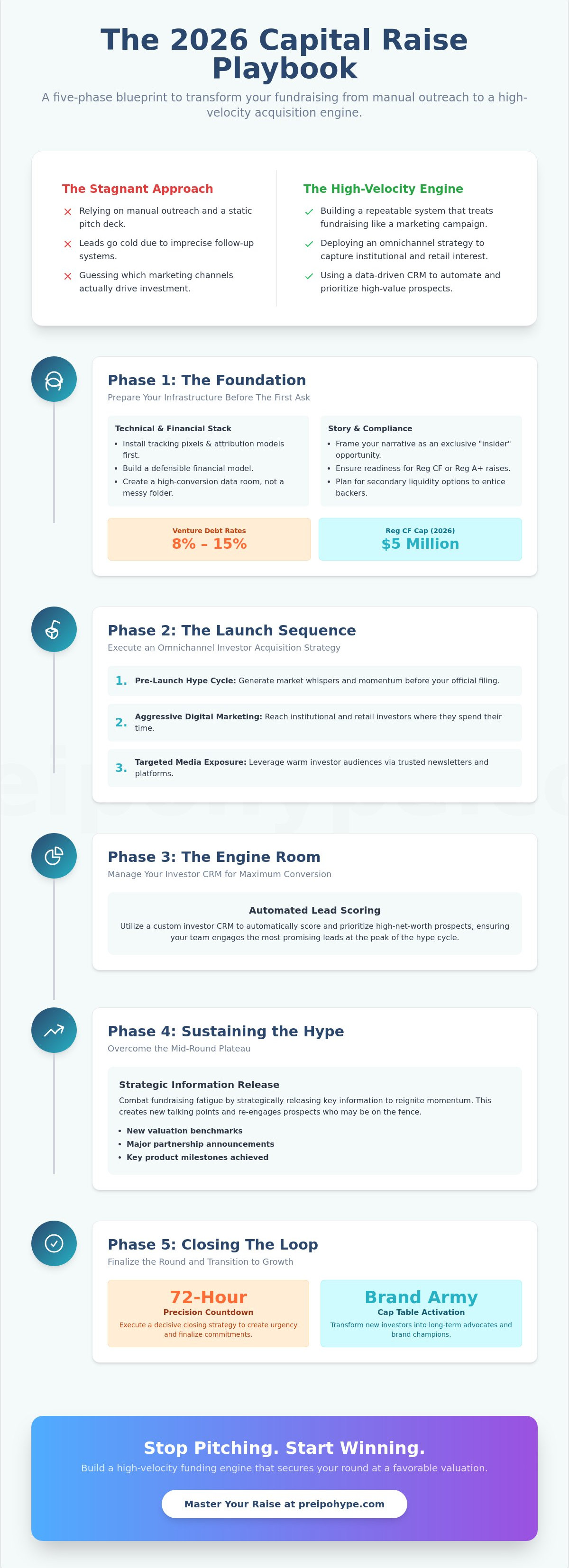
- Master the art of managing a funding round from start to finish by deploying an omnichannel acquisition strategy that captures both institutional and retail interest.
- Utilize a custom investor CRM to automate lead scoring, ensuring high-net-worth prospects are prioritized during the peak of the "hype" cycle.
- Learn to overcome the mid-round plateau by strategically releasing valuation benchmarks and partnership news to maintain fundraising momentum.
- Execute a precision 72-hour countdown strategy to close your round decisively and transform your new cap table into a long-term brand army.
The Foundation: Preparing Your Infrastructure Before the First Ask
Founders who treat fundraising as a series of casual coffee chats are destined for dilution or total stagnation. Managing a funding round from start to finish in 2026 is an exercise in systems engineering. It's the calculated orchestration of legal frameworks, financial modeling, and digital marketing ecosystems. While the journey often begins with seed funding, the path to a successful late-stage close requires a professionalized approach to investor acquisition. If you're still relying on static PDFs and manual spreadsheets, you've already lost the momentum game.
To visualize the transition from a standing start to a completed capital raise, review this high-speed breakdown of the process:
Technical readiness is your primary competitive advantage. You need a tracking pixel and a multi-touch attribution model active before you send a single teaser email. Without this data, you're flying blind. You won't know which marketing channels drive high-net-worth interest and which are simply burning your budget. In May 2026, investors are scrutinizing unit economics with unprecedented intensity. They expect to see a defensible financial model that accounts for current venture debt interest rates, which currently range from 8% to 15%. Managing a funding round from start to finish means proving you understand these macro-economic levers.
The Story Framework: Beyond the Pitch Deck
Stop pitching what your company does; start selling what it will become. Modern capital raises thrive on the "insider" angle. You're bridging the gap between private secrecy and public opportunity. Your narrative should make investors feel like they're joining an exclusive movement rather than just executing a transaction. Identify your unique market wedge. Frame your company as the final frontier of wealth creation in your specific niche. This creates the "hype" necessary to drive urgency among institutional and retail backers alike.
Technical Readiness and Compliance
Setting up your foundation infrastructure is non-negotiable for Reg CF or Reg A+ raises. As of February 2026, the Reg CF cap sits at $5 million per year, but hitting that limit requires a frictionless experience. Your data room shouldn't be a messy folder of unorganized documents. It needs to function like a high-conversion landing page. Consider how secondary liquidity options can entice early-stage backers. Offering a vision of potential exit paths before the final liquidity event makes your round significantly more attractive to those seeking flexibility.
The Launch Sequence: Executing an Omnichannel Investor Acquisition Strategy
The era of the quiet raise is over. If you want to succeed in 2026, you can't just email a few VCs and hope for the best. Managing a funding round from start to finish requires the precision of a high-growth product launch. You're not just asking for capital; you're building a movement. This begins with a calculated "hype" cycle designed to generate immediate momentum before the doors officially open. By the time you file your paperwork, the market should already be whispering your name.
Your second step involves aggressive digital marketing and advertising. You need to reach both accredited institutional players and motivated retail investors where they actually spend their time. While the U.S. Small Business Administration provides a baseline for understanding funding options, elite founders know that modern visibility is bought and optimized through data. Third, you leverage targeted newsletter exposure like Invst Guru to tap into warm investor audiences who are already looking for the next unicorn. Finally, you must implement retargeting loops. A typical investor needs multiple touchpoints over a 60-day period before committing. If you aren't staying top-of-mind, you're leaving money on the table.
Omnichannel Mastery: Being Everywhere at Once
Success in 2026 is about "surround sound" marketing. Your social ads, email sequences, and PR efforts must speak the same language at the same time. This creates a sense of ubiquity that makes your company feel inevitable. A high-converting video funnel is the most effective tool for this, as it humanizes the opportunity and explains complex valuation benchmarks in seconds. This strategy allows you to balance the gravitas required for institutional outreach with the broad appeal needed for a diversified cap table. If you're unsure how to sync these moving parts, you can always consult with an insider to refine your approach.
Building the Waitlist and Early Commitments
The "ground floor" opportunity is a powerful psychological trigger. Use "Test the Waters" (TTW) periods to gauge market appetite before your formal SEC filing. This isn't just about compliance; it's about building a massive waitlist of eager participants. Securing anchor investors early provides the social proof that late-stage growth seekers demand. When the broader market sees that respected names have already committed, the fear of missing out does the heavy lifting for you. Managing a funding round from start to finish is easier when you've already proven the demand exists before the first dollar is even officially collected.
The Engine Room: Managing Your Investor CRM for Maximum Conversion
Why do founders still treat investor relations like a manual sales process from 2010? In the high-velocity environment of 2026, relying on spreadsheets is the fastest way to kill your momentum. A custom investor CRM isn't just a database; it's the central brain of your entire capital raise. Managing a funding round from start to finish requires a level of data granularity that manual tracking simply cannot provide. If you aren't tracking exactly who is opening your deck, which slides they're lingering on, and how many times they've returned to your data room, you're flying blind while your competitors are using heatmaps to close rounds.
Your CRM should automate the 60-day attribution window, allowing you to see the true path to investment. Most investors won't commit on the first touchpoint. Data from early 2026 shows that the average accredited investor requires seven distinct digital interactions before moving from "interested" to "committed." By automating this tracking, you can identify exactly which marketing channels are delivering "whales" and which are merely generating noise. This level of insight allows you to pivot your budget in real-time, ensuring every dollar spent on acquisition is working toward a closed round.
Lead Scoring and Segmentation
Not all leads are created equal. Effective lead scoring allows you to prioritize high-net-worth individuals over casual observers who are just "unicorn hunting" for information. While a standard guide to seed fundraising might suggest broad outreach, elite founders use automated workflows to segment their audience by check size, industry interest, and engagement level. If an investor opens your deck three times in 24 hours, your CRM should trigger an immediate, high-priority alert. This data-driven approach ensures your team spends 90% of their energy on the 10% of leads most likely to wire funds this week.
The Art of the Data-Driven Follow-Up
Stop sending the "just checking in" email. It's the hallmark of an amateur. Instead, use your CRM data to provide "insider updates" that drive genuine FOMO. If your analytics show a cluster of investors from the fintech sector are engaging with your regulatory slides, send a targeted update about your latest compliance milestone. Managing a funding round from start to finish means scaling the personal touch. You want to make 1,000 prospective investors feel like they have a direct line to the CEO. By timing your outreach based on their specific behavior, you transform a cold transaction into an exclusive opportunity they can't afford to miss.
Sustaining the Hype: Strategies to Overcome the Mid-Round Plateau
Success isn't linear. In fact, data from the first half of 2026 shows that 90% of funding rounds experience a significant "mid-raise slump." This is the dangerous territory where the initial surge of early believers tapers off, but the cautious majority hasn't yet felt the pressure to commit. Managing a funding round from start to finish is a test of your ability to manufacture secondary momentum. If you allow the narrative to go cold, you risk losing the leverage required to close at your target valuation.
Re-igniting the fire requires more than just more emails. You need to introduce fresh valuation benchmarks or announce a strategic partnership that validates your long-term growth. This isn't just a corporate update; it's a calculated "hype" trigger. It signals to the market that while they were watching from the sidelines, your company was busy executing. By shifting the conversation from "what we might do" to "what we are currently doing," you force a re-evaluation of the opportunity cost of staying out.
Scarcity is your most powerful closer. Deploying a "Closing Soon" tactic creates a hard deadline that forces off-the-fence investors to act. Combine this with a "Mid-Round Pivot" in your marketing creative to avoid audience fatigue. Refreshing your messaging keeps the raise feeling like a current event rather than a lingering obligation. If you want to see how elite founders structure these high-pressure windows, book an advisory session to refine your closing strategy.
Leveraging Social Proof and Momentum
Investors are social creatures. When you showcase the growing number of participants in your cap table, you transition from a solitary pitch to a collective movement. Live Q&A sessions are particularly effective here, as they allow you to break through skepticism with direct, authoritative answers. By highlighting the potential for secondary liquidity, you further reduce the perceived risk, making the "ground floor" feel like a secure foundation rather than a gamble.
Refining the Audience: A/B Testing Your Investor Acquisition
Data is the only cure for a stalling round. Use your investor acquisition platform to pinpoint exactly which channels are delivering the highest ROI. Managing a funding round from start to finish means shifting your budget in real-time to the segments that are actually writing checks. By A/B testing your messaging against different investor profiles, you can address the primary objection, "Why now?", with surgical precision. This data-driven refinement ensures your "hype" cycle remains profitable until the final wire is confirmed.
Closing the Loop: Finalizing the Round and Transitioning to Growth
The final 72 hours of your raise are the most critical. Managing a funding round from start to finish culminates in this high-pressure window where urgency overrides hesitation. Internal benchmarks from May 2026 show that a well-executed "Final Push" campaign can capture up to 18% of total capital in the closing three days. This isn't the time to relax. It's the time to deploy a precise countdown strategy that forces every remaining lead in your CRM to make a definitive choice. You're no longer selling a vision; you're offering the last remaining seats on a departing vessel.
Once the wires are confirmed, your job shifts from acquisition to retention. Your new cap table isn't just a list of names; it's a brand army. These investors are now your most vocal advocates, and they expect the "informed insider" treatment you promised during the hype cycle. A successful round in 2026 sets the stage for your next major liquidity event, whether that's a Series B or a direct listing. To ensure you're ready for the next level, it's vital to audit your results with experts who can identify the specific attribution patterns that drove your success.
The Legal and Financial Finish Line
Managing wire transfers and escrow releases should be a frictionless experience. In the current regulatory environment, ensuring your cap table is updated accurately and certificates are issued promptly is a baseline requirement for maintaining investor trust. Conduct a rigorous "Post-Mortem" on your acquisition data. Analyze which digital marketing channels delivered the highest-quality leads and where the mid-round friction points occurred. This data is the most valuable asset you've gained, second only to the capital itself. It provides the blueprint for your next raise, allowing you to bypass the learning curve and move straight to execution.
Building the Legacy: From Raise to Exit
The momentum you've built must be sustained to fuel your growth roadmap. Transitioning from a fundraising mindset to an operational one doesn't mean the "hype" should stop. Instead, shift the narrative to your expansion milestones and upcoming valuation benchmarks. Keeping your investors engaged through consistent, high-energy updates ensures they remain ready for the next "ground floor" opportunity you present. You've successfully bridged the gap between private secrecy and public opportunity. Now, it's time to scale that success into a lasting legacy.
Ready to engineer your next raise? Ask our CEO anything or book a strategy session to master the mechanics of managing a funding round from start to finish.
Master the Mechanics of the Modern Raise
Capital is no longer just about the pitch; it's about the pipeline. You've seen how a technical foundation and a custom CRM transform a chaotic raise into a high-velocity acquisition engine. Managing a funding round from start to finish in 2026 requires the same precision as a Silicon Valley product launch. By the time you reach the final 72-hour push, your data room should be a well-oiled machine that converts curiosity into capital. Relying on outdated manual follow-ups is a liability you can't afford when the hype cycle moves this fast.
Don't leave your valuation to chance. We've facilitated over $100M in funding and mastered omnichannel outreach for 230+ companies. It's time to stop guessing which marketing channels drive investment and start using a system designed for elite results. Your next liquidity event is closer than you think if you act with decisive momentum. Book a 30-Minute Fundraising Strategy Session today and reclaim your seat at the table. The ground floor is waiting for those who move first.
Frequently Asked Questions
How long does a typical funding round take from start to finish?
A typical capital raise in 2026 takes three to six months from initial outreach to the final close. This timeline includes the four to six weeks required for foundation infrastructure setup and the subsequent 60 to 90 days of active investor acquisition. Managing a funding round from start to finish requires consistent momentum to ensure the process doesn't stall during the mid-round plateau.
Can I manage a funding round without a dedicated investor CRM?
You can attempt it, but you'll likely lose 40% of your potential capital to poor follow-up. Modern raises generate thousands of leads through omnichannel marketing; manual spreadsheets simply can't handle the lead scoring required to prioritize high-net-worth individuals. Without an automated system, you'll miss the critical 72-hour windows where investors are most likely to commit after viewing your deck.
What is the difference between Reg CF and Reg A+ for digital fundraising?
The primary difference lies in the capital cap and the level of SEC scrutiny. As of February 3, 2026, Regulation Crowdfunding (Reg CF) allows you to raise up to $5 million per year with relatively streamlined filing requirements. Reg A+ allows for raises up to $75 million but demands much more rigorous legal documentation and ongoing reporting, making it better suited for late-stage growth rounds.
How much should I spend on digital marketing for a $5M raise?
Industry data from early 2026 suggests that successful raises typically allocate 5% to 15% of their target goal toward investor acquisition and digital advertising. For a $5 million raise, this budget covers the "hype" cycle, retargeting loops, and content creation needed to stay top-of-mind for 60+ days. It's a strategic investment in the infrastructure required to reach a diversified cap table.
What happens if we don’t reach our minimum funding goal?
If you fail to hit the escrow minimum specified in your filing, all funds are generally returned to the investors. This is the ultimate risk of managing a funding round from start to finish without a data-driven strategy. Most failures occur because the founder didn't have a repeatable system to re-ignite interest when the initial "ground floor" excitement began to taper off.
Is it possible to raise capital entirely from retail investors?
Yes, many companies now bypass institutional VCs entirely by leveraging Reg CF and Reg A+ frameworks. By using sophisticated digital marketing and advertising, you can build a brand army of thousands of retail backers who provide the same capital as a single fund but with significantly more brand loyalty. This democratized approach is the final frontier of private market wealth creation.
How do I handle due diligence for thousands of small investors?
You handle it through a standardized, high-conversion data room rather than individual meetings. By providing all necessary legal and financial documents in a user-friendly digital environment, you satisfy the transparency requirements for thousands of people simultaneously. This allows the CEO to focus on high-level strategy while the foundation infrastructure handles the repetitive inquiries of the retail crowd.
What is the most common reason funding rounds fail in 2026?
Momentum stagnation is the #1 killer of modern raises. Data shows that 90% of funding rounds hit a mid-raise slump where investor interest drops and the round goes cold. Rounds fail when founders lack the "insider" updates or valuation benchmarks needed to force off-the-fence investors to act before the deadline. Without a secondary "hype" trigger, the round simply expires.
Disclaimer
Educational only. Not investment, tax, or legal advice. Pre-IPO Hype is investor relations infrastructure for Regulation CF and Regulation A+ raises. We are not a broker-dealer, funding portal, or investment adviser, and we do not offer or sell securities or make investment recommendations. Any securities offering is made only by the issuer, through its own offering documents and, where required, a registered intermediary.


