
Marketing a Convertible Note Round: A Founder's Guide
When planning how to market a convertible note round, one of the main risks is sharing a message that does not match the offering. Founders need to build awareness while keeping communications consistent with issuer-approved materials and the raise’s actual status. A practical plan gives each message a clear purpose, review path, and destination.
It’s reasonable to feel uncertain about what to say before and during a raise. A clear workflow can help you coordinate campaign messages, review them against approved materials, and know when to involve qualified securities counsel and the issuer’s registered intermediary. This guide covers how to prepare communications, coordinate outreach for the issuer, and keep the company story accurate without treating marketing activity as legal advice.
Pre-IPO Hype is investor relations infrastructure for Regulation CF and Regulation A+ raises. We are not a broker-dealer, funding portal, or investment adviser, and we do not offer or sell securities or make investment recommendations. Campaign support is provided for the issuer alongside its registered intermediary and qualified securities counsel. Results vary. No marketing approach guarantees that a raise will close.
Key Takeaways
- Learn how to market a convertible note round with a coordinated workflow that keeps campaign messaging clear and consistent.
- Separate the company story from offering details, and build communications from facts approved for the issuer.
- Choose outreach channels based on audience fit, control over the message, and the team’s capacity to respond accurately.
- Use engagement signals to improve communications, not to forecast fundraising outcomes.
- Coordinate campaign roles and review points with the issuer’s registered intermediary and qualified securities counsel.
Why a Convertible Note Round Needs a Clear Marketing Plan
Founders preparing a raise have two connected stories to communicate: what the company is building and how the financing process works. Clear communication helps readers understand the business without blurring that story with details that belong in issuer-approved offering materials. A disciplined approach to how to market a convertible note round starts by separating company education from information about the offering.
A convertible note has features associated with both debt and equity. Convertible bond offers background on this hybrid security structure, but it isn’t a substitute for reviewing the issuer’s documents or getting advice from qualified securities counsel. Marketing communications can explain the company in plain language. They aren’t legal, investment, or securities advice.
This video provides a general introduction to how convertible notes work:
Define the purpose and audience for the campaign
Before drafting public messaging, clarify the issuer’s communication goals and intended audience. Decide what readers should understand about the company, such as its product, customers, or business direction. Then list the questions that relate to the offering itself. Keeping these purposes distinct helps the team create useful company education without improvising or paraphrasing offering details.
Audience questions can point to topics that need clearer explanations. If readers repeatedly ask what problem the company solves, a factual product explainer may help. If they ask about the financing process or note terms, direct them to the issuer’s registered intermediary or offering page. Use questions to find gaps in understanding, not to infer investor intent or suggest that interest is stronger than it is.
Set boundaries before publishing
Agree on a review process before campaign communications go live. Gather the facts approved for use, identify who reviews company claims, and route legal decisions or questions about offering language to qualified securities counsel. Check each message against the issuer-approved materials. If a draft raises uncertainty about what can be said, pause publication and seek the appropriate review rather than guessing.
Campaign support is one part of a coordinated process. It takes place for the issuer alongside the registered intermediary and qualified securities counsel, not in place of them. Outreach and campaign communications should stay factual, supportable, and aligned with approved materials. Treat marketing as communication, not as advice or evidence that a raise will attract investors or be completed.
With the purpose, audience, and review boundaries set, founders have a stable foundation for choosing messages and channels. The next step is a content workflow that makes consistency easier to maintain.
Build a Convertible Note Campaign Around Accurate, Consistent Messaging
A consistent campaign starts with approved information, not a blank page. Before drafting, collect the issuer’s current offering materials and identify which company facts are approved for broader communications. This gives everyone preparing content a shared reference and helps prevent campaign messages from drifting away from what the issuer has authorized.
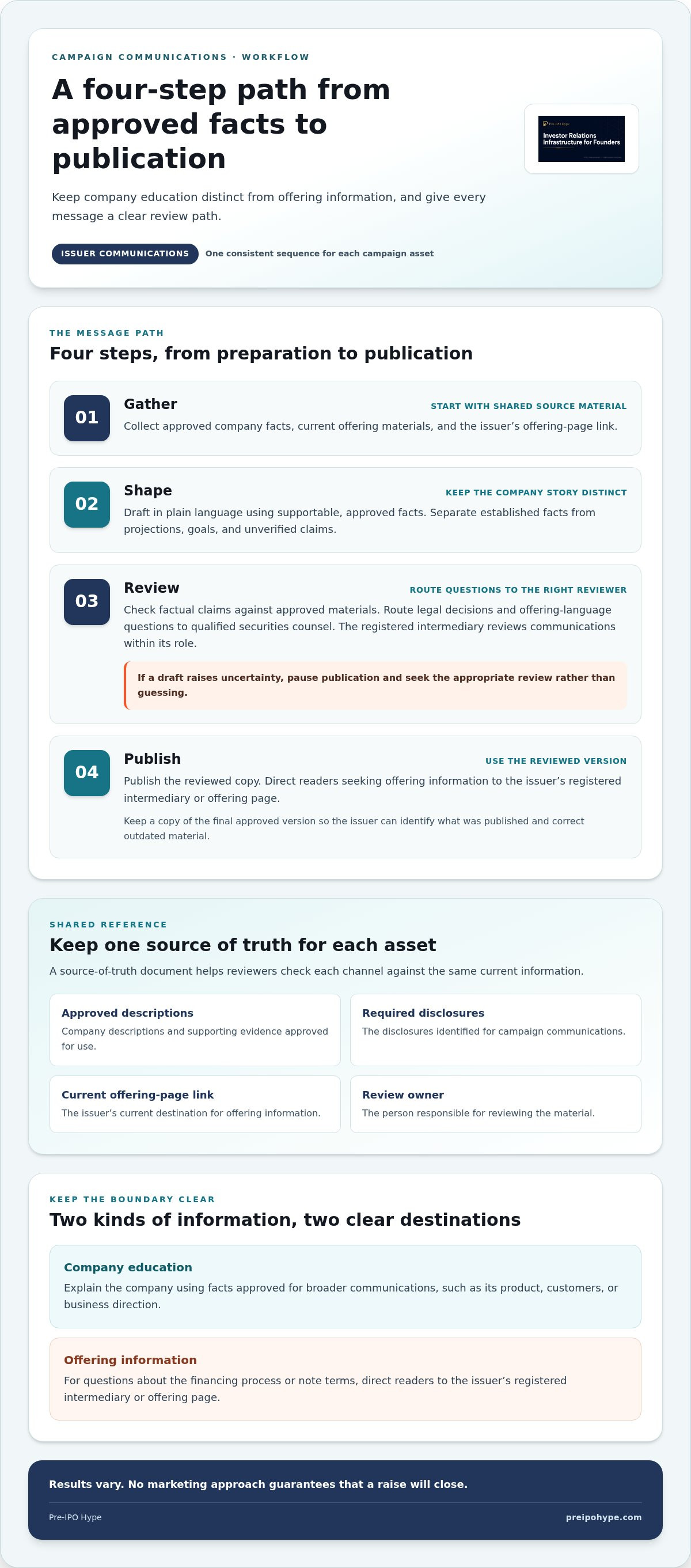
Use the same review sequence for each asset, whether it’s a founder post, an email, or an explainer for the company website:
- Gather: Collect approved company facts, current offering materials, and the issuer’s offering-page link.
- Shape: Draft the company story in plain language, keeping it distinct from information about the offering.
- Review: Check factual claims and route legal or offering-language questions to the appropriate reviewer.
- Publish: Use the reviewed version and direct readers to the issuer’s registered intermediary or offering page for offering information.
Create the company narrative from verifiable facts
Build the story from facts the company can support: the problem it addresses, its approach, and evidence it is approved to share. Mark established facts separately from projections, goals, and unverified claims. This lets founders describe the company’s direction without presenting expectations as current results.
Plain language matters, especially when describing a convertible note. Harvard Business Review’s Convertible Notes in Early-Stage Financing discusses the financing structure and tradeoffs. General educational explanations can help readers understand the subject, but they shouldn’t replace or conflict with the issuer’s approved materials. Don’t fill gaps in those materials with assumptions.
Prepare and review campaign materials
Create a source-of-truth document that records approved descriptions, supporting evidence, required disclosures, the current offering-page link, and the person responsible for review. Update it when issuer-approved information changes, and use it to check each channel before publication. Keep a copy of the final approved version so the issuer can identify what was published and correct outdated material.
Reviewers have distinct roles. Qualified securities counsel should address legal decisions and questions about offering language. The registered intermediary should review communications within its role in the offering process. Campaign support is conducted for the issuer alongside these parties, not in place of them. Founders refining this workflow can discuss campaign coordination in that context.
- Check that company descriptions use the same approved facts across channels.
- Confirm that disclosures and links are current and consistent with approved materials.
- Remove claims that can’t be supported or that turn a projection into a present fact.
- Route questions about offering language to qualified securities counsel.
These checks make how to market a convertible note round a repeatable communications process, not a prediction about investor response.
Choose Outreach Channels Without Creating Confusion or Compliance Risk
Channel choice shapes how people encounter the company’s story and where they go for offering information. Assign each channel a clear purpose, then check that its content and links fit that purpose. For founders working out how to market a convertible note round, the goal is coordinated communication, not posting the same message everywhere.
Match each channel to a specific communication purpose
Owned content, such as company webpages or email updates, can explain the business and direct readers to the issuer’s registered intermediary or offering page for offering information. Founder-led communications can share the company’s perspective and answer questions using reviewed facts and consistent wording. Platform communications should follow the registered intermediary’s process and requirements. The channel may differ, but the source of offering information should remain clear.
Choose channels using three practical criteria: whether the intended audience uses them, how much control the issuer has over the message, and whether the team can respond accurately to questions there. A channel that reaches people but leaves no capacity to manage replies may create confusion. Set a response process, identify who can answer company questions, and route offering questions to the issuer’s registered intermediary or offering page.
Keep outreach transparent and coordinated
Before publishing, use an approval process for copy, creative, and updates. Keep a record of the current version, its reviewer, and the approved destination link. If a detail changes, pause and review materials that repeat it rather than allowing older language to circulate. Campaign infrastructure can help organize those moving parts. The fundraising technology stack provides further context on how tools can fit into a coordinated process.
Be clear about paid promotion. If the issuer pays for a placement or sponsored content, identify that payment plainly in the same communication. For Regulation Crowdfunding promotion on the platform, anyone the issuer pays to promote the offering must disclose that compensation each time under Rule 205. Include the disclosure in the relevant promotional communication, and have qualified securities counsel review questions about its wording or application.
Platform communications also need coordination. The issuer’s registered intermediary has a defined role in the offering process, so align campaign timing, approved copy, and links with its requirements. Direct investors only to the issuer’s registered intermediary or offering page for offering information. Make clear which content is company education and which provides offering information.
- Use owned content for company education and a clear route to offering information.
- Use founder communications for reviewed answers about the business.
- Coordinate platform messages with the registered intermediary’s process.
- Label paid promotion plainly and include required compensation disclosures.
This structure gives each channel a defined job and helps the issuer keep messages aligned as outreach develops.
Measure Engagement and Improve the Campaign Responsibly
Campaign measurement can show whether communications are reaching people and helping them find useful information. It can’t predict whether a raise will close. Keep engagement measures separate from fundraising outcomes, and use them to improve clarity, not to imply investor demand or forecast results.
Choose useful engagement signals
Start with measures tied to each communication’s purpose. For an educational article, review page visits and clicks to the issuer’s offering page. For a founder update, note replies that raise questions about the company’s product or business model. Record the channel and message associated with an interaction only when the underlying data supports that connection.
Compare messages carefully. A difference in clicks between two channels doesn’t automatically mean one message is better. The audiences, placement, timing, and destination may differ, so consider those factors before drawing a conclusion. Look for patterns you can act on, such as repeated questions that suggest an explanation is unclear or a link that readers have trouble finding.
Our Custom Investor CRM supports lead scoring and attribution tracking.
Use engagement data as a prompt for review, not as proof of an outcome. A visit to an offering page doesn’t establish a person’s intent, and a question doesn’t confirm that someone will invest. Don’t present clicks, replies, or other activity as evidence that a raise is likely to close.
Turn campaign reviews into careful adjustments
Make each change traceable. Note what was revised, why it was revised, and which approved information supports the new wording. For example, if readers repeatedly misunderstand a product description, clarify it using verified facts. If a communication contains outdated information, pause its distribution and review affected materials.
Keep revisions aligned with current offering documents and the guidance of qualified securities counsel. Route legal or offering-language questions to counsel, and coordinate campaign updates with the issuer’s registered intermediary within its role. Changes to campaign copy shouldn’t introduce unsupported claims or conflict with issuer-approved materials.
- Review: Identify which approved messages prompted useful questions or visits to offering information.
- Clarify: Address recurring confusion with factual, accessible educational content.
- Document: Record the reason for each revision and its supporting approved information.
- Coordinate: Check updates with the appropriate reviewers before publishing.
Responsible measurement helps founders improve how to market a convertible note round without manufacturing demand, social proof, scarcity, urgency, or momentum. The goal is a clearer communication process, not a prediction about fundraising results.
Put the Convertible Note Marketing Workflow Into Practice
A repeatable workflow gives each communication a clear owner and review path. For founders applying what they’ve learned about how to market a convertible note round, the sequence is practical: align responsibilities, gather approved information, review materials, publish, and assess. Keep a record of decisions so the team can see who approved each communication and where it appeared.
Coordinate responsibilities before launch
Before publication, assign responsibility for preparing campaign materials, reviewing changes, maintaining current links, and responding to audience questions. The issuer should keep the registered intermediary and qualified securities counsel aligned on their respective roles. Campaign support is conducted for the issuer alongside the issuer’s registered intermediary and qualified securities counsel.
Use a simple sequence to move from preparation to review:
- Align roles: Identify owners for drafting, review, updates, and responses.
- Gather approved information: Work from current issuer-approved facts and offering materials.
- Review: Check the message, supporting claims, disclosures, and destination link with the appropriate reviewers.
- Publish: Distribute the reviewed communication for the issuer through the selected channel.
- Assess: Review engagement for questions or points of confusion, then document any proposed changes.
Keep public links consistent. Direct investors only to the issuer’s registered intermediary or offering page for offering information. If a link or description changes, update the relevant campaign materials through the established review process rather than making an unreviewed edit in one channel.
Make the next step straightforward
Keep the workflow active after publication. Record which materials were used, note recurring questions, and assign responsibility for reviewing proposed updates. If a question raises a legal issue or concerns offering language, refer it to qualified securities counsel. This keeps routine campaign coordination distinct from legal decisions and gives the team a clear path for handling changes.
Before closing the review, confirm that each communication has an owner, a documented approval, and an appropriate destination for readers seeking offering information. A consistent process gives the issuer a practical basis for managing communications as the campaign develops.
Make Clear Communication Part of the Raise
A campaign workflow is most useful when it becomes part of how the issuer makes decisions, not just a set of tasks before publication. When new questions arise or company information changes, return to the same review process. This helps founders keep communications understandable while developing the company story from verified information.
Use your next planning session to decide who owns each communication, how revisions are reviewed, and where readers should go for offering information. Those decisions give the team a practical starting point for applying what it has learned about how to market a convertible note round, while keeping the work grounded in the issuer’s actual materials.
To discuss how a fundraising workflow could fit your campaign, schedule a workflow conversation.
Clear roles and a thoughtful review process can make the next steps easier to manage. Build the workflow carefully, and give your team a sound basis for communicating with confidence.
Frequently Asked Questions
Can I market a convertible note round before all campaign materials are finalized?
You can prepare company education and draft campaign materials before everything is finalized, but don’t publish details that haven’t been approved for use. For example, a founder might draft a product overview while counsel and the registered intermediary review offering materials. Keep draft content internal until its claims, disclosures, and destination links have been reviewed through the issuer’s process.
What should a founder say about a convertible note in marketing materials?
Explain the company’s business and describe the financing only with language approved for public use. Avoid paraphrasing note terms or suggesting what they mean for an individual reader. When considering how to market a convertible note round, use company-focused content for the narrative, then direct questions about the note to the issuer’s offering page or registered intermediary.
Can a company use social media to promote a Regulation Crowdfunding offering?
Social media can share company information and direct readers to the issuer’s registered intermediary or offering page, but Regulation Crowdfunding rules affect how an offering may be promoted. Coordinate posts with the intermediary and ask qualified securities counsel about specific copy. Keep each post factual, within its approved purpose, and consistent with the issuer’s current materials.
How should founders respond when investors ask questions about note terms?
Keep the reply factual and avoid giving an improvised interpretation. Direct the person to the issuer’s registered intermediary or offering page, where approved information is available. If the question points to unclear or potentially outdated language, record it and send it to the appropriate reviewer. Qualified securities counsel should address legal questions and determine whether materials need revision.
Should founders use paid promotion to market a convertible note round?
Paid promotion is an option, but weigh its audience fit, message control, and the team’s capacity to review responses. Identify paid placements or sponsored content clearly as paid in the same communication. Coordinate the placement and its language with the issuer’s review process, and ask qualified securities counsel about disclosure questions or how promotion rules apply.
How can founders tell whether campaign messaging is confusing investors?
Look for repeated questions about the same company claim, inconsistent descriptions across channels, or readers who can’t find the issuer’s offering information. Review the specific message and its destination rather than assuming a single interaction proves confusion. If several people misunderstand a phrase, replace it with clearer wording grounded in approved facts, then route the revision through the normal review process.
Does marketing a convertible note round guarantee that the raise will close?
No. Marketing supports communication, but it can’t guarantee investor interest or determine whether a raise closes. The result depends on factors beyond campaign activity, and engagement measures shouldn’t be treated as a funding forecast. Keep public statements factual, and don’t present clicks, inquiries, or audience response as evidence of a future outcome.
Disclaimer
Educational only. Not investment, tax, or legal advice. Pre-IPO Hype is investor relations infrastructure for Regulation CF and Regulation A+ raises. We are not a broker-dealer, funding portal, or investment adviser, and we do not offer or sell securities or make investment recommendations. Any securities offering is made only by the issuer, through its own offering documents and, where required, a registered intermediary.


