
Marketing to Retail Investors: Engineering the Capital Hype Cycle in 2026
We know the frustration of watching potential investors stall at the finish line while your ad spend climbs. This article promises to bridge that gap by providing the data-driven frameworks and omnichannel strategies necessary to turn retail curiosity into committed capital. You'll learn how to deploy a technical stack that automates your investor relations and secures a predictable flow of funds for your next multi-million dollar round. We're moving beyond basic awareness to show you how to dominate the 2026 investment landscape with precision and authority.
Key Takeaways
- Understand why individual capital is now the primary driver of market momentum in the pre-IPO and equity crowdfunding space.
- Discover the three distinct phases of the investor psychology cycle and how to engineer FOMO to drive late-stage capital commitments.
- Master the art of marketing to retail investors by integrating email, social, and search into a seamless omnichannel engine that slashes your cost per acquisition.
- Learn why standard sales CRMs fail during a raise and how a custom investor CRM solves the critical 60 day attribution problem.
- Explore the high-impact methodology used to bridge the gap between startup and scale-up through specialized Reg CF marketing services.
The 2026 Retail Investor Landscape: From Crowd to Capital Powerhouse
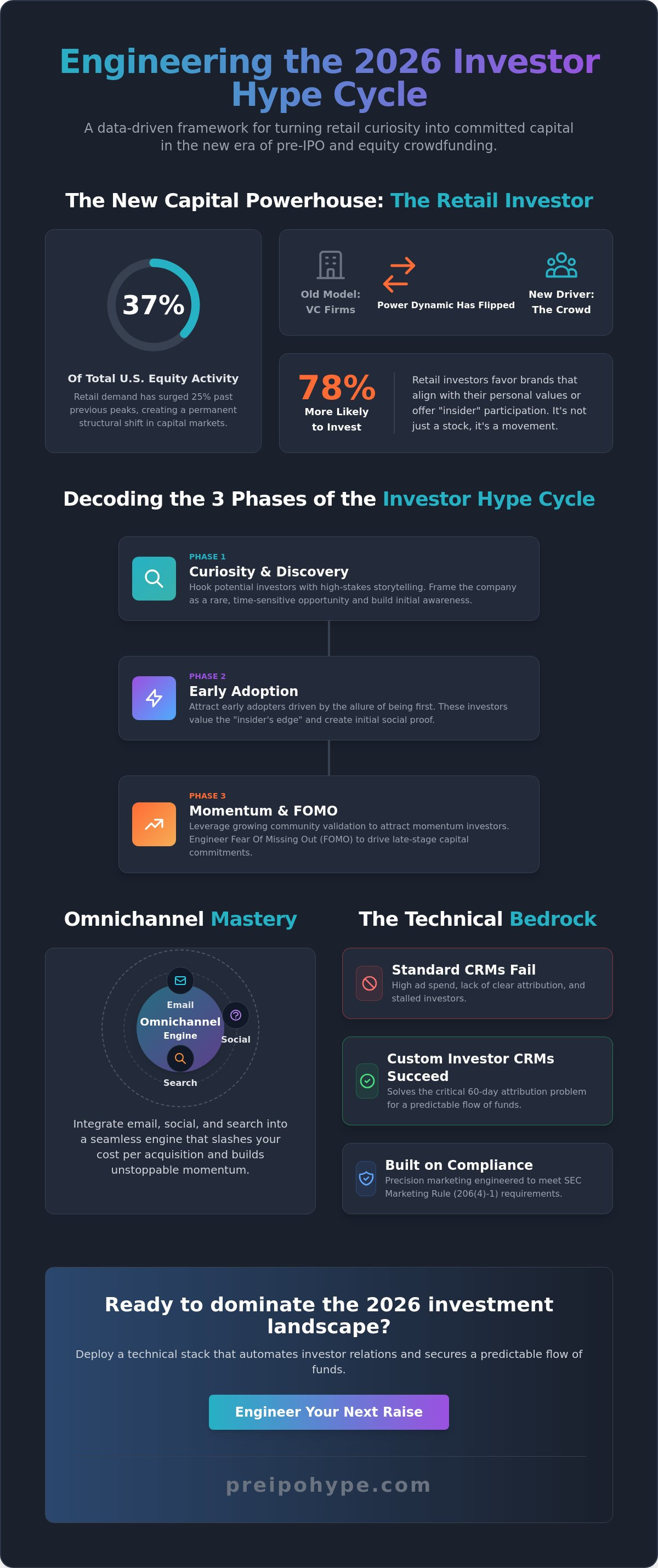
Marketing to retail investors is no longer a peripheral activity for secondary capital; it's the strategic mobilization of individual capital through high-precision digital channels. The power dynamic has flipped. While venture capital firms once held the keys to early stage growth, the democratization of finance through Reg CF and Reg A+ has handed that authority back to the public. Retail investors now dictate market momentum in the pre-IPO and equity crowdfunding space, accounting for nearly 37% of total U.S. equity activity as of late 2025. They don't just provide capital; they provide a network effect. Every committed investor becomes a brand advocate, a node in a digital web that amplifies your message across social platforms and private forums.
This shift represents a fundamental change in how a company prepares for an Initial Public Offering (IPO) or a major funding round. By the time a company reaches the institutional level, a well-engineered retail campaign has already established the valuation floor and built a loyal community of thousands. The crowd is no longer just a source of funds; it's a capital powerhouse that validates your market fit in real time. To harness this energy, you must understand the new rules of engagement.
To better understand this concept, watch this helpful video:
Why Traditional VC Pitching Fails the Retail Crowd
The Regulatory Guardrails: Marketing Within SEC Compliance
Precision in marketing must be matched by precision in compliance. As of 2026, the SEC is actively enforcing the Marketing Rule (Rule 206(4)-1), focusing heavily on how testimonials and endorsements are used. While you want to build hype, every claim must be substantiated and balanced with risk disclosures. This is where your Foundation Infrastructure becomes critical. It ensures that your omnichannel outreach remains within the legal boundaries of Reg CF while still maintaining the aggressive pace required for a successful raise. Factual accuracy isn't a hurdle; it's the bedrock of the trust you need to close the round.
Decoding the Retail Hype Cycle: How Curiosity Becomes Capital
Phase 1: The Foundation of Awareness
In the initial phase, precision is everything. We use data-driven insights to identify lookalike investors who have previously backed similar high-growth sectors. This isn't just basic demographic targeting; it's behavior-based mapping. High-energy content is deployed to cut through the digital noise, emphasizing the "Coming Soon" or "Test the Waters" phase. This creates a low-friction entry point where curiosity is captured without the immediate pressure of a transaction. If you want to see how this looks in practice, you can see our strategic framework here.
Phase 2 & 3: Momentum and the FOMO Trigger
Once the raise is live, milestones become your most powerful marketing assets. Announcing that you've raised the first $100k or hit 50% of your target triggers the secondary wave of momentum investors. They see the social proof and fear being left behind. However, most raises hit a mid-campaign slump where interest plateaus. This is where you inject fresh liquidity through Newsletter Exposure. By tapping into established investor communities, you bridge the gap between the initial excitement and the final surge.
The Final 48 Hours is the ultimate FOMO trigger. As the clock winds down, the psychological pressure to act peaks. This is when the largest checks often clear. You've built the foundation and maintained the momentum. Now, you close the cycle by emphasizing the scarcity of the remaining allocation. Retail investors don't just want to invest; they want to win. Positioning your raise as a winning movement ensures that curiosity finally converts into committed capital.
Omnichannel Mastery: Reaching Investors Where They Live
The "Rule of 7" is a cornerstone of this strategy. Potential investors rarely commit capital on the first click. They need multiple touchpoints across different platforms before they feel the security necessary to move from curiosity to commitment. Retargeting is the glue that holds this together. If an investor sees your CEO on LinkedIn, reads a press release on a major financial site, and then receives a targeted email, the psychological barrier to entry drops significantly. You aren't just an ad; you're a market presence that feels established and inevitable.
Email Marketing: The Engine of Retail Conversion
Your investor list is the most valuable asset you own. Unlike social algorithms, you own the access to these inboxes. A lead who signs up for more information is just beginning their journey. We deploy a 14 day nurture sequence designed to move them from "interested" to "invested" by providing deep dives into the company's roadmap and market potential. Segmentation is key here. You don't send the same message to a lead as you do to a committed investor. One needs a reason to join; the other needs a reason to stay an advocate and bring others into the round through their own networks.
Paid Media and Social Momentum
Executing high-performance Digital Marketing and Advertising requires a shift toward authenticity. We've found that founder-led advertising consistently outperforms generic brand ads. When a potential investor sees the CEO's face and hears the vision directly, conversion rates spike. LinkedIn remains the primary territory for capturing high-net-worth retail individuals and "Accredited Lite" investors. These are professionals who understand market dynamics and are looking for elite opportunities that haven't hit the public markets yet. By synchronizing these channels, you create an inescapable loop of opportunity that drives capital toward your raise.
The Technical Bedrock: Why a Custom Investor CRM is Non-Negotiable
Why do elite raises often stall despite massive traffic? It's rarely a lack of interest. It's usually a failure of the technical stack. When marketing to retail investors, you aren't just selling a product; you're managing a complex flow of capital and data. Standard sales CRMs like HubSpot or Salesforce are designed for traditional B2B cycles. They lack the specialized architecture needed for an equity raise. You need a Custom Investor CRM that functions as the central nervous system of your entire operation, tracking every dollar back to its source.
The most critical failure point is the 60-Day Attribution problem. A retail investor might click your ad in week one, join your newsletter in week three, and finally commit capital in week eight. Most off-the-shelf tools lose that thread. They attribute the conversion to the last touchpoint, or worse, lose the data entirely due to modern privacy restrictions. This leaves you blind, unable to see which channels actually drive dollars versus just clicks. Without this visibility, your ad spend is a gamble rather than a calculated investment.
Tracking the Investor Journey with Precision
Elite raises rely on server-side tracking to maintain data integrity and combat the decline of third-party cookies. This allows you to build a Heat Map of your raise, identifying exactly where your most valuable leads are coming from. You need to know if your LinkedIn outreach is driving the $10,000 checks or if your search ads are just generating low-intent traffic. If your current setup feels opaque, you can Ask the CEO about implementing custom data integrations that bridge these technical gaps and provide a clear view of your capital flow.
Lead Scoring and Automated Outreach
Not all leads are created equal. Your CRM should automatically score potential investors based on high-intent actions. If a lead views your Form C or deep-dives into your pitch deck three times in 48 hours, that's a high-priority signal. We set up triggers to automate a "personal" touch, such as a direct email from the founder, at the exact moment of peak interest. This level of automation maintains the momentum we discussed in previous sections without draining your team's resources. Post-raise, this same system manages investor relations, keeping your base primed for secondary offerings. If you're ready to engineer this level of precision into your next round, book a 30-minute strategy session to audit your technical stack.
Engineering Your Raise: The Pre-IPO Hype Methodology
Most founders approach a capital raise as a marketing experiment. They buy some ads, post on social media, and hope the crowd notices. In a market where retail trading volume hit record highs in early 2026, hope is a poor strategy. Pre-IPO Hype operates as the elite partner for companies that demand more than just generic reach. We treat marketing to retail investors as a high-stakes engineering project. By utilizing our specialized Reg CF Marketing Services, we bridge the gap between startup potential and scale-up reality. We've facilitated over $100M in funding by treating every investor as a node in a data-driven network. It's time to stop guessing at your retail strategy and start engineering your capital flow.
The transition from a private startup to a public-facing powerhouse requires a fundamental shift in how you communicate value. You're no longer just pitching a product; you're pitching a realization event. Our methodology ensures that every digital touchpoint serves this goal, moving the needle from initial curiosity to committed capital. We provide the insider advantage that turns a standard raise into a market-moving event.
The 230+ Company Track Record
Your Next Steps to Market Dominance
Market dominance doesn't happen by accident. It begins with a rigorous Discovery phase before a single ad goes live. We audit your Foundation Infrastructure to ensure you're actually ready for a 7-figure raise. If your tracking is broken or your narrative lacks emotional resonance, more traffic will only lead to a higher cost per acquisition. We identify these friction points early. Once the foundation is secure, we map out the omnichannel roadmap required to dominate your sector. If you're ready to move beyond the crowd and join the elite circle of companies that command retail capital, the next step is clear. Schedule a Strategy Session to map your roadmap and secure your allocation of the 2026 retail market.
Seize Your Position in the New Capital Order
We've already facilitated over $100M in funding for 230+ companies across the most competitive sectors. This track record proves that when you move from guessing to engineering, the market responds. You have the vision to build a powerhouse; we have the frameworks to fund it. Don't leave your next milestone to the whims of the algorithm. It's time to take control of your capital destiny and secure the growth your company deserves.
Ready to engineer your $5M raise? Book a 30-minute strategy session with our team.
Frequently Asked Questions
What is the difference between marketing to retail vs. institutional investors?
Marketing to retail investors is a one-to-many digital strategy that prioritizes emotional resonance and social proof to build a community. Institutional marketing relies on one-to-one negotiations and deep financial diligence within private networks. While institutions focus on rigid mandates, retail campaigns move on momentum and the feeling of insider access. You need high-frequency touchpoints to turn a retail lead into a committed capital partner.
Is marketing a Reg CF raise legal under SEC rules?
Marketing a Reg CF raise is legal as long as you adhere to SEC communication rules regarding tombstone ads and factual consistency. All public messaging must align with the information filed in your Form C and include necessary risk disclosures. We use Foundation Infrastructure to ensure that every campaign remains within these guardrails. This allows you to build aggressive hype without compromising your regulatory standing.
How much should I budget for retail investor acquisition?
Your budget should be viewed as a capital acquisition cost rather than a standard marketing expense. Most successful raises allocate a percentage of their target goal to cover digital marketing and advertising, creative production, and the technical stack. The total amount depends on your current organic reach and the aggressiveness of your timeline. A well-funded campaign ensures you don't lose momentum during the mid-raise slump.
What is an Investor CRM and why do I need one?
An Investor CRM is a specialized technical stack designed to track the multi-month journey of a capital commitment. You need one because standard sales tools can't handle the 60 day attribution windows or the specific compliance needs of an equity raise. It identifies high-intent leads who have viewed your pitch deck multiple times. This allows you to prioritize outreach to those most likely to write large checks.
Can I market my raise to retail investors before I file my Form C?
You can use the "Test the Waters" provision to gauge interest and collect non-binding indications of interest before your official filing. This is a critical phase for marketing to retail investors because it builds a pre-heated list of leads ready to convert on Day 1. You must include specific SEC-mandated legends in these communications. Starting early ensures your raise launches with immediate, visible momentum.
How do I track which ads are actually resulting in investments?
Tracking actual dollars requires server-side attribution that connects your ad platforms directly to your funding portal's back end. Standard browser tracking is often blocked by privacy settings or lost during the long decision cycle of an investment. By using advanced analytics and performance tracking, you can see which specific creative assets are driving capital. This data allows you to shift spend toward the highest-performing channels in real time.
What is the best social media platform for reaching retail investors in 2026?
LinkedIn and X are the primary territories for reaching high-intent retail investors and accredited individuals in the current market. LinkedIn offers unmatched professional targeting, while X serves as the hub for real-time market sentiment and viral momentum. For consumer-facing brands, Meta platforms remain effective for driving high-volume awareness. The best results come from an omnichannel approach that retargets leads across all these environments simultaneously.
How long does a typical retail investor marketing campaign last?
A typical high-performance campaign lasts between 60 and 90 days. This timeframe is split into a pre-launch phase to build a lead list, a momentum phase to hit mid-campaign milestones, and a final FOMO surge. The first 30 days are essential for establishing the valuation floor through early commitments. The final two weeks leverage the scarcity of the remaining allocation to close out the round with maximum impact.
Disclaimer
Educational only. Not investment, tax, or legal advice. Pre-IPO Hype is investor relations infrastructure for Regulation CF and Regulation A+ raises. We are not a broker-dealer, funding portal, or investment adviser, and we do not offer or sell securities or make investment recommendations. Any securities offering is made only by the issuer, through its own offering documents and, where required, a registered intermediary.


