
Measuring Fundraising Campaign ROI: The Private Market Playbook for 2026
In the 2026 private market, your capital raise is either a precision-engineered machine or an expensive shot in the dark. If you aren't obsessively measuring fundraising campaign ROI across every digital touchpoint, you are likely subsidizing your competition's market share. You already know the frustration of watching your cost per closed investor climb toward $6,500 while staring at opaque data from crowdfunding portals. It feels like navigating a gated financial world without a map. You need more than just traffic. You need a way to attribute every dollar of capital to a specific interaction.
This article provides the elite playbook to master the high-stakes metrics of equity crowdfunding and convert investor curiosity into measurable growth. We will show you how to move beyond vanity metrics to secure actual capital. We examine the framework for optimizing the 60-day attribution window and using performance tracking to drive higher conversion rates. From investor acquisition campaigns to sophisticated omnichannel outreach, you will discover how to build the foundation infrastructure required to dominate the 2026 fundraising cycle. The opportunity is rare, but the tools to capture it are now within your reach.
Key Takeaways
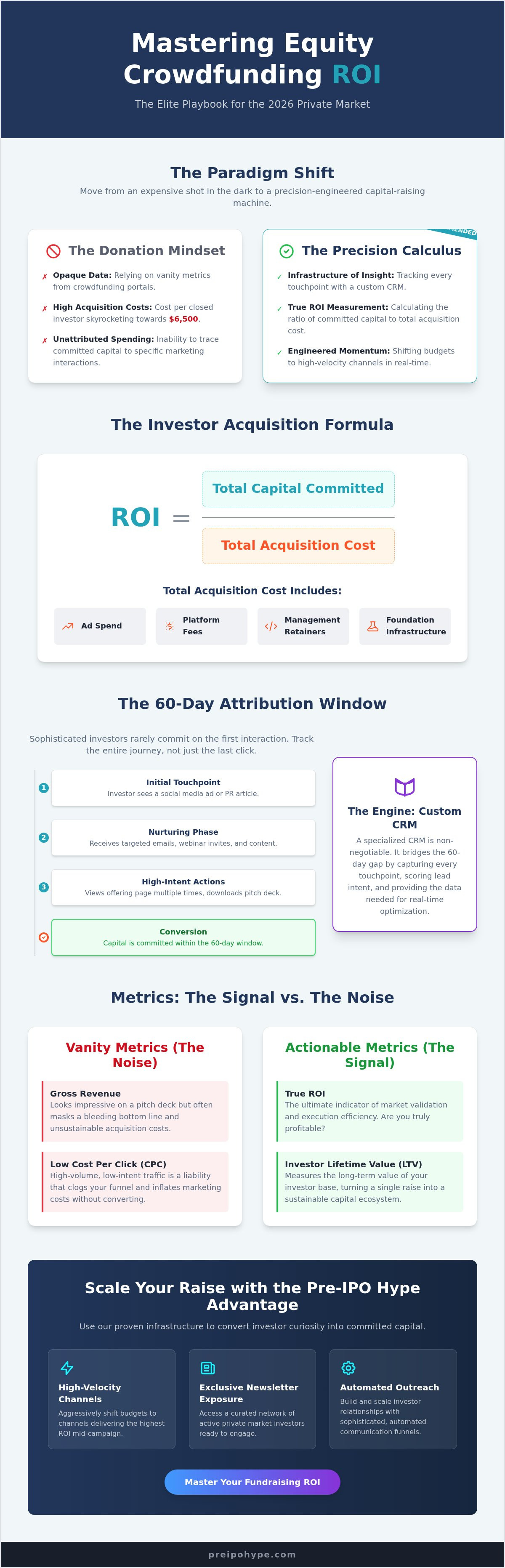
- Move beyond the donation mindset and adopt a precision calculus that defines ROI as the ratio of committed capital to total acquisition cost.
- Deploy the infrastructure of insight to bridge the 60-day attribution window, ensuring every digital touchpoint is tracked and scored through a custom CRM.
- Master the high-stakes playbook for measuring fundraising campaign ROI, balancing management retainers and ad spend against the long-term value of your investor base.
- Engineer momentum mid-campaign by aggressively shifting budgets to high-velocity channels and optimizing creative frameworks in real-time.
- Scale your raise with the Pre-IPO Hype advantage, using automated outreach and exclusive newsletter exposure to convert investor curiosity into capital.
Beyond the Donation: Why Equity Crowdfunding ROI Requires a New Calculus
Is your capital raise actually profitable, or are you just buying vanity points on a leaderboard? In the high-stakes world of private markets, measuring fundraising campaign ROI isn't about counting pennies like a local charity. It's a precision exercise in financial engineering. While a non-profit might be satisfied with a simple donor-to-dollar ratio, equity crowdfunding under Reg CF or Reg A+ demands a more sophisticated Return on Investment (ROI) calculation. We define this as the ratio of total capital committed against the total acquisition cost, including every dollar spent on foundation infrastructure and digital marketing.
Gross Revenue is the ultimate vanity metric. It looks impressive on a pitch deck, but it often masks a bleeding bottom line. Real momentum is found in the spread between what you pay to acquire an investor and the lifetime value that investor brings to your ecosystem. We look at the "Investor Hype Cycle" as a legitimate ROI multiplier. When your campaign hits a certain velocity, the cost per lead drops as social proof takes over, turning curiosity into a self-sustaining capital engine. To visualize how these dynamics shift in a digital environment, watch this helpful video:
The Private Market Distinction
Investor acquisition is not e-commerce. You aren't selling a $50 gadget; you're selling a piece of your company's future. This creates a critical distinction between "committed capital" and "cleared funds." In 2026, SEC clarifications remind us that the $5 million Reg CF limit is a rolling 12-month cap based on closing dates. Your ROI reporting must account for this timeline. You also have to factor in platform fees and management retainers. If you don't account for these on the investment side of your calculus, your ROI figures are nothing more than fiction.
The Trap of Surface-Level Metrics
Don't get seduced by low Cost Per Click (CPC) rates. High-volume, low-intent traffic is a liability that clogs your Custom Investor CRM and inflates your costs. The real danger lies in ignoring the foundation infrastructure costs required to set up a compliant, high-converting funnel. Measuring fundraising campaign ROI effectively requires looking at the "Total Investment" side, which includes legal setup and content creation. True ROI is the ultimate indicator of market validation and execution efficiency. It tells you if the market actually believes in your vision or if you're just paying for an expensive audience.
The Infrastructure of Insight: Attribution and Lead Scoring
Data is the new capital, but only if you know how to read it. Most founders fail because they treat investor acquisition like a standard e-commerce funnel. They see a click, wait for a conversion, and panic when it doesn't happen instantly. In the elite circles of private equity, measuring fundraising campaign ROI requires a sophisticated Custom Investor CRM designed to track high-stakes movement. You aren't just looking for traffic. You are looking for intent. Without a technical bedrock that captures every touchpoint, your marketing spend is essentially a donation to the ad platforms.
Sophisticated investors rarely commit on the first interaction. They need to see the vision, verify the momentum, and feel the exclusivity of the opportunity. This is why a 60-day attribution window is the industry standard for 2026. If you are only looking at last-click data, you're missing the narrative that actually drives the check. Early research on crowdfunding ROI highlighted that multi-touch engagement is the primary driver of successful raises. By integrating omnichannel data, you can see how a lead moves from a newsletter mention to a retargeting ad and finally to a committed investment.
Mastering the 60-Day Attribution Window
The psychological journey from curiosity to capital commitment is rarely linear. An investor might discover your brand on a mobile device during their morning commute but won't execute a legal document until they are at their desk three weeks later. Tracking this cross-device engagement is critical for accurate ROI reporting. Retargeting isn't just about staying top-of-mind. It is about providing the specific data points that move a lead through the funnel. When you align your digital marketing with this extended window, your long-term ROI calculations become far more predictable and profitable.
Lead Scoring as a Predictive ROI Tool
Not all leads are created equal. Lead scoring allows you to distinguish between "Whales" capable of six-figure commitments and retail investors who may only contribute the minimum. By ranking leads based on engagement levels and net worth indicators, you can perform surgical ad spend allocation mid-campaign. You should use your Foundation Infrastructure to automate this data collection. This allows your team to focus their energy on the highest-probability leads while the system handles the retail volume. If you want to see where your tracking is leaking capital, you should audit your current tracking setup to ensure every dollar is accounted for.
Calculating the High-Stakes Return: The Investor Acquisition Formula
Most founders treat ROI like a simple math problem: capital raised minus ad spend. That's a dangerous oversimplification. In the elite private markets of 2026, measuring fundraising campaign ROI requires a multi-layered formula that accounts for the true cost of momentum. You have to look at the "Total Investment" side, which includes your setup fees, management retainers, and creative production costs. These aren't just expenses. They are the capital required to build a high-performance engine that converts cold leads into committed shareholders. If you don't account for these, your performance data is fundamentally flawed.
On the "Return" side, the capital hitting your escrow account is only the beginning. A successful raise generates massive brand equity and establishes a base of investors with a significant Lifetime Value (LTV). These individuals are often the first to participate in future rounds or secondary offerings. To calculate your true Customer Acquisition Cost (CAC), you must look at the cost per closed investor. Industry data for 2026 suggests that direct digital marketing for Rule 506(c) offerings typically sees a CAC between $1,500 and $6,500. Comparing this against the $12,500 to $50,000 range often charged by traditional placement agents reveals why digital Investor Acquisition Campaigns have become the preferred vehicle for sophisticated issuers.
Defining Direct vs. Indirect Campaign Costs
Your ROI equation must go deeper than your Meta or LinkedIn dashboard. Direct costs like ad spend and creative production are easy to track, but indirect costs often leak capital. You have to factor in the hidden cost of founder time and the rigorous legal compliance required for Reg CF and Reg A+ offerings. We view setup fees as a "capitalized" investment. By building a robust technical foundation early, you lower your long-term acquisition costs and ensure your data remains clean for institutional-grade reporting. This is where Foundation Infrastructure pays for itself by preventing expensive attribution errors later in the raise.
Measuring the Hype Multiplier
The most successful raises benefit from a "Halo Effect" where paid momentum triggers organic growth. You should quantify the value of PR and Newsletter Exposure, such as features in the Invst Guru, by tracking how much organic capital they drive. This hype multiplier is what separates a standard raise from a market-moving event. By establishing a baseline for organic vs. paid ROI, you can see exactly how much leverage your marketing spend is creating. Don't ignore "Soft Circles" and Indications of Interest (IOI). These are your leading indicators. They tell you where the market is moving before the funds actually clear, allowing you to optimize your strategy in real-time.
Engineering Momentum: Strategies to Optimize ROI Mid-Raise
Momentum is not a stroke of luck. It is the calculated result of mid-campaign engineering. Once your raise is live, measuring fundraising campaign ROI shifts from a planning exercise to a tactical survival skill. You must be willing to kill underperforming ads and double down on the creative frameworks that are actually moving the needle. In 2026, the market moves too fast for a set-it-and-forget-it strategy. You need to be A/B testing your story-driven hooks against data-heavy investor decks to see which narrative triggers the "Invest Now" action.
Speed is the ultimate ROI lever. By deploying a Video Funnel, you can compress the decision-making cycle significantly. This allows you to educate prospects while they're still in the "curiosity" phase, moving them toward capital commitment faster than text-heavy landing pages ever could. If Meta is delivering high-volume leads but LinkedIn is delivering the "Whales" identified in your lead scoring, your budget must shift immediately. Integrating Newsletter Exposure mid-raise can provide the necessary jolt of social proof to reignite a plateauing campaign.
Omnichannel Mastery for ROI Growth
Elite Reg CF Marketing Services don't just run ads. They coordinate email, social, and SMS to create a "surround sound" effect around your target investors. This omnichannel mastery ensures that once a lead enters your ecosystem, they see your opportunity everywhere. It reduces friction and prevents the "cart abandonment" that often happens when the investment process feels disjointed. By leveraging cross-platform data, you can see which specific combination of touches leads to a closed check.
A/B Testing for Capital Conversion
Don't guess what your investors want. Test it. We often see a massive disparity in performance between "Story Frameworks" that focus on the founder's vision and "Data-Heavy" decks that focus on market cap projections and performance metrics. Optimizing your landing pages for a single, clear action is non-negotiable. Continuous testing is the only hedge against market volatility.
The final 48 hours of your raise are where ROI often sees its biggest spike. This is the "Scarcity Play." By leveraging the momentum you've built over the previous months, you create an environment where the fear of missing out becomes the primary driver. It is about converting that 60-day attribution window into a final, aggressive surge of capital. If you want to optimize your current momentum, you should schedule a mid-raise performance audit to identify exactly where your funnel is leaking capital.
Scaling the Raise: The Pre-IPO Hype Advantage
Scaling a capital raise isn't just about spending more money on ads. It's about maximizing the efficiency of every dollar already in play. By the time you reach the scaling phase, measuring fundraising campaign ROI should be a real-time activity that dictates your hourly moves. You've built the foundation. You've tested the creative. Now, you need to leverage the hype cycle to turn broad market curiosity into definitive capital. This is where most founders lose their grip, but it's where elite raises find their second wind.
The difference between a plateau and a breakout often comes down to internal access. Direct exposure through the Invst Guru Newsletter offers a strategic advantage that generic agencies simply can't match. It provides a concentrated burst of high-intent eyeballs that can trigger an instant spike in ROI. Our data-driven management has already facilitated over $100M in funding, proving that when you combine elite Investor Acquisition Campaigns with the right technical bedrock, the results are repeatable. You aren't just buying traffic; you're joining a movement of high-growth momentum.
The Custom CRM Edge
Standard analytics platforms often fail to account for "dark social"—the private shares and direct messages where high-net-worth individuals discuss opportunities. Our Custom Investor CRM is engineered to track these nuances, providing a clear view of the 60-day attribution window we've discussed. This level of insight is essential for measuring fundraising campaign ROI with institutional precision. Recurring management allows us to optimize your funnel daily, ensuring that no lead is left behind. If you're ready to see the truth behind your data, you should book a strategy session to audit your current metrics and identify scaling opportunities.
Turning Curiosity into Capital
The journey from building your technical bedrock to closing an elite raise requires a partner who understands the high-stakes nature of the private market. You don't need a generalist. You need an Equity Crowdfunding Marketing Agency that treats your raise like the financial event it is. We've shown you how to move from vanity metrics to hard ROI, and how to engineer momentum when the market gets volatile. The tools to democratize elite investment circles are now in your hands. It's time to act decisively. If you're ready to scale your vision and convert curiosity into measurable capital growth, the next step is to align your raise with the infrastructure of the future.
Dominating the New Era of Capital Acquisition
The landscape of private equity is shifting under your feet. You've seen how a precision-engineered approach to measuring fundraising campaign ROI separates the market leaders from those who simply burn through their marketing budgets. It's no longer enough to hope for traffic. You must own the data, master the 60-day attribution window, and leverage an omnichannel strategy that turns cold interest into committed capital. The transition from curiosity to check-writing is a high-stakes journey that requires a sophisticated technical bedrock.
We've facilitated over $100M in funding for more than 230 companies by deploying our proprietary Custom Investor CRM and expert 60-day attribution tracking. This isn't guesswork; it's a calculated system designed to bridge the gap between restricted information and broader opportunity. If you're ready to stop guessing and start scaling with a team that has a proven track record, the keys to the gated financial world are now within your reach. Engineering your next capital raise? Book a strategy session with Fuzzy Wenzel.
The future of your company depends on the momentum you build today. Act decisively and secure the capital your vision deserves.
Frequently Asked Questions
What is a good ROI for an equity crowdfunding campaign in 2026?
A strong ROI in the current private market typically ranges from 5x to 10x the total acquisition cost. While a 3x return is often considered the baseline for a viable raise, elite campaigns target higher multiples by optimizing every stage of the funnel. Measuring fundraising campaign ROI effectively requires you to look beyond the immediate capital hit and account for the long term value of a dedicated shareholder base.
How do I track investor attribution over a 60-day period?
Tracking over an extended window requires a Custom Investor CRM that captures multi touch data points from the first interaction to the final commitment. Sophisticated investors rarely move on the first touch; they often require weeks of nurturing through omnichannel outreach. By using persistent tracking, you can see how an initial newsletter feature or ad click eventually converts into capital weeks later, avoiding the errors of last click models.
Should I include agency management fees in my ROI calculation?
You must include all management retainers, setup fees, and creative production costs to find your true return. Ignoring these expenses provides a distorted view of your capital efficiency and masks the real cost of investor acquisition. A comprehensive calculation ensures you're comparing the true performance of your digital campaigns against traditional, more expensive methods like placement agents.
Can I accurately measure ROI on organic social media for a capital raise?
Organic ROI is measurable when you use unique UTM parameters and dedicated landing pages for every social channel. While organic reach acts as a hype multiplier that lowers your overall blended cost, it's difficult to attribute without a robust technical bedrock. Measuring fundraising campaign ROI across organic channels helps you understand how social proof influences the conversion speed of your paid leads.
How does lead scoring impact the overall return on investment?
Lead scoring allows you to prioritize high net worth individuals over low intent retail traffic, ensuring your resources are spent on the most probable checks. By identifying "Whales" early in the 60 day window, you can deploy surgical omnichannel outreach to close larger amounts of capital with less effort. This precision reduces wasted ad spend and significantly improves the efficiency of your management team.
What is the difference between ROI and ROAS in investor acquisition?
ROAS measures the return on direct ad spend, while ROI factors in the total cost of the raise, including foundation infrastructure and consulting services. In 2026, a high ROAS can be a vanity metric if your overhead and setup costs are bleeding capital. ROI is the ultimate indicator of your campaign's financial success, telling you if the entire operation is actually profitable.
How often should I audit my fundraising campaign ROI?
You should perform a deep dive audit of your metrics weekly, with daily checks during the high stakes final 48 hours of a raise. Real time data allows you to pivot budget away from underperforming ads and toward high velocity channels like the Invst Guru newsletter. Regular audits are the only way to maintain market momentum and ensure your acquisition costs don't spiral out of control.
What role does a Custom CRM play in improving ROI?
A Custom CRM serves as the central nervous system for your raise, capturing data that standard analytics platforms often miss. it automates the nurture process during the critical decision making cycle, ensuring no lead is lost to friction. By providing a clear view of the investor journey, it allows for more accurate lead scoring and higher conversion rates from curiosity to capital.
Disclaimer
Educational only. Not investment, tax, or legal advice. Pre-IPO Hype is investor relations infrastructure for Regulation CF and Regulation A+ raises. We are not a broker-dealer, funding portal, or investment adviser, and we do not offer or sell securities or make investment recommendations. Any securities offering is made only by the issuer, through its own offering documents and, where required, a registered intermediary.


