
Omnichannel Marketing for Startups: Engineering the Investor Hype Cycle in 2026
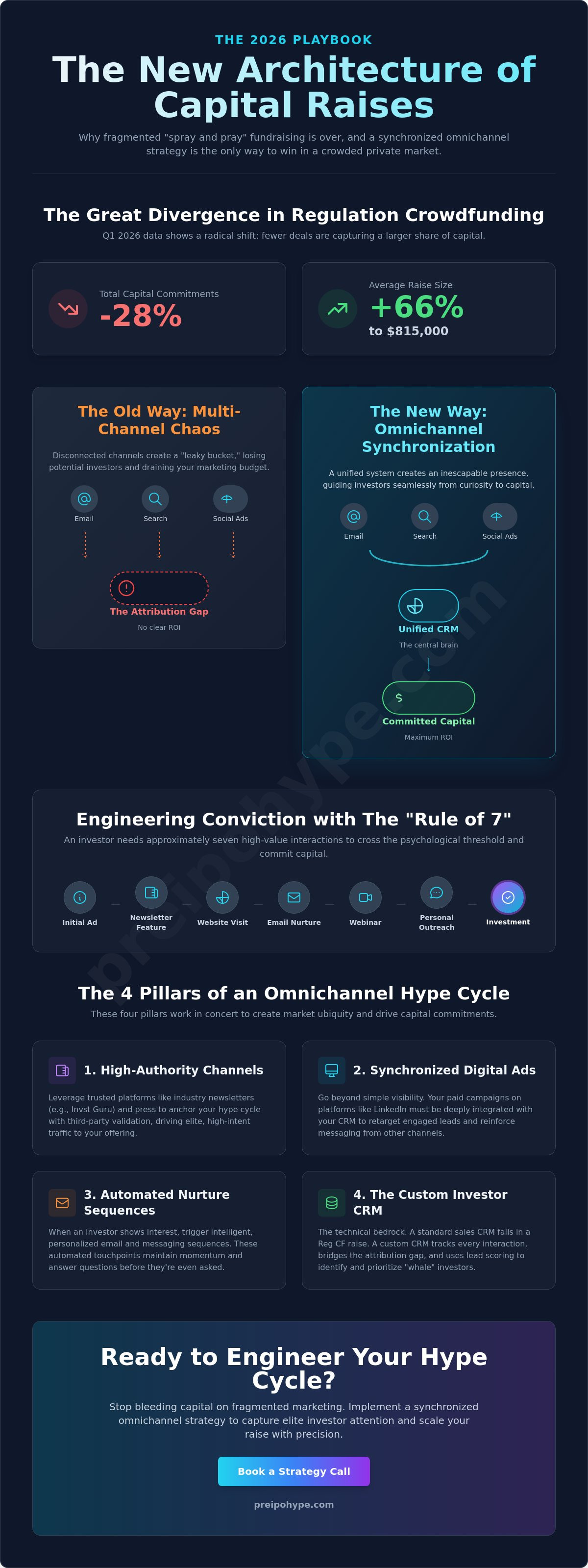
In the first quarter of 2026, total capital commitments under Regulation Crowdfunding plummeted by 28% while the average raise size simultaneously surged 66% to $815,000. This divergence proves that the era of "spray and pray" fundraising is over. Only the founders who engineer an inescapable digital presence are capturing the lion's share of available capital. It's no longer enough to be visible; you must be synchronized. Using omnichannel marketing for startups is the only way to ensure your message hits with the frequency and authority required to move the needle in a crowded private market.
You've likely felt the frustration of fragmented data. It's nearly impossible to see which specific ad or newsletter placement drove an actual investment, leaving you with a high cost of acquisition and no clear ROI. You know the momentum is there, but you're worried about missing your funding targets because your channels aren't talking to each other. This article will show you how to synchronize your digital footprint to capture elite investor attention and scale your capital raises with precision. We'll preview the architecture of a unified acquisition system that provides clear visibility into the investor journey from initial curiosity to committed capital.
Key Takeaways
- Learn why the "Rule of 7" is the psychological threshold for investor conviction and how to hit it using a synchronized digital footprint.
- Master the four pillars of omnichannel marketing for startups to create a sense of market ubiquity that converts casual observers into committed capital.
- Identify the "Attribution Gap" that drains marketing budgets; discover how to bridge the data divide between fragmented platforms.
- Understand why standard sales CRMs fail during a Reg CF raise and how to implement custom lead scoring to prioritize high-net-worth "whale" investors.
- Leverage high-authority channels like the Invst Guru newsletter to anchor your hype cycle and drive elite traffic to your offering.
Beyond the Pitch Deck: Why Startups Need Omnichannel Investor Marketing in 2026
The delta between a failed raise and a unicorn exit in 2026 isn't just the product; it's the architecture of the attention surrounding it. For the modern founder, omnichannel marketing represents a shift from siloed communications to a singular, high-frequency ecosystem. This isn't about being everywhere at once. It's about engineering a synchronized investor journey where every touchpoint reinforces the last. Traditional "spray and pray" advertising is dead. If your LinkedIn ads don't talk to your email sequences, and your newsletter features don't align with your search presence, you're bleeding capital before the first pitch deck is even opened.
High-stakes investor psychology relies on the "Rule of 7." An investor rarely commits capital upon the first impression. They need seven distinct, high-value interactions to cross the threshold of conviction. In a fragmented market, omnichannel marketing for startups ensures these seven touches happen within a compressed timeframe, creating a sense of inescapable momentum. Relying on a single channel is a single point of failure. If your primary platform shifts an algorithm or your email deliverability dips during a Reg CF raise, your entire funding goal is at risk.
To better understand how this strategy creates market leaders, watch this helpful video:
The Scarcity of Attention in the Private Markets
Competition for retail capital has reached a fever pitch. Crowdfund Capital Advisors reported that while new issuers declined by 32% in early 2026, the average raise size jumped 66% to $815,000. This means more capital is chasing fewer, more sophisticated deals. To win, you must project a "unified signal." Investors are no longer just looking at your deck; they're scanning social, search, and news for validation. Investor Hype is the delta between market noise and strategic momentum.
From Curious to Capital: The Omnichannel Journey
The journey from a cold lead to a signed subscription agreement usually spans a 60-day consideration window. Without a unified system, "lead leakage" is inevitable as investors lose interest between touchpoints. Success requires a robust foundation infrastructure to track these movements. This technical bedrock ensures that when a "whale" investor engages with a newsletter, your CRM triggers a personalized follow-up, keeping the hype cycle alive until the wire hits.
Engineering the Hype Cycle: The 4 Pillars of Omnichannel Investor Outreach
Engineering a capital raise in 2026 isn't a linear process; it's a structural one. To dominate the private market, you need four distinct pillars that work in concert to create a sense of ubiquity. When these components are synchronized, your startup doesn't just ask for capital. It becomes an exclusive movement that investors feel they must join. This is the essence of omnichannel marketing for startups. While a basic Omnichannel Marketing For SMBs guide might focus on customer retention, for a high-stakes capital raise, every pillar must serve the hype cycle.
At the center of this ecosystem sits the Custom Investor CRM. It acts as the brain of the operation, processing data from every touchpoint to ensure no lead goes cold. Whether an investor engages with a high-authority newsletter like Invst Guru or clicks an ad, the CRM tracks the intent. This visibility allows you to prioritize high-net-worth "whales" over retail curiosity, ensuring your outreach is always focused on the highest possible ROI. By integrating newsletter exposure with your technical stack, you anchor your brand in circles that were previously gated.
Content as the Strategic Signal
Investors are looking for an insider opportunity, not just another pitch. Your content strategy must use story frameworks that frame the investment as gaining exclusive access to the ground floor of a major industry shift. You aren't just selling equity; you're selling a future valuation benchmark. Synchronizing your video funnel across platforms like YouTube and Instagram creates a visual narrative that follows the investor. This prevents the fragmented signal that kills so many Reg CF raises. It turns a simple transaction into a high-stakes liquidity event that demands immediate action.
Paid Media as the Momentum Multiplier
Paid media acts as your velocity multiplier. Meta and Google ads drive the first-touch awareness, but retargeting is where the deal is closed. In a market where 39% of consumers report AI is already improving their digital experiences, investors expect a personalized, sophisticated ad journey. You must balance this hype with strict SEC-compliant financial disclosures to maintain institutional-grade credibility. If your retargeting isn't firing based on specific CRM triggers, you're leaving capital on the table. If you're unsure where your current infrastructure stands, you can book a strategy session to audit your investor acquisition stack.
Multi-channel vs. Omnichannel: Why Fragmented Marketing Kills Capital Raises
Founders often mistake being "everywhere" for being effective. Multi-channel marketing is a collection of silos; you have a LinkedIn strategy, an email list, and a few Meta ads running independently. This fragmentation is where capital raises go to die. In contrast, a sophisticated omnichannel marketing strategy ensures that every platform shares data to move an investor toward a wire transfer. When your marketing is fragmented, you suffer from the "Attribution Gap." This is the black hole where you lose track of an investor who saw your ad on Monday but didn't sign the subscription agreement until three weeks later. Without a unified trail, you can't optimize your spend.
| Feature | Multi-channel (Fragmented) | Omnichannel (Engineered) |
|---|---|---|
| Data Visibility | Siloed; platforms don't share lead intelligence. | Unified; 360-degree view of the investor journey. |
| Investor Experience | Disjointed; repetitive or conflicting messaging. | Seamless; narrative evolves with investor intent. |
| ROI Tracking | Estimated; high reliance on "last-click" data. | Precise; full attribution over a 60-day window. |
For private market deals, a 60-day attribution window is non-negotiable. Investors in 2026 aren't making impulsive $5,000 decisions. They're performing due diligence across multiple touchpoints. Fragmented marketing leads to "investor fatigue," where the same static ad follows a lead for weeks without providing new value. This lack of progression signals a lack of sophistication, which ultimately lowers your valuation benchmarks. If you can't manage your marketing data, investors won't trust you to manage their capital.
The High Cost of Fragmented Data
Siloed marketing results in a significantly higher Cost per Acquired Capital (CAC). When your systems don't talk, you end up paying to show "awareness" ads to people who have already downloaded your pitch deck. Effective omnichannel marketing for startups allows for real-time A/B testing across the entire funnel, not just on a single platform. In 2026, data is the only hedge against market volatility. If you aren't using synchronized data to pivot your spend toward high-intent "whale" clusters, you're burning through your runway.
Building the Informed Insider Experience
The difference between a cold multi-channel ad and a warm omnichannel sequence is the "insider" feeling it creates. A cold lead might see a generic ad, but an omnichannel lead receives a nurture sequence that references the specific video they watched or the newsletter they read. Using professional Reg CF marketing services ensures this experience remains compliant while building the necessary urgency. It transforms your raise from a desperate plea for funds into an exclusive liquidity event that investors feel privileged to join.
The Technical Bedrock: Setting Up Your CRM for a Reg CF Raise
Standard sales CRMs like HubSpot or Salesforce offer incredible utility, but they often fail investor relations teams right out of the box. These platforms are designed for traditional B2B sales cycles, not the nuanced, high-velocity world of equity crowdfunding. For omnichannel marketing for startups to actually convert, your CRM must be customized to handle specific investor behaviors and regulatory requirements. Without this technical bedrock, you're essentially flying blind, unable to distinguish between a casual browser and a high-net-worth individual ready to commit $100,000 to your round.
The "Foundation Infrastructure" of your raise is what automates this technical complexity. It integrates your email automation with real-time campaign page engagement, ensuring that your messaging evolves based on what the investor does, not just what they click. If an investor downloads your audited financial statements, your system should immediately trigger a high-priority nurture sequence. This isn't just about organization; it's about engineering a sense of exclusivity. You can ask the CEO for a direct strategy session to audit your current CRM setup and identify where you're losing potential capital.
Lead Scoring and Investor Nurturing
Lead scoring is the heartbeat of a successful omnichannel system. A "hot" lead isn't just someone who opened an email; it's someone who has engaged with your Invst Guru feature, watched 80% of your video funnel, and visited your offering page multiple times. By using automated SMS and email sequences, you can "warm up" these leads before your raise even opens. This pre-launch hype ensures that when you finally go live, you have a concentrated pool of high-intent capital ready to hit the "invest" button on day one.
60-Day Attribution and ROI Tracking
In the private market, the path to investment is rarely linear. You need a technical requirement for tracking a lead from their first social click on LinkedIn to their final subscription agreement 45 days later. This 60-day attribution window allows you to see which channels are actually driving the "whales" versus which ones are just generating retail curiosity. With this data, you can reallocate your budget mid-campaign to the highest-performing multipliers. For a deeper look at the tech stack required to pull this off, refer to our investor acquisition platform guide. Precision tracking is the only way to ensure your cost of acquisition stays below your capital targets.
Turning Curiosity into Capital: Executing Your Omnichannel Strategy with Pre-IPO Hype
Strategic infrastructure is only half the battle. To actually close a round in 2026, you need the "informed insider" perspective to navigate the inherent volatility of the private markets. Pre-IPO Hype acts as the architect of your momentum, transforming fragmented digital signals into a singular, high-impact movement. Mastering omnichannel marketing for startups isn't a "set and forget" task. It requires active management and a sophisticated understanding of how elite capital moves from initial discovery to a final wire transfer. We operate with a tone of controlled ambition, positioning your brand as the next exclusive entry point for seasoned investors.
One of our most potent weapons is the Invst Guru newsletter. This isn't just another email blast; it's a strategic anchor that places your offering in front of a curated audience of high-net-worth individuals. By integrating this newsletter exposure into your broader digital footprint, you create the ubiquity required for investor conviction. Our campaign management retainers ensure this momentum never stalls. We provide ongoing ROI optimization, using real-time performance tracking to shift resources toward the channels that are delivering the highest-quality leads. This level of analytics ensures your cost of acquisition remains efficient while your valuation benchmarks continue to climb.
The Pre-IPO Hype Advantage
Our track record is built on results. We've facilitated over $100 million in funding for early-stage companies by perfecting a specific methodology we call the Hype Cycle. This process moves through three critical phases: Discovery, where we identify your unique value proposition; Story Framework, where we craft the "insider" narrative; and Omnichannel Execution, where we flood the market with a unified signal. This isn't about traditional PR. It's about engineering an environment where your startup feels like the next inevitable unicorn. If you're ready to see how this framework fits your specific capital goals, book a consulting session to map your raise today.
Your Roadmap to a Successful 2026 Raise
In a market where McKinsey reports B2B buyers now engage with 10 or more channels, your ability to maintain a consistent story is your greatest asset. Moving from market noise to capital momentum requires a disciplined approach to your launch. Use this final checklist to ensure your omnichannel engine is primed for the 2026 landscape:
- CRM Readiness: Ensure your Custom Investor CRM is lead-scoring every interaction from day one to identify "whale" intent.
- Content Sync: Verify that your video funnels and social narratives are perfectly aligned to avoid lead leakage.
- Paid Media Multipliers: Confirm your retargeting pixels and 60-day attribution windows are active to maximize ROI.
- Newsletter Scheduling: Secure your Invst Guru placements to coincide with your highest-priority raise milestones.
The private market remains the final frontier of significant wealth creation. By acting decisively and synchronizing your digital footprint, you move your startup from the "curious" pile to the "capital" pile. Don't leave your funding to chance. Engineer your hype cycle and dominate the 2026 raise cycle with a system that turns digital attention into hard assets.
Master the Modern Capital Raise
The private market is no longer a place for trial and error. As we've explored, the difference between a stalled round and a record-breaking exit lies in your ability to synchronize every digital signal. By moving beyond fragmented tactics, you can implement omnichannel marketing for startups that builds genuine investor conviction. Our methodology has already facilitated over $100 million in funding for early-stage companies. We achieve these results by leveraging our proprietary Custom Investor CRM and providing elite access to the market through our Invst Guru newsletter.
Success in 2026 requires more than a pitch deck; it requires an engineered hype cycle that follows an investor from their first click to the final wire transfer. You now have the roadmap to bridge the gap between digital curiosity and committed capital. It's time to stop guessing and start scaling with a technical bedrock designed for the high-stakes world of pre-IPO opportunity. Ready to engineer your investor hype cycle? Book a strategy session with our CEO today.
The ground floor is waiting for those who act with speed and precision. We're ready to help you turn your vision into the next major market movement.
Frequently Asked Questions
What is the difference between multichannel and omnichannel marketing for startups?
Multichannel marketing involves using various platforms independently, while omnichannel marketing for startups creates a unified, data-sharing ecosystem. In a multichannel approach, your LinkedIn ads and email sequences operate in silos. An omnichannel strategy ensures your narrative evolves based on investor behavior, preventing repetitive messaging and ensuring a seamless transition from first touch to final investment.
Is omnichannel marketing expensive for an early-stage startup?
Implementing an omnichannel system is an investment in capital efficiency rather than just an expense. While custom infrastructure requires an initial layout, startups can leverage programs like HubSpot for Startups, which offers discounts up to 90% in the first year. By reducing the Cost per Acquired Capital through better lead prioritization, the system often pays for itself by preventing wasted ad spend on low-intent retail curiosity.
How does omnichannel marketing help with Reg CF and Reg A+ compliance?
A synchronized system provides a single source of truth for all communications, making it easier to manage SEC-mandated disclosures. When your marketing is centralized, you can ensure that every "hype" message is automatically paired with required financial links across all channels. This technical oversight reduces the risk of non-compliant "testing the waters" communications that could jeopardize your 12-month rolling raise limit of $5 million.
Which channels are most effective for investor acquisition in 2026?
High-authority newsletters like Invst Guru and mobile-first vertical video are the top performers in 2026. With 39% of consumers reporting that AI already improves their digital experiences, investors expect highly personalized, fast-loading content. Combining these with professional signals on LinkedIn and aggressive retargeting on Meta creates the "ubiquity" needed to hit the Rule of 7 psychological threshold for conviction.
How do I track investor attribution across multiple platforms?
Successful tracking requires a 60-day attribution window and a technical stack that connects social pixels directly to your CRM records. This allows you to follow a "whale" investor from their initial newsletter click to the moment they sign a subscription agreement. By identifying which specific touchpoints drive the highest capital commitments, you can reallocate your budget mid-raise to the most profitable channels.
Can a Custom Investor CRM really improve my funding results?
A custom CRM improves results by shifting your focus from volume to intent. Standard sales tools don't distinguish between a casual browser and a high-net-worth individual who has spent 10 minutes reviewing your audited financials. By lead-scoring these specific investor actions, your team can prioritize personal outreach to high-value leads, which significantly increases the conversion rate from "curious" to "capital."
How long does it take to set up an omnichannel marketing system for a raise?
A comprehensive system typically takes 4 to 6 weeks to fully deploy. This window allows for the customization of your CRM, the creation of synchronized video funnels, and the integration of your foundation infrastructure. Attempting to launch sooner often results in "lead leakage," where valuable investor interest is lost because the automated follow-up sequences weren't properly mapped to the investor journey.
What role does PR play in an omnichannel fundraising strategy?
PR serves as the institutional-grade anchor that validates your paid and social efforts. In a crowded market where average Reg CF raise sizes increased 66% to $815,000 in early 2026, earned media provides the "insider" credibility needed to stand out. Your omnichannel system then amplifies this third-party validation by retargeting potential investors with the news coverage, turning a single press mention into a permanent momentum multiplier.
Disclaimer
Educational only. Not investment, tax, or legal advice. Pre-IPO Hype is investor relations infrastructure for Regulation CF and Regulation A+ raises. We are not a broker-dealer, funding portal, or investment adviser, and we do not offer or sell securities or make investment recommendations. Any securities offering is made only by the issuer, through its own offering documents and, where required, a registered intermediary.


