
Optimising Ad Spend for Investor Acquisition: The Insider Playbook for 2026
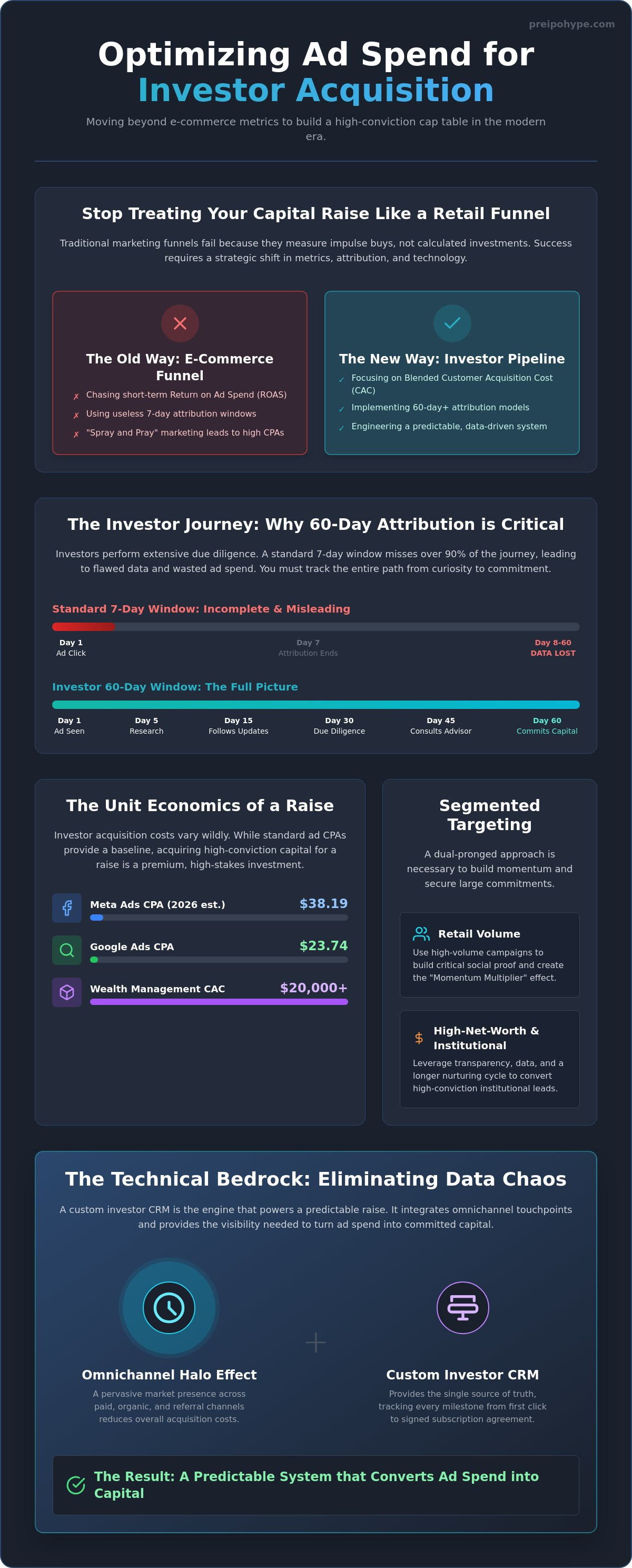
If you're still treating your capital raise like a standard e-commerce funnel, you're essentially subsidizing the platforms rather than building your cap table. With the average cost per acquisition on Meta Ads climbing to $38.19 in 2026, the era of "spray and pray" marketing has officially ended. Success now requires a calculated approach to optimizing ad spend for investor acquisition, or you risk watching your margins disappear into the algorithmic void. You've likely felt the sting of rising CPAs and the crushing frustration of fragmented data that fails to show which ads actually lead to signed subscription agreements.
It's time to stop guessing and start engineering. This guide provides the data-driven frameworks necessary to slash costs while attracting high-net-worth individuals who move the needle. We'll show you how to move past the data chaos by using a 60-day attribution model and the technical bedrock of a sophisticated CRM infrastructure. We're pulling back the curtain on a predictable system that turns cold traffic into high-conviction investors, positioning your raise as the exclusive opportunity the market is waiting for. You'll learn to bridge the gap between a digital click and a capital commitment with surgical precision.
Key Takeaways
- Move beyond the "ROAS Trap" by adopting Blended CAC as your primary KPI to measure true investor conviction across the entire funnel.
- Master the art of optimizing ad spend for investor acquisition by implementing 60-day attribution to capture "silent" investors who monitor your raise before committing.
- Deploy segmented targeting strategies that use retail volume to build social proof while leveraging transparency and data to convert high-net-worth institutional leads.
- Utilize the Omnichannel Halo Effect to create a pervasive market presence, reducing overall acquisition costs through strategic sequencing from awareness to retargeting.
- Eliminate data chaos by integrating a Custom Investor CRM, providing the technical bedrock needed to track every milestone from the first click to the final subscription agreement.
Beyond ROAS: Why Your Capital Raise Needs a Different Ad Spend Metric
Stop measuring your equity raise with a retail yardstick. If you’re hunting for a high Return on Ad Spend (ROAS) in the first 48 hours of a campaign, you’re falling directly into the "ROAS Trap." Immediate revenue is a poor proxy for investor conviction because capital commitments aren't impulse buys. They are calculated, high-stakes decisions. Optimizing ad spend for investor acquisition is about building a long-term pipeline, not just clearing seasonal inventory. You aren't selling a product; you're selling a future.
To better understand the mechanics of budget management and how to avoid wasting your capital, watch this helpful video:
Founders must shift their focus to Blended CAC as the primary KPI. This metric accounts for the "Momentum Multiplier," where paid ad spend creates a ripple effect of organic interest that standard dashboards simply can't see. When you flood the market with high-authority creative, you trigger secondary searches, word-of-mouth referrals, and direct traffic. Private equity is a long-lead game. Unlike e-commerce, where the transaction happens at the point of sale, the real value in a capital raise often materializes weeks after the initial click.
The Failure of Standard Attribution
Standard 7-day click windows are effectively useless for a sophisticated raise. An investor doesn't see a Meta ad and drop $10,000 in five minutes. They watch, they research, and they perform due diligence. This strategic management responsibility ensures that every digital touchpoint builds conviction over a 30 to 60-day cycle. You need a fundraising tech stack that tracks the psychological journey from curiosity to commitment. Investor Acquisition Cost in Reg CF is the total capital deployed to move a single prospect from initial discovery to a legally binding subscription agreement.
Unit Economics of a Successful Raise
The unit economics of a raise are fundamentally different from traditional sectors. While the average CPA on Google Ads sits at $23.74 and Meta at $38.19 in 2026, these figures are just the baseline. High-growth tech sectors often see higher front-end costs that are easily justified by the lifetime value of an investor. An investor isn't just a one-time check; they are a brand advocate and a source of follow-on funding for future rounds. In the wealth management space, CAC can exceed $20,000 because you're acquiring a strategic partner, not just a customer. High-net-worth leads require a premium approach, and your spend must reflect that level of exclusivity. Optimizing ad spend for investor acquisition means knowing when to pay a premium for high-conviction capital.
For those looking to diversify into the essential healthcare and senior living markets, you can check out Modern Vintage Home Care to learn more about the specialized services that drive long-term value in this space.
Engineering the Momentum Cycle: The Role of Custom Investor CRMs
Standard CRMs are built for the linear world of SaaS subscriptions and e-commerce transactions. They track simple funnels. But a capital raise is a high-stakes movement with a non-linear roadmap. An investor might discover your brand on day one, follow your updates for a month, and only sign the subscription agreement on day 45. Without a Custom Investor CRM, you're effectively flying blind. You'll likely attribute your success to the last touchpoint, completely ignoring the initial ad that sparked the interest. This lack of visibility is where most founders lose their grip on growth.
Optimizing ad spend for investor acquisition requires a 60-day attribution window. This captures the "silent" investor, the sophisticated individual who watches from the sidelines, performing quiet due diligence without clicking a single button until they're ready to commit. By the time they wire funds, they've often been nurtured by your omnichannel presence for two months. If your tracking window closes at standard intervals, your data will tell you the ad failed. In reality, it was the catalyst for the entire transaction. You need a system that recognizes this long-lead reality.
Bridging the Data Gap
Data chaos is the silent killer of elite raises. When Meta and Google signals aren't synced with individual investor profiles, you can't distinguish between high-net-worth leads and retail curiosity. You must implement unified UTM naming conventions that flow directly into your Foundation Infrastructure. This technical bedrock allows you to see the exact path an investor took through your ecosystem. It moves the conversation from guesswork to precision, ensuring you're only scaling the creative assets that actually drive capital commitments.
Converting Curiosity into Capital
Lead scoring for investors isn't about generic email opens. It's about identifying who is ready to move. A custom system tracks specific milestones like downloading the pitch deck or viewing the "Offering Circular" multiple times. These high-intent actions should trigger automated, personalized outreach that feels like an exclusive invitation. This creates an "Insider Access" effect, making the participant feel like they're joining a movement rather than just executing a transaction. If you're looking to map these touchpoints with surgical accuracy, you might want to discuss your specific data architecture with an insider. Tracking the "First Order Profitability" of your marketing ensures that every dollar spent is an investment in future momentum, not just a sunk cost.
Segmenting for High-Conviction: Targeting Retail vs. Institutional
Not all capital is created equal. If you're treating a $1,000 retail check the same as a $500,000 institutional commitment in your ad strategy, you're wasting resources. Optimizing ad spend for investor acquisition requires a dual-track approach that leverages the "Retail Rally" for social proof while deploying surgical precision for high-conviction leads. Retail investors provide the volume and momentum that signals market validation. They are the engine of the "Retail Rally," creating the social proof that makes your raise feel like a movement rather than a transaction. This volume is essential for building the optics of a successful, oversubscribed round.
Institutional investors, however, operate on a different frequency. They aren't moved by catchy headlines or flashy graphics. They demand data, transparency, and a clear path to scalability. For these players, your ad spend must focus on high-authority environments and deeper content funnels. Reaching these pre-qualified leads often requires moving beyond standard social feeds. Leveraging the Invst Guru newsletter allows you to tap into an audience already primed for high-stakes opportunities, bypassing the noise of general interest platforms.
The Psychology of the Private Market
Language is your most potent tool for segmentation. Retail audiences respond to "Early Entry" and "Ground Floor" narratives. They want to feel they've discovered a hidden gem before the rest of the world catches on. Conversely, institutional players are won over by "Market Dominance" and "Operational Excellence." You must craft ad creative that satisfies strict SEC regulations while maintaining enough "Hype" to drive action. Position your raise as a gated opportunity, creating an "Elite Insider" persona that suggests participation is a privilege reserved for those who act decisively. It's about connecting restricted information with a broader opportunity.
High-Net-Worth Targeting Tactics
Precision is paramount when hunting for high-net-worth individuals. In 2026, Meta's Special Ad Category for financial services restricts traditional demographic targeting, making first-party data your most valuable asset. Use "Lookalike Audiences" built from your highest-value existing investors to find similar profiles with surgical accuracy. This is where Investor Data services become the technical bedrock of your campaign. By layering professional seniority and net worth proxies on platforms like LinkedIn, you can execute a high-touch acquisition strategy that speaks directly to those with the capacity to lead a round. Don't just buy clicks. Buy the right eyes on your offering circular.
Omnichannel Mastery: Scaling Your Raise Without the CPA Disaster
Why settle for a single-channel strategy when the market rewards omnipresence? The "Omnichannel Halo Effect" isn't just a marketing buzzword; it's a financial necessity in 2026. By appearing across multiple platforms simultaneously, you create a sense of inevitable success that reduces your overall Blended CAC. When a potential investor sees your vision on Instagram, searches for your brand on Google, and then receives a curated update in their inbox, the psychological friction of committing capital begins to dissolve. Optimizing ad spend for investor acquisition in this high-stakes environment requires a surgical approach to sequencing. You can't just dump capital into a single bucket and hope for a sustainable LTV:CAC ratio. You need to orchestrate a narrative that follows the investor from the first spark of curiosity to the final signature.
The 5-Step Scaling Framework
Scaling a raise requires a disciplined progression. You don't start with a massive budget; you earn the right to spend by validating your story through data. This framework ensures you build momentum without the typical CPA spikes that plague unoptimized campaigns.
- Step 1: Establish Your Foundation. Use our Foundation Infrastructure to ensure clean tracking and high-authority story frameworks are in place before the first dollar is spent.
- Step 2: High-Velocity Retail Testing. Launch creative on Meta and Instagram to build early volume. With average CPAs around $38.19, these platforms provide the rapid feedback needed to refine your messaging.
- Step 3: Layer Search Intent. Use Google Ads to capture high-conviction keywords. Capturing search intent at an average CPA of $23.74 allows you to snag investors who are already looking for opportunities in your sector.
- Step 4: Aggressive Retargeting. Use social proof and realization events to "stalk" potential investors who have engaged with your content but haven't yet signed.
- Step 5: Real-Time Reallocation. Move capital away from underperforming segments and into the winners that show the highest conversion to signed subscription agreements.
Preventing Budget Bleed
Budget bleed is the fastest way to kill a capital raise. In 2026, with new location-based fees on Meta and stricter Google verification processes, every unoptimized click is a liability. You must set campaign rules that automatically pause low-quality placements when they exceed your target CPA. However, don't fall for the "Learning Phase" paradox. While AI-driven features like Performance Max are powerful, they require high-quality first-party data to function. If you intervene too early, you break the algorithm; if you wait too long, you flush capital. In the world of SEC-regulated spending, human oversight is non-negotiable to ensure every ad remains compliant while chasing performance. You need an investor acquisition platform that provides total visibility into cross-channel performance.
Ready to build your own omnichannel engine and slash your acquisition costs? Book a strategy session to see how we architect high-conviction momentum for elite raises.
The Pre-IPO Hype Advantage: Converting Ad Spend into Committed Capital
Hype isn't a distraction. It's a signal. In the 2026 private markets, hype represents the measurable velocity of investor interest. It’s the difference between a raise that drags on for months and one that closes oversubscribed in weeks. Optimizing ad spend for investor acquisition is the process of capturing that signal and funneling it into a high-conviction commitment cycle. We move beyond basic digital marketing into the realm of capital engineering. This approach treats every ad dollar as a precision instrument designed to trigger specific milestones within our proprietary momentum frameworks.
The secret to our success lies in the seamless integration of our Custom Investor CRM with aggressive omnichannel execution. This isn't just about showing ads. It's about creating a unified data environment where every click informs the next outreach. We have facilitated over $100M in funding for more than 230 companies by mastering this "Hype Cycle." By treating market excitement as a legitimate indicator of momentum, we bridge the gap between restricted information and democratized opportunity, making participation feel like joining a movement.
Your Fundraising Tech Stack
In 2026, your technical bedrock is more important than your ad creative. A flashy video won't save a broken funnel. A sophisticated Fundraising Tech Stack ensures that your attribution is airtight and your lead scoring is automated. You need tools that can handle 60-day attribution windows and sync cross-platform signals into a single source of truth. Without this infrastructure, you're just guessing. With it, you possess the keys to a gated financial world, allowing you to scale your spend with total confidence in your return on capital.
Taking Decisive Action
The high-growth market moves at a rhythmic, fast-paced clip. It doesn't wait for the hesitant. The cost of inaction is often higher than the cost of the campaign itself, as missed windows of market interest can stall a raise indefinitely. We are in an era of democratized elite investing where the barriers to entry have fallen for those who act decisively. The opportunities are rare, but they are within reach. If you are ready to move from fragmented data to a predictable system for capital growth, it’s time to consult with an insider. You can Ask the CEO for a strategic audit to identify the hidden inefficiencies in your current spend and engineer a high-conviction path to your next milestone.
Secure Your Future: The Blueprint for Over-Subscribed Rounds
The roadmap to a successful capital raise in 2026 isn't found in standard marketing playbooks. It's built on the technical bedrock of 60-day attribution and the strategic shift from vanity ROAS to high-conviction Blended CAC. By integrating our proprietary Custom Investor CRM and mastering omnichannel scaling, you move from simple digital advertising to true capital engineering. This is how you bridge the gap between market noise and committed capital.
We've facilitated over $100 million in funding for 230+ companies by relentlessly optimizing ad spend for investor acquisition. Our system replaces data chaos with surgical precision, ensuring every dollar spent builds the momentum necessary for an elite raise. The opportunities in today's high-growth sectors move fast. The most significant rewards go to those who act with calculated ambition.
Ready to transform your fundraising trajectory? Book a 30-Minute Fundraising Strategy Session today to audit your current spend and unlock your momentum. The gate to elite investment circles is open for those ready to lead.
Investor Acquisition FAQs
What is a good CAC for investor acquisition in 2026?
A target Customer Acquisition Cost (CAC) varies by sector, but industry benchmarks in 2026 suggest consumer fintech CAC ranges from $1,340 to $2,140. For those targeting high-net-worth individuals, wealth management proxies often exceed $20,000 per acquisition. You should aim for a minimum LTV to CAC ratio of 3:1 to maintain sustainable growth and investor confidence throughout your raise.
How much should I spend on ads before my Reg CF raise officially opens?
Founders typically allocate 15% to 25% of their total marketing budget to the "Testing the Waters" or pre-launch phase. This spend is critical for building a high-conviction reservation list and ensuring your campaign launches with immediate social proof. Starting with a warm audience allows you to hit early funding milestones, which signals market validation to larger institutional players later in the cycle.
Can I use retargeting ads for investors who haven’t committed yet?
Retargeting is a non-negotiable component of optimizing ad spend for investor acquisition. Because the journey from discovery to a signed subscription agreement often spans weeks, retargeting allows you to "stalk" potential investors with social proof and realization events. It keeps your opportunity top-of-mind during their due diligence process, significantly reducing the friction required to move from curiosity to a capital commitment.
Does ad spend on Meta actually work for high-net-worth investors?
Meta remains a powerhouse for building volume and social proof, though reaching high-net-worth individuals requires a sophisticated strategy. While the Special Ad Category restricts traditional demographic targeting, you can leverage first-party data to build lookalike audiences of your existing high-value investors. High-authority creative that positions the raise as an exclusive movement can still capture institutional-level interest on the platform.
How do I track investor attribution over a 60-day fundraising cycle?
Tracking over a 60-day cycle requires a custom CRM that integrates unified UTM naming conventions with cross-platform signals. Standard attribution windows are too narrow to capture the non-linear path of a private equity investor. By mapping the entire journey from the first click to the final wire transfer, you ensure that your top-of-funnel awareness ads receive the credit they deserve for sparking the initial interest.
What are the SEC rules for digital advertising in a Reg A+ raise?
All digital communications must be fair, balanced, and include specific risk disclosures to remain compliant with SEC and FINRA standards. In 2026, there is increased scrutiny on Rule 206(4)-1, particularly regarding testimonials and third-party ratings. If you use promoters who receive over $1,000 in a 12-month period, you must have a written agreement in place and provide clear disclosures to potential investors.
How does a custom CRM improve my ROI on ad spend?
A custom CRM improves ROI by eliminating "Data Chaos" and identifying exactly which ads drive capital rather than just clicks. When you can see which specific creative assets lead to signed subscription agreements, you can reallocate your budget in real-time to the highest-performing segments. This technical bedrock transforms your marketing from a speculative expense into a predictable system for acquiring high-conviction capital.
Should I focus my budget on retail or institutional investors first?
Focus your initial budget on retail investors to engineer a "Retail Rally" and build the social proof required for a successful round. High volume and rapid early funding milestones create a sense of market momentum that institutional investors find attractive. Once you've established this baseline validation, layer in high-touch, targeted outreach to institutional leads who are moved by the optics of an oversubscribed raise.
Disclaimer
Educational only. Not investment, tax, or legal advice. Pre-IPO Hype is investor relations infrastructure for Regulation CF and Regulation A+ raises. We are not a broker-dealer, funding portal, or investment adviser, and we do not offer or sell securities or make investment recommendations. Any securities offering is made only by the issuer, through its own offering documents and, where required, a registered intermediary.


