
Post-Raise Investor Relations Strategy: Engineering Momentum for the IPO Path
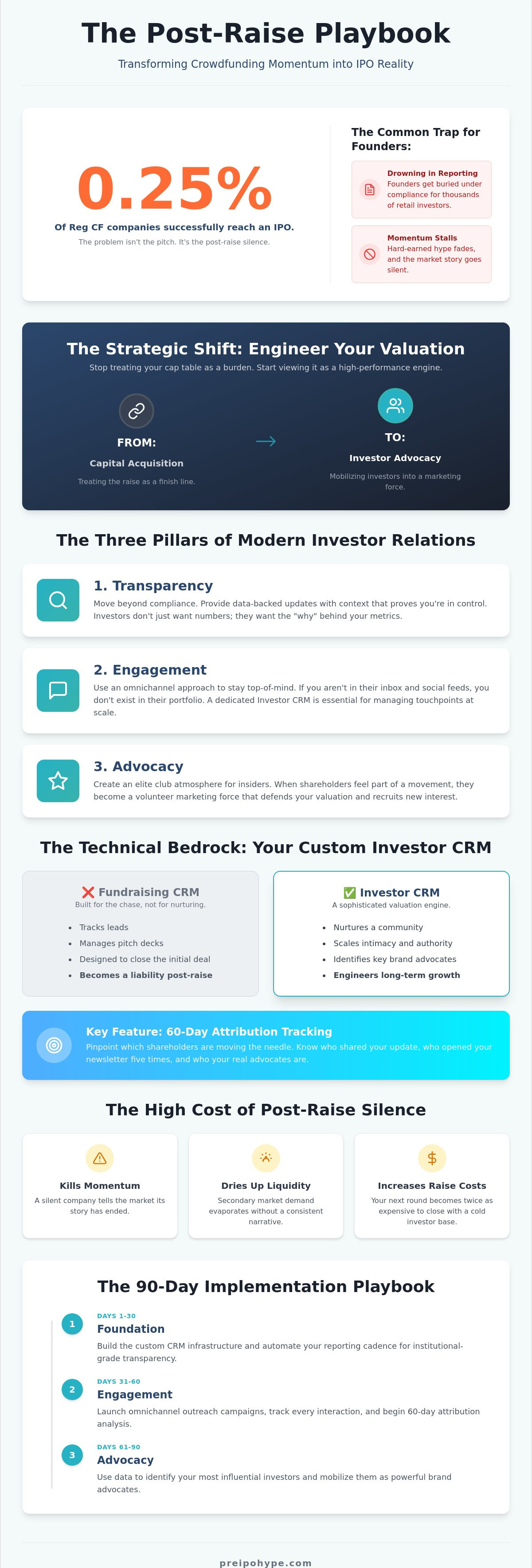
Why do only 0.25% of companies that raise through Regulation Crowdfunding ever successfully reach an IPO? The answer isn't found in the pitch; it's hidden in your post-raise investor engagement strategy for crowdfunding. Most founders celebrate the wire transfers only to find themselves drowning in reporting requirements for thousands of retail investors. It's a common trap to watch that hard-earned momentum stall while you struggle to identify which shareholders are actually your most valuable brand advocates.
You can stop treating your cap table as a burden and start viewing it as a high-performance valuation engine. This article provides the blueprint to transform passive check-writers into a mobilized force of advocates. We'll explore how to use custom CRM infrastructure to automate your outreach, track attribution with 60-day precision, and maintain the elite level of transparency required for IPO readiness. You'll learn the exact framework to keep your investor base warm for the next capital event while engineering the secondary market demand that drives long-term growth. The path to a major liquidity event isn't built on a single raise; it's engineered through the momentum you maintain after the hype ends.
Key Takeaways
- Learn why the most successful firms shift focus from capital acquisition to investor advocacy to maintain post-raise market momentum.
- Discover how a data-driven investor engagement strategy for crowdfunding uses 60-day attribution to pinpoint and mobilize your most influential brand advocates.
- Master omnichannel outreach techniques that go beyond simple email updates to create a sense of elite insider access for your retail base.
- Follow a structured 90-day implementation playbook to automate your reporting cadence and build the technical infrastructure required for a future IPO.
- Understand how early adoption of institutional-grade IR and ESG reporting creates the transparency needed to attract major institutional investors.
What is a Post-Raise Investor Relations Strategy?
Most founders treat the closing of a funding round as a finish line. In reality, it is the starting block for your company's next phase of valuation growth. A post-raise investor relations strategy is the systematic framework you use to maintain transparency, build trust, and ignite secondary market demand once the initial hype of the raise fades. To grasp the core function of this discipline, it helps to view What is Investor Relations? as a strategic management responsibility that integrates finance, communication, and marketing to manage the narrative between a company and its investment community.
By 2026, the market has shifted. Capital is no longer just a transaction; it's the beginning of a high-stakes relationship. You're no longer just acquiring capital. You are engineering investor advocacy. Traditional IR was designed for a handful of institutional suits, but that model fails when your cap table is packed with thousands of retail investors from a Reg CF or A+ raise. You need a system that scales intimacy and authority simultaneously.
To better understand how this strategy integrates with your brand's growth and future funding goals, watch this helpful video:
The Three Pillars of Modern IR
- Transparency: Move beyond basic SEC compliance. Provide data-backed updates that show the "why" behind your performance metrics. Investors don't just want numbers; they want the context that proves you're in control.
- Engagement: Use an omnichannel approach to stay top-of-mind. If you aren't appearing in their inbox and their social feeds, you don't exist in their portfolio. A dedicated Custom Investor CRM is essential for managing these touchpoints at scale.
- Advocacy: This is your ultimate goal. You want to create an elite club atmosphere where investors feel like valued insiders. When shareholders feel like part of a movement, they become a volunteer marketing force that defends your valuation and recruits new interest.
Why 2026 Requires an Always-On Strategy
Digital markets move at the speed of light. A quarterly PDF is a relic of the past that kills momentum. If you go silent after the raise, you're effectively telling the market your story has ended. This silence is a valuation killer that dries up secondary market liquidity and makes your next round twice as expensive to close. A robust investor engagement strategy for crowdfunding ensures your narrative stays active and your investor base stays warm for the next capital event. Post-raise IR is the bridge between current capital and future liquidity.
The Technical Bedrock: Why a Custom Investor CRM is Non-Negotiable
A fundraising CRM is built for the chase. It's designed to track leads, manage pitch decks, and close the initial deal. But once the round is funded, that system becomes a liability. Managing a post-raise cap table requires a fundamental shift in your technical stack. You aren't just hunting for capital anymore; you're nurturing a community. This is where your investor engagement strategy for crowdfunding must evolve from a simple spreadsheet into a sophisticated valuation engine.
The core of this engine is 60-day attribution tracking. In the retail-heavy environment of Reg CF and Reg A+, identifying which investors are actually moving the needle is impossible without granular data. You need to know which shareholder shared your latest update on LinkedIn and which one opened your newsletter five times in 24 hours. By integrating your foundation infrastructure directly with your IR workflows, you create a seamless loop between operational milestones and investor sentiment.
Lead scoring isn't just for sales teams. In a post-raise world, it's how you prioritize your time. Your CRM should automatically flag institutional-grade behavior from retail check-writers, allowing you to prioritize high-touch follow-ups with potential whales while maintaining automated, high-quality updates for the broader base. If you're feeling overwhelmed by the technical setup, you might consider a strategy session to audit your current stack.
Centralizing the Cap Table Data
Crowdfunding platforms are excellent for the raise, but they often create data silos that hinder long-term growth. To prepare for an IPO, you must eliminate these gaps. A custom investor CRM allows you to segment your cap table by check size, location, and engagement level. This isn't just about organization; it's about compliance. Automating the KYC update process ensures your records remain pristine, a non-negotiable requirement for any future public listing or major institutional round.
Tracking the Hype Cycle Post-Raise
Market momentum is fragile. To maintain it, you must treat your investor updates as high-value content. Effective Crowdfunding Engagement Strategies rely on monitoring real-time behavior rather than just sending quarterly reports. By tracking newsletter open rates and click-throughs, you can gauge the market's temperature before you announce your next big move. Identifying whales who are increasing their engagement levels allows you to tap into a warm base when you need it most. Explore our Fundraising Tech Stack to see how these technical pieces fit together to drive long-term liquidity.
Omnichannel Mastery: Engaging the Modern Investor
If your post-raise communication plan relies solely on a monthly email, you're already losing the battle for attention. In 2026, retail investors are bombarded with high-frequency digital noise. To cut through, your investor engagement strategy for crowdfunding must move beyond the inbox and into the feeds where your shareholders actually live. You aren't just sending updates; you're managing a high-stakes narrative that maintains market momentum and defends your valuation between funding rounds.
Elite firms leverage social proof and exclusive insider content to stay top-of-mind. This requires a synchronized approach where LinkedIn ads, automated email sequences, and SMS updates work in concert to tell a unified story of growth. Broad market visibility is also critical. Utilizing Newsletter Exposure via Invst Guru ensures your brand remains visible to the wider investment community, not just those already on your cap table. This multi-layered visibility creates a sense of ubiquity that institutional investors recognize as a hallmark of a company ready for the next level.
Content Strategy for Post-Raise Growth
The tone of your communication must shift immediately after the round closes. Investors no longer want to hear why they should buy; they want to see what you're building with their capital. This means moving from pitching to progress reporting. High-impact video updates and live Ask the CEO sessions are the most effective ways to humanize the brand and build long-term trust. By deploying a multi-touchpoint communication loop, omnichannel outreach prevents investor churn in private markets by ensuring the brand remains an active, exciting part of the shareholder's daily digital experience.
Building the Investor Club Experience
To truly mobilize your cap table, you must treat your shareholders like members of an exclusive club. Creating tiered access levels for top-tier investors fosters a deep sense of loyalty and exclusivity. These private communities serve as a powerful tool for gathering market intelligence and direct product feedback from your most invested advocates. When you position your company as a gated opportunity with restricted access, you're not just managing current shareholders. You're engineering the scarcity and demand that will fuel your future capital events. This transformation from a simple company into a movement is what separates stagnant startups from IPO-bound powerhouses.
The 90-Day Post-Raise Playbook: A Step-by-Step Implementation
The first 90 days after closing a round determine if your company is a one-hit wonder or an IPO contender. This is the "honeymoon" phase where your new shareholders are most attentive. If you fail to implement a rigorous investor engagement strategy for crowdfunding now, you risk total momentum stagnation. You need a chronological roadmap that moves from basic data onboarding to high-velocity market advocacy. This isn't just about sending a thank-you note. It's about engineering a permanent valuation engine.
Day 1 to 7 focuses on the "Welcome to the Family" sequence. This is a high-stakes data onboarding phase where you sync new shareholder information into your CRM and set the tone for elite access. By Day 30, you must establish your reporting cadence and finalize technical integrations. This ensures your foundation infrastructure is capturing every interaction and attribution point. Between Day 31 and 60, your goal is to identify and mobilize your top 10% power investors. These are your brand's most vocal advocates. By Day 90, you transition to an always-on market awareness state, preparing the ground for secondary market demand and future liquidity.
Setting Measurable IR KPIs
You cannot manage what you don't measure. In the era of data-driven finance, your IR success should be tracked via an Investor Sentiment Score. This metric combines CRM engagement data, newsletter interaction rates, and direct feedback. You should also measure the Referral Velocity of your existing base. When your current investors actively recruit new interest, your future cost of acquisition (CAC) drops significantly. Review our Investor Data services to benchmark your KPIs against the $100M+ in funding we've facilitated.
Preparing for the Next Liquidity Event
Consistent investor relations is the most effective way to lower the marketing cost per dollar in subsequent rounds. When your investor base stays warm, you don't have to spend millions to re-educate the market for your Series A or IPO. There is a direct link between post-raise engagement and the premium valuations found in secondary markets. By maintaining a unified narrative, you craft the story framework that leads naturally to your ultimate realization event. If you want to ensure your first 90 days build an elite foundation, book a technical audit of your post-raise roadmap today.
Scaling Toward IPO: Institutional-Grade IR for Private Companies
Your post-raise investor engagement strategy for crowdfunding is the ultimate dress rehearsal for a public listing. Institutional "whales" don't just look for revenue growth; they look for operational maturity and predictable communication. By implementing institutional-grade IR while you're still private, you demonstrate that your company can handle the transparency and reporting rigors of the NASDAQ or NYSE. This is the critical moment where you shift from a startup making noise to a corporation delivering institutional value.
One powerful lever for attracting elite capital is the early implementation of ESG (Environmental, Social, and Governance) reporting. Even for private companies, tracking these metrics signals a level of sophistication that retail-only competitors lack. It proves you're thinking about long-term risk and global standards, making your company a safer bet for "smart money." Navigating these complex regulatory environments, especially under the scrutiny of Reg A+, requires specialized advisory that understands the intersection of retail excitement and institutional precision.
Pre-IPO Hype specializes in bridging the gap between startup hype and institutional authority. Our Foundation infrastructure isn't just about tracking clicks; it's about building the audit-ready trail that institutional investors demand before they commit significant capital. We help you transition your narrative from a speculative bet to a calculated opportunity for massive wealth creation.
The Path to Elite Capital Circles
To secure a Series A or B from a top-tier VC firm, you must prove "Product-Market-Investor Fit." This goes beyond sales data. It requires using your data-driven IR to show a loyal, growing base of advocates who actively defend your valuation. Positioning your company as a gated opportunity creates the scarcity that drives institutional interest. Join the Pre-IPO Hype Club for exclusive founder insights on how to manage these elite relationships and prepare for the next tier of capital.
Finalizing the Narrative for the Realization Event
The realization event, whether a strategic acquisition or an IPO, is the final chapter of the story framework you've built since your first raise. Your cap table shouldn't be a passive list of names. It should be a conversion-ready force that supports liquidity and stabilizes the stock price on day one of trading. This requires a final checklist of technical readiness, clean data, and a warm investor base that understands the long-term vision. The path to the public markets is narrow, but it's open to those who act decisively. Book a strategic fundraising roadmap session to finalize your narrative and engineer your exit.
Secure Your Valuation and Engineer Your Exit
The transition from a successful raise to a sustained valuation requires more than just luck. It demands a shift from simple capital acquisition to aggressive investor advocacy. By prioritizing technical infrastructure and a disciplined 90-day implementation roadmap, you turn a passive cap table into a high-velocity engine for future liquidity. Implementing a data-driven investor engagement strategy for crowdfunding ensures your narrative remains dominant in the digital feeds of both retail and institutional observers.
Pre-IPO Hype has facilitated over $100 Million in funding by leveraging proprietary 60-day attribution tracking and strategic omnichannel mastery. We bridge the gap between early-stage hype and the institutional authority required for an IPO. The keys to elite investment circles are now accessible to founders who choose to act with precision and ambition rather than silence. Your path to a major realization event is being built right now through the momentum you maintain after the wire transfers arrive.
Engineering your post-raise momentum? Let’s build your Custom Investor CRM today.
Frequently Asked Questions
How often should I update my investors after a Reg CF or Reg A+ raise?
Monthly updates are the standard for high-growth firms, though quarterly reporting is the absolute legal minimum. Frequent touchpoints prevent momentum decay and keep your brand top of mind during the critical months following a successful raise. You should supplement formal reports with timely "insider" updates whenever a major operational milestone is reached to maintain the sense of exclusivity.
What are the most important KPIs to track in a post-raise IR strategy?
Focus on your Investor Sentiment Score and Referral Velocity as your primary health indicators. These metrics reveal how effectively your investor engagement strategy for crowdfunding is converting passive shareholders into active brand advocates. Tracking specific engagement data within your CRM helps you identify which investors are most likely to participate in your next capital event or secondary market opportunity.
Can I use a standard sales CRM for investor relations?
You shouldn't, because sales CRMs are built for short-term transactions rather than long-term equity relationships. A Custom Investor CRM is engineered to handle complex cap table segmentation and the unique compliance needs of thousands of retail investors. Standard systems lack the 60-day attribution tools required to track the behavior of advocates who influence your long-term valuation.
How do I handle negative investor sentiment post-raise?
Address it with radical transparency and data-backed explanations immediately. Silence during a market downturn or a missed milestone is a valuation killer that breeds mistrust among your retail base. Use your omnichannel infrastructure to host "Ask the CEO" sessions where you can directly answer concerns and pivot the narrative back to your future growth roadmap.
What is the role of omnichannel marketing in investor relations?
It ensures your narrative cuts through digital noise by appearing exactly where your investors already spend their time. By synchronizing LinkedIn ads, SMS updates, and email sequences, you create a sense of ubiquity and elite access. This unified approach, bolstered by professional event photography from Festival City Photography, prevents the "out of sight, out of mind" syndrome that often plagues private companies after their initial raise hype ends.
How does a post-raise IR strategy impact my company valuation?
It defends your premium by maintaining secondary market demand and proving operational maturity to institutional observers. Companies that demonstrate "Investor-Market Fit" through consistent engagement often see a lower cost of capital in subsequent rounds. Proving you can successfully manage thousands of retail investors suggests to the market that you're ready for the rigors of an IPO.
What are the legal requirements for investor communication post-funding?
You must comply with SEC annual reporting requirements, such as filing Form C-AR for Reg CF, but strategic communication goes far beyond these basics. While legal mandates focus on financial disclosures, your broader strategy should ensure all communications are consistent with your original offering documents. Always consult with legal counsel to ensure your updates don't violate fair disclosure rules during sensitive periods.
Should I hire an external agency for my post-raise IR or keep it in-house?
Most high-growth firms find a hybrid approach most effective for scaling. You keep the core vision in-house while leveraging specialized advisory and Foundation Infrastructure to handle the technical heavy lifting. External experts provide the Custom Investor CRM tools and omnichannel mastery needed to manage thousands of investors without overwhelming your internal executive team.
Disclaimer
Educational only. Not investment, tax, or legal advice. Pre-IPO Hype is investor relations infrastructure for Regulation CF and Regulation A+ raises. We are not a broker-dealer, funding portal, or investment adviser, and we do not offer or sell securities or make investment recommendations. Any securities offering is made only by the issuer, through its own offering documents and, where required, a registered intermediary.


