
PR Hype: Engineering Investor Momentum for the 2026 Private Market
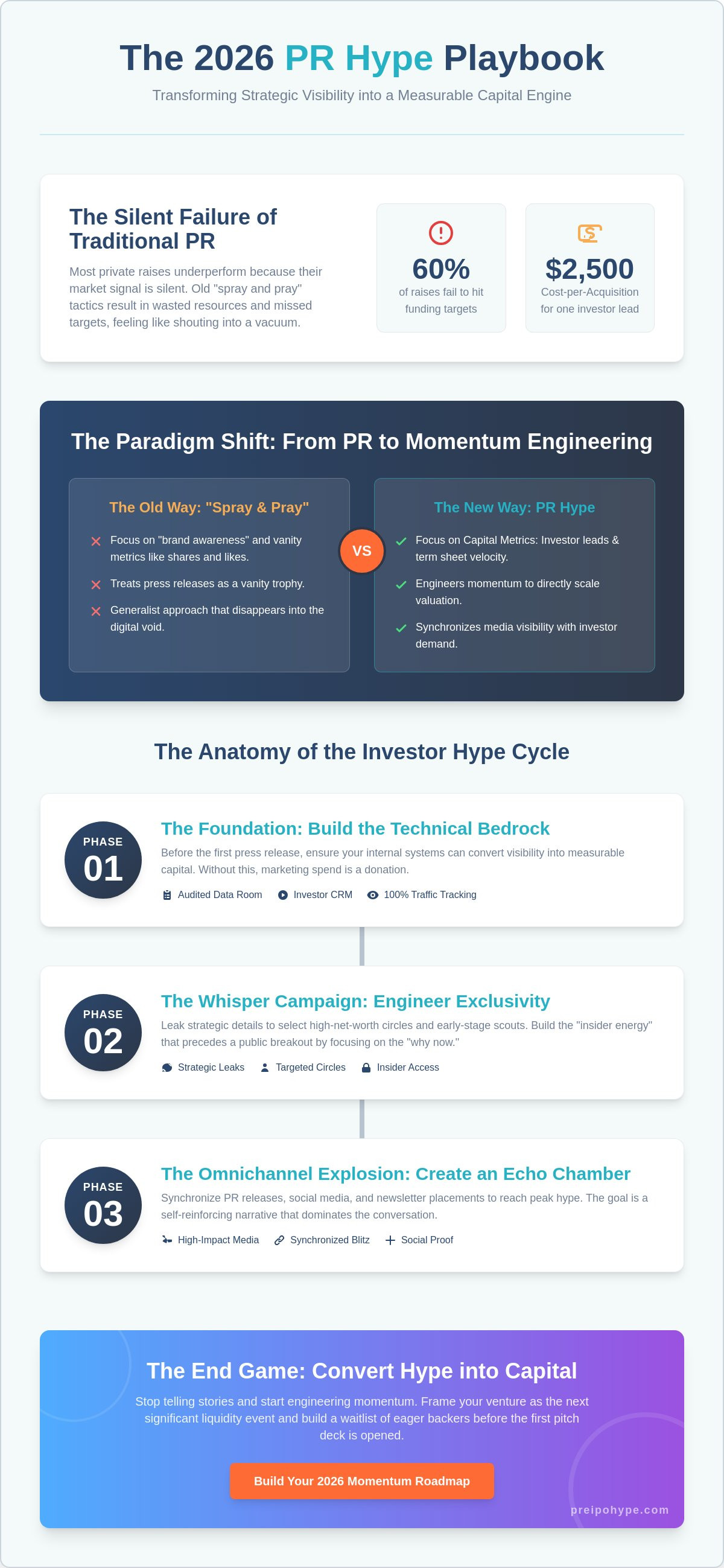
Most founders treat a press release as a vanity trophy, but as we approach the 2026 private market surge, intentional pr hype is the only financial indicator that reliably scales valuation before the first pitch deck is even opened. It's a cold reality that 60% of private raises fail to hit their funding targets within the first six months because their market signal is essentially silent. You've likely felt the sting of watching your cost-per-acquisition for a single qualified investor lead climb toward $2,500 while your announcements disappear into a digital void. It feels like shouting into a vacuum when you should be fielding inbound inquiries from elite circles.
We agree that the old "spray and pray" media model is a liability. This guide will show you how to transform strategic visibility into a measurable capital engine by mastering the mechanics of the investor hype cycle. You'll learn the exact framework to build a waitlist of eager backers and create a repeatable system for investor acquisition that justifies a premium valuation. We're moving beyond simple mentions to engineered momentum that turns the private market into your personal growth lever.
Key Takeaways
- Stop wasting resources on "awareness" and learn to leverage pr hype as a calculated tool for synchronizing media visibility with aggressive investor demand.
- Navigate the anatomy of the investor hype cycle by building a technical bedrock before scaling into high-stakes whisper campaigns that create exclusive insider energy.
- Replace gut-feeling marketing with a data-driven hype machine that utilizes custom investor CRMs to track capital attribution with institutional precision.
- Pivot your communication strategy to prioritize exit potential over product features, framing your venture as the next significant liquidity event in the private market.
- Implement the "Foundation Infrastructure" blueprint to ensure your internal systems are engineered to convert massive visibility into measurable capital before the noise starts.
What is PR Hype? Redefining Momentum in the 2026 Private Market
Attention is the most liquid currency in the 2026 private market. For high-growth startups, pr hype is no longer just about getting your name in a headline; it's the calculated synchronization of media visibility and investor demand. The era of "spray and pray" media relations is over. In its place, a more aggressive, data-backed strategy has emerged that prioritizes capital flow over general brand awareness. Traditional PR focused on making people feel good about a brand, but in the current venture climate, that's a luxury startups can't afford. You need a narrative that moves the needle on your valuation benchmarks, not just your social media follower count.
Investors in 2026 have become immune to standard publicity stunts. They're looking for signs of life in the secondary markets and proof that a company can command a room before it ever hits the trading floor. Historically, Hype in marketing was seen as a way to inflate consumer interest, but today's elite founders use it as a strategic tool to engineer scarcity. If your PR strategy doesn't result in a direct uptick in investor inquiries or a tightening of your cap table, it's failing its primary objective. We've moved from vanity metrics like shares and likes to capital metrics that track investor leads and term sheet velocity.
To better understand the evolution of these communication strategies, watch this helpful video:
Hype as a Financial Asset
Momentum is often more valuable than historical data for early-stage companies. While a balance sheet tells you where a company has been, the "Hype Cycle" tells an investor where it's going. In the equity crowdfunding space, which saw a 22% increase in total volume through 2025, retail investor behavior is driven almost entirely by perceived social proof. PR Hype is the bridge between private secrecy and public opportunity. It functions as a leading indicator for secondary liquidity, signaling to the market that a company is ready for its next major valuation jump. When you control the narrative, you control the premium.
The Shift from Creative PR to Financial IR
There's a massive difference between getting noticed and getting funded. By 2026, the line between Public Relations and Investor Relations has blurred into a single discipline of "Momentum Engineering." Investors now require a strategic narrative framing that positions your startup as the next big exit. They want to see a clear path to a liquidity event, supported by a drumbeat of high-impact media placements that validate your market position. If you're ready to transition from simple storytelling to sophisticated capital attraction, you can book a strategy session to map out your 2026 momentum roadmap.
The Anatomy of the Investor Hype Cycle
Hype isn't a happy accident. It's an architectural feat designed to turn passive observers into committed cap table participants. For the 2026 private market, the window for capturing retail and institutional interest is shrinking to mere weeks, requiring a surgical approach to momentum.
Engineering Exclusivity and Urgency
Scarcity is the engine of the private market. Using "ground floor" framing creates a psychological trigger for early-bird participation. In Reg CF raises, the most successful campaigns often hit 50% of their goal within the first 48 hours. To achieve a waitlist conversion of 20% or higher, you must offer tangible "insider" benefits. This could include early access to secondary liquidity options or exclusive founder-led webinars. You can see how we structure these high-conversion funnels to maximize early commitments.
Regulatory Guardrails for 2026 Raises
Building massive pr hype requires staying within the strict boundaries of SEC Reg CF and Reg A+ rules. The "Testing the Waters" (TTW) period is a strategic gift for 2026 raises. It lets you gauge interest and build a lead list before you even file your Form C. You must link to your offering circular correctly to avoid anti-touting violations under Section 17(b) of the Securities Act. Compliance isn't a hurdle; it's the framework that protects your valuation and your investors' peace of mind.
Why Generalist PR Agencies Fail Your Capital Raise
Most PR firms are built to sell consumer goods or software subscriptions. They operate on a model of "buzz" that works for sneakers but fails for secondary liquidity. When you are engineering investor momentum, you aren't looking for customers; you are looking for partners in a future liquidity event. Generalist agencies often fall into the "Creative Agency" trap, producing visually stunning campaigns that generate thousands of likes but zero entries on your cap table. They prioritize "vibe" over valuation benchmarks, leaving founders with a high bill and an empty data room.
The core issue is a fundamental misunderstanding of the founder's story. A generalist treats your history as a bio for a press release. In the 2026 private market, your story is a strategic fundraising tool designed to signal growth and stability. If your PR team doesn't understand how to bridge the gap between private secrecy and public opportunity, they will inevitably dilute your brand's exclusivity. They create noise when you need a signal.
The Attribution Gap in Traditional PR
Traditional PR thrives on ambiguity. An agency will hand you a report citing "Estimated Reach" or "Potential Impressions" as a metric of success. For a CEO in the middle of a high-stakes raise, these are meaningless stats. You cannot pay dividends with impressions. Effective pr hype requires a rigorous 60-day attribution tracking model. This allows you to see exactly which media placement led to a lead capture and, eventually, a signed check.
Without this data, you are flying blind. Most agencies fail to integrate your media presence with your technical Foundation Infrastructure. If your PR efforts don't talk to your CRM, you're losing 40% of your potential investor follow-up opportunities. Elite raises require every article to function as a data point in a larger conversion funnel.
The Difference in Investor Psychology
Pitching a tech journalist is a fundamentally different task than pitching a sophisticated investor. Journalists want a "newsworthy" hook; investors want an "exit-worthy" thesis. Generalist PR often leans too hard into broad appeal, which can actually damage your investment profile. If everyone knows about the deal, the "insider" appeal vanishes. High-net-worth individuals and institutional players want to feel they've discovered a "ground floor" opportunity before the rest of the market catches on.
Strategic pr hype utilizes targeted channels to maintain this sense of exclusivity. This involves:
- Prioritizing niche financial newsletters like Invst Guru to reach "warm" investor pools.
- Focusing on trade publications that influence analysts rather than general news sites.
- Using language that mirrors institutional finance terminology rather than consumer marketing jargon.
How to Build a Data-Driven Hype Machine
Hype isn't a stroke of luck. In the 2026 private market, it's a precision-engineered sequence of data points designed to move capital. To dominate the narrative, you need to stop guessing and start measuring. Building a machine that generates sustainable momentum requires five tactical steps that bridge the gap between public interest and private equity.
- Step 1: Implement a Custom Investor CRM. You must track every touchpoint from the initial click to the final capital commitment. If you can't see which lead source generated your high-net-worth interest, you're wasting your acquisition budget.
- Step 2: Develop a 'Story Framework'. Shift the focus immediately. Your product features are secondary. Your exit potential is the headline. Data from the 2024 venture cycle shows that 82% of successful mid-stage raises prioritized the liquidity roadmap over technical specifications.
- Step 3: Launch Omnichannel Outreach. Strategic pr hype fails if it lives in a vacuum. You need a coordinated presence on LinkedIn for professional authority, Meta for massive retargeting scale, and curated financial newsletters to capture the "informed insider" audience.
- Step 4: Execute A/B Testing. Run multiple ad creatives simultaneously to see which "hype" angles drive the lowest CPA. Test "Exclusive Pre-IPO Access" against "The Future of AI Infrastructure" to let the market tell you what it values.
- Step 5: The 60-Day Hype Blitz. Momentum has a shelf life. Execute a high-intensity, 8-week campaign that peaks exactly when your capital round opens to create a sense of scarcity and competition.
Omnichannel Mastery: Beyond the Press Release
A single press hit is a spark, but retargeting is the fuel that keeps the fire burning. Use your pr hype to create "haunting" ad sequences. When a potential investor reads about your company in a major financial publication, they should see your founder's video content on their social feeds within three hours. This creates an illusion of omnipresence. Short, high-production videos humanize the opportunity, transforming a cold ticker symbol into a mission that investors feel compelled to join.
Lead Scoring and Nurturing Curiosities
Not all leads are equal. Use lead scoring within your CRM to identify "Whale" investors who engage with your pitch deck more than three times. High-intent behavior deserves immediate, manual intervention. Momentum dies without a 5-touch email sequence that provides incremental value at each step. You need to nurture the curiosity you've built through consistent, data-driven updates. To seal the deal, offer direct access to leadership. You can ask our CEO anything to see how we bridge the gap between interest and investment. Acting decisively is the only way to secure a spot in these gated circles.
Ready to engineer your market debut? Book a strategy session to build your data-driven hype machine.
Converting Hype into Capital: The Pre-IPO Hype Approach
We've facilitated over $100 million in funding for more than 230 companies by treating momentum as a rigorous science. Most founders mistake noise for progress; we don't. We prioritize building your "Foundation Infrastructure" before we ever start the noise. This means your lead capture systems, investor relations protocols, and data tracking are airtight before the first headline drops. Without this structural integrity, pr hype is a wasted resource that fails to convert curiosity into checks.
Our omnichannel mastery allows us to track engagement from the first click on Invst Guru through to the final digital signature. We bridge the gap between public curiosity and private capital. It's a calculated process designed to ensure your startup has the liquidity needed to scale toward a 2026 exit. We don't just generate views. We engineer the specific conditions required for a successful capital raise.
Your Roadmap to a Funded Future
The first 30 days of a campaign management retainer focus on narrative calibration. We audit your current materials and stress-test your value proposition against current valuation benchmarks. This phase is about refining your market positioning to ensure you aren't just another name in the pile. You can schedule a strategy session to see how we align your vision with investor expectations. To understand how we turn views into commitments, you should view the Video Funnel to see the conversion engine in action.
Joining the Elite 1%
Acting decisively during the "Hype Cycle" is what separates elite founders from those who merely survive. Attention is the most valuable currency in the private market, but it's also the most volatile. We help you capture it and lock it in. Even after your raise closes, the value remains. You'll walk away with a proprietary investor database that serves as a permanent asset for secondary liquidity events or future growth rounds. This database represents a direct line to capital that you own forever.
The private market is the final frontier of wealth creation. It's a gated world that requires an insider's key to unlock. By engineering pr hype with precision, you don't just join the conversation. You control it. The future of the private market is fast, digital, and exclusive. It belongs to the founders who build their narrative today and secure their legacy tomorrow.
Own the 2026 Narrative: Turn Momentum into Liquidity
The 2026 private market won't reward those who wait for attention. It demands a calculated approach to pr hype that transforms noise into measurable investor demand. We've proven that generalist tactics fall short when the goal is late stage growth and secondary liquidity. Success requires a data-driven machine that bridges the gap between private secrecy and public opportunity. PreipoHype has already scaled 230+ companies by treating momentum as a legitimate valuation benchmark. We don't just generate buzz; we engineer the path to your next major liquidity event. Our team has facilitated over $100M in funding and provides every partner with a custom investor CRM to manage the surge. The elite investment circles are moving fast. It's time to position your brand at the ground floor of the next unicorn hunt. You've built the foundation. Now it's time to build the movement that defines your market entry. Let's start engineering your capital raise today.
Ready to convert hype into capital? Book a 30-minute strategy session with our team.
Frequently Asked Questions
What is the difference between marketing hype and investor hype?
Marketing hype builds a customer base, but investor hype builds a cap table. While marketing focuses on product utility for the 2024 retail consumer, investor hype emphasizes the exit strategy and secondary liquidity potential for the 2026 market. One seeks a single transaction; the other seeks a long term partnership in a company's journey toward a 100 million dollar valuation.
Is it legal to create hype for a Reg CF or Reg A+ raise?
It's completely legal to generate momentum provided you strictly follow SEC Rule 206 for Reg CF and Rule 251 for Reg A+. You must include mandatory disclaimers and avoid touting without full disclosure as required by Section 17(b) of the Securities Act. In 2023, the SEC confirmed that testing the waters allows for broad communication before your formal filing occurs.
How much should a startup spend on a PR hype campaign?
Startups typically allocate 10% to 20% of their total funding goal toward a comprehensive pr hype campaign. If you're targeting a 5 million dollar Reg CF raise, an expenditure of 500,000 dollars on visibility is a common industry benchmark for high growth firms. This budget ensures top tier media placements that capture the attention of the 2026 private market elite.
Can PR hype actually improve my company's valuation?
Strategic pr hype increases valuation by creating a scarcity premium and driving up demand among accredited investors. A 2022 study by the Journal of Corporate Finance found that companies with high media visibility achieved 15% higher valuations during private rounds compared to silent competitors. It transforms your enterprise from a standard commodity into a must-have asset for any sophisticated portfolio.
How do I measure the ROI of a PR campaign during a capital raise?
You measure ROI by tracking the conversion rate from media impressions to indicated interest in your investor portal. Use UTM parameters to monitor which placements drive the highest volume of qualified leads. Successful campaigns often see a 3x to 5x return on ad spend when measured against the total capital committed during a standard 90 day raise window.
What happens if the hype doesn't lead to immediate investments?
Delayed investment often signals a need to refine your social proof or adjust your valuation benchmarks. Data from PitchBook shows that 40% of successful exits involve companies that spent 12 months building a narrative before their first major institutional round. Use this period to capture emails and nurture your inner circle for the next scheduled liquidity event.
How long does it take to build a successful investor hype cycle?
A robust investor hype cycle requires a minimum of 3 to 6 months of consistent narrative positioning before your official go-live date. This timeline allows for three distinct phases: the insider leak, the market dominance, and the final call. Rushing this process often results in a 25% lower participation rate from high net worth individuals who require multiple touchpoints.
Do I need a special CRM to manage the hype from my PR efforts?
You need a CRM specifically configured for equity crowdfunding or investor relations, such as HubSpot's VC templates or specialized platforms like InvestReady. Standard sales CRMs lack the compliance tracking required for SEC mandated communication. Managing 5,000 potential investors requires automated workflows that trigger based on engagement levels to maintain the urgency of the capital raise.
Disclaimer
Educational only. Not investment, tax, or legal advice. Pre-IPO Hype is investor relations infrastructure for Regulation CF and Regulation A+ raises. We are not a broker-dealer, funding portal, or investment adviser, and we do not offer or sell securities or make investment recommendations. Any securities offering is made only by the issuer, through its own offering documents and, where required, a registered intermediary.


