
Pre-IPO Crowdfunding Explained: A Strategy for Growth
What if the most powerful tool in your IPO arsenal isn't a bulge-bracket bank, but a digital movement of thousands of motivated investors? Many founders view Reg CF and Reg A+ as regulatory gauntlets filled with fragmented cap tables and high acquisition costs. It's a common frustration; you want the capital but don't want the administrative nightmare or the inefficient investor tracking that often follows. However, when you see 6. pre-IPO crowdfunding explained as a strategic marketing event, it becomes a vehicle to force institutional momentum and build a firm valuation floor.
You already know that a successful public debut requires more than just a solid balance sheet; it requires a fanatical base of supporters. This article promises to help you master the mechanics of crowdfunding to build market momentum, secure institutional-grade data, and bridge the gap to a public listing. We will preview the latest 2026 regulatory limits, including the $75 million cap for Reg A+ Tier 2 offerings, and show you how to use modern infrastructure to maintain a clean, data-backed investor list. Get ready to turn your next raise into a high-stakes realization event that captures the market's attention.
Key Takeaways
- Discover how the democratization of private markets has shifted the IPO window earlier, allowing retail participants to enter elite investment circles before the bell.
- Navigate the 2026 regulatory landscape to leverage Reg CF for rapid $5 million rounds or Reg A+ for expansive $75 million raises.
- Learn how to weaponize retail interest to create a "Moat of Advocates," turning thousands of investors into a 24/7 marketing force that validates your valuation to underwriters.
- Identify the critical components of a high-performance tech stack, ensuring your 6. pre-IPO crowdfunding explained strategy captures institutional-grade data and attribution metrics.
- Master the transition from private fundraising to public listing by managing the first 100 days of being "pre-public" with a clean, institutional-ready cap table.
What is Pre-IPO Crowdfunding? Opening the Gated World of Private Equity
Pre-IPO crowdfunding is a late-stage private funding round that utilizes equity crowdfunding regulations to raise capital from both accredited and retail investors. It isn't just about the money; it's about the narrative. When you have 6. pre-IPO crowdfunding explained as a tool for growth, it becomes clear that this is a strategic maneuver to build a valuation floor. By 2026, the democratization of private markets has moved the "IPO window" earlier for retail participants, allowing them to capture growth once reserved for elite venture capital firms. For a comprehensive Equity crowdfunding overview, one can see how the JOBS Act fundamentally changed the capital formation landscape.
To better understand how this market evolved, watch this helpful video:
Unlike early-stage seed rounds that focus on product-market fit, pre-IPO rounds are about scaling and valuation validation. Founders use this stage to secure institutional-grade data, transforming a fragmented list of names into a clean, actionable asset. This is where 6. pre-IPO crowdfunding explained reveals its true power: it bridges the gap between a private company and a public exchange by proving secondary market demand long before the first trade on the NASDAQ or NYSE. It's the difference between hoping for a successful debut and engineering one through data-driven momentum.
The Pre-IPO Timeline: When to Launch
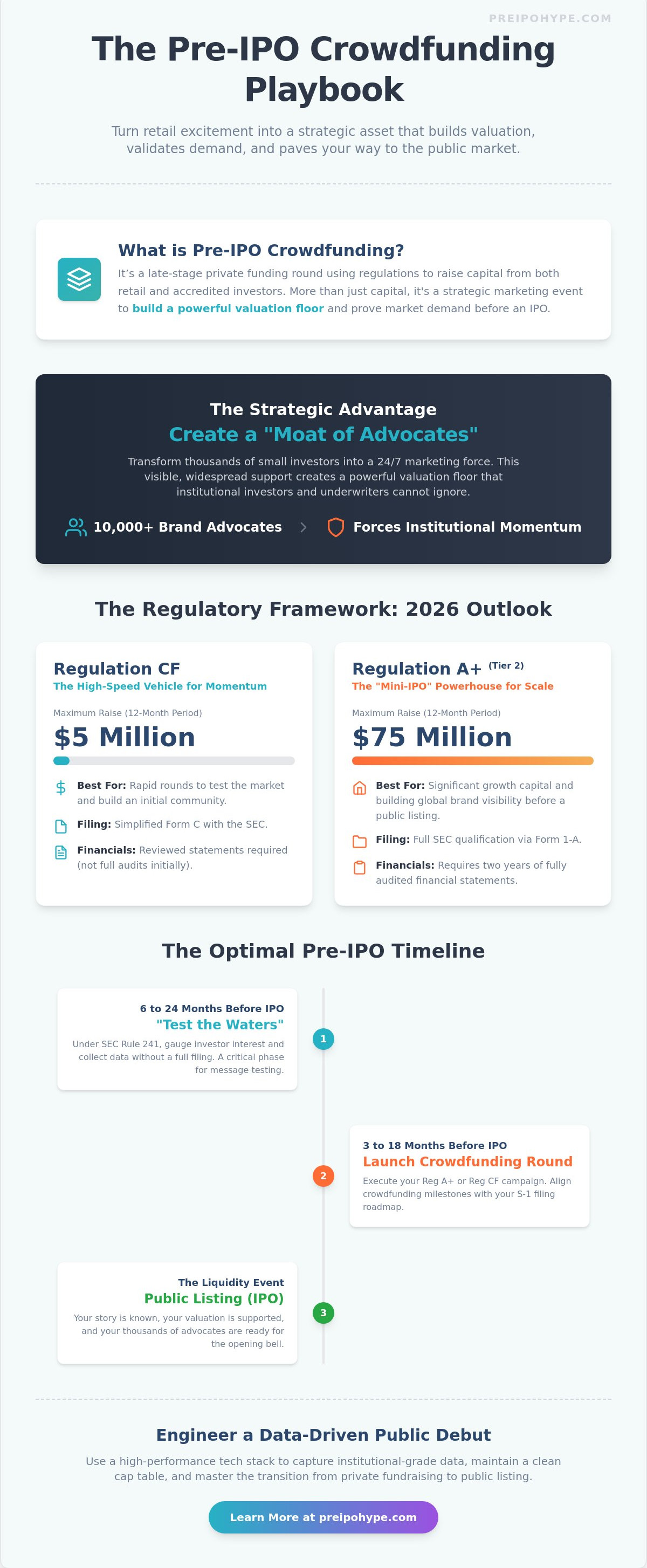
The optimal window usually opens 6 to 24 months before a planned liquidity event. Many companies use this time to "test the waters" under SEC Rule 241, gauging investor interest without a full filing. This phase allows you to align your crowdfunding milestones with your S-1 filing roadmap. It ensures that by the time you reach the public markets, your story is already well-known and vetted by thousands of participants. This isn't just a raise; it's a dress rehearsal for the public stage that builds the necessary infrastructure for life as a public entity.
Retail vs. Institutional Synergy
A crowd of 10,000 brand advocates creates a powerful valuation floor that institutional investors can't ignore. When a raise is visibly oversubscribed, it exerts psychological pressure on Tier-1 venture capital and investment banks. They see a company that doesn't just have a product, but a movement. This retail momentum often forces institutional hands, leading to more favorable terms for the founder during the final private rounds. It proves that the demand is real, measurable, and ready to follow the company into the secondary market, making the eventual IPO a realization event rather than a risk.
The Regulatory Framework: Reg CF vs. Reg A+ in 2026
Choosing the right legal vehicle for your raise is a high-stakes decision that dictates your speed to market. Regulation Crowdfunding (Reg CF) serves as a high-speed vehicle for companies looking to raise up to $5 million in a rolling 12-month period. It's efficient, requires a Form C filing, and allows for a rapid launch. However, for companies eyeing a massive public debut, Regulation A+ is the undisputed powerhouse. Often called a "Mini-IPO," Reg A+ Tier 2 allows you to raise up to $75 million while bypassing the cumbersome "Blue Sky" registration requirements in individual states. Having 6. pre-IPO crowdfunding explained through this regulatory lens shows that while Reg CF is for momentum, Reg A+ is for scale.
The distinction between these two paths often comes down to the depth of disclosure and the cost of entry. Reg CF typically requires reviewed financial statements once you cross certain thresholds, but Reg A+ demands full SEC-qualified audits. While the upfront costs for Reg A+ are higher, the payoff is unparalleled visibility and the ability to market your offering to a global audience of both accredited and retail investors. This is why late-stage founders are increasingly opting for the $75 million cap of Reg A+; it provides the capital necessary to fuel a global expansion while acting as a rigorous dress rehearsal for a future S-1 filing. You can verify the latest technical requirements via the SEC Regulation Crowdfunding rules to ensure your team is aligned with current 2026 standards.
SEC Compliance for High-Growth Rounds
Compliance at this level isn't just about avoiding fines; it's about building institutional trust. Filing a Form 1-A for a Reg A+ round requires a level of transparency that mirrors a traditional IPO. This includes ongoing reporting requirements, such as annual and semiannual reports, which prepare your internal team for the cadence of public life. Successfully managing these filings proves to future underwriters that your organization is mature enough for a secondary market listing. If you are unsure about which path fits your timeline, discussing your regulatory roadmap with an expert can save months of wasted effort.
Investor Eligibility and Limits
The magic of 6. pre-IPO crowdfunding explained lies in its ability to mix accredited sophistication with retail energy. In 2026, non-accredited investors are generally limited to investing 10% of the greater of their annual income or net worth in Reg A+ Tier 2 offerings. Managing thousands of these participants without cluttering your cap table requires sophisticated Foundation Infrastructure. This technology automates the verification process and ensures that every "informed investor" meets the 2026 suitability standards. By automating compliance, you protect the integrity of your cap table while maximizing your reach across the broadest possible investor pool.
The Strategic Advantage: Why Elite Founders Crowdfund Before the Bell
Elite founders don't crowdfund because they lack options; they do it to weaponize their community. While some analysts mistakenly see this as a simple exit strategy, the reality is far more sophisticated. By turning 10,000 retail investors into a "Moat of Advocates," you create a 24/7 marketing force that lives and breathes your success. This massive grassroots support is a critical component of 6. pre-IPO crowdfunding explained, as it provides undeniable proof of secondary market demand to future underwriters. The rise of equity crowdfunding has transformed the landscape, making these rounds a prerequisite for companies looking to dictate their own terms on Wall Street rather than being at the mercy of institutional gatekeepers.
Ownership of investor data is the ultimate currency in a high-stakes raise. By utilizing a Custom Investor CRM, you move beyond generic tracking to true data mastery. This allows you to reduce the "IPO pop," a phenomenon where underwriters intentionally underprice your stock to provide a quick win for their institutional clients at your expense. When you can prove exactly who your buyers are and what they are willing to pay, you gain the leverage to price your offering fairly. This strategic use of data ensures long-term price stability by building a base of long-term holders who are emotionally and financially invested in your brand's future. Viewing 6. pre-IPO crowdfunding explained as a data-gathering mission gives you the upper hand in every negotiation.
Engineering the Hype Cycle
Success requires more than a simple listing; it requires "Omnichannel Mastery." This involves a calculated blitz across LinkedIn and Facebook, paired with high-impact Newsletter Exposure to reach seasoned capital. We use lead scoring to filter the noise, identifying high-net-worth participants within the retail crowd who have the potential to become institutional-grade anchors. This creates a sense of exclusivity and urgency, framing the opportunity as an "early entry" narrative. It's about moving the narrative from "participation" to "joining a movement" that traditional venture capital can no longer gatekeep.
Protecting the Cap Table
One major concern for late-stage founders is the administrative burden of managing thousands of small shareholders. Modern platforms solve this through Special Purpose Vehicles (SPVs), which aggregate the crowd into a single line item on your cap table. This keeps your structure clean for an IPO while the platform handles the thousands of K-1s or 1099s automatically without founder intervention. Our team understands What We Do to streamline these complex raises, ensuring your focus remains on growth rather than logistics. This robust infrastructure is the bedrock of a successful pre-public transition, keeping your cap table institutional-grade while still capturing the power of the crowd.
Engineering Momentum: The Tech Stack Required for a Pre-IPO Raise
Generic CRMs are built for standard sales cycles, not the high-velocity intensity of a capital raise. In a pre-IPO environment, you need to track every dollar from "curiosity to capital" within a precise 60-day attribution window. This technical granularity is how 6. pre-IPO crowdfunding explained moves from a theoretical strategy to a high-yield execution. By integrating your raise with leading compliance-first funding portals and institutional-grade transfer agents, you ensure that no potential investor is lost in the transition from initial discovery to final commitment. It's about building a digital paper trail that proves market demand to future auditors.
The real magic happens when you use lead scoring to identify the participants who have the capacity to become $50,000 anchors. You aren't just collecting $500 checks; you're identifying high-net-worth individuals within the crowd who can fuel your growth. Automated follow-ups based on behavioral data ensure your message stays in front of the right eyes at the right time. This level of automation allows a lean team to manage thousands of relationships without sacrificing the personal touch required for institutional-grade fundraising. If your current tools can't distinguish between a casual browser and a motivated whale, your raise is leaking capital.
The Custom Investor CRM Advantage
Real-time engagement tracking allows you to see exactly who watched your pitch video multiple times in a single afternoon. This isn't just data; it's high-intent behavior that requires immediate action. By segmenting institutional leads from retail fans, you can deliver personalized outreach that resonates with each group's specific risk profile and investment goals. A custom CRM serves as the central nervous system of a Reg CF marketing campaign, synchronizing every touchpoint in the investor journey. This ensures that your narrative remains consistent across every channel, from the first ad to the final signature.
Omnichannel Outreach Automation
Maintaining top-of-mind awareness requires a seamless blend of email, SMS, and social retargeting. This omnichannel approach ensures a frictionless "Click-to-Invest" experience, removing any barriers between an investor's interest and their capital commitment. Leveraging Newsletter Outreach through the "Invst Guru" network provides instant credibility, placing your offering alongside established market leaders. It creates a steady pulse of opportunity that feels urgent but controlled, mirroring the rapid movement of high-growth markets. Ready to build your technical bedrock? Schedule a tech stack consultation to audit your fundraising infrastructure and prepare for your next milestone.
Navigating the Liquidity Event: From Crowdfunding to the Exchange
The IPO isn't just an exit; it's a beginning. Your crowdfunding round has already pre-sold your story to the market long before the listing date. When you have 6. pre-IPO crowdfunding explained as a strategic asset, you realize your retail base isn't just a list of names. They are your day-one liquidity providers. Transitioning these participants into public shareholders requires a delicate hand and a clear communication strategy. You're moving from a private community to a regulated exchange environment where every statement carries institutional weight.
Data mastery pays dividends during the roadshow. The insights gathered from your Investor Acquisition Platform allow you to present a data-backed narrative to institutional underwriters. You can prove exactly where your demand lives, how much they're willing to pay, and how loyal they've remained through the pre-public phase. This isn't just an IPO pitch deck; it's a validation of your entire growth strategy. It shows that you've already won the battle for market attention before the bell even rings. By closing the loop on your crowdfunding success, you dictate the terms of your public debut.
Final Preparation Checklist
The first 100 days of being "pre-public" are about rigorous discipline. Your crowdfunding financials must be ready for PCAOB standards to ensure a smooth audit process when the S-1 filing begins. You'll also need to transition your governance, moving to a board structure that satisfies exchange requirements and institutional expectations. This shift from a founder-centric approach to one of public accountability is the final hurdle. If you're feeling the pressure of this transition, you can Ask the CEO for strategic guidance on bridging the gap between private raises and public listings.
Your Next Step in the Hype Cycle
The most successful IPOs of 2026 won't be the ones with the biggest banks, but the ones that owned their crowd. Having 6. pre-IPO crowdfunding explained to your internal team as a momentum-builder ensures you don't just go public; you go public with a roar. Our Pre-IPO Hype promise is simple: we help you convert market curiosity into permanent capital. Don't leave your debut to chance or the whims of a volatile market. Book a strategy session today to engineer your raise and secure your place in the elite circles of the public market.
The Blueprint for Your Public Market Debut
We have explored how 6. pre-IPO crowdfunding explained serves as the ultimate engine for valuation validation and institutional momentum. By selecting the right regulatory vehicle and arming your team with a high-performance tech stack, you transform a simple funding round into a market-defining movement. Success in 2026 belongs to the founders who own their investor data and use it to bridge the gap between private growth and public secondary markets. This is your opportunity to dictate the terms of your listing rather than following the traditional, gated path.
Our team has facilitated over $100 million in funding and scaled more than 230 companies by deploying proprietary Custom Investor CRM technology. We don't just help you raise capital; we help you build the infrastructure required for long-term stability on the exchange. The window of opportunity is open for those ready to act with precision and ambition. It's time to turn your growth story into a permanent capital asset.
Ready to engineer your pre-IPO hype? Book a 30-minute strategy session now.
Your path to the public markets starts with a single, decisive move. Let's build your legacy together and capture the momentum your company deserves.
Frequently Asked Questions
What is the difference between pre-IPO crowdfunding and a traditional IPO?
Pre-IPO crowdfunding is a private capital raise conducted while a company is still off the public exchanges, utilizing exemptions like Reg CF or Reg A+. A traditional IPO is the formal process of registering securities with the SEC via an S-1 filing to list on a major exchange like the NASDAQ. Crowdfunding acts as a strategic bridge, allowing founders to validate their valuation and build a moat of advocates before the final listing.
Can non-accredited investors participate in pre-IPO crowdfunding rounds?
Yes, both Regulation Crowdfunding and Regulation A+ Tier 2 allow non-accredited investors to participate in these exclusive rounds. This inclusivity is a cornerstone of 6. pre-IPO crowdfunding explained, as it democratizes access to high-growth opportunities once reserved for elite venture capital. Limits apply based on an investor's annual income or net worth to ensure regulatory compliance while maximizing the reach of your raise.
How much can a company raise through pre-IPO crowdfunding in 2026?
In 2026, companies can raise a maximum of $5 million per year through Regulation Crowdfunding (Reg CF). For those requiring more significant scale, Regulation A+ Tier 2 allows for raises up to $75 million within a 12-month period. These limits provide late-stage companies with the necessary runway to fuel global expansion and prepare for a full public debut on a secondary market.
Does crowdfunding a pre-IPO round hurt my chances with venture capitalists?
Crowdfunding often strengthens your position with venture capitalists by providing undeniable proof of market demand. When a founder shows a cap table backed by thousands of motivated investors and institutional-grade data, it reduces the perceived risk for Tier-1 firms. It proves that the brand has a fanatical base ready to support the stock once it hits the public exchange.
How do I manage thousands of investors on my cap table?
You manage large investor bases efficiently by using Special Purpose Vehicles (SPVs) and modern Foundation Infrastructure. These tools consolidate thousands of retail participants into a single line item on your cap table, keeping your corporate structure clean for future underwriters. This technology automates the administrative burden, handling everything from investor communications to the distribution of tax documents without founder intervention.
What are the typical costs associated with a Reg A+ pre-IPO raise?
Typical costs involve legal fees for the Form 1-A filing, PCAOB-compliant audits, and digital marketing expenses to drive investor acquisition. While the upfront investment is higher than a seed-stage raise, the ability to secure $75 million makes it a cost-effective alternative to traditional investment banking fees. The total spend depends on the complexity of your audit history and the intensity of your omnichannel outreach.
How long does a pre-IPO crowdfunding campaign typically last?
The active portion of a campaign usually lasts between 60 and 120 days, though the preparation phase is equally critical. You must factor in the time required for SEC qualification in a Reg A+ round, which often takes several months of back-and-forth reviews. The most successful raises use this lead time to engineer a hype cycle, ensuring the round is oversubscribed shortly after launch.
What happens to my crowdfunding shares when the company goes public?
Crowdfunding shares generally convert into the same class of common stock that is listed on the public exchange during the IPO. This realization event provides your early supporters with the liquidity they need while turning them into long-term public shareholders. Clear communication during this transition is vital to ensure your base remains a stabilizing force for the stock price during the first 100 days of trading.
Disclaimer
Educational only. Not investment, tax, or legal advice. Pre-IPO Hype is investor relations infrastructure for Regulation CF and Regulation A+ raises. We are not a broker-dealer, funding portal, or investment adviser, and we do not offer or sell securities or make investment recommendations. Any securities offering is made only by the issuer, through its own offering documents and, where required, a registered intermediary.


