
Pros and Cons of Equity Crowdfunding: The Founder’s Strategic Playbook for 2026
Why settle for a handful of venture capital gatekeepers when you can turn your customer base into a $75 million war chest? Most founders treat public raises as a last resort, but the elite are using them as high-velocity marketing events that convert curiosity into aggressive capital. You likely worry about the administrative weight of thousands of retail investors or the exposure of your financial data. It's a logical fear in a market where a 30% abandonment rate for Regulation A+ offerings is the standard for the unprepared.
This playbook dissects the pros and cons of equity crowdfunding to help you determine if this digital capital engine is your startup's fastest path to market dominance. You'll learn how to execute a raise with institutional-grade precision while building a loyal brand army that fuels your growth long after the round closes. We will explore the technical infrastructure, from custom investor CRMs to omnichannel outreach, that transforms a messy cap table into a strategic advantage for your 2026 roadmap.
Key Takeaways
- Transition from traditional funding to high-velocity SEC-regulated vehicles that leverage retail capital for institutional-grade growth.
- Evaluate the pros and cons of equity crowdfunding by balancing the strategic benefit of a loyal brand army against the rigorous transparency of public financial disclosures.
- Select the optimal capital architecture for your raise by comparing the $5M Reg CF limit with the $75M Reg A+ "mini-IPO" framework.
- Learn to treat your raise as a high-stakes marketing event, utilizing foundation infrastructure and data tracking to convert digital interest into hard capital.
- Execute a 60-day foundation strategy to build pre-launch momentum and ensure your campaign enters the market with elite-level velocity.
The Evolution of Equity Crowdfunding: Elite Access for the Modern Founder
The old guard of finance is crumbling. What was once a "charity-style" digital tip jar has evolved into a high-stakes engine for capital formation. Modern founders don't look at public raises as a fallback for failed VC pitches; they see them as a way to engineer market momentum. This Equity crowdfunding overview highlights how the sector has matured into a sophisticated intersection of retail capital and institutional-grade marketing. It's about democratizing access to private markets while maintaining the surgical precision of a Wall Street roadshow.
To better understand how this mechanism operates in the current market, watch this helpful video:
Success in 2026 isn't just about having a great product. It's about velocity. By weighing the pros and cons of equity crowdfunding, founders can decide if they want to trade a board seat for a community of thousands. The shift toward SEC-regulated vehicles means that retail participation is no longer noise. It's fuel. The democratization of these markets offers a rare window where founders can access millions while investors gain entry into previously gated opportunities.
The Regulatory Landscape: Reg CF and Reg A+ in 2026
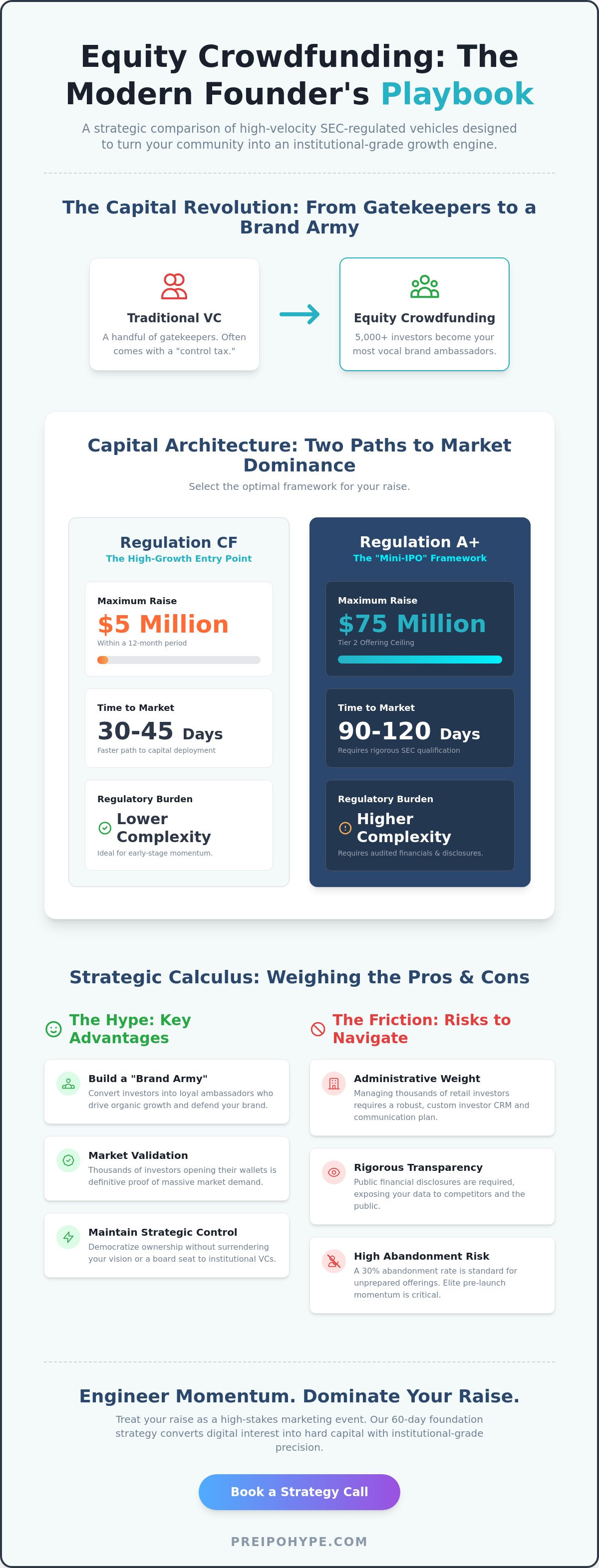
The 2026 regulatory environment offers two distinct paths for the ambitious founder. Regulation Crowdfunding (Reg CF) serves as the high-growth entry point, allowing companies to raise up to $5 million within a 12-month period. For those ready for a "mini-IPO," Regulation A+ Tier 2 provides a massive $75 million ceiling. These aren't just numbers. They represent a fundamental shift in SEC focus toward strengthening capital formation. While a Reg CF offering can get you to market in 30 to 45 days, the $75 million Reg A+ path requires more rigorous qualification, often taking 90 to 120 days for SEC approval.
Why Traditional VC is No Longer the Only 'Elite' Path
Venture capital often comes with a "control tax" that many founders are no longer willing to pay. Choosing a public raise allows you to maintain strategic control while building a brand army. Imagine having 5,000 investors who are also your most vocal brand ambassadors. This community resonance often outperforms the influence of a single institutional board member. When you analyze the pros and cons of equity crowdfunding, the ability to democratize ownership without surrendering your vision is the ultimate competitive advantage. It turns a transaction into a movement, ensuring your cap table is filled with people who actually use your product and advocate for your success.
The Pros: Why High-Growth Companies are Fueling the Crowdfunding Hype
Stop viewing digital raises as a secondary option for those who can't get venture capital attention. In the 2026 market, this is a strategic weapon for founders who demand both capital and community. When you weigh the pros and cons of equity crowdfunding, the most explosive advantage is the "Brand Army" effect. Imagine 5,000 investors who aren't just names on a cap table. They are 5,000 active brand ambassadors with literal skin in the game. They'll defend your brand in comment sections, buy your products first, and evangelize your mission to their personal networks. This isn't just capital; it's a high-velocity movement that institutional investors simply cannot provide.
Beyond the community, you're gaining real-time market validation. If thousands of retail investors are willing to open their wallets, you have definitive proof of massive market demand. This hype is essentially non-dilutive marketing. Every dollar you spend on your raise serves a dual purpose: it secures capital and builds massive brand awareness through omnichannel mastery. By coordinating social media, targeted email sequences, and your CRM, you create a pulse of opportunity that traditional funding rounds lack. You're not just asking for money; you're inviting the public to join an elite circle of early-stage growth.
Capital Plus Community: The Ultimate Growth Lever
A successful raise can significantly lower your customer acquisition costs (CAC) in the long term. Investors who own a piece of your company have a psychological incentive to see you succeed, turning them into lifelong customers. This "skin in the game" creates a feedback loop where capital fuels marketing, and marketing attracts more capital. To manage this influx, many founders rely on an Investor Acquisition Platform to act as the engine for this growth. It's about tracking every click from initial curiosity to the final investment, ensuring no momentum is wasted. If you want to see how your specific metrics align with this model, you can book a strategy session to map out your trajectory.
Valuation and Control: Keeping the Founder in the Driver's Seat
Crowdfunding often allows for more founder-friendly valuations than predatory venture capital rounds. Because you're appealing to a broad base of "passive" retail investors, you don't have to surrender a board seat or grant veto power over your strategic decisions. This Corporate Finance Institute's Guide to Equity Crowdfunding explains how these structures maintain your leadership while democratizing ownership. Using a valuation calculator helps you set the stage for a raise that reflects your company's true potential. You keep the wheel while your brand army provides the fuel, allowing you to scale with institutional-grade precision without the institutional-grade interference.
The Cons: Navigating the Friction of Public Capital Raises
Every elite opportunity carries a price. While the advantages are clear, the pros and cons of equity crowdfunding involve a significant "Transparency Tax" that many founders overlook. You aren't just raising capital; you're opening your books to the public, your competitors, and the SEC. This level of exposure demands a level of institutional-grade precision that most early-stage startups haven't yet mastered. If you don't have the stomach for public financial disclosures, the digital capital markets will feel like a spotlight you're not ready for.
The 2026 market is crowded. Success requires more than just a great pitch; it requires a dedicated advertising budget to cut through the noise. Many founders fall into the trap of believing that the platform will provide the audience. The reality is that a "build it and they will come" mentality leads directly to failure. Research shows a 30% abandonment rate for Regulation A+ offerings, often because the marketing engine stalled before reaching the finish line. A public lack of momentum isn't just a quiet failure. It's a visible mark that can damage your reputation with future institutional investors.
The Cost of Curiosity: Why 'Free' Crowdfunding Doesn't Exist
Capital formation has fixed costs that you must account for before launching. You'll face platform fees, which typically range from 5% to 8% of the total funds raised, alongside legal filings and accounting reviews. The real variable is your spend on Reg CF marketing services. In the architecture of a raise, your cost per lead represents the exact price of buying the attention required to convert a stranger into a shareholder. Under-investing here is the primary reason campaigns stagnate and die.
The Disclosure Dilemma: SEC Form C and Beyond
Filing SEC Form C is a non-negotiable requirement that puts your financials and business risks on public record. You must also commit to ongoing annual reporting, which keeps your performance under a permanent microscope. This exposure can feel like a vulnerability, especially when managing competitive intelligence risks. Elite founders solve this by framing their financial disclosures to showcase transparency and market confidence. If you want to see how to position your numbers for maximum impact, you can consult with an insider to refine your disclosure strategy before you go live.
Capital Architecture: Reg CF vs. Reg A+ Comparison
Choosing the right regulatory framework is the difference between a minor capital injection and a market-defining event. When evaluating the pros and cons of equity crowdfunding, you must match your capital needs with your operational speed. Regulation Crowdfunding (Reg CF) is the high-velocity option, allowing you to raise up to $5 million in a 12-month period. It's the entry point for startups that need to move fast, with a time to market typically ranging from 30 to 45 days. In contrast, Regulation A+ Tier 2 is the mini-IPO vehicle, offering a massive $75 million ceiling. While powerful, it demands more patience, often requiring 90 to 120 days for SEC qualification.
The investor profiles also differ significantly. Reg CF allows you to tap into the energy of everyone, but non-accredited investors face stricter limits based on their income or net worth. For instance, those earning less than $100,000 can only invest the greater of $2,000 or 5% of their annual income. Regulation A+ Tier 2 opens the doors wider, allowing non-accredited individuals to invest up to 10% of their annual income or net worth. However, this larger pool comes with a higher "entry fee" in the form of audited financials, which can impact your early-stage budget before you even launch.
Which Regulatory Vehicle Fits Your Momentum?
For early-stage tech companies, the Seed to Series A path often begins with Reg CF. It serves as a perfect bridge, providing the capital needed to scale while you build your community. If your goal is institutional-scale capital or an eventual national exchange listing, you'll eventually transition into the Reg A+ path. Regardless of the route, success depends on your foundation infrastructure. This technical bedrock ensures you can track every lead and manage your cap table with precision as you scale from $5 million to $75 million.
The 506(c) Hybrid Approach
Smart founders don't limit themselves to one pool of capital. You can run a parallel 506(c) raise specifically for accredited "whale" investors alongside your public campaign. This hybrid approach combines the infectious energy of the crowd with the heavy-hitting check sizes of institutional players. By managing these different legal requirements under one unified marketing strategy, you create a sense of exclusivity that drives both groups to act. You get the brand ambassadors from the crowd and the strategic stability from the whales, all while maintaining the momentum of a single, cohesive raise.
If you're ready to determine which architectural path will fuel your 2026 growth, consult with our CEO to map out your custom capital strategy.
Engineering Momentum: The Pre-IPO Hype Approach to Winning
Winning isn't accidental. It's manufactured. Most founders fail because they treat the launch as day one. In reality, your raise begins 60 days before the public ever sees your offering. This is the "Foundation" strategy. It's about building a reservoir of demand so that when you flip the switch, you hit the ground with elite velocity. Navigating the pros and cons of equity crowdfunding requires acknowledging that while the capital is democratized, the competition for it is fierce. You don't just need a platform; you need a machine.
You need a Custom Investor CRM to act as your central nervous system. This isn't just a list of names. It's a tracking engine that monitors every click from initial curiosity to the final investment. By synchronizing email, SMS, and retargeting, you create an "everywhere" presence that builds psychological familiarity. Precision matters. With advanced attribution tracking, you'll know exactly which marketing dollar resulted in which investment, allowing you to scale your winners and cut your losers in real-time.
Turning Investors into a Movement
Passive investors don't drive growth. Movements do. Using a high-stakes video funnel allows you to tell a story that resonates on both an emotional and financial level. We utilize "Hype Cycle" mechanics to build scarcity and urgency through data-driven outreach. Don't get distracted by vanity metrics. Tracking "Investor Intent", such as actions like downloading a pitch deck or viewing a term sheet, is infinitely more valuable than counting "Likes." It's the difference between a spectator and a shareholder.
Your Next Move: Decisive Action in the Private Markets
The window for elite capital raises in 2026 is open for those who act with surgical precision. Your roadmap must include a 60-day pre-launch phase to audit your current digital presence for "fundability." If your brand doesn't look institutional-grade, the crowd won't treat it as such. This is the final piece of the pros and cons of equity crowdfunding puzzle: the outcome is entirely dependent on the infrastructure you build before the first dollar is committed. You're either engineering your success or hoping for it. The market only rewards the former.
Ready to engineer your own momentum? Book a strategic consultation with Pre-IPO Hype to map your 2026 raise and secure your place in the next generation of market leaders.
Seize Your Strategic Advantage in 2026
The transition from a startup to a market leader requires more than just capital. It requires a movement. You've explored how the right regulatory architecture, from Reg CF to Reg A+, serves as a high-velocity engine for growth. By weighing the pros and cons of equity crowdfunding, you can move beyond the uncertainty of public disclosures and focus on the explosive potential of a loyal brand army. Success is no longer a guessing game; it's a technical execution of foundation infrastructure and data-driven momentum.
Since 2015, we've helped 230+ companies scale and facilitated over $100M in funding. Our Custom Investor CRM is designed to give you the 60-day attribution necessary to track every click from initial curiosity to hard capital. Don't leave your next raise to chance. Schedule your 30-minute fundraising strategy session now to map out your path to market dominance. The private markets are opening their gates. It's time for you to walk through them with confidence and lead your company into its next elite chapter.
Frequently Asked Questions
Is equity crowdfunding better than venture capital for a startup?
It is a strategic choice rather than a binary "better." Venture capital provides concentrated mentorship and massive checks but often costs you a board seat and significant control. Equity crowdfunding allows you to maintain strategic leadership while building a loyal brand army. If your company thrives on community resonance and consumer engagement, the crowd often provides higher velocity than a single institutional seat.
What are the biggest risks of equity crowdfunding for a founder?
The primary risks include public disclosure of sensitive financial data and the high visibility of a failed raise. Filing SEC Form C means your books are open to competitors and the public alike. Additionally, a public lack of momentum can signal weakness to future institutional investors. You must weigh these pros and cons of equity crowdfunding before exposing your internal metrics to the open market.
How much does it actually cost to run a Reg CF campaign?
Running a Reg CF campaign involves platform fees that typically range from 5% to 8% of total funds raised. Beyond those fees, you must budget for legal filings, accounting reviews, and aggressive digital marketing. The real cost lies in the investor acquisition spend required to cut through the 2026 market noise. Under-investing in your marketing engine is the most common path to a stalled or abandoned campaign.
Can I do equity crowdfunding if I'm not a tech company?
Absolutely, and consumer-facing brands often perform better than pure tech plays. Any business with a passionate community or a product people can physically use has a natural advantage in the digital markets. Community-focused sectors like renewable energy, craft beverage, and consumer goods often see high retail investor participation because the brand story is easy for the public to evangelize.
What happens if I don't reach my funding goal on a platform?
Most platforms operate on an "all or nothing" basis, meaning funds are returned to investors if you don't hit your minimum target. This is why a 60-day foundation strategy is vital for success. You need to secure enough interest pre-launch to ensure you hit that minimum threshold quickly. Failing to reach your goal is a public event that requires careful reputation management for your next funding round.
How do I manage thousands of small investors on my cap table?
You manage them through specialized technology and foundation infrastructure rather than manual spreadsheets. Using a custom investor CRM allows you to automate communication and track engagement across your entire cap table effortlessly. Many founders also utilize Special Purpose Vehicles to roll thousands of retail investors into a single line item, keeping the structure clean for future institutional rounds.
Do I need an SEC-registered platform to do equity crowdfunding?
Yes, Regulation Crowdfunding mandates that all offerings take place through an SEC-registered intermediary. This can be either a registered funding portal or a broker-dealer. These platforms provide the necessary compliance infrastructure, investor verification, and fund escrow services. Attempting to raise from non-accredited investors outside these regulated channels can lead to severe legal consequences and SEC enforcement actions.
What is the difference between reward-based and equity-based crowdfunding?
Reward-based crowdfunding gives backers a product or perk, while equity-based crowdfunding provides actual shares and ownership in the company. In the equity model, your backers are legal shareholders who participate in the company's future growth or realization events. This shift from "buying a product" to "owning the business" is what creates the powerful "skin in the game" effect unique to the pros and cons of equity crowdfunding.
Disclaimer
Educational only. Not investment, tax, or legal advice. Pre-IPO Hype is investor relations infrastructure for Regulation CF and Regulation A+ raises. We are not a broker-dealer, funding portal, or investment adviser, and we do not offer or sell securities or make investment recommendations. Any securities offering is made only by the issuer, through its own offering documents and, where required, a registered intermediary.


