
Real Estate Crowdfunding Platforms: The 2026 Insider Comparison Guide
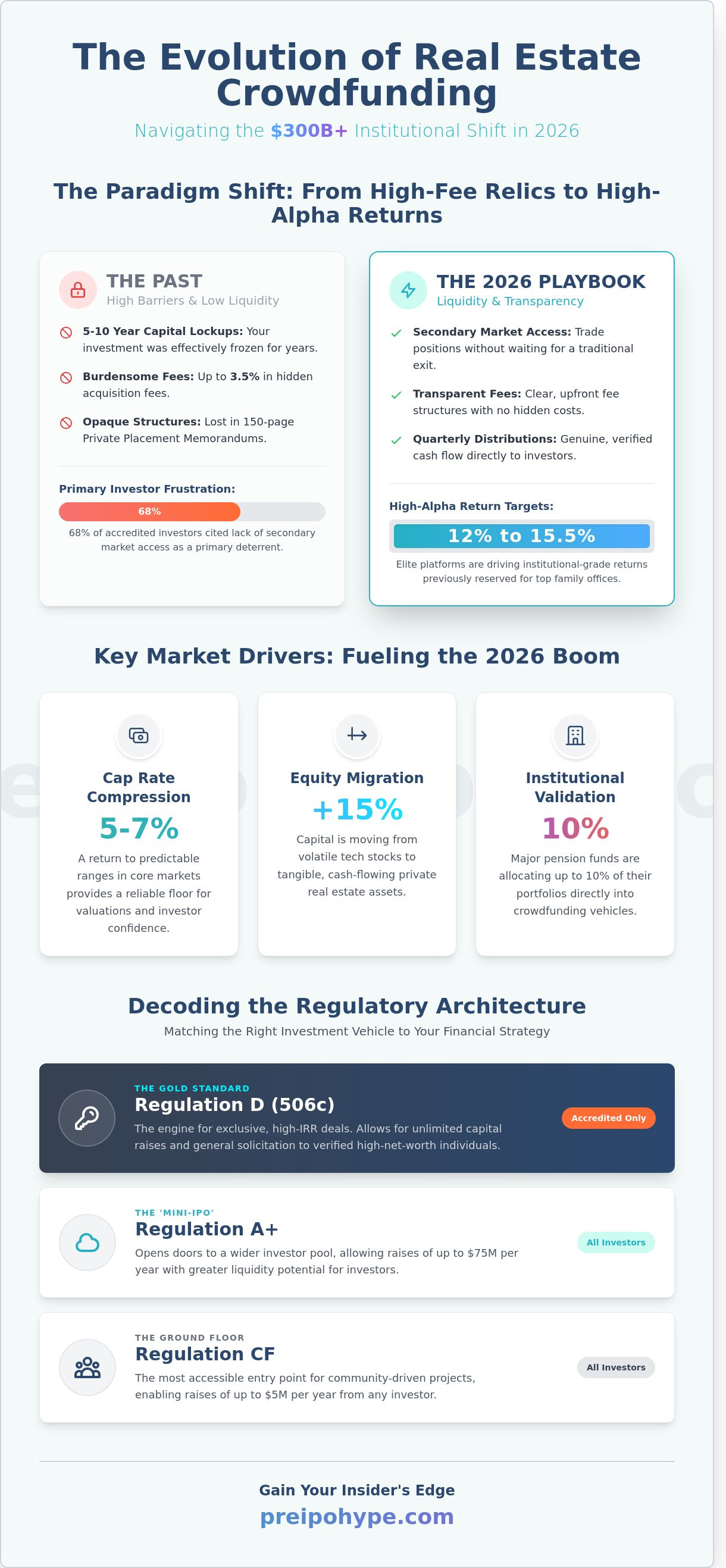
The five year capital lockup is officially a relic of the past. You've likely spent hours squinting at 150 page Private Placement Memorandums only to find 3.5% acquisition fees buried in the fine print. It's a common frustration; 68% of accredited investors now cite a lack of secondary market access as their primary reason for staying on the sidelines. Choosing between the dozens of real estate crowdfunding platforms shouldn't feel like a high stakes guessing game where your liquidity is the sacrifice. You deserve the institutional grade access that was once reserved for the top 0.1% of family offices.
We're here to bridge that gap and give you the insider's edge. You'll master the 2026 landscape to identify which elite platforms are driving 12% to 15.5% high alpha returns while finally solving the exit strategy puzzle. We've audited the top performers to reveal the opportunities that offer genuine quarterly distributions and verified secondary trading. This comparison breaks down the fee structures and valuation benchmarks you need to stop the analysis paralysis and start building your private market empire today.
Key Takeaways
- Navigate the $300B+ institutional shift as real estate crowdfunding evolves from experimental fintech into a sophisticated asset class for elite wealth creation.
- Decode the technical architecture of Reg D, Reg A+, and Reg CF to identify which investment vehicles match your specific liquidity and net worth requirements.
- Evaluate the "Big Three" real estate crowdfunding platforms to determine which provider offers the optimal balance of fee transparency and secondary market liquidity for 2026.
- Uncover the "Insider Playbook" to access oversubscribed deals before they reach public dashboards, ensuring you capture alpha rather than just platform leftovers.
- Learn how to engineer your own successful raise by utilizing custom investor CRMs to drive momentum and scale real estate offerings with pre-IPO hype.
The Evolution of Real Estate Crowdfunding Platforms in 2026
The wall between private secrecy and public opportunity has officially crumbled. By 2026, real estate crowdfunding platforms have matured from a niche fintech experiment into a powerhouse institutional asset class exceeding $300 billion in total market volume. Traditional REITs are losing ground because they can't offer the same level of transparency or direct ownership that modern digital portals provide. Investors are bypassing the fees and volatility of public trusts to secure direct, digital access to specific, high-performing properties. This shift is fueled by the arrival of secondary liquidity. For the first time, private equity real estate is semi-liquid; investors can trade their positions on secondary desks rather than waiting a decade for a traditional exit event.
The Democratization of the Ground Floor
The regulatory landscape changed everything. Successive updates to Reg CF and Reg A+ opened the gates, allowing retail investors to enter elite institutional circles that were previously locked behind high net-worth requirements. This isn't just about passive income anymore. The psychological shift is real. Investors are now "unicorn hunting" in the housing and industrial sectors, looking for the next high-growth play before it hits the public eye. Real estate crowdfunding platforms serve as the digital syndication of private equity for the modern era. It provides a level of insider access that was unimaginable ten years ago, turning the average investor into a sophisticated participant who uses real-time data to outmaneuver traditional funds.
Market Drivers: Why 2026 is the Year of Private CRE
Stability is the primary catalyst for this year's explosion in deal flow. Following the interest rate stabilization that took hold in late 2025, cap rates have finally found a reliable floor. This makes 2026 the optimal window for entering private commercial real estate. Capital is migrating away from the erratic swings of equities toward tangible, cash-flowing assets that offer a hedge against inflation. In this environment, "hype" has become a legitimate financial indicator of deal momentum. We track how fast a project gains traction on a platform because it reflects a high-conviction consensus that legacy banks are too slow to catch. This digital momentum ensures that the best deals are funded in hours, not months. Key drivers include:
- Cap Rate Compression: A return to predictable 5% to 7% ranges in core markets.
- Equity Migration: A 15% increase in capital moving from tech stocks to private brick-and-mortar assets.
- Institutional Validation: Major pension funds are now allocating up to 10% of their portfolios directly into crowdfunding vehicles.
The result is a market that feels both elite and democratized. You're no longer waiting for a bank's permission to build wealth. You're joining a movement of informed insiders who recognize that the final frontier of significant wealth creation is no longer on Wall Street, but on the digital ground floor of the private markets.
Decoding Platform Architecture: Accredited vs. Non-Accredited
The technical bedrock of most real estate crowdfunding platforms isn't the user interface or the glossy property photos. It is the SEC regulatory framework. These rules dictate the velocity of capital and the caliber of the investor pool. Specifically, Regulation D, Regulation A+, and Regulation CF represent the three distinct pillars of modern capital raising. Each carries its own set of compliance burdens and profit potential. Understanding these mechanics is the difference between joining a retail crowd and entering an elite syndicate.
The gated community of accredited investing remains the most lucrative sector. SEC guidelines define an accredited investor as someone with an annual income exceeding $200,000 or a net worth over $1 million, excluding their primary residence. While this feels like an archaic barrier, it serves as a filter for high-stakes deal flow. Platforms catering to this group focus on higher Internal Rate of Return (IRR) targets. They often bypass the heavy disclosure requirements that eat into retail returns. It's a trade-off. You trade accessibility for raw performance and direct sponsor access.
Reg D 506(c): The Gold Standard for Accredited Deals
Reg D 506(c) is the engine behind the most exclusive real estate offerings. It allows sponsors to market their deals publicly while ensuring every participant is a verified accredited investor. This verification wall protects the sponsor and ensures the capital table consists of sophisticated partners. These deals often offer direct relationships with the developers. This transparency allows for deeper due diligence than a standard REIT. If you are looking to build a high-velocity funnel for these elite players, learn how we engineer 506(c) investor acquisition to capture market share.
Reg A+ and Reg CF: Wealth Creation for the 99%
The retail revolution took flight with the expansion of Reg CF and Reg A+ limits. As of 2026, Reg CF allows issuers to raise up to $5 million from the general public. Reg A+ Tier 2 offerings, often called "Mini-IPOs," allow for raises up to $75 million. These real estate crowdfunding platforms provide "insider" access to people who previously couldn't get past the velvet rope.
- Reg A+ Reach: These offerings require SEC qualification, providing a layer of audited transparency that protects retail participants.
- The IRR Gap: Retail deals often carry higher administrative fees and lower projected returns, typically ranging from 8% to 12%, compared to the 15% to 20% often seen in private 506(c) placements.
- Liquidity: Some Reg A+ REITs offer redemption programs, providing a path to exit that traditional private equity lacks.
The architecture you choose defines your trajectory. If you need clarity on which regulatory path fits your current scale, you can ask our CEO for a direct perspective on the 2026 market dynamics.
Fundrise vs. RealtyMogul vs. CrowdStreet: A 2026 Direct Comparison
Access to institutional-grade assets is no longer a gated secret. The "Big Three" real estate crowdfunding platforms have matured into distinct financial vehicles by 2026, each carving out a specific territory in the private markets. Fundrise remains the undisputed king of passive, tech-driven diversification. It manages over $3.2 billion in assets through its proprietary platform, allowing investors to enter the market with as little as $10. It's the ultimate tool for those who want exposure to residential and industrial sectors without the headache of individual property selection.
RealtyMogul has pivoted to become the sophisticated middle ground. They've specialized in 1031 exchange-eligible investments and Delaware Statutory Trusts (DSTs), catering to investors who need to defer capital gains. As of late 2025, RealtyMogul has facilitated over $1.1 billion in capital across 450 plus properties. CrowdStreet, by contrast, operates as a high-stakes marketplace. It's designed for the "informed insider" looking for direct institutional-grade equity. This is where you find specific $50 million office redevelopments or specialized life sciences hubs rather than broad, diversified pools.
Fee Structures and Hidden Costs
Don't fall for the "zero fee" marketing trap. If a platform claims it doesn't charge investors, it's often a red flag for weakened due diligence or hidden sponsor kickbacks. Reliable real estate crowdfunding platforms generally charge asset management fees ranging from 0.15% to 1.50% annually. You must scrutinize the Private Placement Memorandum (PPM) to find the "promote" structure. This is the sponsor's share of profits, typically 20% after hitting an 8% preferred return hurdle. These structures align interests; the sponsor only gets rich if you win first.
Liquidity and Exit Strategies
Digital dashboards create an illusion of instant liquidity, but physical real estate moves at its own pace. Most platforms require a 5 to 7 year hold period to realize full valuation benchmarks. While secondary market trading gained some momentum in 2024, these markets remain thinly traded and often require a 1% to 3% discount to Net Asset Value (NAV) for a quick exit. Redemption programs exist but are frequently capped or suspended during periods of extreme market volatility. Liquidity in real estate crowdfunding is a spectrum, not a binary switch.
Successful investors in 2026 don't treat these platforms like a stock brokerage. They treat them like a vault. By locking in capital for the long haul, you bypass the noise of the public markets and capture the true "hype" of early-stage property appreciation. If you want to discuss how these platforms fit into a broader national real estate portfolio, you can ask our CEO for a direct perspective on the current acquisition climate.
The Insider Playbook: Why Platform Presence Isn’t Enough for Alpha
Many sponsors believe that securing a spot on real estate crowdfunding platforms is the finish line. It isn't. It's just the starting block. The reality of the 2024 private market is that a platform listing doesn't guarantee a single dollar. In fact, 62% of deals on major portals struggle to reach their minimum funding goal within the first 30 days because they rely solely on the platform's internal traffic. Relying on a dashboard to do your heavy lifting is a recipe for a stalled raise.
The most lucrative opportunities are often oversubscribed before they even hit the public eye. Elite sponsors use aggressive pre-marketing phases to lock in 75% of their capital from an inner circle of insiders. By the time a retail investor sees the deal, the momentum is already unstoppable. This isn't luck; it's a calculated omnichannel strategy. You must create a digital ecosystem where your deal follows the investor across LinkedIn, specialized newsletters, and targeted retargeting. This builds the psychological "hype" necessary for a rapid close and a successful future exit. Sophisticated investors track this engagement; they want to see a sponsor who dominates the digital conversation before they commit their capital.
Identifying High-Momentum Sponsors
Smart money doesn't just look at the property; it looks at the sponsor's tech stack. High-momentum sponsors utilize 60-day attribution models to track exactly where their investors originate. If a sponsor can't show you their lead scoring data or how they manage their CRM, they aren't ready for a high-stakes raise. A robust "Foundation Infrastructure" ensures that every click is a data point that shortens the sales cycle. The shift toward real estate crowdfunding platforms has democratized access, but it has also increased the noise. Check out our video funnel strategy for high-growth raises to see how elite sponsors convert cold traffic into committed capital in under 14 days.
Due Diligence in the Age of AI
Moving beyond the pitch deck is mandatory. Sophisticated investors now use AI tools to verify track records and cross-reference valuation benchmarks against 5,000+ similar assets in the Detroit market. A "Hype Audit" is a quantitative assessment of a sponsor’s digital momentum, sentiment analysis, and community engagement used to verify if market excitement aligns with underlying asset performance. Without this audit, you're just betting on a pretty PDF. You want to see 15% month-over-month growth in digital engagement before committing. If you want to see how the pros vet these deals, schedule a session with our CEO to break down the data.
Engineering the Raise: Scaling Real Estate Offerings with Pre-IPO Hype
Stop watching from the sidelines. Transitioning from an investor to a sponsor is the pivot that separates the wealthy from the ultra-wealthy. While many individuals rely solely on real estate crowdfunding platforms to find deals, the real power lies in owning the distribution engine yourself. You need to dominate these ecosystems by becoming the primary source of momentum, not just another listing in a crowded marketplace.
It's about the data. High-stakes raises require sophisticated infrastructure to manage the flow of capital. We utilize a Custom Investor CRM to transform simple curiosity into committed capital. You aren't just collecting emails; you're tracking the digital footprint of high-net-worth individuals across every touchpoint. This level of insight ensures that when an investor clicks a link in our Invst Guru newsletter, you know their intent before they ever pick up the phone. This newsletter is a direct line to elite capital circles, placing your Detroit asset in front of decision-makers who ignore standard marketing channels.
- Data-Driven Precision: Tracking engagement from the first click to the final wire transfer.
- Elite Distribution: Leveraging the Invst Guru network to reach accredited investors globally.
- Calculated Momentum: Using the "hype" cycle to create a sense of exclusivity and urgency.
Omnichannel Mastery for Real Estate Sponsors
Building a multi-channel acquisition engine is the only way to bypass platform reliance. Relying on a single source of traffic is a gamble you'll eventually lose. Pre-IPO Hype facilitated over $100M in funding by deploying strategic outreach across LinkedIn, proprietary investor lists, and targeted digital ads. This isn't just marketing; it's financial engineering. You can ask our CEO how to scale your real estate raise to see the exact blueprint we use to bypass the noise of traditional real estate crowdfunding platforms.
Your Strategic Roadmap to Private Equity Dominance
The lifecycle of a high-stakes raise begins with initial discovery and moves rapidly into aggressive A/B testing. We test the hook, the cap table structure, and the exit narrative to ensure maximum resonance. By the time you hit the market, your real estate asset is positioned as a must-have exclusive opportunity. This isn't a pitch; it's an invitation to the inner circle. The private market is the final frontier for significant wealth creation in 2026. Public markets are too volatile and too transparent; real wealth is built where the public can't see. Schedule a strategy session to engineer your next capital raise and secure your spot at the top of the capital stack.
The Blueprint for Your 2026 Alpha Strategy
The era of passive entry into real estate crowdfunding platforms has ended. In 2026, the distinction between accredited and non-accredited architecture determines your liquidity potential before the first brick is laid. You've analyzed the direct performance metrics of titans like Fundrise and CrowdStreet; now you must decide if you'll settle for market averages or engineer an oversubscribed raise. True alpha isn't found in the listing itself. It's built through the strategic momentum of the hype cycle and a sophisticated understanding of Reg CF, Reg A+, and Reg D frameworks.
Pre-IPO Hype has facilitated over $100M in funding for elite offerings by bridging the gap between private secrecy and public opportunity. We deploy a proprietary Custom Investor CRM to ensure your message hits the right desks at the right time. Don't leave your capital stack to chance when you can leverage a proven system for secondary liquidity and valuation growth. The private market remains the final frontier for massive wealth creation for those who move with calculated urgency.
Ready to dominate the private markets? Book your 1-on-1 strategy session with Fuzzy Wenzel.
Your next major exit starts with the decision to lead the market rather than follow it.
Frequently Asked Questions
Is real estate crowdfunding safer than the stock market in 2026?
Real estate crowdfunding offers a tangible asset hedge that often outperforms the S&P 500's volatility. In 2026, the correlation between private real estate and public equities remains low at approximately 0.3. While the stock market can swing 2% daily, institutional-grade real estate provides steady cash flow. You're trading daily liquidity for a hard asset backed by physical land, reducing your exposure to panic-driven sell-offs.
Can I invest in real estate crowdfunding with only $500?
Yes, you can start building your portfolio with as little as $500 on several leading real estate crowdfunding platforms. Apps like Fundrise or Groundfloor have lowered the entry barrier from the traditional $25,000 minimum to just $10 or $500. This democratization allows you to secure a stake in multi-family developments or industrial hubs without needing a massive capital stack. It's the ultimate entry point for ground-floor opportunities.
How much are the typical management fees on these platforms?
Most platforms charge an annual management fee ranging from 1% to 2.5% of your invested capital. You'll also encounter acquisition fees between 0.5% and 2% at the start of a deal. These costs cover the heavy lifting of sourcing, vetting, and managing the assets. Always check the offering circular for "carried interest," which usually gives the platform 20% of profits after you hit an 8% preferred return.
What happens if a real estate crowdfunding platform goes bankrupt?
Your investment is typically held in a Special Purpose Vehicle, which is a separate legal entity from the platform itself. If the platform fails, the underlying real estate assets are still owned by the members. A backup manager, often named in the 2026 operating agreement, takes over the administration. This structure ensures that platform insolvency doesn't wipe out your equity or the 15% projected returns on the property.
Is real estate crowdfunding income taxable as capital gains or ordinary income?
Rental income distributions are usually taxed as ordinary income, while the profit from a property sale after one year qualifies for long-term capital gains rates of 15% or 20%. You'll receive a Schedule K-1 or Form 1099-DIV by March 15th each year. Utilizing depreciation through cost segregation studies can often offset 30% to 50% of your taxable distributions, keeping more cash in your pocket for the next deal.
Can I use a Self-Directed IRA to invest in these platforms?
Absolutely, using a Self-Directed IRA is a power move for tax-deferred growth. By 2026, over 12% of SDIRA holders have allocated capital to real estate crowdfunding platforms to bypass the volatility of public REITs. You simply direct your custodian to wire the funds to the platform. This strategy allows your 10% to 14% annual returns to compound without the immediate sting of the IRS taking a cut.
What is the average annual return for real estate crowdfunding in 2026?
The average annual return for diversified real estate portfolios in 2026 hovers between 9% and 16%. Debt-based investments typically yield 8% to 11% in fixed interest, while equity-based deals targeting value-add properties can hit 18% or higher upon exit. These figures represent a significant premium over the 7% historical average of the public markets, making the private sector the clear choice for aggressive wealth builders.
How do I verify if a real estate sponsor is legitimate?
Start by auditing their track record of realized deals and checking their SEC Form D filings. A legitimate sponsor should show at least 5 to 10 years of experience and a minimum of $50 million in assets under management. Look for a "skin in the game" commitment where the sponsor invests 5% to 10% of their own capital alongside you. This alignment of interests is the best indicator of a winning play.
Disclaimer
Educational only. Not investment, tax, or legal advice. Pre-IPO Hype is investor relations infrastructure for Regulation CF and Regulation A+ raises. We are not a broker-dealer, funding portal, or investment adviser, and we do not offer or sell securities or make investment recommendations. Any securities offering is made only by the issuer, through its own offering documents and, where required, a registered intermediary.


