
Reg A+ Marketing Budget: The 2026 Founder’s Guide to Capital Engineering
Why do most founders treat their Reg A+ marketing budget like a slot machine when the math for a $75 million raise is already solved? It's a valid concern. You're likely tired of opaque agency models and the fear of burning cash on cold traffic that doesn't convert. We know that in the high-stakes world of equity crowdfunding, uncertainty is the enemy of momentum. You need to know exactly how much it costs to acquire a shareholder before you spend your first dime on digital ads.
This guide promises to hand you the exact financial architecture required to fuel a $75 million capital raise without wasting a single dollar on unoptimized outreach. You'll master the precise mechanics of investor acquisition and learn how to turn your marketing spend into a high-performance capital engine. We're going to break down the 2026 benchmarks for fixed versus variable costs, lead-to-investor conversion rates, and the specific infrastructure needed to track every dollar from the first click to the final investment. It's time to stop guessing and start engineering your growth with the precision of an industry insider.
Key Takeaways
- Learn to distinguish between 'Setup' and 'Scale' costs to protect your liquidity and ensure every dollar fuels immediate market momentum.
- Discover why a 10-15% marketing-to-raise ratio remains the definitive benchmark for successful Tier 2 capital acquisition in 2026.
- See how integrating a Custom Investor CRM into your Reg A+ marketing budget provides the technical tracking needed to eliminate lead leakage and optimize ROI.
- Master the phased execution roadmap, transitioning from story framework to Foundation Infrastructure before launching aggressive omnichannel outreach.
- Understand the "Warm Lead" advantage and how to engineer elite capital by blending existing fanbases with high-conversion cold traffic strategies.
The Anatomy of a Reg A+ Marketing Budget: Fixed vs. Variable Costs
Precision capital formation isn't a guessing game; it's a structural necessity. When you architect a Reg A+ marketing budget, you aren't just buying ads. You're building a capital engine. Many founders fail because they view marketing as a single, vague line item rather than a bifurcated system of fixed foundational costs and variable scaling levers. In the 2026 landscape, where the SEC has tightened guidance on general solicitation and advertising disclosures, your financial blueprint must be as rigorous as your audit.
Fixed Costs: The Foundation of Your Raise
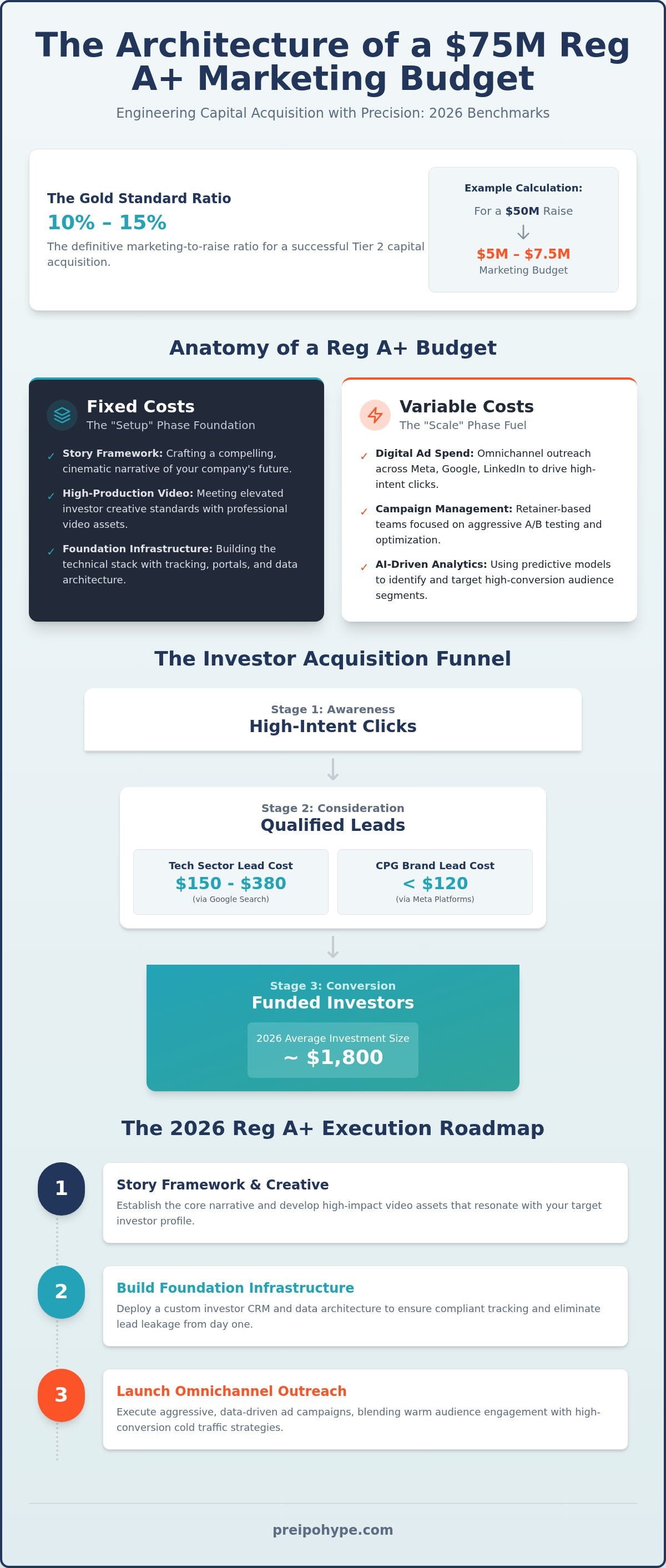
Success starts long before the first ad goes live. Your fixed costs represent the "Setup" phase, the non-negotiable technical and creative bedrock required to handle institutional-grade scrutiny. While legal and audit fees are standard for any Regulation A+ offering, your marketing foundation requires its own dedicated allocation. This includes the development of a "Story Framework" and high-production video assets that meet the elevated creative standards of 2026. Investors today expect more than a pitch deck; they want a cinematic narrative of your company's future.
The most critical fixed investment is your Foundation Infrastructure. This isn't just a landing page. It's the technical integration of tracking pixels, compliance-ready investor portals, and data architecture that ensures every click is accounted for. If you choose to "Test the Waters" (TTW) to gauge market appetite, remember that TTW communications carry their own fixed overhead. You must fund the infrastructure to capture that early interest, or you're simply burning cash on data you'll never use.
Variable Costs: The Fuel for Investor Acquisition
Once the foundation is set, your variable costs become the "Fuel" that drives your raise toward that $75 million Tier 2 limit. This is where your budget stays fluid, moving with the rhythm of market momentum. Digital ad spend across Meta, Google, and LinkedIn typically consumes the largest portion of this category. However, top-performing teams in 2026 don't just set a daily cap and walk away. They use a "Scale" model that reallocates 10-15% of the budget every quarter based on real-time performance data.
Effective variable spending also includes:
- Strategic newsletter outreach to tap into established investor communities.
- Retainer-based campaign management that prioritizes aggressive A/B testing of creative assets.
- AI-driven predictive analytics to identify which audience segments are most likely to convert at a lower Cost Per Investor (CPI).
By separating the infrastructure from the outreach, you gain a clear view of your ROI. You stop asking "how much does marketing cost" and start asking "how much capital can this engine generate."
The Tier 2 Capital Acquisition Formula: Calculating Your ROI
What is the true price of $75 million? In the world of high-velocity fundraising, you aren't just selling shares; you're purchasing capital at a specific price point. Your Reg A+ marketing budget should be viewed as the purchase price of your company's future liquidity. Industry data from 2026 suggests that a total marketing-to-raise ratio of 10% to 15% is the gold standard for Tier 2 offerings. If you're raising $50 million, expect to deploy $5 million to $7.5 million to maintain the momentum required to close the round.
The math follows a rigid investor funnel. It begins with high-intent clicks that transition into qualified leads, eventually maturing into funded accounts. According to SEC Regulation A+ Rules, your communications must remain compliant throughout this funnel, but the underlying engineering remains the same. Investor CAC is the total marketing spend divided by the number of unique investors.
Benchmarking Your Cost Per Acquisition (CPA)
In 2026, the average investment size has climbed to approximately $1,800. This shift means your CPA must be aggressively managed to ensure profitability. Lead costs vary significantly by sector. A high-growth Tech play might see qualified leads in the $150 to $380 range on Google Search, while a consumer-facing CPG brand might leverage Meta for leads under $120. Your deal terms, specifically your minimum investment threshold, act as a filter. A higher minimum often increases your lead cost but can significantly lower your overall Investor CAC by increasing the average ticket size.
Scaling from $5M to $75M: The Budget Curve
Fundraising is not a linear expense. The first $5 million is almost always the most expensive capital you'll ever buy. You're fighting for brand recognition and building the initial trust required to move cold traffic. However, as you cross the mid-raise threshold, your efficiency should spike. Social proof kicks in, and the cost of discovery drops. At this stage, your budget shifts from pure discovery to aggressive re-engagement.
By retargeting the thousands of leads who "watched" but didn't "wire" in phase one, you slash your late-stage acquisition costs and accelerate toward the $75 million finish line. If your data infrastructure is sound, you can book a technical audit to analyze how to optimize these mid-raise shifts. This re-engagement strategy is the secret to maintaining a predictable ROI as you scale your outreach to the broader market.
Audience Maturity: Fanbase vs. Cold Traffic Strategy
Your Reg A+ marketing budget is only as effective as the maturity of the audience it targets. High-growth founders often make the mistake of treating all traffic as equal. In reality, your capital raise operates on a sliding scale of trust. On one end, you have "The Faithful," your existing customers and fans who already believe in your mission. On the other, you have "The New," cold institutional and retail investors who require significant engineering to convert. A balanced budget recognizes this disparity and allocates resources accordingly to maximize the velocity of the raise.
Monetizing Your Existing Community
Existing fans are your lowest-cost path to early momentum. These individuals don't need a 12-step education sequence; they need a clear call to action. By leveraging your proprietary investor data, you can deploy sophisticated email automation and SMS sequences that drive high-intent traffic to your portal for a fraction of the cost of social ads. This "Warm Lead" advantage is what allows top-tier raises to hit their first $1 million in days rather than months. For larger check sizes within this group, high-touch outreach and exclusive webinars provide the necessary exclusivity to close six-figure investments early in the campaign.
Conquering Cold Markets with Precision
Engineering elite capital from cold audiences is a different game entirely. You aren't just buying clicks; you're building institutional-grade authority in real time. Cold investor leads typically require 7 to 12 touchpoints across multiple channels before they feel comfortable wiring funds. This is why omnichannel outreach is non-negotiable. If you only show them one ad on Meta, you're leaving money on the table. You need a strategy that follows them from LinkedIn to Google to their favorite financial newsletters.
Successful founders apply the "60-Day Attribution" rule to their cold traffic spend. This means you must budget for a two-month window from the first touchpoint to the final investment. During this period, Digital Marketing and Advertising efforts focus on retargeting and social proof to bridge the trust gap. By dividing your spend between community monetization and cold market conquest, you ensure a steady pulse of capital that doesn't rely solely on one audience segment. This dual-track approach protects your ROI and keeps the raise moving forward even when cold traffic costs fluctuate.
Lowering CAC Through Custom Investor CRM and Infrastructure
Why do so many raises bleed cash? The answer is lead leakage. Without a centralized "brain" to manage your Reg A+ marketing budget, you're effectively pouring capital into a bucket with holes. A Custom Investor CRM transforms your marketing from a series of disjointed experiments into a closed-loop system that captures every data point. By plugging the gaps where potential investors fall through the cracks, you significantly lower your Customer Acquisition Cost (CAC) and increase the velocity of your raise.
A sophisticated infrastructure allows for 60-day attribution tracking. This is vital because retail investors rarely wire funds on the first touch. If you only look at 7-day windows, you'll mistakenly kill high-performing ads that actually deliver capital 45 days later. By accurately mapping the long-tail conversion path, you save your budget from being wasted on short-sighted optimizations. Lead scoring then takes the wheel, allowing your team to focus human capital on the 20% of prospects responsible for 80% of the capital. Automating the nurture sequence through SMS and email further reduces manual Investor Relations (IR) costs, ensuring no lead goes cold without an expensive headcount.
The ROI of Technical Infrastructure
Comparing "Agency-only" raises to "Tech-enabled" raises reveals a stark contrast in efficiency. Traditional agencies focus on the click; tech-enabled systems focus on the capital. The "Foundation" setup fee is often the most important investment in your Reg A+ marketing budget because it builds a permanent asset. You aren't just renting an audience; you're owning the data. This ownership pays dividends in follow-on rounds, as you can re-engage your previous lead list for a fraction of the original acquisition cost. It's the difference between a one-time transaction and a repeatable capital engine.
Omnichannel Mastery: Efficiency Across Platforms
Efficiency is born from synchronization. When your social ads, email sequences, and SMS alerts operate in a synchronized rhythm, you create a multiplier effect. A lead sees an ad on LinkedIn, receives a newsletter, and gets a text alert about a closing milestone. This consistency builds the institutional-grade authority required for a $75M raise. Real-time data allows you to kill underperforming channels instantly, reallocating those funds to the platforms actually moving the needle. If you're ready to stop the leakage and engineer a more efficient raise, schedule a technical strategy session to review your current stack and identify where you're losing potential investors.
The 2026 Reg A+ Execution Roadmap: Phasing Your Spend
Timing is the most underrated variable in capital engineering. A Reg A+ marketing budget isn't a flat monthly expense; it's a phased deployment designed to trigger specific market milestones. If you wait until the SEC qualifies your offering to start spending, you've already lost the momentum race. You need a roadmap that accounts for the psychological journey of the investor, moving from initial curiosity to the final wire transfer. This trajectory is divided into four distinct phases that mirror the rapid movement of high-growth markets.
- Phase 1: Discovery and Story Framework (Month 1): Defining the narrative and creative assets.
- Phase 2: Technical Build and Foundation Infrastructure (Month 2): Deploying the Foundation Infrastructure to track every future dollar.
- Phase 3: The Hype Launch and TTW (Month 3): Gauging market appetite and building the waitlist.
- Phase 4: Scaling to the $75M Ceiling (Months 4-12): Aggressive omnichannel expansion and conversion optimization.
Month 1-3: Front-Loading the Momentum
The first 20% of your Reg A+ marketing budget should be spent before your raise officially goes live. Momentum isn't found; it's engineered. During the first 90 days, your focus is on building a "Day 1" event. By utilizing "Testing the Waters" (TTW) communications, you can legally build a waitlist of high-intent investors who are ready to participate the moment you open the round. This early spend focuses on scroll-stopping video production and a story framework that positions your company as a rare, elite opportunity. If you don't have a crowd waiting at the gates on launch day, your cost per investor will skyrocket as you struggle to manufacture social proof from scratch.
Month 4+: The Optimization and Scale Phase
Once the initial "Hype" phase settles, your budget shifts from broad discovery to surgical conversion. This is where your technical infrastructure pays for itself. You'll move from "Awareness" bidding on ad platforms to "Conversion" bidding, targeting individuals who mirror the profile of your early investors. By leveraging data from your first $5M raised, you can create "Lookalike" audiences that significantly lower your late-stage CAC.
This phase is about relentless re-engagement. You're no longer just introducing the brand; you're pushing for realization events. Your budget should remain fluid, allowing you to double down on the channels that demonstrate the highest ROI in real-time. Ready to engineer your raise? Ask our CEO anything or book a strategy session to map out your 2026 capital roadmap.
Architect Your $75M Capital Event
Mastering your Reg A+ marketing budget is the difference between a stalled raise and a market-defining success. We've established that technical infrastructure, specifically the distinction between fixed foundation costs and variable scale levers, is the bedrock of a high-performance raise. By adhering to the 10% to 15% marketing-to-raise gold standard and utilizing a phased execution roadmap, you transform your fundraising into a predictable capital engine. Success in 2026 requires more than just capital; it demands the data-driven omnichannel mastery that only a specialized partner can provide.
Pre-IPO Hype has facilitated over $100M in funding for more than 230 companies. We achieve these results through our proprietary Custom Investor CRM and Foundation infrastructure, ensuring no lead is ever left behind. We've opened the gates to elite investment circles that were once restricted, and now it's your turn to step through. If you're ready to stop guessing and start engineering your growth with surgical precision, it's time to act. Scale Your Capital: Deploy the Pre-IPO Hype Fundraising Stack. The future of your company is waiting for those bold enough to claim it.
Frequently Asked Questions
What is the average marketing cost for a Reg A+ offering?
The industry gold standard for a successful raise is between 10% and 15% of the total capital target. For a $75 million Tier 2 offering, this means budgeting for a high-performance engine that can sustain momentum over several months. While initial setup costs are fixed, the variable spend scales as you prove your investor acquisition cost. Most companies spend between $150,000 and $300,000 on legal, audit, and marketing before the first dollar is even raised.
Can I use Reg A+ marketing funds from the capital raised?
You cannot typically use the capital raised to pay for the initial setup costs required to launch the offering. These front-end expenses, including legal fees and foundation infrastructure, must be funded by the company's existing treasury. However, once the offering is live and you've achieved your first closing, you can often use a portion of the proceeds to fuel your ongoing Reg A+ marketing budget and scale your digital acquisition efforts.
How much should I spend on digital ads versus agency fees?
A healthy budget allocation usually prioritizes the direct ad spend over management fees. In 2026, top-performing founders aim for a 4:1 or 5:1 ratio, where the majority of the capital goes directly into platforms like Meta, Google, and LinkedIn. High agency fees that dwarf the actual media spend are a red flag. You want your budget working on the front lines, acquiring shareholders and building market momentum rather than funding administrative overhead.
What is a 'Testing the Waters' (TTW) budget?
A TTW budget is the capital allocated to gauge investor interest before you commit to the full SEC qualification process. This phase allows you to run targeted ads and build a waitlist, legally soliciting interest without accepting funds. Budgeting for TTW typically involves $20,000 to $50,000 for creative testing and lead generation. It's a strategic move that provides the data needed to justify a larger marketing spend once the offering is officially live.
Does a Reg A+ raise require a Custom Investor CRM?
While not a regulatory requirement, a Custom Investor CRM is essential for managing a $75 million raise without massive lead leakage. Standard CRMs aren't built for the specific complexities of the investor journey, such as tracking 60-day attribution or managing subscription agreements. Without this technical brain, your acquisition costs will likely spiral. It's the infrastructure that allows you to score leads and automate the nurture sequences that turn curious clicks into committed shareholders.
How do I calculate the ROI of my investor acquisition campaign?
ROI is calculated by dividing the total capital raised by the total marketing spend, including both fixed and variable costs. For example, if you spend $1 million to raise $10 million, your ROI is 10x. In the 2026 landscape, savvy founders also track Investor CAC by dividing spend by the number of unique investors. This metric helps you understand the efficiency of your funnel and where to reallocate funds for the highest impact.
What are the hidden costs of a $75 million capital raise?
Beyond ad spend, hidden costs often include two years of audited financial statements, which can range from $30,000 to $90,000 for Tier 2 offerings. You must also account for state Blue Sky filing fees and the technical integration of tracking pixels across your fundraising stack. Many founders overlook the cost of high-quality video production and creative refreshes required to prevent ad fatigue. These foundational expenses are critical for a successful Reg A+ marketing budget.
How long does the Reg A+ marketing cycle typically last?
The typical cycle spans 12 to 15 months. This includes a three-month preparation phase for discovery, technical build, and Testing the Waters before the official launch. Once live, the SEC allows 12 months to hit your target. The most efficient raises front-load their budget in the first 90 days to trigger a hype event, then shift to a steady-state optimization phase to reach the $75 million ceiling through consistent omnichannel outreach.
Disclaimer
Educational only. Not investment, tax, or legal advice. Pre-IPO Hype is investor relations infrastructure for Regulation CF and Regulation A+ raises. We are not a broker-dealer, funding portal, or investment adviser, and we do not offer or sell securities or make investment recommendations. Any securities offering is made only by the issuer, through its own offering documents and, where required, a registered intermediary.