
Reg A+: The "Mini-IPO" Guide to Raising $75M in 2026
Venture capital is no longer the only kingmaker. While founders chase elusive term sheets on Sand Hill Road, a quiet revolution is happening in plain sight: in 2022 alone, companies bypassed the VC gatekeepers to raise over $1.8 billion directly from the public. You know the traditional grind. The crippling legal fees, the uncertainty of finding enough investors, and the constant fear of a failed, public-facing raise. It’s a high-stakes game where you often lose control before you’ve even won.
This guide is your key to joining the new capital class. We're breaking down exactly how to leverage a reg a+ offering, the "Mini-IPO," to secure up to $75 million by 2026. Forget the old rules. You'll get the insider’s roadmap for mastering the mechanics, building the marketing tech stack to attract thousands of retail investors, and creating the secondary liquidity options your early team deserves. Let's build your funding powerhouse.
Key Takeaways
- Discover how a reg a+ offering, or "Mini-IPO," allows high-growth companies to access public-style capital without the seven-figure cost of a traditional IPO.
- Pinpoint the two critical success criteria for reg a+-brand momentum and financial readiness-to determine if your company can command a retail investor audience.
- Master the marketing engine behind a successful reg a+ offering, converting your company's story into a high-demand reg a+ investment opportunity.
- Implement the core "Foundation Infrastructure" that separates a chaotic capital raise from a streamlined, movement-driven reg a+ funding event.
What is Reg A+? The Elite "Mini-IPO" for High-Growth Startups
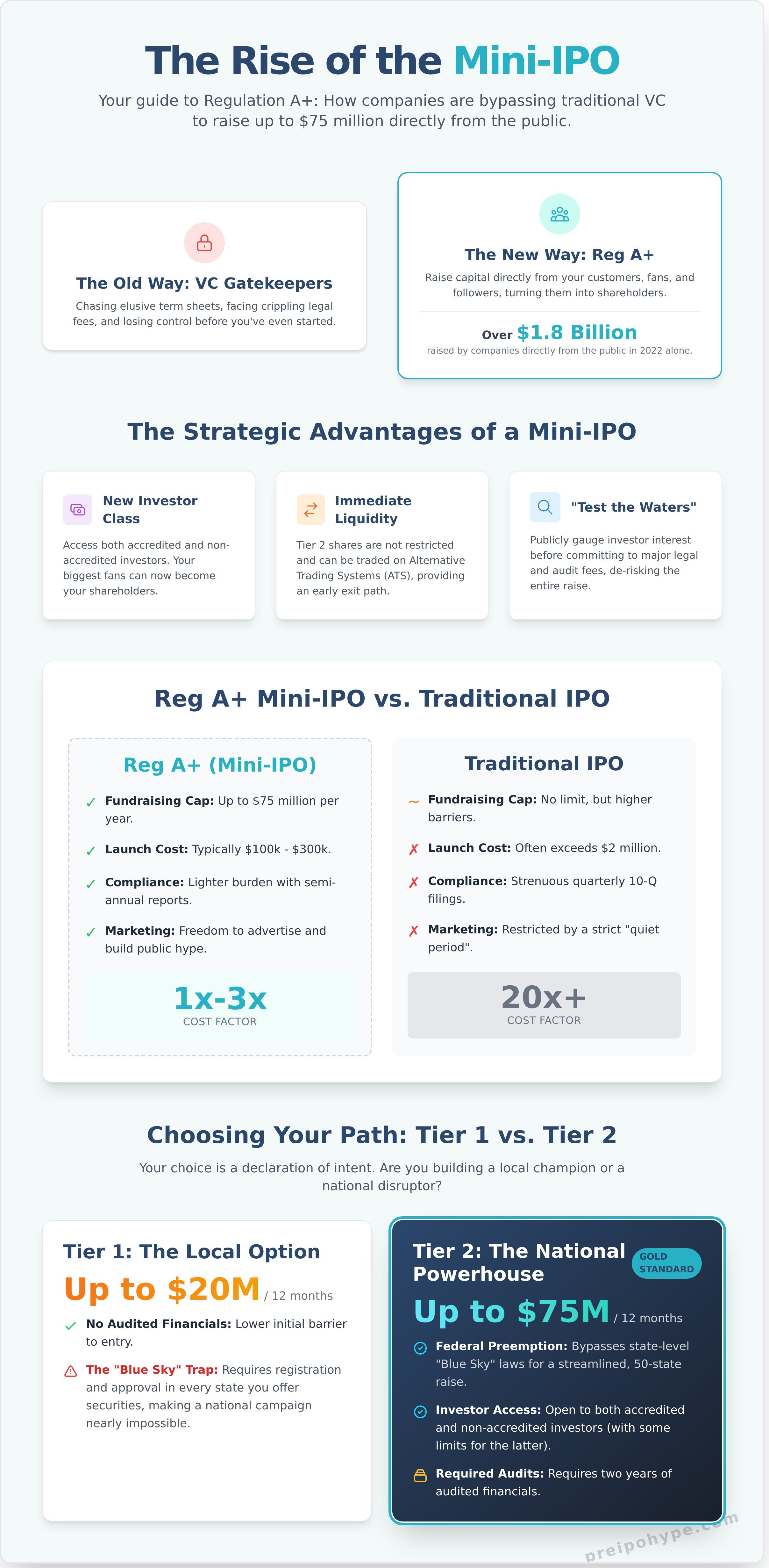
What if you could take your company public without the seven-figure price tag? This isn't a hypothetical. It's the strategic advantage powering the next wave of high-growth companies. Welcome to Regulation A+, the SEC-sanctioned pathway that allows ambitious private startups to raise up to $75 million from the general public. It's earned the nickname "Mini-IPO" for a reason: it delivers the fundraising power and public exposure of a stock market debut at a fraction of the cost and complexity.
This isn't just another fundraising exemption; it's a fundamental restructuring of capital markets. Born from the 2012 Jumpstart Our Business Startups (JOBS) Act, the modern Regulation A (Reg A+) framework was fully realized in 2015 and updated in March 2021 to its current $75 million cap. It was designed to bridge the chasm between the tight-lipped secrecy of venture capital and the full-blown exposure of a Nasdaq listing. This is the democratization of capital in action, unlocking ground-floor investment opportunities for millions of retail investors previously shut out of pre-IPO deals.
The Core Benefits: Why Founders Choose Reg A+
The strategic calculus for founders is clear and compelling. A reg a+ offering isn't just about capital; it's about building a brand and a community of evangelists. The key advantages include:
- Access to a New Investor Class: Unlike traditional private placements limited to the wealthiest 13% of U.S. households, Reg A+ opens the cap table to both accredited and non-accredited investors. Your customers, fans, and followers can now become your shareholders.
- Immediate Liquidity Potential: Shares issued under a Tier 2 offering are not restricted. They can be made immediately tradable on Alternative Trading Systems (ATS) like tZERO, providing early investors with an exit path long before a major exchange listing.
- "Test the Waters" Solicitation: Before committing over $100,000 to legal and audit fees, companies can publicly gauge investor interest. This allows you to build hype and validate demand, de-risking the entire capital raise.
Reg A+ vs. Traditional IPO: A Strategic Comparison
Choosing between a Mini-IPO and a full-blown S-1 filing on the NYSE or Nasdaq comes down to efficiency and control. A traditional IPO is a monumental undertaking, often costing over $2 million and requiring a lock-step process managed by underwriters. A Reg A+ offering, by contrast, is a more agile and founder-friendly alternative.
The cost differential is stark: a typical Reg A+ campaign costs between $100,000 and $300,000 to launch, compared to the $1 million-plus floor for a traditional IPO. The ongoing compliance burden is also significantly lighter. Instead of strenuous quarterly 10-Q filings, Reg A+ issuers file semi-annual reports (Form 1-SA). Most importantly, it liberates marketing. Where traditional IPOs have a strict "quiet period," Reg A+ allows companies to leverage digital advertising and social media to directly engage investors and build momentum. It transforms fundraising from a closed-door negotiation into an open, public campaign.
Tier 1 vs. Tier 2: Navigating the Regulatory Framework
Choosing your Regulation A+ tier isn't a simple choice. It’s a declaration of intent. Are you building a local champion or a national disruptor? Both paths begin with the SEC Form 1-A, the core document within the SEC Regulation A+ framework that details your business, financials, and offering terms. Getting this document "Qualified" by the SEC is your license to raise capital from the public.
But before you even pick a tier, the SEC runs a background check. The "Bad Actor" disqualification rules are non-negotiable. Past securities violations or criminal convictions tied to your founders, directors, or key shareholders can terminate your capital raise before it even starts. In this game, your team’s history is just as important as your company’s future.
Tier 1: The Local Option
Tier 1 allows you to raise up to $20 million in a 12-month period. On the surface, it looks less demanding with no requirement for audited financials. But don't be fooled. Tier 1 hides a fatal flaw for any company with national ambitions: the "Blue Sky" trap. You must register and gain approval in every single state where you plan to offer securities. Imagine getting approval in Michigan, only to have your momentum stall while navigating Ohio's and Illinois's unique regulatory hurdles. This state-by-state friction makes a cohesive, fast-paced national campaign nearly impossible.
Tier 2: The National Powerhouse
This is the gold standard. For serious companies aiming for significant scale, Tier 2 is the only viable path. It allows you to raise up to $75 million in a 12-month period, a cap increased from $50 million in March 2021. The defining feature? Federal preemption. Tier 2 offerings bypass the state-level Blue Sky registration gauntlet, creating a streamlined path to a 50-state investor audience. This is the mechanism that transforms a local Detroit startup into a nationally recognized investment opportunity.
The cost of entry for this powerful advantage is higher scrutiny. You must provide two years of audited financials prepared in accordance with U.S. GAAP. This isn't just a compliance hurdle; it’s a powerful signal of institutional readiness. It tells sophisticated investors that your company is organized, transparent, and ready for prime time. This audit requirement, combined with modest ongoing reporting obligations (semi-annual and annual reports), establishes the credibility needed for a high-impact reg a+ offering.
For Detroit-based companies with a vision that extends beyond the Great Lakes, the choice is clear. Tier 2 provides the framework for a truly national capital raise, transforming public interest into growth capital. Understanding which tier aligns with your company's trajectory is a critical first step, and our platform insights can help clarify that strategic decision before you commit significant resources.
Is Reg A+ Right for You? The Success Criteria
Is your company ready for the main stage? A Regulation A+ offering isn't just another funding round; it’s a public debut without the full IPO. But the spotlight is intense, and only certain companies are built to command that level of attention. Before you commit, you must pass a brutal self-assessment. This isn't about hope; it's about a cold, hard evaluation of your readiness.
The decision hinges on four critical pillars:
- The "Hype" Test: Do you have a story that can mobilize an army of believers?
- Financial Readiness: Can you fund the six-figure setup cost before raising a dime?
- The Valuation Benchmark: Is your "ground floor" valuation anchored in reality?
- Strategic Fit: Is this the right capital tool for your current growth stage?
Hype isn't a dirty word in this arena; it's a leading indicator of retail market demand. Think of consumer brands with a cult following or tech companies solving a deeply felt problem. You need the emotional pull to convert thousands of followers into investors, not just a few dozen angels. A successful reg a+ campaign requires a brand that people want to own a piece of, a mission they feel compelled to join.
This path also demands significant upfront capital. Before you collect a single dollar, expect to invest $50,000 to $100,000 in your "Foundation." This covers two years of audited financials, expert legal counsel for your Form 1-A filing, and the initial marketing infrastructure. You are fronting the cost to access the public markets.
Reg A+ vs. Reg CF: When to Level Up
Think of Regulation Crowdfunding (Reg CF) as your off-Broadway debut. It’s where you test your narrative and prove you can sell tickets, capped at $5 million. A successful Reg CF round is the ultimate proof-of-concept. A Reg A+ offering is your Broadway show, demanding a six-figure, omnichannel marketing budget to fill a potential $75 million house. The investor access is also fundamentally different. While Reg CF has its own limits, the framework detailed in the official SEC Regulation A+ Rules for Tier 2 offerings allows non-accredited investors to commit a greater percentage of their income, dramatically expanding your potential capital base.
The 2026 Liquidity Landscape
The game has evolved. Previously, early investors were locked in for years, waiting for an IPO or acquisition. Now, with SEC-registered Alternative Trading Systems (ATS) like StartEngine Secondary and tZERO, the narrative has shifted. You can now offer your backers a potential path to liquidity within 12-24 months. This is the "exit" before the exit. It’s a core selling point that transforms your offering from a long-term bet into a strategic asset with near-term potential, perfectly positioning your company for a future NASDAQ or NYSE uplisting.
The Investor Acquisition Engine: Marketing Your Reg A+
Your financials are audited. Your legal filings are perfect. None of it matters if you can’t get the offering in front of the right investors. A successful reg a+ offering isn't won on paper; it's won in the market. This is where you move from a compliant company to a must-have investment. The difference is a meticulously engineered marketing engine that translates your vision into investor capital.
It starts with your story. Forget the jargon-filled PPM. Your narrative must be simple, powerful, and emotionally resonant. Are you revitalizing a historic Detroit neighborhood? That’s not a cap rate discussion; it’s a story about restoring a city’s soul. Data from a 2023 Nielsen study shows that ad campaigns with a strong emotional focus outperform logic-based campaigns by 23%. Your marketing must convert complex financial projections into a compelling story of future value.
The core of this engine is a high-production video pitch. This isn't optional. It’s the single most critical asset for driving conversions. A professionally shot, 3-5 minute video featuring the founding team, showcasing the project, and articulating the market opportunity can increase landing page conversions by over 80%. It’s your digital handshake, building trust and conveying passion in a way a PDF never can. Without it, you’re flying blind.
Finally, you cannot afford to guess which marketing dollars are working. Precision attribution tracking is non-negotiable. You must know that the $10,000 spent on LinkedIn ads targeting accredited investors in Oakland County generated $150,000 in commitments, while the $5,000 on general Facebook ads produced zero. Every dollar must be accountable, tracing the investor's path from first click to final wire transfer.
The 60-Day Attribution Playbook
An investor's journey from curiosity to capital is rarely a straight line; it's a 30 to 60-day process across multiple touchpoints. We use precise tracking to map this path, using powerful video funnel strategies to build authority at each step. Smart retargeting campaigns are the final piece, re-engaging the 70% of potential investors who visit your offering page but don't commit on the first visit, often closing them weeks later.
Omnichannel Outreach vs. Single-Channel Failure
Relying solely on one platform, like Facebook, is a recipe for a stalled capital raise. A true omnichannel strategy integrates multiple channels to create a surround-sound effect. Imagine a feature in a local Detroit business journal, amplified by social ads showcasing pull quotes, followed by programmatic ads on financial websites. This creates "Hype Cycles," manufacturing urgency around key milestones like a tranche closing to drive decisive action from investors on the fence.
Building this engine requires expertise and relentless optimization. Don't leave your fundraising to chance. Discover how our data-driven campaigns find and convert your ideal investors.
Building Your Foundation with Pre-IPO Hype
Filing your Form 1-A is not the finish line. It's the starting gun. The difference between a Detroit company that raises $5 million and one that hits its $75 million reg a+ ceiling isn't the business plan; it's the infrastructure. Without a purpose-built system, you're not running a capital raise. You're managing a very expensive, very public mess. This is where you build a movement, not just a shareholder list.
Foundation infrastructure is the critical difference. It’s the framework that allows you to handle an influx of 10,000 potential investors on day one without your systems crashing. It's the engine for lead scoring that separates the $100 retail investor from the $1M family office, focusing your high-touch outreach where it delivers a 10x return. A messy launch kills momentum. A structured launch creates it.
The Power of the Custom Investor CRM
Forget your sales CRM. It wasn't designed for this. A successful offering requires a central nervous system built for one purpose: converting public interest into funded investment at scale. Our Custom Investor CRM is the operational brain behind your entire capital raise, engineered to manage the unique complexities of a public offering and provide clarity in a high-stakes environment.
- Managing 10,000+ Retail Relationships: We automate segmentation, communication, and compliance tracking for a massive retail investor base. Imagine knowing which of your 12,000 followers are accredited versus non-accredited and tailoring your SEC-compliant outreach automatically. No more manual spreadsheets. No more lost leads.
- Automating Strategic Outreach: Our system uses lead scoring based on over 50 data points, from engagement history to estimated net worth. It flags a private equity analyst who has reviewed your offering circular three times and automatically schedules a follow-up for your team. This is how you secure institutional-level backers without an army of analysts.
- Real-Time ROI Monitoring: Every dollar you spend on marketing must be accountable. The CRM provides a live dashboard tracking your cost-per-funded-dollar, not just cost-per-click. You'll know instantly that your Detroit Free Press feature generated investments at $0.07 per dollar raised, while your Google Ads campaign is lagging at $0.22.
Your Next Steps to a $75M Raise
The path from a qualified offering to a fully funded company is paved with strategic decisions, not chance. The time for discovery is over. It's time to execute. The right infrastructure is the critical first step in launching your reg a+ offering and capturing the market's attention before your competitors do.
Your journey to a landmark Detroit capital raise starts here. Take decisive action.
- First, schedule a 30-minute strategy session with our team. We'll conduct a rapid audit of your corporate structure and marketing assets to evaluate your true readiness for a public offering.
- For founders facing complex regulatory or marketing hurdles, get direct access to the Pre-IPO Hype CEO. Bring your toughest questions for an insider's perspective.
Don’t just file your paperwork and hope for the best. That’s a recipe for a stalled campaign and a missed opportunity. Build the machine that drives results. Don’t just file-fuel your growth with the right infrastructure.
Execute Your Mini-IPO with Precision
The path to raising $75M is no longer gated by Wall Street. You've seen how Regulation A+ unlocks main street capital, but success isn't guaranteed by the framework alone. It's forged by a powerful investor acquisition strategy and the ground-floor hype you build before your offering even goes live. This isn't just about compliance; it's about creating undeniable market momentum.
Mastering your reg a+ offering requires a battle-tested system. We've deployed ours for over 230 companies, facilitating more than $100M in funding. Our proprietary Investor CRM technology isn't just software; it's the operational backbone for turning hype into committed capital.
Don't leave your raise to chance. Ready to turn your Reg A+ into a funding powerhouse? Book your strategy session now. Your future valuation is being built today. Let's build it together.
Frequently Asked Questions
How much does it cost to launch a Reg A+ offering?
Expect to spend between 5% and 10% of your total capital raise on offering costs. The primary expenses are legal, audit, and marketing. Upfront legal and audit fees typically range from $75,000 to $150,000 to prepare your Form 1-A filing. Marketing is the largest variable; a successful multi-million dollar raise often requires a digital marketing budget exceeding $250,000 to drive investor acquisition and build momentum for the deal.
How long does the SEC qualification process take for Reg A+?
The SEC qualification process typically takes 90 to 120 days from the initial filing of your Form 1-A. This timeline is not guaranteed and depends on the complexity of your business and the volume of comments from SEC examiners. Companies that work with experienced securities counsel and provide a meticulously prepared filing can often navigate the review process closer to the 90-day mark, accelerating their path to market.
Can I use Reg A+ to buy back shares from early employees?
Yes, you can use proceeds to provide liquidity for early stakeholders. The rules for a Reg A+ offering allow for up to 30% of the total capital raised to come from selling shareholders, which includes founders, early employees, and seed investors. This powerful feature allows you to reward your core team and consolidate your cap table long before a traditional M&A or IPO event, making it a strategic tool for retention and growth.
What is the maximum I can raise under Regulation A+ in 2026?
The maximum you can raise under a Tier 2 Regulation A+ offering is $75 million within any 12-month period. This fundraising cap was increased from $50 million on March 15, 2021, by the SEC. The commission reviews these limits for inflation every five years, so the $75 million ceiling is expected to hold firm through 2026. Tier 1 offerings remain capped at a lower threshold of $20 million per year.
Do I need a broker-dealer to do a Reg A+ raise?
No, a broker-dealer is not a legal requirement to conduct a Reg A+ offering. Companies have the right to market their own securities directly to investors. However, for ambitious raises targeting over $20 million, partnering with a broker-dealer is a key strategic move. They provide access to established investor networks and add a layer of institutional credibility that can significantly accelerate your fundraising velocity and increase the odds of a successful close.
Is Reg A+ better than a traditional VC round?
It’s not better; it’s different. A Reg A+ raise is a strategic choice for founders who want to maintain control, access capital from the public, and turn thousands of customers into brand-evangelist shareholders. A traditional VC round injects capital from a few professional investors who demand significant equity and a board seat. Your choice depends entirely on your objective: democratized capital and brand building versus concentrated institutional expertise.
What happens if I don’t hit my funding goal in a Reg A+?
The outcome is based on how you structure the offering. If you set a minimum funding threshold and fail to reach it, all investor funds are returned from escrow and the deal is terminated. Alternatively, you can structure the offering with a $0 minimum. This allows you to conduct a "first closing" and keep all capital raised, even if you don't hit your ultimate target. This flexibility minimizes the risk of a complete offering failure.
Are the shares issued in a Reg A+ immediately tradable?
Yes, shares from a Tier 2 Reg A+ offering are unrestricted and freely tradable upon issuance. This provides immediate secondary liquidity, a critical advantage over traditional private placements that have multi-year lockups. To enable active trading, your company must secure a ticker symbol and get listed on an alternative trading system like the OTC Markets (OTCQX or OTCQB) or a national exchange like NASDAQ, each with its own specific listing requirements.
Disclaimer
Educational only. Not investment, tax, or legal advice. Pre-IPO Hype is investor relations infrastructure for Regulation CF and Regulation A+ raises. We are not a broker-dealer, funding portal, or investment adviser, and we do not offer or sell securities or make investment recommendations. Any securities offering is made only by the issuer, through its own offering documents and, where required, a registered intermediary.