
Reg CF Marketing Guide for Startups
How do you plan communications for a Regulation CF or Regulation A+ raise while keeping every message consistent with the offering materials? Sequence, channels, and review matter. A responsible raise campaign is a coordinated communications workflow, not a collection of promotional posts.
This guide covers how to plan campaign stages, prepare accurate communications, and track activity. It also explains how to coordinate with qualified securities counsel, who should handle legal decisions.
Pre-IPO Hype is investor relations infrastructure for Regulation CF and Regulation A+ raises. We are not a broker-dealer, funding portal, or investment adviser, and we do not offer, sell or recommend securities. This article is educational only and is not legal or investment advice. Pre-IPO Hype fees are never tied to investment results. Our Custom Investor CRM supports lead scoring and attribution tracking. Pre-IPO Hype provides campaign support alongside the issuer’s registered intermediary and qualified securities counsel. For Regulation Crowdfunding promotion, anyone the issuer pays to promote the offering on the platform must disclose that compensation each time (Rule 205). Direct investors to the issuer’s registered intermediary or offering page. Results vary. No marketing approach guarantees that a raise will close.
Key Takeaways
- Start with the offering plan, and leave legal questions with qualified securities counsel.
- Build messages from issuer-approved facts so plain-language explanations remain consistent with the offering materials.
- Choose owned, earned, and paid channels according to their purpose, level of control, and measurement needs.
- Track communication activity against clear objectives. Do not treat engagement as evidence of investment decisions or fundraising outcomes.
- Coordinate review, publication, monitoring, and handoffs with the issuer’s registered intermediary and qualified securities counsel.
Start with the offering plan: define what the marketing must support
Before selecting channels or drafting posts, decide what the campaign needs to communicate and how each message will be reviewed. This is a planning workflow, not legal or investment advice. Regulation CF and Regulation A+ have different processes, so base the communications plan on the issuer’s specific offering. Refer legal questions and decisions to qualified securities counsel.
Create a source-of-truth document for everyone preparing communications for the issuer. Link to the current approved offering materials, identify which facts are cleared for public use, and name the people responsible for drafting, reviewing, publishing, and routing responses. For background on the framework, see the Regulation CF Overview. Use issuer-approved materials and qualified securities counsel for decisions about the issuer’s communications.
Campaign planning organizes communications; it doesn’t provide legal or investment advice.
Set campaign objectives before choosing channels
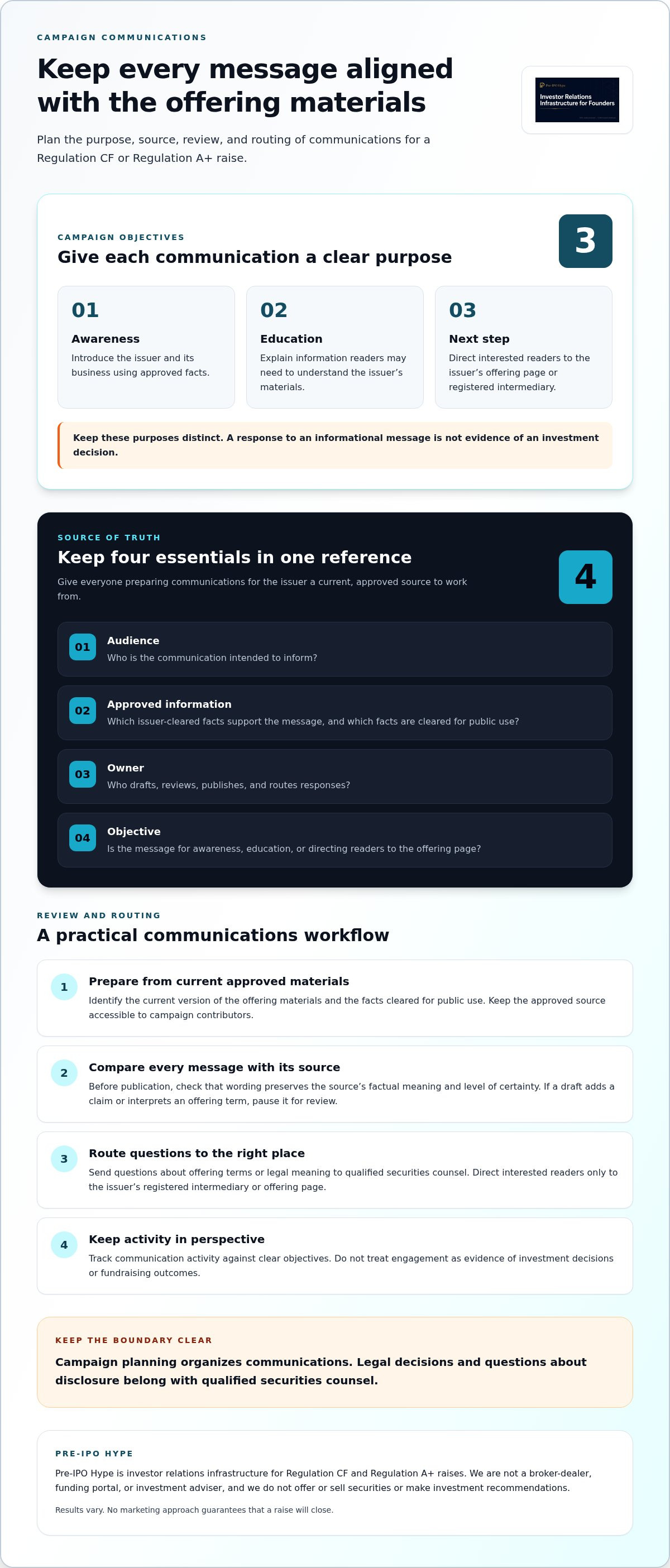
Define the purpose of each communication. Awareness introduces the issuer and its business using approved facts. Education explains information readers may need to understand the issuer’s materials. A next-step message can direct interested readers to the issuer’s offering page or registered intermediary. Keep these objectives distinct. A response to an informational message is not evidence of an investment decision.
List likely audience questions and locate the approved information that addresses each one. Use the issuer’s approved description to explain what the company does. If a question is not answered in the available materials, do not fill the gap with an assumption, unsupported projection, or claim about investor outcomes. Assign owners for drafting, approval, publication, and inquiry routing. Send questions about offering terms or legal meaning to qualified securities counsel.
Build a review process around the offering materials
Make current approved language and offering documents accessible to campaign contributors. Identify the current version so drafts are not based on outdated information. Before publication, compare each message with the relevant source materials. If a draft introduces a new claim or interprets an offering term, pause it for review rather than trying to resolve the issue through marketing edits.
Make the registered intermediary’s role clear in investor-facing communications. Regulation CF offerings are conducted through an SEC-registered intermediary. For either offering type, direct interested readers only to the issuer’s registered intermediary or offering page. Do not use campaign channels to receive or relay investment decisions. Refer legal requirements, disclosure questions, and decisions about proposed wording to qualified securities counsel.
- Audience: Who is the communication intended to inform?
- Approved information: Which issuer-cleared facts support it?
- Owner: Who drafts, reviews, publishes, and routes responses?
- Objective: Is the message for awareness, education, or directing readers to the offering page?
Record the answers in the source-of-truth document and update it when approved materials change. This gives contributors a practical reference for keeping communications aligned as campaign activity develops.
Prepare clear, consistent messages for a Regulation CF or Regulation A+ campaign
Plain language helps readers understand issuer-approved information without changing its meaning. It is an editing choice, not permission to add claims or alter offering details. Keep each message tied to information the issuer has approved. Use direct wording to explain what the company does, what the campaign communicates, and where readers can find offering information.
Every public campaign message should match the issuer’s approved source material. Apply this standard to email, web content, social posts, and other communications for the issuer. A useful edit makes a sentence easier to read while preserving its factual meaning and level of certainty. If a rewrite adds an implication that is not in the source, revise it or send it for review.
Create a message framework founders can use across channels
Organize draft language into separate categories: company background, offering information, campaign updates, and directions to the issuer’s offering page. This helps contributors avoid blending a general company description with offering details. For instance, an approved company description can explain the business in plain terms, while offering information should remain grounded in the issuer’s current approved materials.
Prepare answers to common questions using the same source material. If readers ask what the company does, use its approved description. If they ask about information not covered in the materials, do not guess, add a projection, or make a recommendation. Route unresolved questions through the issuer’s established process. Direct readers to the issuer’s registered intermediary or offering page when they need offering information.
Explain unfamiliar terms in ordinary language only when the explanation preserves their meaning. Avoid wording that implies a result is certain or suggests a particular investor outcome. Compare each draft with its source: does it say the same thing without adding a claim or strengthening a promise?
Plan review and correction for published communications
Agree on a review path before adapting messages for different channels. The issuer should identify who reviews content and who approves publication. Coordinate investor-facing materials with the issuer’s registered intermediary as appropriate. Refer legal interpretations and decisions about disclosure or offering language to qualified securities counsel.
Keep approved versions and publication locations in a record contributors can use. When copy is reused in an email, post, or web update, note which approved version it came from. This makes it easier to locate related communications if the issuer updates its information or identifies an error.
If copy is inaccurate or outdated, follow the issuer’s established correction process. Review where the wording appeared and handle corrections through the appropriate owner. Avoid adding an informal explanation that creates further claims. Refer legal questions about corrections or disclosure to qualified securities counsel. Clear language is useful only when it stays accurate across every version.
Compare owned, earned, and paid channels for offering communications
Choose channels based on the communication task and the review work it requires. Issuer-owned email and web content give the issuer control over wording and publication. Earned coverage is shaped by editorial decisions. Paid placements involve an agreed payment relationship and a publisher’s placement format. Each channel offers different ways to observe activity, but none establishes an investment decision or fundraising result.
Compare the options against the issuer’s objectives before planning campaign activity for the issuer. The table outlines practical differences to consider.
| Channel | Purpose and control | Review focus | Possible activity to track |
|---|---|---|---|
| Owned email and web content | Share issuer-controlled information and direct readers to the offering page. | Check copy against approved materials and verify that links lead to the issuer’s registered intermediary or offering page. | Delivery information, page visits, and link activity. |
| Earned coverage | Editorial coverage is decided by the publication, not purchased by the issuer. | Keep issuer-provided statements accurate and distinguish the publication’s reporting from issuer-authored content. | Coverage published and referral activity, where observable. |
| Paid placement | The issuer pays for specified placement or sponsored content. | Identify the payment relationship plainly and review the message and destination. | Placement delivery and referral activity, where reported. |
Use owned channels for information the issuer controls
An issuer’s website and email can provide a direct route to its information. A campaign email might summarize an issuer-approved update and link to the relevant offering page. Keep the wording aligned with current source materials. If those materials change, review related owned content through the issuer’s process before sharing it again. For Regulation Crowdfunding platform promotion, follow the compensation disclosure requirement described earlier.
Evaluate earned and paid activity transparently
Earned coverage and paid placement are different activities. A publication makes its own editorial decisions about earned coverage. A paid placement or sponsored article is purchased by the issuer, so state that plainly in the same paragraph. For example: “The issuer paid for this sponsored placement.” Do not describe paid material as independent editorial coverage.
When reviewing channel activity, note what was published and what could be observed, such as referral activity where reported. A placement may be delivered without generating visits, and a visit does not show what a reader thinks or intends to do. Keep channel reporting focused on communication activity, not assumptions about investor interest or the outcome of the raise.
Measure campaign activity without confusing engagement with fundraising outcomes
Campaign measurement is most useful when it answers a practical question: did a communication reach its intended audience, and was its message clear? Opens, page visits, link activity, and incoming questions are observable communication activity. They are not evidence that someone will invest, an indication of likely demand, or a forecast of how an offering will perform.
Choose indicators based on the issuer’s stated objectives. If the goal is to help readers find approved information, review relevant page visits and link activity. If the goal is to explain a topic, review the questions readers ask and whether the content addresses them clearly. Track interactions through the issuer’s documented process, and direct investment-related inquiries to the issuer’s registered intermediary or offering page.
Choose indicators that answer operational questions
Set the question before selecting a metric. For example, “Are readers reaching the offering information?” can be assessed through visits to the relevant page. “Are readers understanding this explanation?” may be informed by recurring questions or requests for clarification. Keep the review focused. A longer dashboard does not automatically provide better insight.
- Awareness: Review delivery or reach information available for the communication.
- Information access: Review visits and link activity for issuer-controlled pages.
- Clarity: Group repeated questions or points of confusion for content review.
Use patterns to improve how the issuer explains approved information, not to suggest that engagement signals an investment decision. If readers repeatedly ask about a subject, the issuer can consider whether approved materials explain it clearly. Send questions about legal meaning or offering terms to qualified securities counsel.
Keep campaign reporting factual and appropriately limited
Attribution tracking can organize engagement data by campaign activity. It may show which communication was associated with a page visit or inquiry, but it cannot establish that the communication caused an investment decision or predict an offering outcome. Report what was observed and how it was measured, without turning activity into a claim about future investment.
For example, a report may state that an email generated link activity if that is what the recorded data shows. It should not describe those clicks as committed investors, proof of demand, or evidence that the offering is likely to succeed. Keep observations separate from forecasts and promises.
Our Custom Investor CRM supports lead scoring and attribution tracking. Treat these as operational tools for organizing campaign information, not as a measure of investment intent or an outcome forecast.
For a practical discussion of campaign indicators and review steps, see fundraising workflow conversation.
Coordinate the campaign with the issuer’s intermediary, counsel, and support workflow
Clear handoffs help organize campaign activity without blurring responsibilities. The issuer owns its offering information and sets the approval process. Its registered intermediary has a separate role in the offering journey, while qualified securities counsel handles legal decisions. Campaign support should sit alongside these roles and follow the issuer’s agreed process.
For each planned communication for the issuer, use a consistent sequence:
- Confirm the materials. Identify the current issuer-approved information the draft can rely on, and make sure contributors are working from the same version.
- Assign the review. Name the person responsible for content review and approval. Coordinate with the registered intermediary and qualified securities counsel when their input is relevant.
- Prepare publication. Use the approved copy in the intended channel and check that directions for investors point only to the issuer’s registered intermediary or offering page.
- Monitor the communication. Record where the material appeared and review observable activity in line with the communication’s purpose.
- Route questions and updates. Send investor-facing offering questions through the issuer’s established process. Refer legal interpretations to qualified securities counsel.
Before publication, confirm that every handoff has an owner. The person who drafts a campaign email, for example, may not be the person who approves it or handles replies. Make those distinctions clear in the workflow. If issuer-approved information changes, pause reuse of affected copy until the issuer’s review process determines whether an update is needed.
Keep responsibilities visible throughout the workflow
A concise responsibility record can show who approves content, coordinates with the registered intermediary, publishes communications, monitors activity, and routes questions. Regulation CF and Regulation A+ have different processes, so tailor the handoffs to the issuer’s offering. Ask qualified securities counsel to resolve legal questions rather than relying on campaign contributors to interpret requirements.
Organizing these responsibilities is part of building the issuer’s campaign infrastructure. The fundraising technology stack can be considered in that context, with tools supporting the workflow rather than replacing the roles of the intermediary or counsel.
Make the next step useful and low pressure
A workflow discussion can focus on practical questions: Are content owners and approvers clear? Can contributors locate current approved materials? Is there a defined path for publication, monitoring, and question routing? These questions can help the issuer identify process gaps without making assumptions about investor interest or fundraising outcomes.
To discuss campaign workflow and coordination, schedule a fundraising workflow conversation.
Make the campaign workflow part of the operating plan
A raise campaign is easier to manage when communication responsibilities are part of the issuer’s broader operating rhythm. Decide how the team will keep materials current, review new communication needs, and pass questions to the right person. These habits can help the issuer maintain a clear process as circumstances change, without treating attention or engagement as a measure of investment decisions.
Keep the next step practical. A workflow discussion can help identify how campaign support fits alongside the issuer’s registered intermediary and qualified securities counsel, and where responsibilities need clearer ownership. Legal decisions remain with qualified securities counsel.
Use the fundraising workflow conversation to discuss a process that fits the issuer’s communications plan. Clear roles and a consistent review approach help founders prepare communications carefully as the raise progresses.
Frequently Asked Questions
Can a Regulation CF campaign use social media?
Yes, social media may be one channel for communications about a Regulation CF campaign. For example, an issuer can share a link to its offering page with information drawn from approved materials, after coordinating the post with its registered intermediary. A post does not establish investor suitability, interest, or an investment decision. Direct investors only to the issuer’s registered intermediary or offering page, and send legal questions to qualified securities counsel.
What should an issuer include in offering marketing materials?
Use clear, accurate messages based on issuer-approved materials. Keep company background separate from information about the offering so readers can tell which is which. Do not add terms, projections, or claims that are not in the approved information. For example, simplify a company description without changing its meaning or adding a prediction about future performance. Ask qualified securities counsel to address legal interpretations, and direct investors only to the issuer’s registered intermediary or offering page.
Does paid promotion of a Regulation Crowdfunding offering need a disclosure?
Yes. Anyone the issuer pays to promote the offering on the platform must disclose that compensation each time under Rule 205. For a paid placement or sponsored content, state plainly in the same paragraph that the issuer paid for the placement or content. Keep the description accurate, and coordinate campaign questions with the issuer’s registered intermediary and qualified securities counsel. Do not present paid material as independent editorial coverage.
How should founders choose between email, social media, and paid placements?
Choose channels based on the issuer’s communication objectives, the approved content available, the review process, and the ability to monitor activity. Email can deliver a direct update, while social media can share a short explanation or link. Paid placements involve a payment relationship, which should be disclosed plainly. Compare operational control and review needs, not assumed performance. Keep messaging consistent and direct prospective investors only to the issuer’s registered intermediary or offering page.
Can marketing engagement predict whether an offering will close?
No. Clicks, email responses, and page visits describe communication activity, not investment decisions or a completed raise. An issuer can review those observations to understand how people interact with campaign information, but engagement data cannot establish why someone acted or predict an offering outcome. Keep reporting factual and avoid treating clicks or responses as proof of demand. Results vary. No marketing approach guarantees that a raise will close.
Who should answer legal questions about a Regulation CF or Regulation A+ campaign?
Qualified securities counsel should address legal decisions and interpretations. Campaign support should operate alongside the issuer’s registered intermediary and counsel, without replacing either role. Keep public messages tied to approved materials, and route investor-facing questions about the offering through the issuer’s registered intermediary or offering page. If a reader asks what a disclosure means, do not interpret it in a marketing reply. Refer the question to qualified securities counsel.
Disclaimer
Educational only. Not investment, tax, or legal advice. Pre-IPO Hype is investor relations infrastructure for Regulation CF and Regulation A+ raises. We are not a broker-dealer, funding portal, or investment adviser, and we do not offer or sell securities or make investment recommendations. Any securities offering is made only by the issuer, through its own offering documents and, where required, a registered intermediary.


