
Reg CF Rules for Advertising: The Insider Playbook for Compliant Capital Raises in 2026
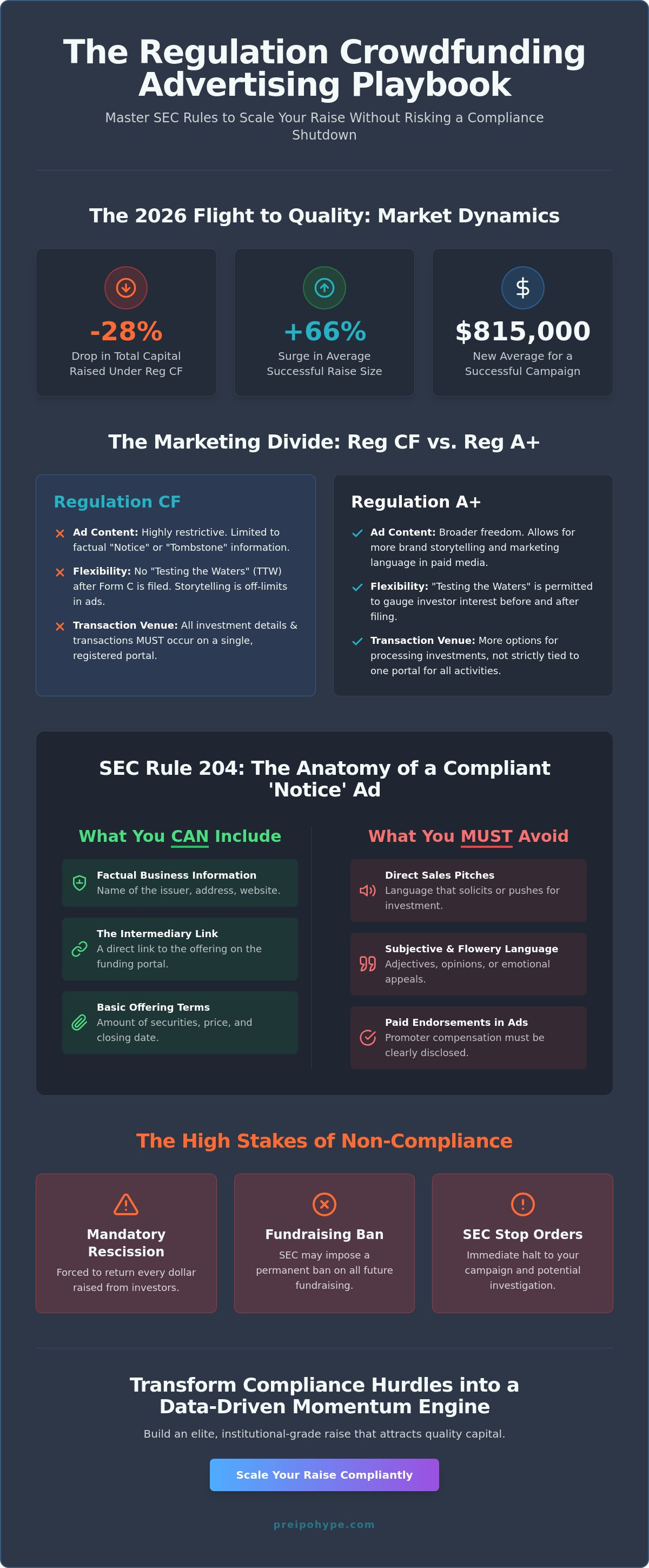
While the total capital raised under Regulation Crowdfunding dropped by 28% in early 2026, the average successful raise surged by 66% to $815,000. This data signals a clear flight to quality, where the winners are those who treat their raise like an elite institutional event rather than a generic crowdfunding campaign. You've likely felt the tension of this maturing market. It's the constant fear that a single non-compliant Facebook ad could trigger an SEC stop order or that your marketing spend is being wasted because you're confused about the Reg CF rules for advertising compared to Reg A+ limits.
You shouldn't have to choose between aggressive growth and legal safety. This insider playbook will show you how to master the intricate SEC advertising regulations to scale your raise without risking a compliance shutdown. We'll provide a clear list of dos and don'ts for your ad copy, a high-conversion strategy for cold traffic, and the specific framework needed to track investor attribution with precision. You're about to transform your compliance hurdles into a data-driven momentum engine that connects your vision with the capital it deserves.
Key Takeaways
- Master the specific constraints of SEC Rule 204 to build high-performance "Notice" ads that capture attention without crossing regulatory lines.
- Understand the Reg CF rules for advertising to ensure every paid endorsement and promoter communication includes the mandatory transparency disclosures.
- Synchronize Meta and Google Search strategies to capture high-intent traffic while keeping your messaging strictly within factual "tombstone" requirements.
- Deploy a custom investor CRM to solve the complex attribution puzzle; this provides the granular data needed to scale your raise while maintaining a clean audit trail.
- Learn how to engineer a compliant momentum engine that transforms your raise from a generic crowdfunding effort into an elite, institutional-grade event.
The 2026 Regulatory Landscape: Why Reg CF Advertising Rules Matter
In the high-velocity world of venture capital, ignorance isn't just a hurdle; it's a liability. Under Section 4(a)(6) of the Securities Act, Regulation Crowdfunding (Reg CF) advertising is defined as any communication that promotes a securities offering to the public. The stakes are immense. Non-compliance doesn't just mean a slap on the wrist. It can trigger mandatory rescission offers, where you're forced to return every dollar raised, or even result in a permanent ban from future fundraising. For the ambitious founder, these rules are the guardrails that keep your momentum from turning into a legal catastrophe.
With the annual cap set at $5 million, your ability to scale depends entirely on your marketing engine. However, you must navigate the fine line between "Testing the Waters" (TTW) and active offering communications. While TTW allows you to gauge interest before your Form C filing, the actual Reg CF rules for advertising become significantly more rigid once the campaign is live. The SEC's February 2026 guidance clarified that even platform switching requires a total cancellation and new Form C filing if any sales were made, proving that your initial advertising strategy must be flawless from day one.
To better understand how to navigate these complexities, watch this helpful video:
The Evolution of Equity Crowdfunding in 2026
Retail investor participation has reached a fever pitch, but the "dumb money" of previous cycles has vanished. Investors are now building sophisticated retail portfolios with institutional-grade scrutiny. While total capital raised in the market dropped 28% in Q1 2026, the average raise size climbed to $815,000. This "flight to quality" means your advertising must be more than just hype. Recent regulatory refinements have tightened the definition of general solicitation, focusing on the intent of the communication. If an ad feels like an offer, the SEC will treat it as such, making precision in your copy more valuable than ever.
Reg CF vs. Reg A+: The Marketing Divide
Many founders mistakenly apply Reg A+ marketing logic to their Reg CF raises, which is a dangerous shortcut. Reg CF is significantly more restrictive regarding "Notice" content. While Reg A+ allows for broader storytelling in paid media, Reg CF mandates that all substantive deal terms and investment transactions occur exclusively on a single regulated platform. The Intermediary Rule in 2026 mandates that all substantive deal terms and investment transactions must occur exclusively on a single registered funding portal or broker-dealer platform to ensure centralized transparency. You can't close a deal in a DM; you have to drive every click back to the source.
SEC Rule 204: The Anatomy of a Compliant 'Notice' Ad
SEC Rule 204 isn't a suggestion; it's the operational manual for your paid media. The SEC designed the final crowdfunding advertising rules to ensure that investors find the meat of the deal on the intermediary portal, not in a flashy Instagram story. Under these guidelines, your ads must function as a "Notice" rather than a direct sales pitch. This means you're strictly limited to factual data points. Any deviation into subjective claims or flowery descriptions can flag your campaign for a compliance audit before you've even gained traction.
The core of a compliant ad is the "tombstone" format. You must include a statement that the offering is being made, the name of the intermediary, and a direct link to the portal where your Form C is hosted. If you're looking to scale while staying within these bounds, you can discuss your ad strategy with a specialist to ensure your creative hits the mark. Every ad you run must point back to that central source of truth on the portal, as the SEC wants to ensure retail investors have access to all risk disclosures before they commit capital.
What You CAN Include in Your Reg CF Ads
Precision is your best friend here. You're allowed to state the name of the issuer and the total amount of securities being offered. You must also disclose the nature of the securities, whether you're offering Equity, a SAFE, or a Revenue Share agreement. A brief, factual description of your business is permitted, but it must remain clinical. For example, "We manufacture modular carbon capture units" is acceptable; "We are the world's most revolutionary climate tech company" is a liability. The Reg CF rules for advertising demand that the portal remains the sole source of substantive investment information.
The 'Only Notice' Trap: Common Copywriting Mistakes
Founders often fall into the trap of using traditional direct-response copywriting that works in other sectors. In the world of Reg CF, terms like "guaranteed returns" or "massive growth potential" are strictly prohibited in the ad creative itself. Your call-to-action (CTA) must also remain neutral. Using "Invest Now" can be interpreted as coercive by regulators. Instead, stick to "Learn More" or "View Offering Details." While you must drive traffic to the portal to close the deal, you can utilize Foundation Infrastructure to capture leads and build your investor database before they hit the portal. This allows you to maintain a clean audit trail while building a community of interest. Mastering these Reg CF rules for advertising ensures your marketing spend builds a foundation for long-term capital success rather than a legal headache.
Navigating SEC Rule 205: Promoters and Paid Endorsements
Rule 205 is where many high-profile raises hit a wall. In the eyes of the SEC, a "promoter" is any person who receives compensation, direct or indirect, to promote an issuer's offering on the intermediary's platform or via any Rule 204-compliant notice. This includes anyone from a high-tier financial influencer to a dedicated marketing agency. The core mandate is transparency. If money or equity is changing hands, the potential investor must know before they click. This isn't just about ethics; it's about maintaining the integrity of the capital markets.
The danger of unfiltered hype is real. While the Reg CF rules for advertising allow for third-party promotion, they do not allow for hidden incentives. Every single communication from a paid promoter must clearly disclose that they are being compensated. Failing to do this doesn't just put the promoter at risk. It creates a liability for the issuer that could lead to a permanent fundraising ban or a forced rescission of capital. You're responsible for the actions of those you hire to represent your brand. It's a high-stakes game where compliance is the only way to win.
Influencer Marketing for Capital Raises
Scaling with influencers requires more than just a large following. Your contracts must explicitly mandate Rule 205 compliance, requiring specific disclosure language in every social media caption and video overlay. This isn't just about a simple hashtag. It's about a clear, conspicuous statement that the post is a paid promotion for a securities offering. To manage this complexity, elite raises utilize a Custom Investor CRM to track attribution. This ensures every lead generated by an influencer is logged with the appropriate compliance metadata, protecting your raise from future regulatory scrutiny.
Founder Outreach and the 'Founder Brand'
Founders often wonder if they can leverage their personal LinkedIn profiles to drive momentum. The answer is yes, but with strict boundaries. You can post "business as usual" updates about hitting milestones, shipping products, or new hires. However, the moment you mention the raise, you're entering the territory of offering communications. The Reg CF rules for advertising require these posts to follow the Rule 204 "Notice" format once the Form C is filed. Smart founders use a pre-emption strategy. They build their personal brand and audience months before the filing. This allows you to communicate with a warm community that already understands your vision, making the eventual compliant notice far more effective.
Omnichannel Advertising Strategy: Scaling Within the Lines
Strategy is the difference between a stalled campaign and a $5 million sell-out. To achieve the latter, you must deploy an omnichannel approach that respects the Reg CF rules for advertising while maximizing every dollar of your budget. Meta remains the primary engine for retail volume. On Facebook and Instagram, your creative must master the "Notice" format by using high-impact, factual visuals. Since you can't use subjective hype, focus on the problem your company solves and the specific terms of the security. This creates a filter that attracts serious investors while keeping the SEC at bay.
Google Search offers a different advantage by capturing high-intent investors. These are individuals actively searching for opportunities in specific sectors like "climate tech startups" or "AI equity crowdfunding." By bidding on these terms, you position your compliant notice in front of a warm audience. Success here requires a long-term view. Most retail investors don't commit on the first click. A 60-day attribution window is critical; you need to track how an initial search click eventually converts after multiple touches. You can book a strategy session to optimize your omnichannel tracking and ensure your spend is driving actual capital, not just vanity traffic.
Email Marketing and CRM Integration
Your database is your most valuable asset. While social ads drive awareness, email marketing drives the close. You can scale your reach by leveraging the Invst Guru newsletter, which puts your offering in front of a pre-vetted investor base. Once leads enter your ecosystem, automation takes over. You should deploy compliant follow-up sequences for users who viewed the portal but haven't committed. Use lead scoring to identify the "whales" in your retail pool. If an investor has viewed your Form C multiple times, they require a different level of outreach than a casual browser.
The Role of Social Proof in Reg CF Marketing
Social proof is the ultimate momentum builder, but it must be rooted in data. The "Amount Raised" is a factual metric you are legally allowed to broadcast. As your raise climbs toward its cap, highlighting this number creates a natural sense of urgency and exclusivity. You can also showcase press coverage, provided you link to the original source and don't add your own embellishments. Community management is also a compliance task. You must moderate comments on your ads to ensure no one is making unsubstantiated claims or providing unauthorized investment advice. In the 2026 landscape, a well-moderated community is a signal of institutional-grade quality. Mastering these Reg CF rules for advertising allows you to turn compliance into a competitive advantage.
Engineering Momentum: How Pre-IPO Hype Automates Compliance
Scaling a raise to the $5 million cap isn't just about high-quality creative; it's about the technical architecture supporting every click. The winners in the 2026 market are those who leverage Reg CF marketing services to automate the rigid Reg CF rules for advertising. While the average raise size climbed to $815,000 in early 2026, breaking past the $1 million mark requires a level of data precision that manual spreadsheets simply can't provide. You need a system that treats compliance as a blueprint for growth rather than a list of restrictions.
The Custom Investor CRM functions as your "Black Box" for tracking omnichannel attribution. It captures every touchpoint from a compliant notice ad on Meta to the final conversion on the funding portal. This granular visibility allows you to see which specific factual business descriptions are driving the most high-intent traffic. By marrying your Reg CF rules for advertising with institutional-grade tech, you ensure that every dollar of your marketing spend is backed by a clean audit trail. This is how you build the trust required to secure larger check sizes in a maturing market.
Your Foundation Infrastructure is the final piece of the puzzle. It ensures your pre-portal landing pages and data rooms meet 2026 standards for security and transparency. These digital assets act as a bridge, warming up potential investors with factual, compliant information before they land on the intermediary's platform. This seamless transition is critical for maintaining the momentum of your raise and preventing the drop-off often seen in poorly engineered campaigns.
Strategic Advisory for Elite Founders
Pre-IPO Hype bridges the gap between your legal counsel's strict requirements and your marketing team's execution. We provide custom roadmaps for high-growth companies that don't just want to raise capital; they want to build a movement. Our advisory services focus on leveraging institutional-grade tools to manage retail-facing campaigns. This ensures that your brand remains exclusive and authoritative while reaching the broadest possible audience within the limits of the law.
Final Steps: Launching Your Compliant Raise
Success is found in the details of the final 48 hours before launch. Your pre-launch checklist must include a total audit of all ad creative to ensure Rule 204 compliance and a verification of all promoter disclosure statements under Rule 205. Once the campaign is live, the work shifts to ongoing monitoring. You must adjust your creative in real-time based on performance data while staying strictly within the "Notice" format. Ready to scale your capital raise with a system built for 2026? Consult with our experts at Pre-IPO Hype to engineer your compliant momentum engine today.
Secure Your Future with Compliant Momentum
The 2026 landscape demands a shift from amateur hype to institutional-grade execution. By mastering the Reg CF rules for advertising, you transform legal constraints into a rigorous framework for scalable, data-driven growth. We've explored how Rule 204 "Notice" ads and Rule 205 promoter disclosures protect your raise while our proprietary Custom Investor CRM tracks the omnichannel attribution that drives high-value conversions. Success in this maturing market belongs to the founders who treat their retail raise with the same precision as a late-stage institutional round.
Pre-IPO Hype has already facilitated over $100M in funding and helped more than 230 companies scale their visions to reality. You don't have to navigate these complex regulatory waters alone. Our systems are specifically engineered to automate compliance and bridge the gap between legal safety and aggressive market momentum. It's time to stop guessing and start engineering your success.
Scale Your Raise with Pre-IPO Hype's Compliant Marketing Systems
The opportunity to lead your sector is now within reach. Act decisively and let's build your momentum today.
Frequently Asked Questions
Can I use 'hype' language in my Reg CF ads if it's true?
No, you cannot use "hype" language in your ads, regardless of whether the claim is technically true. Rule 204 requires all notice communications to be factual and clinical in nature. Subjective claims like "groundbreaking" or "industry leading" invite regulatory scrutiny that can derail your momentum. The SEC's primary goal is to ensure investors make decisions based on the full disclosure found in your Form C, not a flashy headline.
Does every social media post about my company count as an advertisement?
Not every post is an advertisement, but any post mentioning the offering is considered an "offering communication." Standard business updates regarding product launches or new hires are generally safe. However, once you mention the raise, the post must comply with the Reg CF rules for advertising by following the limited "Notice" format and directing traffic to the intermediary portal. It's a fine line that requires consistent moderation.
What are the specific disclosure requirements for paid influencers in a Reg CF raise?
Paid influencers must provide a clear and conspicuous disclosure of their compensation under Rule 205. This isn't just a simple hashtag; it's a specific statement that they are being paid to promote a securities offering. You are responsible for ensuring their content remains factual and includes a direct link to your Form C filing on the funding portal. Failure to disclose this relationship can lead to serious regulatory consequences for your campaign.
How do Reg CF advertising rules differ from Reg A+ rules in 2026?
Reg CF advertising is far more restrictive than Reg A+ because it's limited to "Notice" style communications. While Reg A+ allows for broader general solicitation and more creative storytelling in paid media, Reg CF mandates that all substantive deal terms and the actual transaction occur exclusively on a single regulated portal. In 2026, the SEC maintains this divide to ensure that retail investors are protected by centralized information on the funding portal.
Can I mention the names of famous investors who have already committed to my raise?
You should avoid mentioning specific investor names in your Rule 204 notice ads. The SEC limits notice content to the issuer's name, the terms of the offering, and a factual business description. Including "celebrity" or "famous" investors in an ad is often viewed as promotional hype rather than a factual notice. This type of social proof is better suited for the intermediary portal where the full context of the raise is available.
What happens if the SEC finds my advertising to be non-compliant?
Non-compliance can lead to a mandatory rescission offer where you must return all funds to your investors. The SEC also has the authority to issue significant fines or implement permanent bans on your ability to raise capital in the future. It's a high-stakes scenario that can effectively end a company's growth trajectory. Maintaining a clean audit trail through a custom investor CRM is the best way to prevent these outcomes.
Is email marketing to my existing customer list subject to Rule 204?
Yes, email marketing regarding your raise is subject to the same Rule 204 restrictions as paid social ads. If the email mentions the offering, it must follow the "Notice" format and include the mandatory disclosures. You can still use your Reg CF rules for advertising knowledge to craft compliant, high-conversion emails that drive your existing customer base to the portal for the full disclosure and investment process.
How much can I spend on Reg CF advertising relative to my raise goal?
There is no regulatory cap on your advertising budget, only on the content of those ads. While the market saw a contraction in early 2026, the average raise size increased to $815,000, suggesting that quality companies are investing more in sophisticated, compliant acquisition. Your spend should be dictated by your cost per investor and your total raise goal rather than a specific legal limit. Focus on scaling your spend as you hit your funding milestones.
Disclaimer
Educational only. Not investment, tax, or legal advice. Pre-IPO Hype is investor relations infrastructure for Regulation CF and Regulation A+ raises. We are not a broker-dealer, funding portal, or investment adviser, and we do not offer or sell securities or make investment recommendations. Any securities offering is made only by the issuer, through its own offering documents and, where required, a registered intermediary.


