
Reg CF: The Founder’s Guide to Regulation Crowdfunding in 2026
Why should your company's growth depend on the whims of three partners at a single VC firm when the 2026 private market is being democratized by the masses? For years, founders felt trapped by institutional gatekeepers, but the landscape shifted permanently when the SEC solidified the reg cf limit at $5 million. You've likely realized that traditional venture capital is often a bottleneck that stifles the very innovation it claims to fund. The old guard wants board seats and control; you want momentum and a community that shares your vision.
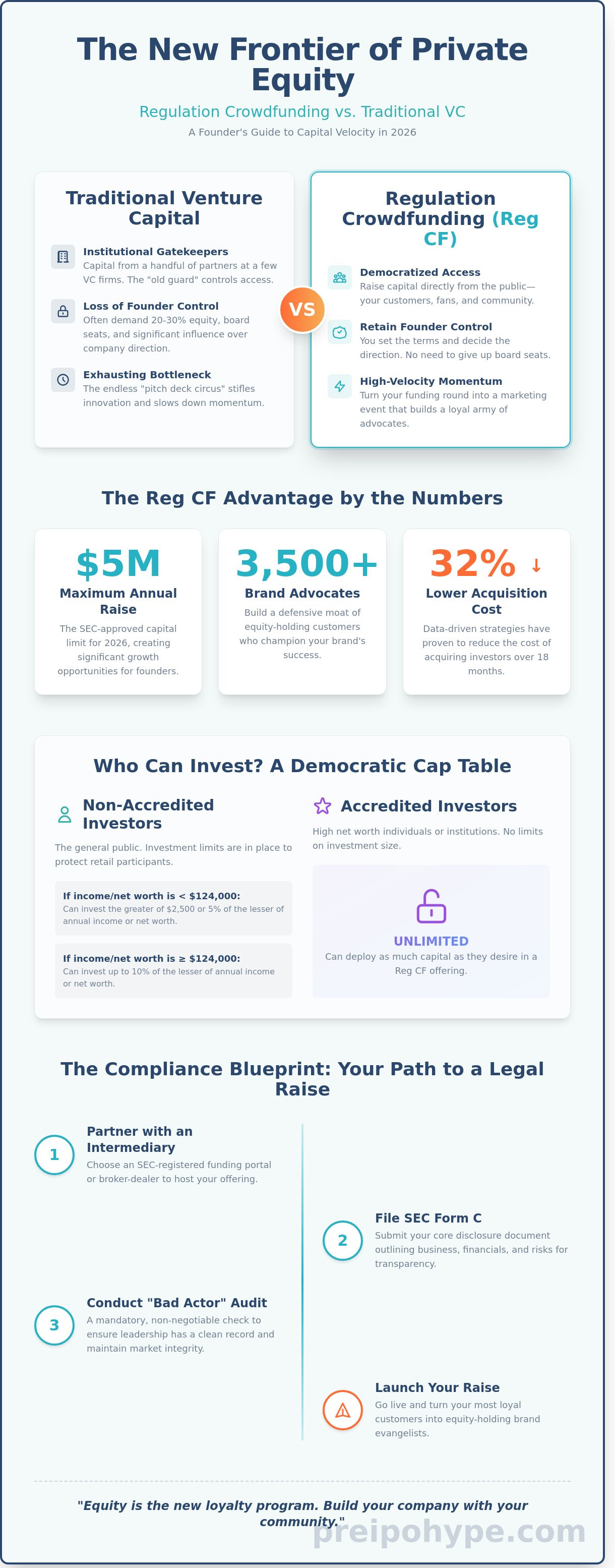
This guide ensures you master the mechanics of Regulation Crowdfunding to turn retail interest into a high-velocity capital engine. We'll show you how to maintain a clean, manageable cap table while building a loyal army of 3,500 brand advocates. You will learn the exact data-driven attribution strategies that helped top-tier founders reduce investor acquisition costs by 32% over the last eighteen months. We're diving into the technical blueprint for a successful raise, covering everything from compliance anxiety to the secondary liquidity options that define the modern private market.
Key Takeaways
- Break free from the VC bottleneck and reclaim founder control by leveraging the democratized landscape of early-stage private equity.
- Learn how to turn your funding round into a high-velocity marketing event that fuels both capital acquisition and long-term brand loyalty.
- Avoid the common pitfalls of a reg cf launch by mastering the investor journey and the critical 60-day attribution window.
- Implement a proven five-phase roadmap designed to build high-intent waitlists and generate the "calculated momentum" required for an oversubscribed raise.
- Discover the insider tactics used to bridge the gap between private secrecy and public opportunity to scale your company toward a major liquidity event.
What is Reg CF? The New Frontier of Private Equity
Private equity is no longer a gated community for the 1%. The old guard of Silicon Valley and Wall Street held the keys to the kingdom for decades, but the walls finally crumbled. Regulation Crowdfunding, or reg cf, is the regulatory bridge that allows startups to raise capital directly from the public. It is the democratization of the ground floor. By 2026, this asset class has evolved from a niche alternative into a mainstream institutional-grade fundraising tool for high-growth companies. It is the final frontier where retail investors and founders meet to build wealth together.
The primary shift occurred when the SEC realized that innovation moves faster than traditional banking. Founders now use this mechanism to bypass the exhausting "pitch deck circus" of traditional VC firms. To grasp the full scope of this shift, you should understand What is Regulation Crowdfunding (Reg CF)? and how it serves as a statutory exemption from registration for certain small business offerings. In 2026, it's the primary engine for companies seeking to turn their most loyal customers into equity-holding brand evangelists. Equity is the new loyalty program.
To better understand this concept, watch this helpful video:
The Legal Mechanics: SEC Form C and Beyond
Raising capital under reg cf requires a specific legal roadmap. The cornerstone is the SEC Form C, a disclosure document that outlines your financial health, business model, and risk factors. In 2026, the annual aggregate limit for these raises stands at $5 million; a significant jump from the original $1.07 million cap set back in 2016. Founders must partner with an SEC-registered intermediary, typically a funding portal or a broker-dealer, to host the offering. These platforms act as the digital marketplace for your shares. Before you launch, you must conduct a mandatory "Bad Actor" audit. This check ensures that no covered person in your company has been involved in securities-related fraud or certain criminal convictions within the last 10 years. It is a non-negotiable step to maintain the integrity of the private markets.
Accredited vs. Retail Investors in Reg CF
The beauty of a reg cf offering is its inclusivity. Unlike Regulation D offerings, which often exclude the general public, this pathway welcomes everyone. However, the rules for participation are tiered to protect the market. Non-accredited investors face specific limits based on their annual income or net worth. If an investor earns less than $124,000 annually, they are generally capped at the greater of $2,500 or 5% of their annual income. For those earning more, the limit is 10%. Conversely, accredited investors have zero investment limits in a crowdfunding raise. They can deploy as much capital as they desire. This mix creates a powerful cap table. Having 2,000 retail investors isn't just a list of names; it's a defensive moat. These shareholders don't just hold stock; they buy your products, defend your reputation on social media, and drive the "hype" that fuels late-stage valuations. It is a strategic alliance that traditional venture capital simply cannot replicate.
- $5 Million: The maximum annual raise limit for 2026.
- Form C: The essential disclosure filing for SEC transparency.
- Intermediaries: The registered portals that facilitate the transaction.
- Secondary Liquidity: The growing market for trading these private shares.
The Strategic Advantages of Regulation Crowdfunding
Why beg for a seat at the Sand Hill Road table when you can build your own? Traditional venture capital often carries a heavy price, specifically the loss of 20% to 30% of your company before you've even hit scale. By utilizing reg cf, you bypass the gatekeepers and go straight to the people who actually use your product. This isn't just about the capital; it's about maintaining founder control. You set the terms, you keep the board seats, and you decide the direction of the ship. In 2026, the most resilient companies are those owned by their users, not by a handful of partners in a Menlo Park office.
Treating your raise as a massive marketing event is the ultimate growth hack. A 90-day campaign doesn't just fill the bank account; it creates an army of 5,000 brand ambassadors who are financially incentivized to see you win. Data from 2025 indicated that retail investors are 3.5 times more likely to refer new customers than standard users. You're effectively getting paid to acquire your most loyal customers. This creates a feedback loop where the capital fuels the marketing, and the marketing drives the sales that justify your next round.
The 2026 market demands proof of concept and proof of "hype." A successful raise under the rules of Regulation Crowdfunding provides an undeniable valuation benchmark. It tells the world exactly what the market is willing to pay. This public validation is a powerful weapon when you eventually sit down for a Series A or move toward a Reg A+ offering. You aren't guessing your worth; you're pointing to a completed transaction involving thousands of participants. As you track private market momentum, you will notice that the companies with the strongest retail backing often command the highest premiums during institutional rounds.
Valuation and Momentum
Setting a valuation that attracts "unicorn hunters" requires a balance of ambition and accessibility. In the 2026 cycle, investors look for entry points that suggest a 10x path within five years. You create investment velocity by engineering a "hype" cycle that rewards early movers with exclusive perks or tiered pricing. Valuation benchmarks in the 2026 landscape function as a vital price-discovery anchor that stabilizes founder equity against the sudden swings of mid-decade market volatility. This momentum ensures your round closes fast, leaving the market hungry for more.
Building a Clean Cap Table
The myth that reg cf creates a "messy" cap table died years ago. By using Special Purpose Vehicles (SPVs), you can bundle 2,000 individual investors into a single line item on your cap table. This keeps your ownership structure lean and attractive to future institutional investors who hate complexity. Professional transfer agents now handle the heavy lifting of investor records, tax documents, and distributions with 99.9% accuracy. This institutional-grade infrastructure does more than just organize your current raise; it prepares your company for the reporting rigors of a future IPO. You are building the foundation of a public company while you're still in the growth phase, ensuring that when the exit window opens, you're ready to jump through it without a single administrative delay.
The Investor Acquisition Challenge: Why Most Raises Fail
The graveyard of failed reg cf campaigns is littered with founders who believed a platform launch was a marketing strategy. It's a fatal mistake. Portals provide the regulatory plumbing; they don't provide the water. Data from 2024 indicates that 63% of campaigns failing to reach their minimum goal relied solely on organic portal traffic. You're competing with thousands of other deals. Standing out requires a tactical siege, not a passive listing.
The investor journey isn't a straight line. It's a 60-day cycle of psychological conditioning. Most retail participants require 7 to 12 touchpoints before they commit capital. They see an ad, browse your site, read a newsletter, and check your social proof before the first dollar moves. If your attribution model doesn't track this 60-day window, you're flying blind. You'll likely kill ads that are actually generating high-value leads just because they didn't convert on the first click.
Success in this space demands a hybrid approach. You need institutional authority to build trust and retail energy to drive momentum. High-net-worth individuals want to see a crowd; the crowd wants to see professional validation. This creates a "hype" cycle that isn't just noise. It's a legitimate financial indicator of market demand. When these two forces align, you don't just hit your cap; you build a brand army.
Founders often question if the marketing spend is worth the capital. If you spend $40,000 to raise $1,000,000, your cost of capital is 4%. This is significantly cheaper than the 10% to 15% equity kickers often demanded by predatory private lenders. It's an investment in your company's permanent capital base and future secondary market liquidity.
The Need for a Custom Investor CRM
Standard sales CRMs like HubSpot or Salesforce struggle with the nuances of SEC-compliant investor funnels. They aren't built to track the specific heat map of a reg cf prospect. You need a system that segments leads by their potential check size and engagement level. High-net-worth prospects require a white-glove digital experience, while retail leads need automated, high-energy touchpoints. You can streamline this by integrating your raise with Pre-IPO Hype’s custom marketing systems, ensuring no lead falls through the cracks of the compliance window.
Omnichannel Mastery in Fundraising
Facebook ads are the floor, not the ceiling. To win in 2026, you must penetrate elite insider circles and high-authority newsletters. This is where "Invst Guru" comes in, providing a direct line to pre-qualified capital that already understands the private market landscape. Don't guess which channels are working. You should Ask our CEO about our 60-day attribution tracking model to see exactly where your capital is coming from. Mastering multiple channels ensures that your message is inescapable to the right people at the right time.
The Reg CF Roadmap: 5 Steps to a Successful Launch
Launching a successful reg cf campaign in 2026 isn't a matter of luck; it's a high-stakes engineering project. You aren't just asking for capital. You're building a community of brand evangelists who own a piece of your future. To hit the $5 million cap, you need a sequence that balances legal compliance with aggressive market momentum. Most founders fail because they treat the launch like a press release rather than a military operation. Success follows a specific, five-phase trajectory:
- Phase 1: Foundation Setup. This starts with your two-year GAAP-compliant financial audit. By January 2026, the SEC has tightened its scrutiny on valuation justifications. You'll need your Form C filed and your story framework locked.
- Phase 2: The "Hype" Phase. You don't launch to a cold audience. You build a pre-launch waitlist of 10,000 leads. This ensures that when the "Invest" button goes live, you hit your minimum escrow within hours, not weeks.
- Phase 3: Launch. Execute an omnichannel blitz. You want your target investors seeing your brand on LinkedIn, Instagram, and specialized financial newsletters simultaneously.
- Phase 4: Scaling. Once the initial surge tapers, use ROI data to identify high-converting channels. If your Cost Per Investor (CPI) is under $45, you pour fuel on that fire to maintain a 3.2x return on ad spend.
- Phase 5: Post-Raise. Shift into investor relations. You're preparing these stakeholders for the next liquidity event, whether that's a secondary market listing or a Series B round.
Pre-Launch: The "Foundation" Infrastructure
You must create an "Elite Insider" feel before the first dollar is committed. Investors want to feel they've discovered a hidden gem before the general public. A high-converting video funnel is your most powerful tool; data from 2025 shows that campaigns with a 90-second "vision" video see a 22% higher conversion rate in the first 48 hours. Precision in your Form C drafting is non-negotiable. Even a minor discrepancy in your capitalization table can lead to a 30-day SEC delay, killing your momentum.
Execution: Scaling the Raise
Scaling requires ruthless A/B testing. We test at least 12 different ad creatives in the first week to find the winning hook. Urgency is your best friend here. Leveraging news about secondary liquidity or upcoming valuation benchmarks drives investors to act now rather than "watching" the campaign. Keep the pulse steady with weekly updates. Founders who post data-driven updates twice a week raise 40% more capital than those who remain silent. It's about maintaining the "ground floor" excitement through the entire 90-day window.
Pre-IPO Hype: Your Partner in Capital Velocity
Raising capital is rarely about who has the loudest ad. It's about who controls the narrative of momentum. At Pre-IPO Hype, we don't just run ads for your reg cf offering. We engineer calculated momentum. This distinction is the difference between a stalled campaign and a viral funding round that hits its maximum cap months ahead of schedule. Since our inception, we've facilitated over $100M in capital for more than 230 high-growth companies. We understand the institutional mechanics required to make a private offering feel like an inevitable public success.
Our advantage lies in a proprietary infrastructure designed for the 2026 market. We deploy a custom CRM built specifically for investor relations, ensuring no lead goes cold. Our omnichannel reach spans across social, email, and direct investor networks. This creates a surround-sound effect that moves prospects from curiosity to capital with surgical precision. We utilize real-time data to pivot strategies every 24 hours. This ensures your cost per acquisition stays low while your velocity stays high. We don't guess. We execute based on millions of data points from successful exits.
The transition from a private startup to a public-ready powerhouse requires more than just a bank balance. It requires a shift in how the market perceives your value. We focus on unicorn hunting by positioning your brand as the next logical step for elite investors. Our team acts as the informed insider, guiding you through the complexities of secondary liquidity and cap table management. We bridge the gap so you can focus on scaling your operations while we scale your investor base.
Beyond the Raise: Investor Relations and Advisory
Securing funds is only the first step on the path to a liquidity event. We provide strategic guidance for late-stage growth, helping you establish valuation benchmarks that stand up to institutional scrutiny. We analyze your 2026 growth projections against current market multiples to ensure your valuation is both attractive to investors and sustainable for future rounds. This data-driven approach removes the guesswork from your capital strategy. Our team prepares you for the final frontier of wealth creation by professionalizing your investor communications. To begin your journey, schedule a 30-minute strategy session to map your 2026 raise roadmap.
The Elite Insider Network
Founders who partner with us gain immediate access to the Invst Guru newsletter. This is our direct line to a hungry network of investors who move markets. This network provides immediate traction, often filling a significant percentage of a round before the general public even sees the offer. Our omnichannel outreach is the industry standard for reg cf because it creates a sense of exclusivity that generic platforms cannot replicate. We don't just blast a list; we cultivate a community of high-net-worth individuals who view your success as their own. Join the movement today and bridge the gap to public opportunity. Your 2026 exit starts with the momentum we build together right now.
Capture Your Momentum in the Private Markets
By 2026, the landscape of capital raising has shifted from gated boardrooms to a democratized digital frontier. Mastering reg cf is no longer optional for founders who demand rapid growth and secondary liquidity. You've seen the roadmap; now you need the engine. Success depends on converting passive interest into committed capital through a rigorous investor acquisition process. Most campaigns stall because they lack the data-driven precision required to scale.
Pre-IPO Hype bridges this gap by functioning as your informed insider. We've facilitated $100M+ in funding and scaled 230+ companies through our proprietary Custom Investor CRM technology. We don't just launch campaigns; we engineer capital velocity. The opportunity to join the elite circle of high-growth ventures is within your reach if you act decisively. Don't let your valuation sit stagnant while the market moves forward.
Join the Elite: Start Your Reg CF Journey with Pre-IPO Hype
The next great liquidity event is being built right now. It's time to take your place at the ground floor of the new economy.
Frequently Asked Questions
What is the maximum amount a company can raise under Reg CF in 2026?
You can raise a maximum of $5 million within a 12 month period under Reg CF. The SEC adjusted this limit from $1.07 million in 2021 to give founders more room to scale without the heavy compliance costs of a full public offering. This $5 million cap provides enough runway for most early stage companies to reach their next major valuation benchmark or a Series A round.
Can anyone invest in a Regulation Crowdfunding offering?
Yes, Reg CF allows both accredited and non-accredited investors to buy equity in your company. This democratized access means you can turn your customers and social media followers into a loyal army of shareholders. While non-accredited individuals are limited by their annual income or net worth, the door to the ground floor is officially open to the general public for the first time in history.
How long does a Reg CF campaign typically last from start to finish?
A typical reg cf campaign takes 4 to 6 months from the initial legal filing to the final distribution of funds. You'll spend roughly 60 days on pre-launch preparation and financial reviews before going live for a 60 to 90 day fundraising sprint. Speed is vital in the private markets because maintaining momentum is the only way to ensure your round closes at the target amount.
Do I need audited financial statements for a Reg CF raise?
You only need audited financials if you've previously raised capital through crowdfunding and are now targeting more than $1.235 million. For first-time issuers aiming for the $5 million limit, reviewed financial statements from an independent CPA are usually sufficient. This rule keeps the entry costs low for startups while providing the institutional-grade transparency that sophisticated investors expect before they commit their capital.
What is the difference between Reg CF and Reg A+?
The primary difference lies in the capital cap and the level of SEC scrutiny. Reg CF allows for a $5 million raise with a relatively fast launch timeline, while Reg A+ permits up to $75 million but requires a "mini-IPO" process that can take 8 months to clear. Think of reg cf as the high-speed gateway for early growth and Reg A+ as the vehicle for late-stage expansion.
Are Reg CF shares immediately tradable on a secondary market?
No, investors must generally hold their Reg CF shares for at least 12 months before selling them on a secondary market. There are specific exceptions for transfers back to the company, to accredited investors, or to family members in the case of death or divorce. This lock-up period ensures that the initial hype surrounding your launch matures into long-term support as the company builds real value.
What are the ongoing reporting requirements after a successful Reg CF raise?
You must file an annual report on Form C-AR within 120 days of your fiscal year-end. This report updates your investors on the company's financial health and progress toward the milestones promised during the raise. It's a critical part of maintaining the "insider" relationship with your cap table and sets the stage for future liquidity events or larger funding rounds in the future.
How much does it cost to market a Regulation Crowdfunding campaign?
Expect to budget between 5% and 15% of your total raise goal for marketing and lead generation. If you're chasing a $1 million raise, a $100,000 investment in digital ads and video content is the standard for building necessary momentum. High-performing campaigns treat this spend as a strategic move to capture market share and prove that their brand has the "hype" required to win.
Disclaimer
Educational only. Not investment, tax, or legal advice. Pre-IPO Hype is investor relations infrastructure for Regulation CF and Regulation A+ raises. We are not a broker-dealer, funding portal, or investment adviser, and we do not offer or sell securities or make investment recommendations. Any securities offering is made only by the issuer, through its own offering documents and, where required, a registered intermediary.


