
Regulation A+ vs Regulation CF: The Insider Guide to Choosing Your Capital Vehicle in 2026
In the 2026 capital markets, the difference between a unicorn trajectory and a stagnant cap table isn't just your product; it's the regulatory engine you choose to fuel your momentum. Choosing between Regulation A+ vs Regulation CF is no longer a back-office legal decision. It's a front-facing marketing strategy. You likely feel the pressure of the 2021 SEC limit increases, where Reg CF jumped to $5 million and Reg A+ hit $75 million, yet the fear of a broken raise that fails to hit its minimum keeps most founders paralyzed.
It's true that the legal jargon can feel like a barrier designed to keep you out of the elite circles. We're here to change that. This guide promises to hand you the insider framework needed to select the capital vehicle that best fuels your company's unique hype cycle. You'll gain a clear decision matrix for your next round, understand the exact marketing infrastructure required for each tier, and build the confidence to bypass traditional gatekeepers. We're diving into the data-driven reality of conversion costs and the strategic leverage of secondary liquidity.
Key Takeaways
- Master the strategic mechanics of Regulation A+ vs Regulation CF to identify which vehicle best fuels your company’s 2026 growth trajectory.
- Decode the "Audit Hurdle" and SEC reporting requirements to ensure your financial infrastructure is ready for a high-stakes Tier 2 raise.
- Learn how to engineer an omnichannel marketing engine that optimizes your cost-per-investor while dominating the digital landscape.
- Identify the hidden operational costs—from GAAP audits to filing fees—that often catch founders off guard during the scale-up phase.
- Discover the insider blueprint for converting retail momentum into institutional-grade capital and long-term secondary liquidity.
The New Era of Capital: Regulation A+ and Regulation CF in 2026
The institutional monopoly on high-growth assets has finally collapsed. By 2026, the retail investor has emerged as the most potent force in the private markets, fueled by a decade of digital transformation and regulatory shifts. For founders, the debate over Regulation A+ vs Regulation CF is no longer just a legal hurdle; it's a branding exercise that defines your trajectory. If you choose wrong, you aren't just limiting your capital; you're capping your hype. The decision determines whether you are perceived as a local startup or a global contender.
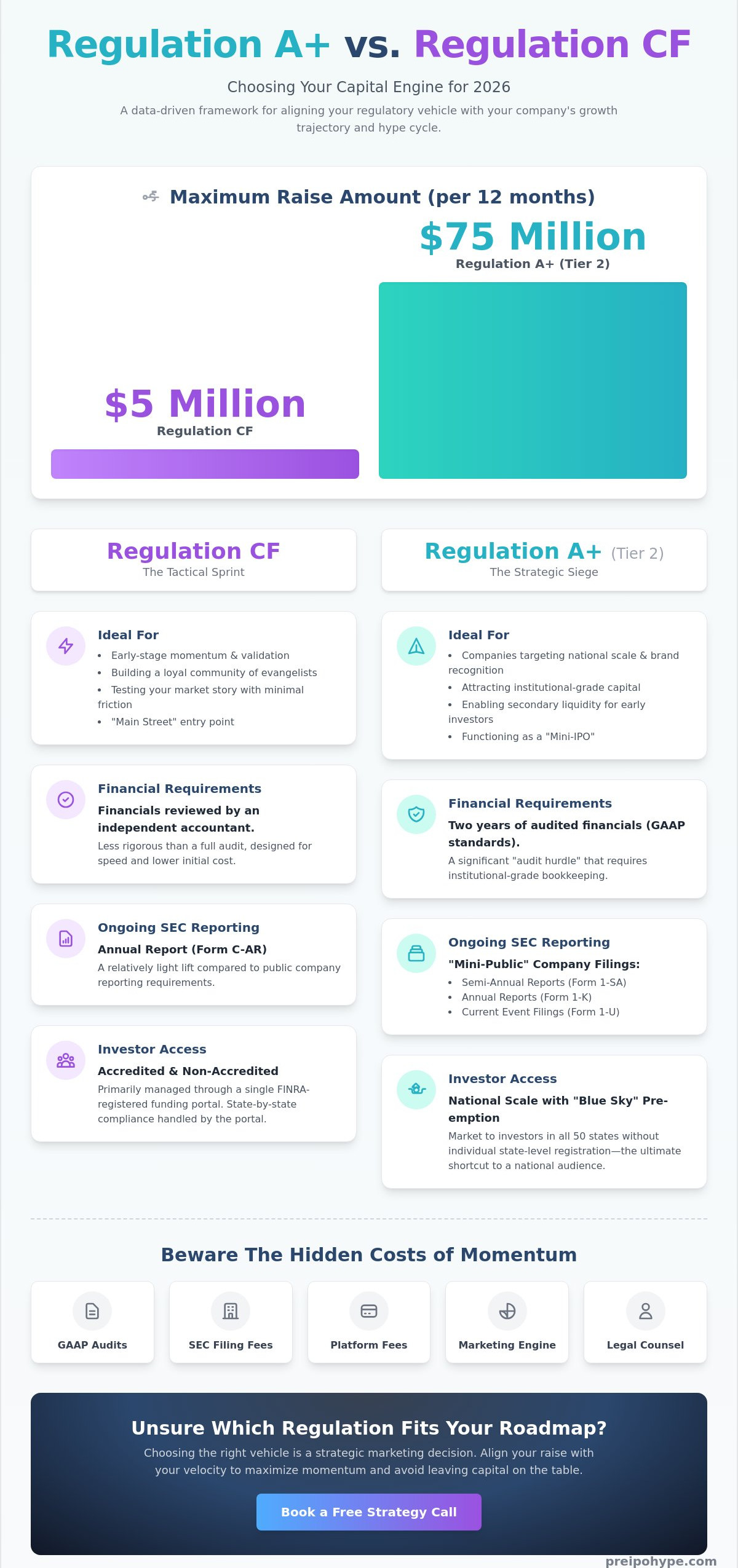
Regulation CF represents the "Main Street" entry point, allowing companies to raise up to $5 million from the general public with relatively low friction. It's the ultimate tool for early-stage momentum and community validation. On the other end of the spectrum, Regulation A+ functions as the "Mini-IPO" for firms targeting a national scale with raises up to $75 million. This choice dictates how the market perceives your ambition. One signals a grassroots movement; the other signals a pre-IPO powerhouse ready for secondary liquidity and institutional eyes.
The Democratization of the Ground Floor
The JOBS Act has matured into a sophisticated ecosystem where founders bypass traditional gatekeepers. In 2026, equity crowdfunding isn't a last resort; it's a strategic play to build a loyal, "evangelist" investor base that acts as a marketing engine. By inviting your customers to become shareholders, you turn users into a volunteer sales force that defends your valuation. Exempt offerings are the bridge between private secrecy and public opportunity.
Why 'Good Enough' Regulation Can Kill Your Momentum
Settling for a Reg CF raise when your business model demands Reg A+ level capital is a common, fatal error. Institutional followers often view raise caps as a psychological ceiling on a company's potential. If you're capped at $5 million, the big players might assume your vision is equally limited. This misalignment can stall your growth and leave you stranded when you need a $20 million injection to dominate the market.
Choosing between Regulation A+ vs Regulation CF requires an honest assessment of your three-year roadmap. If you're building a unicorn, you can't afford to look like a lifestyle business. You need to align your vehicle with your velocity. If you're unsure where you fit in the 2026 landscape, you should ask our CEO about your regulatory fit to ensure you aren't leaving money on the table. Momentum is the only currency that matters in the private market; don't let the wrong paperwork kill yours.
The Mechanical Divide: Caps, Compliance, and SEC Reporting
Choosing between Regulation A+ vs Regulation CF is a decision that dictates your company's operational tempo for the next 24 months. It's the difference between a high-speed tactical strike and a sustained capital siege. While both pathways fall under the umbrella of Exempt Offerings, their maintenance requirements sit on opposite ends of the regulatory spectrum. You aren't just picking a dollar amount; you're choosing the level of transparency you're willing to live with.
The most visible fracture point is the raise limit. Reg CF allows you to secure up to $5 million in a 12 month period. It's built for speed. Reg A+ Tier 2 pushes that ceiling to $75 million, transforming your cap table into a powerhouse. However, that extra $70 million comes with a price. Reg A+ demands a rigorous financial foundation, including two years of audited financials prepared to GAAP standards. If your books aren't institutional grade, the SEC will stall your momentum before you even launch.
Ongoing reporting adds another layer of complexity. Reg CF issuers must file Form C-AR annually. It's a relatively light lift. Reg A+ Tier 2 issuers operate like "mini-public" companies. You'll face semi-annual reports (Form 1-SA), annual reports (Form 1-K), and current event filings (Form 1-U). This infrastructure is what creates the "Blue Sky" advantage. Because Tier 2 pre-empts state-level registration, you can market to investors in all 50 states without the nightmare of individual state filings. This is the ultimate insider shortcut for national scale.
Reg CF: The Sprint to $5 Million
Startups use Reg CF to test their market story with minimal friction. It's the go-to vehicle for companies that need capital yesterday. You'll file a Form C, which reveals your ownership structure, financial health, and use of proceeds to the public. Compliance is largely managed by the funding portal. These platforms act as the gatekeepers, ensuring you don't overstep SEC boundaries while you focus on the hype. If you want to see if your vision resonates with the crowd, ask our CEO how to frame your narrative for a $5 million blitz.
Reg A+: The Marathon to $75 Million
The "Qualification" process for Regulation A+ vs Regulation CF is where most founders feel the heat. Expect a back-and-forth review period with the SEC that can last 60 to 120 days. You're not just filing paperwork; you're undergoing a federal audit of your business model. Tier 2 is the elite choice because it bypasses the "merit review" of state regulators. This national reach is essential for 2026 growth targets. You'll need a dedicated legal and accounting team to manage the timeline, but the reward is a liquid-ready vehicle that mirrors a traditional IPO.
Investor Acquisition Strategy: Marketing a $5M Raise vs. a $75M Raise
Scaling from a $5M Reg CF to a $75M Reg A+ isn't just about adding zeros to your ad spend; it's a total shift in digital architecture. The primary distinction in Regulation A+ vs Regulation CF lies in the sheer volume of the retail engine required to fuel the raise. For a $5M raise, you're hunting for approximately 2,500 investors at a $2,000 average check size. At $75M, that pool balloons to 37,500 investors. This requires a sophisticated understanding of the SEC Overview of Capital-Raising Exemptions to ensure every dollar spent on acquisition remains compliant across jurisdictional lines.
Reg A+ demands an omnichannel approach that goes beyond simple social media ads. You're layering programmatic display, LinkedIn retargeting, and strategic financial influencer partnerships. We track a 60-day attribution window because high-net-worth retail investors rarely commit on the first click. They watch, they research, and they wait for the momentum to reach a fever pitch. Managing 5,000 leads in a Reg CF environment is a manual task; managing 50,000+ leads in a Reg A+ environment is a data science project. If your cost per investor acquisition exceeds $250, a $75M raise becomes mathematically impossible to sustain.
Engineering the Hype Cycle
The "Test the Waters" (TTW) phase is the secret weapon for Reg A+ issuers. It allows you to gauge interest and collect non-binding indications of interest before the SEC qualifies the offering. Use the Invst Guru newsletter to seed your initial 5,000 leads. This builds a massive "waitlist" that converts on day one. A high-conversion video funnel is non-negotiable here. It humanizes the cap table and builds trust at a scale that one-on-one founder calls never could.
The Custom Investor CRM: Your Secret Weapon
Generic CRMs like HubSpot or Salesforce often buckle under the specific needs of equity crowdfunding. You need a system that tracks "intent signals" like document downloads and webinar attendance in real time. Our Custom Investor CRM tracks every dollar, allowing you to prioritize the top 10% of your lead pool. When you're navigating the complexities of Regulation A+ vs Regulation CF, automation must handle the 90% of retail inquiries while your team focuses on closing the whales. This ensures no lead grows cold during a long 12-month Reg A+ offering window.
The Hidden Costs of Momentum: Audits, Filings, and Platform Fees
Capital isn't free. If you're hunting for a "zero-down" path to millions, you're in the wrong asset class. Success in the private markets requires a war chest before you ever launch your campaign page. When weighing Regulation A+ vs Regulation CF, the most immediate differentiator is the price of entry. Beyond the flashy marketing videos, you'll face a gauntlet of legal, accounting, and SEC filing fees that can drain a poorly prepared startup before the first investor clicks "buy."
The "Audit Hurdle" is the most common deal-killer for early-stage founders. For a Reg CF raise exceeding $124,000, you need reviewed financials at a minimum. For Reg A+, it's a full two-year GAAP audit. This isn't just a paperwork exercise; it's a forensic look at your corporate viability. Founders frequently underestimate this cost, leading to three-month delays that freeze momentum and kill the "hype" that drives retail interest.
Platform fees add another layer of complexity. You'll choose between percentage-based portal fees, often ranging from 5% to 8% of the total raise, or hosting the offering on your own site. While independent hosting offers more control over your investor data, it demands a more robust foundation infrastructure to handle the traffic and compliance. In 2026, elite agencies have moved to a hybrid "Success Fee" and "Management Fee" model. You pay a monthly retainer to keep the specialists active, plus a percentage of the capital raised to align their interests with your exit.
Budgeting for a Reg CF Raise
Cutting corners on a Reg CF setup is a recipe for a flat raise. Cheap legal templates and cut-rate accounting lead to SEC comments that can sideline your offering for weeks. Professional founders follow the 10-20% rule: expect to spend $0.10 to $0.20 for every $1.00 you intend to raise. If your goal is $5 million, you need to be ready to deploy $500,000 in marketing and infrastructure to hit that target effectively.
The Financial Commitment of Reg A+
Reg A+ is the heavy hitter of the private markets. It's a "pay to play" environment where upfront legal and audit costs often exceed $50,000 before you're even qualified by the SEC. However, this vehicle opens the door to secondary liquidity, allowing early investors to exit via Alternative Trading Systems (ATS) like tZERO or Templum. While the initial barrier is high, the ability to raise up to $75 million annually makes the upfront legal and audit expenses a fractional cost compared to the massive scale of capital unlocked. The decision between Regulation A+ vs Regulation CF ultimately comes down to your current liquidity and your long-term exit vision.
Ready to map out your 2026 capital strategy without the guesswork? Ask our CEO how to optimize your budget for maximum momentum.
Engineering the Hype: How Pre-IPO Hype Powers Your Exempt Offering
Capital is a commodity, but attention is the ultimate currency. In the current private market, simply filing the paperwork isn't enough to guarantee a successful raise. We've spent years refining a data-driven marketing system that transforms retail curiosity into institutional-grade capital. Our track record speaks for itself. We've facilitated over $100 million for more than 230 companies, proving that momentum is something you build, not something you wait for.
Our approach relies on omnichannel outreach that dominates the digital landscape. We don't just run ads; we create an ecosystem. By synchronizing social media presence, search engine visibility, and aggressive email marketing, we ensure your offering stays in front of the right eyes. While the technical nuances of Regulation A+ vs Regulation CF are critical for your legal structure, the marketing engine is what determines if you hit your funding cap or fall short of the finish line.
From Story Framework to Capital Conversion
We specialize in building the "Insider" narrative. This framework positions your company as the next potential unicorn, giving investors the feeling they've discovered a gated opportunity before the rest of the world catches on. This isn't just about flashy graphics; it's about a strategic psychological funnel. You can watch our video funnel strategy in action to see how we guide prospects from initial interest to a completed investment. We also leverage high-frequency newsletter exposure to maintain investor momentum, ensuring your raise doesn't stall after the initial launch buzz fades.
Book Your Strategy Session
The biggest mistake founders make in the private market is waiting for the "perfect time" to launch. Markets move fast, and hesitation often leads to missed liquidity windows. Deciding between Regulation A+ vs Regulation CF is only the first step; the second is making the market care. We invite you to move beyond the theory and start building your roadmap. Our strategic advisory is designed to take the guesswork out of your fundraising journey. Don't leave your valuation to chance. Schedule your 30-minute consultation with Fuzzy Wenzel today to develop a personalized fundraising strategy that puts your company in the winner's circle.
Own the 2026 Capital Landscape
The choice between Regulation A+ vs Regulation CF defines how you'll navigate the high-stakes private markets of 2026. If you're building early momentum with a $5 million cap, Regulation CF provides a lean, efficient vehicle to activate your community. For those ready to scale toward a $75 million ceiling with secondary liquidity options, Regulation A+ serves as the ultimate mini-IPO framework. Success isn't guaranteed by the filing alone; it's driven by the strategic hype that surrounds it. We've refined this process by scaling 230+ companies and facilitating over $100 million in capital. Our Proprietary Custom Investor CRM technology ensures your offering reaches the right elite circles at the right time. The private market is the final frontier for significant wealth creation, and the tools to conquer it are now in your hands. You've seen the data and you understand the mechanics. It's time to stop watching the market and start leading it.
Ready to engineer your hype cycle? Schedule a 30-minute strategy session with our team today.
Your journey toward a landmark exit begins with a single, decisive move. We're ready to help you execute it.
Frequently Asked Questions
Can I switch from Regulation CF to Regulation A+ mid-raise?
You cannot technically switch mid-stream because these are distinct legal frameworks with different filing requirements. You must close your Reg CF offering entirely before launching a Reg A+ campaign to avoid integration issues under SEC Rule 251(c). To maintain momentum, most insiders wait 30 days between offerings. Don't try to swap horses mid-race; finish the CF sprint and then scale into the Reg A+ marathon.
Is a Regulation A+ offering considered a public company for reporting purposes?
A Regulation A+ Tier 2 issuer isn't a full reporting public company but occupies a "quasi-public" status. You'll file annual Form 1-K and semi-annual Form 1-SA reports to keep investors informed. This creates the transparency required for secondary liquidity on platforms like tZERO. It's a bridge for companies eyeing a future Nasdaq listing without the $1 million plus annual compliance costs of a full S-1.
How much does it typically cost to market a $5 million Reg CF campaign?
Expect to allocate 10% to 15% of your target raise for marketing and digital customer acquisition. For a $5 million Reg CF, this means a $500,000 to $750,000 budget. Data from 2023 industry reports shows that top-tier campaigns spend heavily on Facebook ads and email funnels. This isn't just a cost; it's the fuel for your hype machine to ensure you hit that $5 million cap.
Do I need audited financials for a Reg CF raise in 2026?
You need two years of audited financials if you're targeting more than $1.235 million in a Reg CF raise. For raises between $618,000 and $1.235 million, reviewed financials suffice for first-time issuers. These thresholds, updated by the SEC in 2021, are non-negotiable for compliance. Get your CPAs ready 6 months early to avoid bottlenecks in your 2026 launch timeline and keep the engine running.
What is 'Testing the Waters' and can I use it for both Reg CF and Reg A+?
"Testing the Waters" lets you solicit interest before filing a formal offering statement with the SEC. You can use this strategy for both Regulation A+ vs Regulation CF to build an early investor waitlist. Under SEC Rule 206 and Rule 255, you gauge market heat without spending thousands on legal filings. It's the smartest way to validate your valuation before you go all-in.
What happens if my Reg A+ or Reg CF raise does not hit its minimum goal?
If you don't hit your "break-point" or minimum funding goal, all funds held in escrow must be returned to investors. Most Reg CF portals set a $50,000 minimum to ensure the project is viable. If you fail to reach that 100% mark by your deadline, the deal dies. It's a binary outcome that separates the true unicorns from the noise in the private market.
Can non-accredited investors participate in both Reg CF and Reg A+ offerings?
Non-accredited investors can participate in both, though Regulation A+ vs Regulation CF rules differ on investment caps. In Reg A+ Tier 2, retail investors are limited to 10% of their annual income or net worth. In Reg CF, the limit is the greater of 10% of their income or net worth. This democratizes the ground floor, letting your customers become your most vocal shareholders.
How long does the SEC qualification process take for a Reg A+ Tier 2 filing?
The SEC qualification process for Reg A+ Tier 2 usually takes 60 to 90 days. This timeline includes the initial filing and responding to SEC comment letters. Some companies see this stretch to 120 days if their financials are complex or their cap table is messy. Speed is a competitive advantage. Ensure your legal team is aggressive to keep your 2026 funding window open and active.
Disclaimer
Educational only. Not investment, tax, or legal advice. Pre-IPO Hype is investor relations infrastructure for Regulation CF and Regulation A+ raises. We are not a broker-dealer, funding portal, or investment adviser, and we do not offer or sell securities or make investment recommendations. Any securities offering is made only by the issuer, through its own offering documents and, where required, a registered intermediary.


