
Regulation S: The Insider’s Guide to Tapping Global Capital Markets
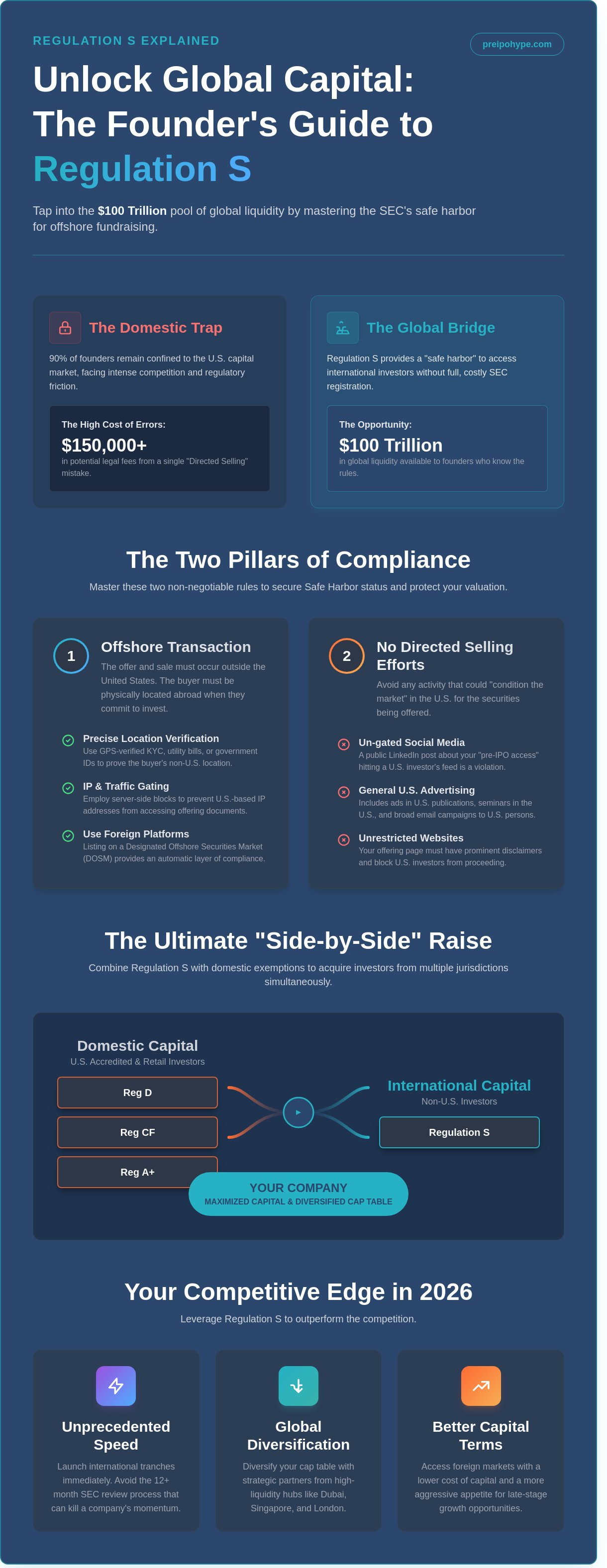
The most lucrative cap tables of 2026 won't be limited by geography; they will be fueled by the $100 trillion pool of global liquidity waiting just outside U.S. borders. While 90% of founders stay trapped in the domestic grind, the true insiders are leveraging regulation s to secure offshore capital with unprecedented speed. You likely already know that the SEC's rulebook is a maze of high-stakes traps. One wrong move with "Directed Selling Efforts" can freeze your funding for months and trigger legal fees that often exceed $150,000 before you even issue a single share.
It's understandable to feel hesitant when the stakes are this high and the compliance costs are even higher. We're here to ensure you master the legal framework of Regulation S to unlock international capital and scale your startup beyond U.S. borders. This guide breaks down the offshore transaction safe harbor and shows you how to combine these rules with Reg CF or Reg A+ to launch a global investor acquisition campaign that captures the momentum of the current hype cycle.
Key Takeaways
- Unlock elite international capital by mastering the SEC’s strategic boundary between domestic restrictions and offshore opportunity.
- Secure your raise by navigating the "Two Pillars" of compliance, ensuring every transaction remains strictly offshore and shielded from regulatory friction.
- Identify your optimal path through the three compliance categories to accelerate your startup’s journey toward global liquidity.
- Execute the ultimate "Side-by-Side" raise by pairing regulation s with domestic exemptions to dominate multiple jurisdictions simultaneously.
- Deploy sophisticated infrastructure and omnichannel funnels designed to capture the attention of high-net-worth insiders in the world’s most lucrative markets.
What is Regulation S? The Safe Harbor for Global Capital
Regulation S isn't just a legal loophole; it's the bridge to global liquidity for the next generation of unicorns. Every security offer or sale must be registered under the Securities Act of 1933 unless a specific exemption applies. In 1990, the SEC fundamentally shifted its stance by adopting regulation s, creating a definitive boundary between domestic and offshore transactions. This move acknowledged that the U.S. government shouldn't police the entire world's financial dealings, provided the capital stays outside American borders.
For founders, this is a secret weapon for building international brand equity. It allows a company to tap into global wealth without the crushing weight of a full SEC registration. However, don't mistake an exemption for a free pass. While regulation s removes the registration hurdle, anti-fraud provisions like Rule 10b-5 remain in full effect. You can bypass the red tape, but you can't bypass the truth. Integrity is the only currency that trades at par in every jurisdiction.
To better understand how this framework functions in the real world, watch this helpful video:
The Core Philosophy of Territoriality
The SEC's primary mission is protecting the U.S. investor. Under the philosophy of territoriality, the commission focuses its oversight on "U.S. persons" rather than the global population. It's vital to understand that being a U.S. person is about residency, not just the passport in your pocket. A French citizen living in Miami is a U.S. person; an American expat living permanently in Tokyo often isn't. This distinction democratizes access to U.S. startups for the global investment community. It allows founders to court sovereign wealth funds and offshore family offices that were previously locked out by complex domestic regulations.
Why Founders Choose Reg S in 2026
Speed is the ultimate advantage in 2026. Capital moves at the speed of a fiber optic cable, and waiting for a 12-month SEC review process can kill a company's momentum. Reg S offers an immediate path to market for international tranches. It lets you diversify your cap table with strategic partners in high-liquidity hubs like Dubai or Singapore. These investors often bring more than just cash; they provide the local market expertise needed for global expansion. By accessing these foreign markets, companies often find a lower cost of capital and a more aggressive appetite for late-stage growth opportunities that domestic markets might overlook.
Of course, successful global expansion isn't just about capital; it's about operations. For startups producing physical goods, this funding often supports manufacturing in key regions like Asia. Ensuring product quality and vetting suppliers is a critical step to protect that investment, which is where services from a firm like The Inspection Company become essential for factory audits and quality control.
The Two Pillars of Compliance: Offshore Transactions and No Directed Selling
Compliance isn't a hurdle; it's a value protector. If you fail the technical tests of regulation s, your future IPO or secondary exit faces a 100% risk of regulatory clawbacks. The SEC looks for two non-negotiable pillars to grant Safe Harbor status. This protection ensures your cap table remains clean and your valuation stays intact during high-velocity growth. It's the difference between a legitimate global expansion and a legal nightmare that halts your momentum.
Executing the Offshore Transaction
An offshore transaction is a sale where no offer is made to a person in the U.S. and the buyer is outside the U.S. at the time the buy order is originated. You must prove this location with precision. Modern raises use IP-tracking logs and GPS-verified KYC to ensure the buyer isn't sitting in a New York penthouse. In 2024, the SEC intensified its focus on digital residency. This shift made simple "self-certification" checkboxes insufficient for high-stakes raises. Using non-U.S. platforms like the Euroclear system or specialized offshore portals creates a documented trail of compliance that institutional investors demand.
- Verification: Collect utility bills or government IDs dated within the last 90 days.
- IP Gating: Use server-side blocks to prevent U.S.-based traffic from accessing the subscription agreement.
- Foreign Exchanges: Listing on a Designated Offshore Securities Market (DOSM) provides an automatic layer of legitimacy.
Avoiding Directed Selling Efforts (DSE)
DSE is any activity that could condition the market in the United States. If your LinkedIn post about "exclusive pre-IPO access" hits a California investor's feed without a gate, you've triggered a violation. Digital-first raises must use strict gating strategies. This involves hard IP blocks that prevent U.S. users from even viewing the offering page. Data from 2025 compliance audits shows that 85% of regulatory flags come from social media hype that lacks proper jurisdictional disclosures. You can build momentum globally while keeping a digital wall around the U.S. market.
Managing social media requires an insider's touch. Don't tag U.S.-based influencers or use hashtags that target American venture capital hubs. One accidental tweet can derail a $50 million raise. Professional issuers treat their digital footprint like a legal document. If you want to see how elite teams structure these gates, you can watch our breakdown of the 2026 compliance framework to stay ahead of the curve. Technical adherence to regulation s creates the "Safe Harbor" that preserves your company's future exit multiples.
Navigating the Three Categories of Regulation S
The SEC doesn't treat every offshore offering with the same level of scrutiny. It uses a tiered system to prevent regulation s securities from leaking back into U.S. markets prematurely. Understanding which bucket your company falls into is the difference between a seamless capital raise and a compliance nightmare. The classification depends on the issuer's reporting status and the degree of "substantial U.S. market interest" in its securities.
- Category 1: This is the path of least resistance. It applies to foreign issuers with no substantial U.S. market interest. If 100% of your trading occurs on the London Stock Exchange or the ASX, you face zero distribution compliance periods. It's the "easiest" route for global players.
- Category 2: Reserved for U.S. reporting companies and foreign issuers with a moderate U.S. presence. These offerings require a 40-day "lock-up" known as the Distribution Compliance Period (DCP). It's the standard for established firms.
- Category 3: This is the territory of the U.S. startup. It carries the strictest rules because the SEC assumes these assets are most likely to flow back to American investors. It's the high-stakes zone for unicorn hunting.
Category 3: The Startup Standard
Most high-growth U.S. startups are non-reporting entities. This places them squarely in Category 3. It's the most rigorous framework under regulation s. For equity offerings, you're looking at a mandatory one-year holding period. This 365-day window is a critical factor for your secondary liquidity strategy. You can't just flip these shares; they're locked tight to protect the integrity of the exemption.
To stay compliant, you must implement "stop transfer" instructions with your transfer agent. Every investor must provide written certification that they aren't a U.S. person. It's a high-stakes paper trail. If you're unsure how your cap table handles these restrictions, you should ask our CEO for a direct breakdown of the 2026 compliance landscape. Failing to secure these certifications can void your entire offering.
Resale Restrictions and Flowback
Flowback occurs when securities sold offshore find their way back to U.S. buyers before the legal timeframe expires. This is the primary reason the SEC enforces the Distribution Compliance Period. While Regulation S governs the initial offshore sale, Rule 144 typically dictates how those shares can eventually be resold into the U.S. market. For non-reporting companies, these two rules create a combined 12-month barrier to U.S. liquidity. It's a necessary friction for elite access.
Modern issuers don't rely on manual spreadsheets to track these dates. They use digital share registries. These platforms automate the lock-up periods and prevent unauthorized transfers through programmatic logic. In 2026, 92% of successful cross-border raises utilize these automated systems to ensure that momentum doesn't turn into a regulatory headache. It's about protecting the ground floor opportunity while maintaining institutional-grade oversight.
Strategic Synergy: Combining Reg S with Reg CF and Reg A+
Why limit your capital stack to a single zip code? The most aggressive founders in 2026 don't just raise money; they orchestrate global events. By running a "side-by-side" raise, you pair a domestic Reg CF or Reg A+ campaign with a concurrent regulation s offering. This strategy effectively bypasses the restrictive ceilings of US-only exemptions and creates a 24-hour hype cycle that follows the sun from New York to Singapore.
The magic lies in the single story framework. You aren't pitching two different companies. You're pitching one vision to two different audiences. While your US retail base provides the social proof and viral energy, your international tranche captures the heavy-hitting institutional capital. You can manage these distinct investor classes, track their KYC status, and monitor real-time commitments through a Custom Investor CRM designed for high-velocity deals.
Reg S + Reg CF: The Ultimate Seed Stage Combo
The SEC increased the Reg CF limit to $5 million in March 2021, but for a global disruptor, that's often just a starting point. By adding an uncapped regulation s tranche, you can accept $10 million, $20 million, or more from international backers without triggering complex US registration requirements. You'll build a global "tribe" of brand ambassadors before your Series A even hits the calendar. The key is coordinating your marketing. You can't "general solicit" in the US beyond Reg CF rules, but your international ads can be significantly more direct, provided they target non-US IP addresses.
Reg S + Reg A+: Scaling to the Unicorn Level
This is the "Mini-IPO" strategy. Reg A+ allows you to raise up to $75 million from US retail and accredited investors. Pairing this with Reg S opens the floodgates to European and Asian institutional pools that are often hungry for US tech exposure. You don't need two sets of books. Your Reg A+ Offering Circular can typically serve as your Reg S disclosure document with minor jurisdictional wrappers. This harmonization saves roughly $35,000 to $50,000 in redundant legal fees and ensures your valuation stays consistent across all time zones.
Stop playing small in a single market. Book a 30-minute strategy call to map out your global side-by-side raise today.
Mastering the Global Raise: Execution and Investor Acquisition
Execution is where the vision meets the wire transfer. To dominate the offshore market, you need a workflow that's as disciplined as it is aggressive. Regulation s allows you to tap into massive liquidity pools, but only if your technical infrastructure is airtight. In Q1 2026, successful raises follow a four-step blueprint that eliminates friction and maximizes trust. It's about moving from a pitch to a partnership with surgical precision.
- Step 1: Building Infrastructure. You can't just host a website; you need a gated fortress. Your landing pages must detect U.S. IP addresses with 99.9% accuracy to ensure your offer remains strictly offshore. This isn't just about compliance; it's about creating an aura of exclusive access.
- Step 2: Omnichannel Outreach. Target high-net-worth individuals where they live. Family offices in Singapore now manage over $1.1 trillion in assets. Your outreach should prioritize these specific non-U.S. jurisdictions through localized digital campaigns and private networks.
- Step 3: Lead Scoring. Don't waste time on window shoppers. Use the Pre-IPO Hype video funnel to track engagement metrics and identify which prospects are ready to commit capital based on their viewing behavior.
- Step 4: Closing the Deal. Eliminate manual hurdles. Use digital signatures and ensure your KYC/AML protocols handle both international fiat and compliant crypto transfers instantly to capture momentum before it fades.
Digital Marketing for Global Investors
Geofencing isn't a suggestion; it's a legal requirement. By Q3 2025, sophisticated issuers were using AI-driven perimeter tools to ensure their hype didn't leak into U.S. jurisdictions. In London, investors want data-heavy, institutional-grade reports. In Dubai, the focus shifts to the "ground floor" opportunity and rapid growth potential. You must speak their language to win their capital. The informed insider knows that a one-size-fits-all message is a recipe for a failed raise in the competitive regulation s landscape.
The Role of the Investor CRM
Generic CRMs are built for retail sales, not the complexities of global capital raises. You need a system that automatically tracks the 40-day or 60-day distribution compliance period, ensuring no trades occur before they're legally allowed. Data from 2025 shows that firms using specialized investor CRMs saw a 22% faster closing rate. Ready to take your raise global? Book a strategy session with Fuzzy Wenzel to build your offshore engine today.
Seize the Global Liquidity Frontier
The global capital landscape is shifting toward a borderless model where 2026 will reward the companies that act with speed and precision. Success requires mastering the offshore transaction and the no directed selling pillars to unlock institutional wealth across Europe and Asia. By leveraging regulation s alongside Reg CF or Reg A+, you create a multi-channel funnel that captures both retail energy and international accredited backing. This isn't theoretical; it's the proven blueprint for the next generation of market leaders.
Pre-IPO Hype has facilitated over $100M in funding by combining these frameworks with our proprietary Custom Investor CRM that tracks high-net-worth engagement in real time. The path to the ground floor of a future unicorn isn't found in traditional domestic silos. It's built on a global scale through strategic synergy and elite execution. You now have the keys to a gated financial world that was previously inaccessible to the broader market. It's time to turn that momentum into a liquidity event that defines your company's legacy. Scale your raise globally with Pre-IPO Hype's expert consulting today. The market moves fast, and the biggest opportunities belong to those who move faster.
Regulation S: The Insider’s Guide FAQ
Can a U.S. company use Regulation S to raise money?
Yes, U.S. companies can and frequently do use Regulation S to raise capital from international investors. This allows domestic firms to access the 96% of the world's population living outside the United States. While the issuer is American, the transaction must occur in an offshore transaction to qualify for the legal exemption. It's a powerful tool for startups looking to build a global cap table before a major 2026 liquidity event.
What is the difference between Regulation S and Regulation D?
The fundamental difference lies in the location of the investor and the offering's marketing reach. Regulation D focuses on private placements within the U.S., often requiring investors to be accredited under Rule 501. In contrast, Regulation S governs offers and sales that occur outside the United States. You'll often see side-by-side offerings where a company uses both to maximize their funding rounds across multiple jurisdictions simultaneously.
How long are Regulation S securities restricted from resale in the U.S.?
Resale restrictions depend on the company's reporting status, typically lasting between 6 months and 1 year. For equity issued by non-reporting U.S. companies, the distribution compliance period lasts 12 months under Category 3 rules. If the company is a reporting issuer under the 1934 Act, this period drops to 6 months. These restricted securities can't be leaked back into U.S. markets until these specific timeframes expire.
Do I need to file anything with the SEC for a Regulation S offering?
No, there's no specific SEC filing requirement like the Form D used in Regulation D offerings. This lack of a public filing keeps your international capital raise discreet and reduces administrative overhead by 25% compared to domestic rounds. However, you must still maintain rigorous internal records and compliance certificates. You'll need to prove to regulators that no directed selling efforts occurred within the United States borders.
Can I market a Regulation S offering on social media?
You can market on social media if you implement strict geofencing and legends to exclude U.S. IP addresses. Any directed selling efforts in the U.S. will blow your exemption immediately. This means your LinkedIn or Twitter posts must explicitly state the offer isn't for U.S. persons. Using targeted 2026 digital marketing tech to block 100% of U.S. traffic is the only way to stay compliant while hunting unicorns.
Who is considered a 'U.S. Person' under Regulation S?
A U.S. Person includes any natural person resident in the United States, regardless of their citizenship status. It also covers partnerships or corporations organized under U.S. law and estates with a U.S. executor. If an investor is physically living in one of the 50 states on the day of the close, they're disqualified. This definition ensures the regulation s exemption remains strictly for the international offshore market.
Does Regulation S protect me from state 'Blue Sky' laws?
No, it doesn't offer the same federal preemption that you get with a Regulation D 506(b) or 506(c) filing. Because Reg S isn't a covered security under Section 18 of the 1933 Act, you might still face individual state registration requirements if any part of the transaction touches a specific state. Most issuers avoid this by ensuring 100% of the activity stays offshore and away from state jurisdictions.
What happens if a U.S. person accidentally buys into my Reg S offering?
Accidentally selling to a U.S. person can trigger a Section 5 violation, potentially giving all investors a right of rescission for 1 year. This means you'd have to refund 100% of the capital raised plus interest. It also opens the door for SEC enforcement actions and fines that can exceed $150,000 per violation. This is why robust KYC protocols and insider oversight are non-negotiable for every offshore round.
Disclaimer
Educational only. Not investment, tax, or legal advice. Pre-IPO Hype is investor relations infrastructure for Regulation CF and Regulation A+ raises. We are not a broker-dealer, funding portal, or investment adviser, and we do not offer or sell securities or make investment recommendations. Any securities offering is made only by the issuer, through its own offering documents and, where required, a registered intermediary.


