
SEC Rules for Raising Capital Online: The 2026 Founder’s Strategic Guide
The most lucrative unicorns of 2026 won't be built behind closed boardroom doors; they'll be engineered through the strategic deployment of public momentum. You likely recognize that the traditional VC gatekeepers are losing their grip, but the underlying fear of a regulatory misstep keeps your vision grounded. It's a rational concern when a single compliance oversight can trigger an enforcement action that freezes your growth. Mastering the SEC rules for raising capital online is no longer just a legal hurdle. It's the tactical edge that separates market leaders from companies that fade into obscurity before their first major exit.
You've watched as Reg CF raises hit their $5 million cap in record time since the 2021 limit increase, yet the choice between Reg A+ and Reg D still feels like a high-stakes gamble. We're here to eliminate that uncertainty. This guide provides a definitive roadmap to master the regulatory landscape, showing you exactly how to leverage specific exemptions to build an elite investor base. We'll break down the 2026 compliance framework, compare high-momentum exemptions, and show you how to turn legal requirements into a strategic advantage for your next funding round.
Key Takeaways
- Transition from closed-door deals to high-velocity digital feeds by mastering the modern frameworks that define the new era of fundraising.
- Identify the strategic differences between Reg CF, Reg A+, and Rule 506(c) to effectively navigate the SEC rules for raising capital online in a digital-first market.
- Deconstruct the myths of general solicitation and learn how to compliantly leverage social media to broadcast your raise to a global audience.
- Implement a technical "foundation infrastructure" that uses lead scoring and investor verification to convert digital interest into committed capital.
- Apply the Pre-IPO Hype methodology to bridge the gap between private secrecy and public opportunity, turning your capital raise into a high-stakes movement.
Navigating the Digital Frontier: Modern SEC Frameworks for Online Capital
Where do the world's most aggressive founders find their fuel? The "smoke-filled room" era of venture capital is officially dead. In 2026, the power has shifted from private country club handshakes to high-velocity digital feeds. Understanding the SEC rules for raising capital online is no longer just a legal necessity; it's a competitive advantage for those hunting unicorn status. The transition from private secrecy to public opportunity is now the standard for any company looking to scale at pace.
Online capital raising defines the modern era of equity. It is the structured process of offering securities through internet platforms, social media, and dedicated investment portals. The SEC has transformed from a restrictive gatekeeper into a regulator that recognizes the speed of the digital age. This shift relies heavily on the transparency of your data. Elite investors don't just want a pitch; they want a clear, compliant window into your company's soul. Building this trust through digital disclosure is how you bridge the gap between a startup and a movement. The JOBS Act of 2012 remains the bedrock of this movement, providing the legal DNA that allows equity crowdfunding to thrive in a globalized economy.
The Rise of the Retail and Accredited Digital Investor
Democratization is the pulse of the 2026 market. Digital platforms have torn down the walls that once kept the best deals reserved for the 1%. Today, your cap table can be a powerful engine of brand advocates. This Equity Crowdfunding Overview shows how the landscape has evolved to allow founders to tap into both the "crowd" and high-net-worth individuals simultaneously. Since the 2021 regulatory updates that increased offering limits, retail participation has surged by over 40% in the private sector.
The psychology of the investor has changed. They expect deal flow at their fingertips. You must distinguish between accredited investors, who bring institutional-grade capital, and non-accredited retail investors, who bring market momentum. Balancing these groups requires a mastery of the SEC rules for raising capital online to ensure every click and commitment stays within the lines of the law.
The Legal Bedrock: Why Exemptions are Your Secret Weapon
The fundamental rule of the SEC is simple: every security sale must be registered or exempt. A full registration is a multi-million dollar burden that can stifle a growing company. Exemptions are the secret weapon of the informed insider. They allow you to bypass the traditional IPO cost and timeline while still accessing public capital. These pathways have become the primary highway for late-stage growth, offering a ground-floor entry point for those who act decisively.
In the 2026 fundraising environment, a Safe Harbor serves as a defined legal sanctuary that shields founders from enforcement actions provided they strictly follow specific solicitation and disclosure mandates.
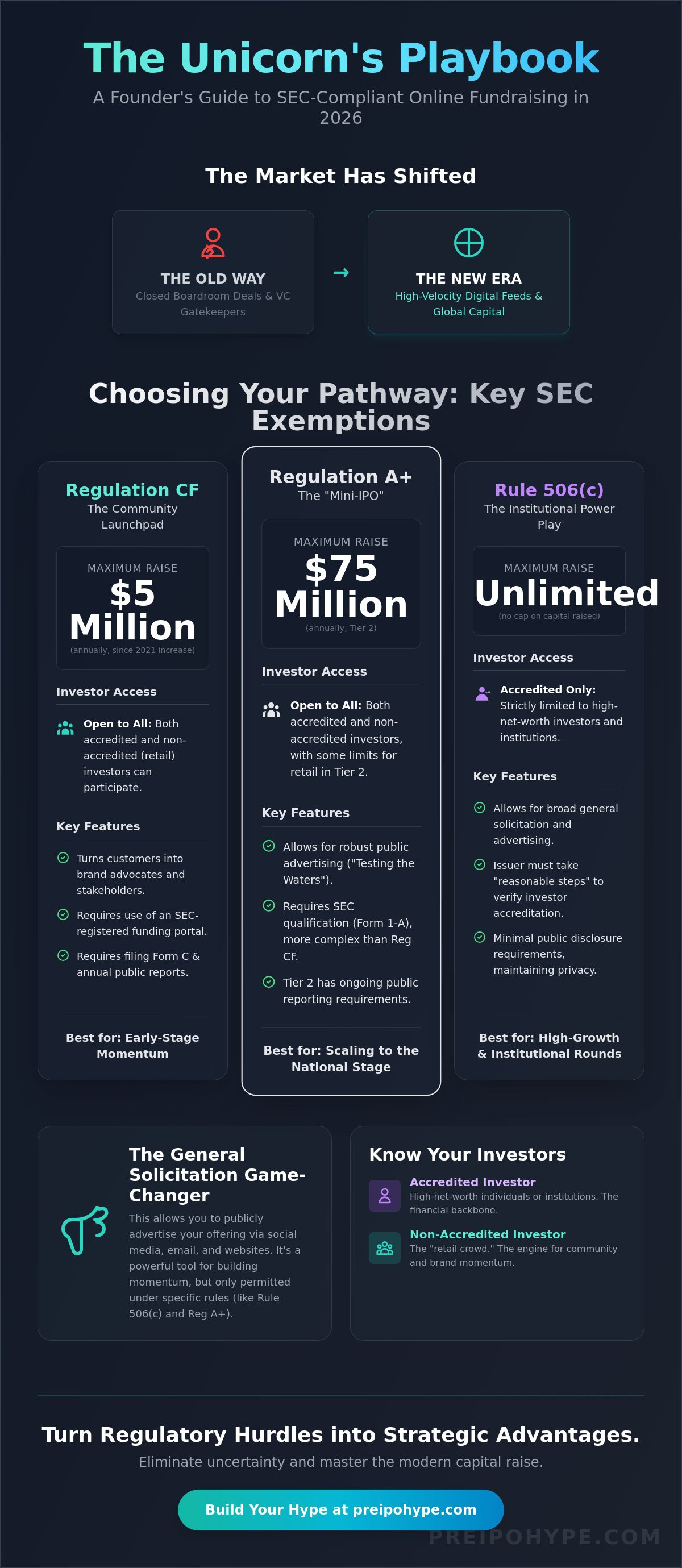
Choosing Your Pathway: Reg CF, Reg A+, and the Rule 506(c) Revolution
Capital is no longer a localized resource. In 2026, the digital landscape has democratized access to the ground floor, turning your cap table into a strategic weapon. Choosing the right framework among the SEC rules for raising capital online isn't just about compliance; it's about matching your growth velocity with the right investor profile. The private market is the final frontier of significant wealth creation, and these three pathways are the keys to the gate.
Regulation Crowdfunding (Reg CF): The Founders Favorite
Reg CF is the definitive launchpad for early-stage momentum. Since the SEC increased the limit to $5 million in 2021, it has become the gold standard for community-driven growth. To play here, you must utilize an SEC-registered funding portal or broker-dealer. This ensures transparency through the filing of Form C. According to the official SEC Regulation Crowdfunding guidelines, issuers must also provide annual reports, keeping your crowd informed as you scale toward a liquidity event. It's about turning customers into stakeholders.
Regulation A+: Scaling to the National Stage
Often called a "Mini-IPO," Reg A+ is built for scalable consumer hype. It offers two distinct tiers: Tier 1 allows up to $20 million, while Tier 2 jumps to $75 million. The real power lies in the "Test the Waters" provision. This allows you to gauge market interest before spending a dime on heavy legal filings. Tier 2 issuers face more rigorous ongoing reporting, but they bypass state-level Blue Sky laws, creating a streamlined path to a national audience. It's the ultimate tool for companies ready to bridge the gap between private secrecy and public opportunity.
Rule 506(c): The Accredited-Only Power Play
Rule 506(c) is the high-octane digital upgrade to the traditional 506(b). While 506(b) forbids public advertising, 506(c) allows you to shout your offering from the digital rooftops. The catch? You can only accept funds from accredited investors, and you must take reasonable steps to verify their status. This isn't just about a self-certification checkbox; it requires tax returns or bank statements. Sophisticated founders often leverage Reg CF marketing services to build a massive funnel of interest that fuels these institutional-grade raises.
Understanding these SEC rules for raising capital online allows you to engineer a raise that fits your 2026 valuation benchmarks. If you're ready to see which pathway aligns with your specific exit strategy, connect with our team to analyze your current trajectory and potential for hype-driven growth.
The General Solicitation Game Changer: Marketing Your Raise Compliantly
The biggest myth in modern venture capital is the "quiet period" for private placements. Founders often believe they can't mention their raise on LinkedIn or Twitter without a knock from the Commission. That's a relic of the past. Under Rule 506(c) of Regulation D and Regulation Crowdfunding (Reg CF), general solicitation isn't just allowed; it's the engine of the raise. You aren't just selling shares. You're building a movement.
Successful founders treat momentum as a legitimate financial indicator. The insider approach involves framing the opportunity as exclusive while using the 2026 digital landscape to reach thousands. You have to balance the raw energy of a ground floor opportunity with the cold, hard precision of institutional authority. If you look like a meme stock, you lose the big checks. If you look like a dusty bank, you lose the crowd. This balance is what defines the SEC rules for raising capital online in the current era.
Digital Ads and Social Media: SEC Best Practices
Every communication that conditions the public interest is an "offer" in the eyes of the Commission. This means every Tweet, Facebook ad, and LinkedIn post requires specific legends and disclaimers. The SEC doesn't care about your aesthetic; they care about compliance. Your digital marketing and advertising must be data-backed to maintain credibility. In 2025, data showed that 82% of successful Reg CF campaigns used targeted social ads to hit their minimums within the first 30 days. You need a paper trail for every claim you make about valuation benchmarks or future growth.
The Role of Portals and Broker-Dealers
You can't just put a "Buy Now" button on your company website for equity. All transactions must occur through a registered funding portal or a broker-dealer. While your website is the primary tool for top-of-funnel awareness, the actual closing happens on neutral, regulated ground. This infrastructure protects you from "bad actor" disqualifications and ensures all investors are properly vetted.
- Wefunder: Best for retail-heavy raises, currently holding over 40% of the Reg CF market share.
- StartEngine: Ideal for companies looking for high-volume secondary liquidity options.
- Custom Infrastructure: Reserved for late-stage growth companies that want to maintain a white-label experience for elite investors.
Choosing the right platform is a strategic decision that impacts your cap table health. SEC rules for raising capital online dictate that these intermediaries must handle the funds, providing a layer of security for the company and the investor. It's about moving from private secrecy to public opportunity without sacrificing your institutional standing.
Engineering Compliance: Data, Attribution, and Investor Verification
Compliance isn't a hurdle; it's the technical bedrock of your entire raise. When you're operating under SEC rules for raising capital online, your data infrastructure serves as your primary defense against regulatory scrutiny. You aren't just selling shares; you're managing a complex flow of sensitive financial data that must be bulletproof from day one. In the high-stakes world of private placements, your tech stack is what keeps the "hype" grounded in legal reality.
- Step 1: Lead Scoring. Implement systems to prioritize high-intent investors. By tracking behavioral data, you can focus your outreach on the 15% of leads who have viewed your offering circular multiple times.
- Step 2: 60-Day Attribution. You must automate the attribution for every dollar raised. Knowing exactly which marketing channel triggered an investment is essential for both scaling your budget and satisfying anti-money laundering (AML) requirements.
- Step 3: Investor Verification. Establish a robust workflow that handles KYC (Know Your Customer) checks without friction. Elite investors won't tolerate a clunky verification process that feels like a bottleneck.
- Step 4: Communication Logs. Every email, webinar, and direct message must be archived. A compliant communication log is your best friend when the SEC conducts an audit of your 2026 raise.
The Custom Investor CRM: Your Compliance Command Center
Generic CRMs fail the unique needs of equity crowdfunding because they lack the necessary guardrails for securities offerings. You need a system that tracks omnichannel engagement to prove investor interest while keeping sensitive data siloed and secure. This is about more than just sales; it's about engineering a transparent record of momentum that stands up to institutional scrutiny. You can learn more about The Custom Investor CRM and how it bridges the gap between private secrecy and public opportunity.
Avoiding the "Bad Actor" Disqualification
The SEC is unforgiving regarding "covered persons" who have prior disciplinary histories. This group includes your officers, directors, and any beneficial owner of 20% or more of your company's outstanding voting equity. A single disqualifying event can bar your company from the capital markets entirely, killing your momentum instantly. Background checks for 2026 raises must account for a ten year look-back period for any relevant criminal convictions or SEC orders. Understanding these SEC rules for raising capital online is the difference between a successful exit and a permanent ban from the ground floor of venture finance.
Don't leave your regulatory standing to chance. Speak with an insider to ensure your investor verification workflow is built for 2026 standards.
Mastering the Raise: Strategic Investor Acquisition with Pre-IPO Hype
Compliance isn't the end goal; it's the prerequisite. Once you've checked the boxes for SEC rules for raising capital online, the real battle begins in the attention economy. Most founders fail here because they treat their raise like a legal filing rather than a high-stakes product launch. Pre-IPO Hype changes that dynamic. We move your offering beyond the shadows of private secrecy and into the light of public opportunity. It's about taking the technical framework of a Regulation A+ or CF raise and injecting it with the momentum of a Tier-1 market debut.
Through the Invst Guru newsletter, we deliver your brand directly to a curated audience of hungry investors. This isn't just a mailing list; it's a community looking for the next ground-floor entry. We position your company as an elite insider opportunity, turning a standard capital call into a movement. You aren't just selling shares. You're offering a seat at a table that was previously locked behind institutional gates. This shift in perception is what separates a slow, painful raise from a high-velocity capital event.
- Conversion Focus: We stop the scroll by framing your valuation benchmarks as milestones of inevitable growth.
- Strategic Exposure: Immediate access to capital-ready participants who understand the late-stage growth landscape.
- Elite Branding: We use the "hype" cycle as a legitimate financial indicator to build urgency and exclusivity.
The Pre-IPO Hype Advantage: Data-Driven Outreach
Our team leverages experience from over $100M in facilitated funding to ensure your message hits the mark. We don't guess; we use data to drive every outreach effort. Strategic storytelling converts curiosity into committed capital by framing your growth as an inevitable trajectory toward a liquidity event. To see how we turn technical specs into high-velocity investment interest, see our video funnel strategy for high-conversion raises. It’s the blueprint we use to bridge the gap between SEC rules for raising capital online and actual bank deposits.
Ready to Engineer Your Capital Momentum?
The most successful founders don't wait for the market to find them. They engineer momentum. Our roadmap takes you from the initial discovery phase straight through to a potential liquidity event, ensuring every step is optimized for maximum valuation. It’s time to stop wondering if your raise will close and start executing with precision. You've built the company; now let's build the capital stack it deserves. Book your 30-minute strategic advisory session today to begin your transition from a compliant founder to a funded visionary.
Claim Your Stake in the New Capital Era
Navigating the 2026 landscape requires more than just a pitch deck; it demands a tactical mastery of the modern regulatory frontier. Founders who successfully leverage Reg CF, Reg A+, and the strategic power of general solicitation are the ones defining the next generation of unicorns. Understanding the SEC rules for raising capital online is the baseline, but the real advantage lies in engineering a data-driven narrative that resonates across omnichannel platforms. Compliance isn't a hurdle. It's the framework for building institutional-grade trust with your future cap table.
Pre-IPO Hype has already facilitated over $100 million for 230+ companies by bridging the gap between private opportunity and public momentum. Our proprietary tech stack, featuring a custom Investor CRM with 60 day attribution, ensures your raise is backed by hard data rather than guesswork. You've built the innovation. Now, it's time to deploy the insider strategies that turn early-stage potential into significant secondary liquidity. The market moves fast, and the most lucrative windows don't stay open forever.
Scale your capital raise with the insiders at Pre-IPO Hype
The future of wealth creation is happening in the private markets right now. Take the lead and let's build your legacy together.
Frequently Asked Questions
What is the maximum amount a company can raise online under SEC rules in 2026?
Under current SEC rules for raising capital online, companies can raise up to $5 million per 12-month period through Regulation Crowdfunding (Reg CF). If your growth trajectory requires more significant fuel, Regulation A+ Tier 2 allows you to secure up to $75 million from the public. These thresholds, last adjusted in March 2021, offer a streamlined path for founders to bypass traditional gatekeepers and hunt for unicorn-level valuations.
Can I use Facebook or LinkedIn ads to find investors for my private company?
You can use social media advertising to attract investors if you conduct your raise under Rule 506(c) or Regulation Crowdfunding. Rule 506(c) specifically permits general solicitation, though it requires you to take reasonable steps to verify that every participant is an accredited investor. SEC guidance from 2023 emphasizes that these ads must be balanced and shouldn't omit material facts that could mislead the "informed insider" you're targeting.
What is the difference between Reg CF and Reg A+ for online fundraising?
Reg CF is the entry-point for early-stage momentum, capped at $5 million with relatively low compliance costs and simple Form C filings. Reg A+ acts as a "mini-IPO" for late-stage growth, allowing for raises up to $75 million but requiring audited financials and SEC qualification. While Reg CF is faster to launch, Reg A+ provides the secondary liquidity options that sophisticated investors crave in the 2026 market.
Do I need to be an SEC-registered broker-dealer to raise money for my own company?
Founders don't need to register as broker-dealers to raise capital for their own ventures if they qualify for the Rule 3a4-1 "issuer exemption." You must ensure you aren't paid a success-based commission and that you perform substantial duties for the company beyond just capital raising. This exemption is vital for maintaining the ground-floor integrity of your raise without incurring the 7 percent to 10 percent fees typical of institutional middle-men.
What is 'General Solicitation' and why does it matter for my digital raise?
General solicitation is the public promotion of a private investment opportunity through digital channels like social media, podcasts, or public websites. It matters because it breaks the "quiet period" restrictions of traditional private placements, allowing you to build the "hype" necessary for a successful modern raise. Since the JOBS Act of 2012, this mechanism has been the primary tool for democratizing access to elite, high-stakes investment circles.
Are there specific SEC rules for using a CRM to track potential investors?
The SEC doesn't mandate a specific software, but it requires strict adherence to record-keeping rules for all digital communications with potential backers. Your CRM must accurately log the timing and content of every interaction to ensure you don't violate "anti-fraud" provisions or provide inconsistent data to different parties. In 2024, regulators increased their scrutiny of how private companies manage "indications of interest" within these digital databases to prevent artificial price inflation.
How do SEC rules for raising capital online apply to non-U.S. investors?
Regulation S dictates how SEC rules for raising capital online apply to investors located outside the United States. This regulation allows you to accept international capital without registering the offering with the SEC, provided the entire transaction occurs offshore and there are no "directed selling efforts" within the U.S. Using Regulation S in tandem with Rule 506(c) is a common strategy for founders looking to tap into global liquidity pools.
What happens if I accidentally violate SEC rules during my online raise?
Violating SEC rules can trigger "rescission rights," which legally obligates you to offer a 100 percent refund to every investor in the offering. You also risk being hit with a "bad actor" disqualification under Rule 506(d), potentially banning you from the private markets for a period of 5 to 10 years. These high-stakes penalties make it essential to move with calculated precision and professional oversight during every phase of your digital campaign.
Disclaimer
Educational only. Not investment, tax, or legal advice. Pre-IPO Hype is investor relations infrastructure for Regulation CF and Regulation A+ raises. We are not a broker-dealer, funding portal, or investment adviser, and we do not offer or sell securities or make investment recommendations. Any securities offering is made only by the issuer, through its own offering documents and, where required, a registered intermediary.